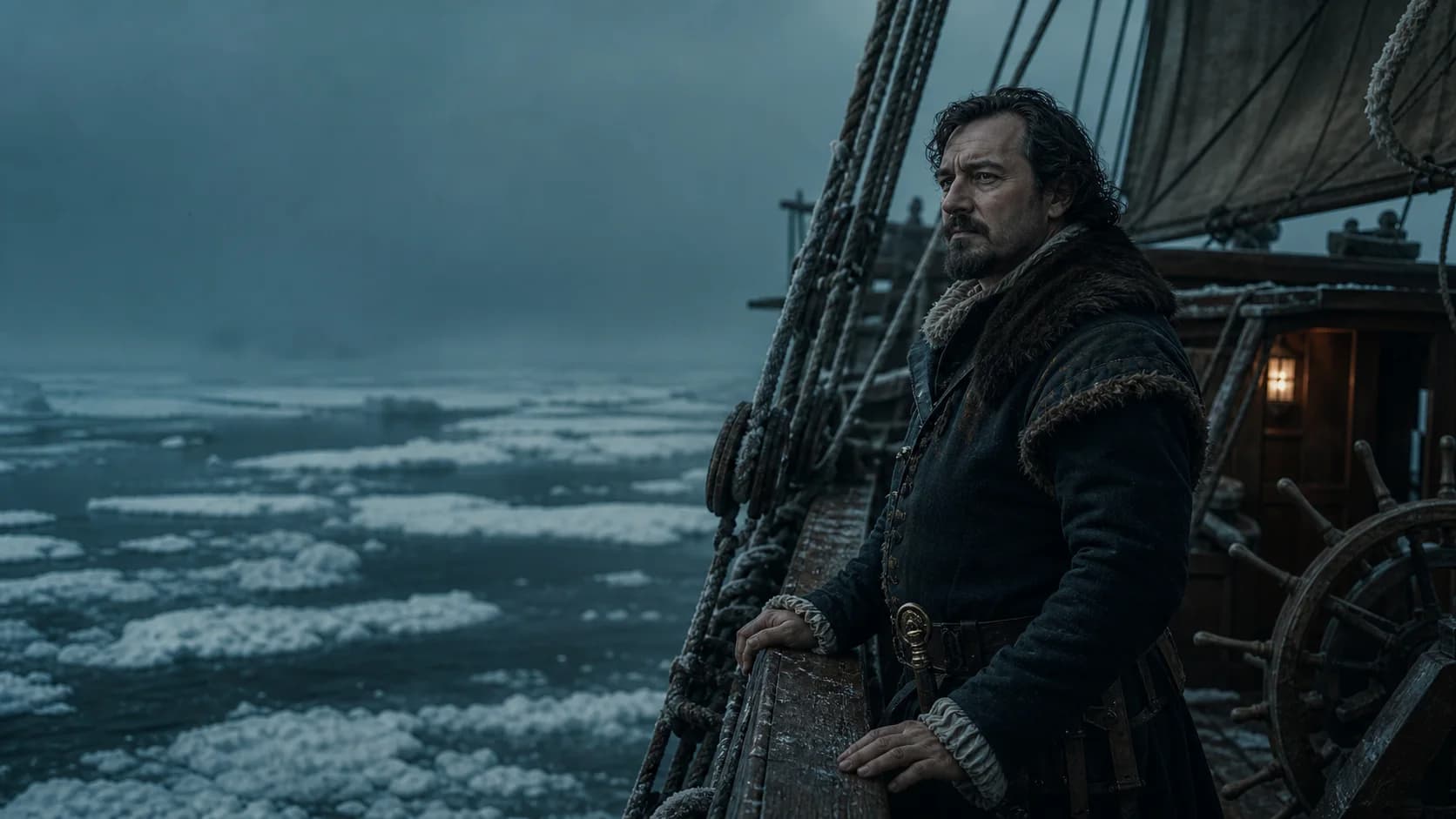
Opening portrait
Who was Henry Hudson?
Henry Hudson made four voyages between 1607 and 1611 in search of northern passages to Asia. Sailing for the Dutch East India Company in 1609, he entered present-day New York Bay and travelled up the river later named for him. On a later English expedition, Discovery became trapped in Hudson Bay. A mutiny in 1611 put Hudson, his son and several companions into a small boat; no reliable record of them follows.
- Principal voyages
- Four, 1607—1611
- Ship in 1609
- Halve Maen
- Final ship
- Discovery
- Objective
- A Northeast or Northwest Passage to Asia
Defining moment
1610–1611 · The final northern voyage
He entered an inland sea vast enough to resemble an ocean—and vanished into it.
Discovery passed through the strait that now bears Hudson’s name and emerged into an immense body of water. Believing the way to Asia might still lie ahead, he pressed on until winter froze the ship into James Bay. Mutineers cast Hudson, his son and several companions into a small boat the following year. No trace of them was ever securely found; the northern sea kept both the mystery and his name.
Life at a glance
Henry Hudson · career timeline
Key dates connect biography, expeditions and later consequences across a career longer than any one ‘discovery’.
- 01
Two voyages seek a Northeast Passage
Arctic ice blocks attempts toward the pole and Novaya Zemlya.
- 02
Halve Maen enters a North American river
Under a Dutch contract, Hudson turns west and explores New York Bay and the river later bearing his name.
- 03
Discovery enters Hudson Bay
The ship passes through the strait into a vast inland sea without finding an outlet to the Pacific.
- 04
Hudson disappears after mutiny
Crew members set him and companions adrift; the reliable record ends there.
The life in sequence
Follow the voyage from its beginnings to its aftermath.
These chapters follow the order of a life and its expeditions, and are designed to be read as one continuous narrative.
Four voyages pursued one commercial shortcut
Merchants wanted an Asian route that avoided the long southern passages. Hudson first pushed north and northeast toward the Arctic and Novaya Zemlya, where ice blocked further progress. A Dutch contract then sent him east again, but he turned west to North America.
Blank spaces and imagined straits survived one failure because financiers could change company, flag and point of entry. Hudson's career followed the persistence of a commercial problem more than a single coherent map.
The 1609 river voyage entered an Indigenous landscape
Halve Maen explored New York Bay and travelled far up the river. The crew traded and fought with Lenape, Munsee, Mahican and other communities whose routes and territorial relationships long preceded the Dutch record.
Hudson found no passage to the Pacific. His report nevertheless directed European trade and later Dutch colonization toward the region. Naming the river after him records that colonial archive, not the river's beginning.
A winter in the bay destroyed command
Discovery entered the strait and vast inland sea now bearing Hudson's name in 1610, then became trapped in ice. Hunger, cold and anger over rations eroded trust through the winter.
When the ship could sail again, mutineers forced Hudson and several others into a small boat. The returning crew faced investigation, but testimony was self-interested and incomplete. The men's fate after the boat disappeared cannot be recovered with confidence.
Beyond the voyage
Some histories come into focus outside the timeline.
Local societies, navigation, surviving records and later consequences each open a separate path into the story.
Records and evidence
How do the sources support these claims?
Confirmed facts, disputed questions and common misconceptions appear as distinct parts of the record.
All four voyages sought a northern Asian route
Sponsors changed, but Northeast and Northwest passage schemes remained central. None found the commercial shortcut.
Hudson's fate has no reliable final scene
The mutiny and open boat are documented; a location, date and cause of death are not.
European naming did not create the geography
Indigenous names, transport routes and land relationships preceded Hudson's record along both river and bay.
Questions to carry forward
Common questions
Did Hudson find the Northwest Passage?
No. He explored large North American and Arctic waterways, but none provided the hoped-for route to the Pacific.
Did he discover the Hudson River?
Indigenous peoples had long known and used the river. His 1609 voyage added it to Dutch commercial and colonial mapping.
How did Henry Hudson die?
The circumstances are unknown. Mutineers cast him adrift in 1611, after which reliable evidence ends.
Did Hudson found New York?
No. He recorded the harbour and river for Dutch sponsors. Other people established later trading posts and New Amsterdam in a region already inhabited.
Sources
Sources and further verification
The institutions below support the account; disputed numbers, place identifications and claims of ‘first discovery’ retain their uncertainty.
- Henry Hudson Interactive MapThe Mariners’ Museum and Park
- Research guide: Exploration and discoveryRoyal Museums Greenwich
- Indigenous Peoples of the Hudson River ValleyNational Park Service
- Colonial and Early American New YorkNational Park Service
Age of Seas editorial research distinguishes documentary facts, scholarly disputes and narrative judgments.Editorial standards and corrections ↗