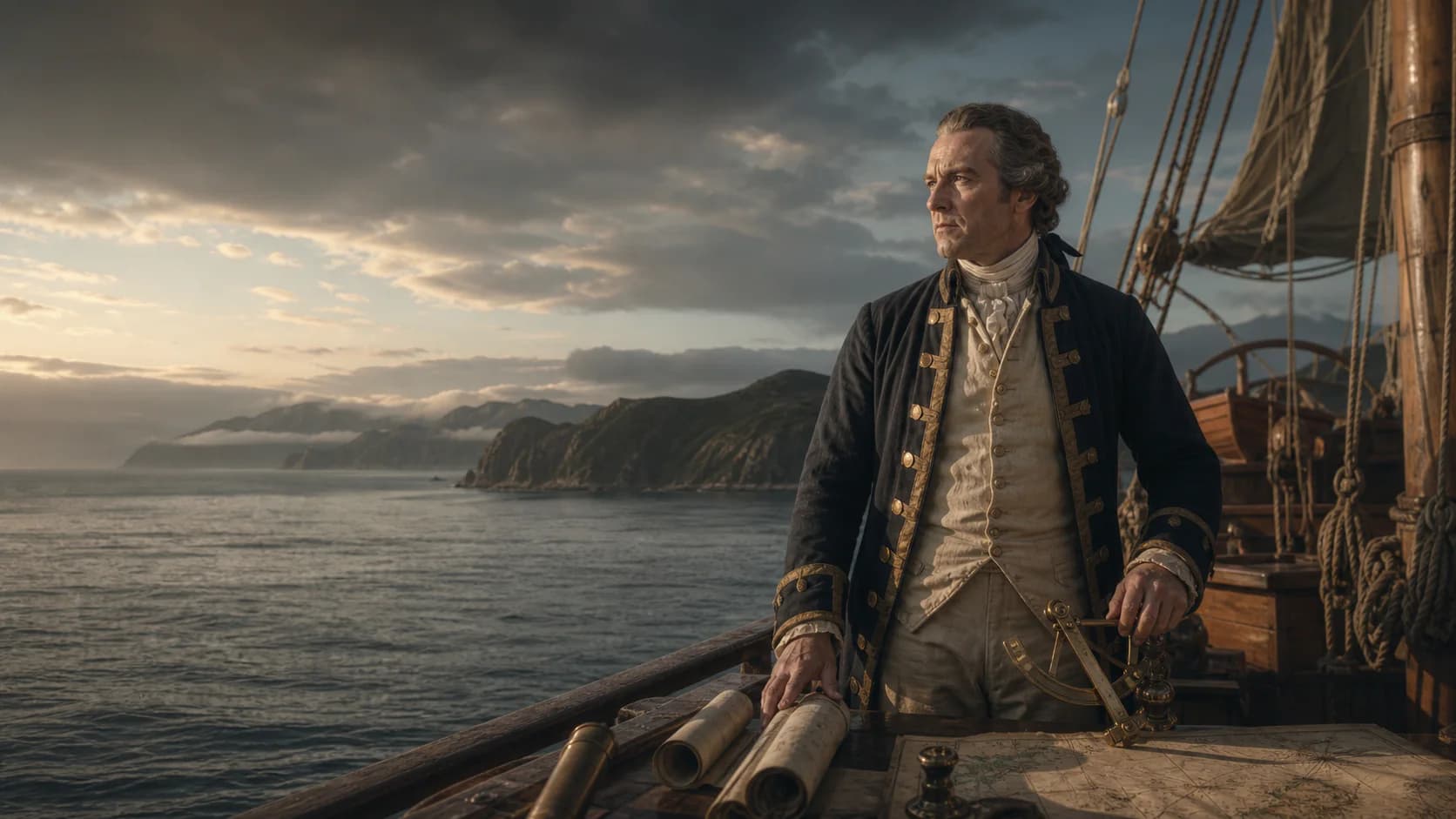
Opening portrait
Who was James Cook?
James Cook was a British naval officer and hydrographer who commanded three Pacific expeditions between 1768 and 1779. Endeavour's public first mission was to observe the transit of Venus in Tahiti; secret orders then directed Cook to search for a southern continent and chart New Zealand and Australia's east coast. Later voyages ranged through the high southern and northern Pacific. Scientific work and imperial possession were never separate projects.
- Three voyages
- 1768—1780
- First-voyage ship
- HMS Endeavour
- Profession
- Navigation and hydrographic surveying
- Death
- Hawaiʻi, 1779
Defining moment
1768–1779 · Three Pacific voyages
Three crossings of the Pacific pushed the edge of the chart farther every time.
From the transit of Venus and the circuit of New Zealand to Australia’s east coast, the Antarctic Circle, Hawai‘i and the northwest coast of America, Cook’s voyages fused astronomy, surveying, chartmaking and blue-water seamanship into one disciplined operation. Coastlines, islands, passages and latitudes accumulated on the page until the Pacific appeared with unprecedented definition.
Life at a glance
James Cook · career timeline
Key dates connect biography, expeditions and later consequences across a career longer than any one ‘discovery’.
- 01
Endeavour sails
The first expedition carries a public Venus-transit mission and sealed Admiralty orders.
- 02
Tahiti observations lead into Pacific surveying
After the astronomy work, Tupaia joins as the ship turns toward New Zealand.
- 03
Cook charts Australia's east coast
After grounding on the Great Barrier Reef, Endeavour is repaired and continues through Torres Strait.
- 04
The second voyage enters the high southern Pacific
Repeated crossings undermine the idea of a vast habitable southern continent in temperate latitudes.
- 05
The third voyage seeks a northern passage
The search fails; Cook is killed after the expedition returns to Hawaiʻi.
The life in sequence
Follow the voyage from its beginnings to its aftermath.
These chapters follow the order of a life and its expeditions, and are designed to be read as one continuous narrative.
The first voyage carried scientific and imperial instructions
Endeavour sailed to Tahiti with astronomers, artists and instruments to observe the 1769 transit of Venus. After that public task, Cook opened Admiralty orders directing him to search for a southern continent, survey coasts and claim suitable lands.
Science supplied measurements, drawings and specimens; naval surveying made coastlines usable to later ships. The same observations that enlarged knowledge could also make distant places legible to imperial power.
Tupaia changed what the ship could know
The Raʻiātean navigator Tupaia joined at Tahiti with a deep geography of islands, kinship, language and sailing routes. In Aotearoa, he interpreted and mediated encounters in ways no British officer could reproduce.
Cook's charts relied on instruments, mathematical skill and continuous crew labour, but accuracy did not come from a captain alone. Pacific knowledge entered the voyage through Tupaia and through the people met along each coast.
Surveying brought encounter, claim and violence together
Cook charted New Zealand and Australia's east coast, where First Nations already held detailed geographical and legal relationships with land and sea. British possession ceremonies did not obtain their consent.
Two later voyages pushed into high southern latitudes and the North Pacific. In 1779, after relations at Kealakekua Bay deteriorated, Cook was killed during an attempt to seize Kalaniʻōpuʻu as leverage for a stolen boat. Exploration never occurred outside local politics.
Beyond the voyage
Some histories come into focus outside the timeline.
Local societies, navigation, surviving records and later consequences each open a separate path into the story.
Records and evidence
How do the sources support these claims?
Confirmed facts, disputed questions and common misconceptions appear as distinct parts of the record.
Scientific and imperial orders belonged to one voyage
Admiralty instructions place the Venus observation, southern search, survey and possession claims in sequence aboard Endeavour.
'Discovery' changes who appears in the story
Cook created major European charts; Māori, Aboriginal and Pacific peoples already held their own geographical knowledge and navigation traditions.
Precision was collaborative
Cook's surveying, instruments, crew labour and Tupaia's oceanic and diplomatic knowledge all sustained the expedition.
Questions to carry forward
Common questions
What was Cook's first voyage for?
The public mission observed the transit of Venus at Tahiti. Secret Admiralty orders then required a search for southern land, survey and territorial claims.
Did Cook discover Australia?
No. First Nations had lived there for tens of thousands of years, and earlier Europeans reached other coasts. Cook charted and claimed part of the east coast for Britain.
How did Cook die?
He was killed at Kealakekua Bay in Hawaiʻi in 1779 during a confrontation after his party tried to take the high chief Kalaniʻōpuʻu hostage.
Why was Tupaia important?
He brought Pacific geography, languages, religion and diplomatic knowledge and mediated many encounters. Calling him merely the ship's interpreter severely understates his role.
Sources
Sources and further verification
The institutions below support the account; disputed numbers, place identifications and claims of ‘first discovery’ retain their uncertainty.
- Captain James Cook timelineRoyal Museums Greenwich
- Tracing EndeavourAustralian National Maritime Museum
- Research guide: Exploration and discoveryRoyal Museums Greenwich
- A view of Endeavour RiverRoyal Museums Greenwich
- European voyaging and discoveryNew Zealand History
- James Cook and HMB EndeavourAustralian National Maritime Museum
Age of Seas editorial research distinguishes documentary facts, scholarly disputes and narrative judgments.Editorial standards and corrections ↗