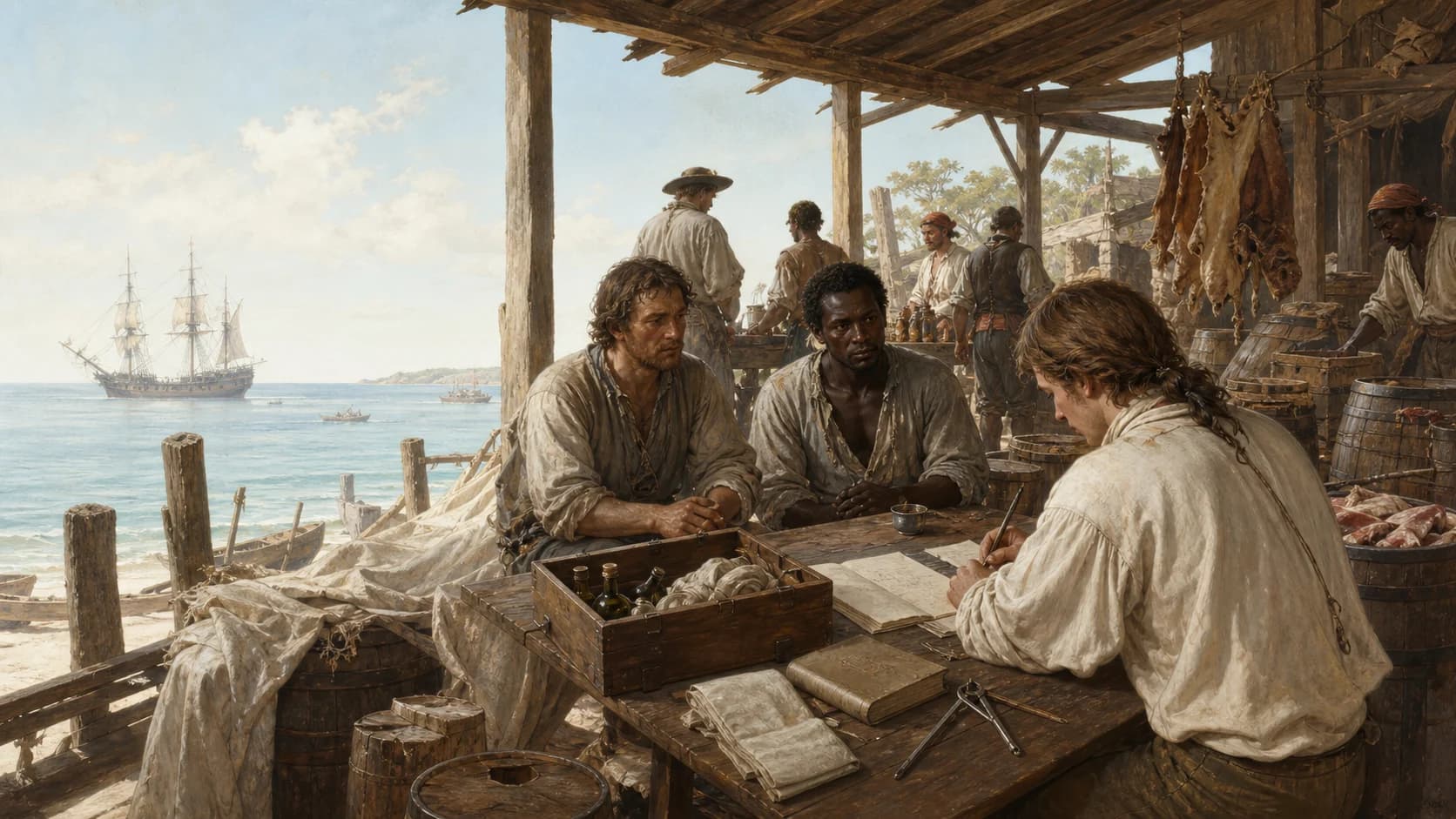
Docket index ↓
Docket abstract
It is both a close record of Caribbean companies and a witness repeatedly rewritten in translation.
The Buccaneers of America first appeared in Dutch as De Americaensche Zee-Roovers, published at Amsterdam in 1678. Alexandre Olivier Exquemelin had reached Tortuga in 1666 as an indentured servant of the French West India Company. He says that he was sold, later served a surgeon, obtained his freedom, and joined buccaneering companies. The original book has three parts and the early English tradition eighteen chapters. Part I describes the French colony, Tortuga, Hispaniola, hunters, and buccaneers. Part II treats buccaneer origins, written articles, shares, injury compensation, and commanders such as l’Olonnais. Part III follows Henry Morgan through Puerto Bello, Maracaibo, Santa Catalina, Chagres, and Panama. The narrative records how ‘no prey, no pay’ contracts assigned occupational rewards and valued permanent injury, while attacks depended on captives, pilots, ransom, torture, food, and intelligence. Mutual support within the company rested on predation beyond it: one compensation schedule even priced enslaved people as substitutes for silver. Exquemelin promises eyewitness ventures, yet that claim cannot cover every chapter automatically. His manuscript is lost; the Dutch edition itself was adapted by publisher Jan ten Hoorn, and German, Spanish, rival English, and French editions altered vocabulary and stories for new markets. Two competing English versions appeared in 1684. Morgan sued one publisher in 1685 and another settled, but the truth of the disputed statements was never tested at trial. The book matters both as unusually close evidence for Caribbean companies, colonial economies, and violence, and as a case study in how translation repeatedly remade a witness, a pirate, and a hero.
Original passages
Six early-English passages open indenture, witness, contract, compensation, and the Morgan dispute.
- EXHIBIT 01IndenturePart I · Chapter I
On this occasion I was also sold, being a servant under the said company in whose service I left France.
Docket readingExquemelin locates himself within company indenture: he left France in its service and was sold after reaching Tortuga.
The book begins inside a colonial labour system. His buccaneer career follows sale and service, not a romance of unrestricted departure. - EXHIBIT 02Eyewitness claimTo the Reader
I shall give him no stories upon trust, or hearsay, but only those enterprises to which I was myself an eye-witness.
Docket readingThe author promises enterprises he witnessed himself rather than stories accepted on trust or hearsay.
The claim is tested chapter by chapter. Reported lives remain in the book, while every surviving text also carries editing and translation. - EXHIBIT 03Written articlesPart I · Chapter III
They likewise agree upon certain articles, which are put in writing, which every one is bound to observe. No prey, no pay.
Docket readingA company writes down binding terms before departure; without captured goods, the crew receives no return.
The articles allocate investment, occupational rewards, shares, and compensation. They make temporary collective action possible by tying income to seizure. - EXHIBIT 04Pricing injuryPart I · Chapter III
for the loss of a right arm, six hundred pieces of eight, or six slaves
Docket readingLoss of a right arm is valued at six hundred pieces of eight or six enslaved people.
Mutual insurance and slavery occupy one schedule. Support for an injured member is materially founded on plunder and ownership of other people. - EXHIBIT 05Common stockPart I · Chapter III
they take a solemn oath to each other, not to conceal the least thing they find among the prizes
Docket readingMembers swear that nothing found among captured goods will be hidden from the common account.
The rule binds crew and commander. The later accusation that Morgan retained jewels becomes serious because it violates this shared standard. - EXHIBIT 06The Morgan disputePart III · Chapter XVIII
they told him to his face that he had reserved the best jewels to himself
Docket readingMembers openly accused Morgan of reserving the finest jewels for himself.
The charge entered later English versions and a legal controversy. Settlement in 1685 did not submit the statement to a factual trial.
Experience × print × law
Six Caribbean years entered five languages and a competitive book market within eight years.
- 01
An uncertain early biography
Exquemelin, Esquemeling, and Oexmelin are among the name forms. He is generally treated as French and medically trained, though the record is incomplete.
- 02
Departure from Le Havre
He sailed on the Saint-Jean as an indentured servant of the French West India Company bound for the Caribbean colonies.
- 03
Arrival at Tortuga
He says that he was sold twice: first to a brutal master and then to a surgeon, who freed him after roughly another year of service.
- 04
Among buccaneering companies
Exquemelin joined or closely accompanied Caribbean ventures and observed companies from the position of medical worker and ordinary member.
- 05
Morgan attacks Puerto Bello
Surprise, control of strongpoints, detention, and ransom make this expedition a major node in Part III.
- 06
The Maracaibo expedition
Narrow waters, shore batteries, a fireship, and negotiated withdrawal expose dependence on intelligence and seamanship.
- 07
Chagres and Panama
After taking San Lorenzo, the force crossed the isthmus. Hunger, marching, battle, fire, captives, and division of plunder form the book’s longest action line.
- 08
Dutch first edition
Jan ten Hoorn published three parts at Amsterdam with copperplates associated with Herman Padtbrugge. The lost manuscript was probably French.
- 09
German and Spanish adaptations
Translators and publishers rearranged material and adjusted judgments about Spanish colonies and buccaneers for different readerships.
- 10
Rival London translations
William Crooke and Thomas Malthus issued competing texts. English transmission ran mainly through the Spanish edition rather than directly from Dutch.
- 11
Morgan’s libel action
Morgan sued Malthus, while Crooke settled separately. The surviving plea roll documents reputation and publishing rivalry; no trial established the disputed facts.
- 12
Ringrose becomes an English volume II
Publishers attached Basil Ringrose’s Pacific journal as a second volume. It was not part of Exquemelin’s three-part book of 1678.
- 13
French edition
The French text expanded subjects including natural history and may at points stand nearer the lost French manuscript; it remains an independently edited version.
Three parts, eighteen chapters
The contents move from colonial economy into company institutions and converge on Morgan’s Panama campaign.
PART 01
Part I · Colony and Tortuga
Company indenture leads into Hispaniola, hunters, and the organization of buccaneers.- 01
Chapter I · Passage and sale
French West India Company, Tortuga, and indenture
- 02
Chapter II · Hispaniola
Colonies, hunting grounds, plantations, and port exchange
- 03
Chapter III · Buccaneer organization
Origins, articles, shares, compensation, and discipline
PART 02
Part II · Companies and commanders
Short ventures and the life of l’Olonnais show attack, capture, reprisal, and the making of reputation.- 04
Chapter IV · Pierre le Grand
The exemplary tale of a small boat taking a ship
- 05
Chapter V · François l’Olonnais
From indenture to buccaneer command
- 06
Chapter VI · Operations in Cuba
Captives, pilots, reprisal, and intelligence
- 07
Chapter VII · Maracaibo and Gibraltar
Town attacks, ransom, and torture
- 08
Chapter VIII · Gulf of Honduras
Division of the company and death of l’Olonnais
PART 03
Part III · Morgan and Panama
Ten chapters connect recruitment, fleet, landing, isthmus march, occupation, and division of plunder.- 09
Chapter IX · Henry Morgan
Origins, Jamaica, and early command
- 10
Chapter X · Cuba and Puerto Príncipe
Provisioning and attack
- 11
Chapter XI · Puerto Bello
Surprise, control, and ransom
- 12
Chapter XII · Maracaibo
Fort, fireship, and withdrawal
- 13
Chapter XIII · A new fleet
Calling ships, people, and provisions
- 14
Chapter XIV · Santa Catalina
Island strongpoint and captive intelligence
- 15
Chapter XV · Chagres Castle
The assault on San Lorenzo
- 16
Chapter XVI · Across the isthmus
Hunger, river, and overland march
- 17
Chapter XVII · Panama
Battle, urban fire, and search for wealth
- 18
Chapter XVIII · Return and shares
Captives, the jewel charge, and dispersal
Position of the witness
A company servant sold on Tortuga later writes from the medical chest and the common company.
Exquemelin left France in 1666 under indenture to the West India Company. On Tortuga, he says, a first master reduced him to severe illness before selling him to a surgeon. His second service placed him close to colonial medical work and may help explain the book’s attention to wounds, sickness, hunger, and injury compensation. After gaining freedom, he entered a buccaneering company.
The biography opens the book within colonial labour. Hunters, planters, merchants, taverns, shipowners, and buccaneers on Tortuga exchanged credit, hides, meat, weapons, and labour. Raiding at sea depended upon a land-based colonial economy.
The prefatory promise of eyewitness ventures does not preserve a continuous log for every episode. Exquemelin writes some companies at close range and relays other lives and reports. His position supplies proximity, while memory, interest, and later editorial work remain visible layers.
Port economy
Tortuga joins hunting grounds, plantations, taverns, credit, and outward-bound companies in one supply chain.
Early chapters spend substantial space on wild cattle and pigs in Hispaniola, smoked meat and hides, French settlement, and the Tortuga base. These materials explain where a company found provisions, firearms, vessels, and recruits.
Hunters delivered meat and hides to port merchants; merchants advanced powder, cloth, alcohol, and credit; commanders recruited against expected prizes. Returns from one attack entered taverns, shops, and plantations, while debt and consumption fed another departure. The common stock had a colonial material base.
That economy also relied on coerced labour, enslaved people, and captives. The injury schedule values silver and enslaved people side by side, exposing the unequal human cost beneath port prosperity and collective insurance.
Operational method
Captives, pilots, ransom, and food determine whether a company can reach the next town.
A raid required more than guns. Companies needed shallows, river mouths, garrisons, roads, stores, and wealthy households, so they repeatedly seized sailors, residents, and enslaved people as pilots, interpreters, and guides. Threat and torture extracted information; ransom extended detention into negotiation.
Puerto Bello, Maracaibo, and Panama present violence as a sequence: concealed approach, seizure of forts, blocked exits, searches, concentrated captives, negotiation, provisioning, and withdrawal with ransom. City and countryside endured separate phases of one operation.
Exquemelin’s details reconstruct logistics through an attacker’s field of view. African-descended people, Indigenous communities, free residents, enslaved people, soldiers, and civilians within Spanish settlements did not form one uniform population. Local archives and archaeology disaggregate the book’s broad labels.
Morgan’s campaign
From Chagres to Panama, numbers, hunger, and division of plunder explain more than individual daring.
The 1670–1671 campaign first captured San Lorenzo at the mouth of the Chagres and then crossed the isthmus by river and land. Boats could not carry all supplies forward. Mud, heat, and hunger consumed the force; villages, maize, and livestock determined whether it could continue.
Panama burned after the battle. Accounts have long disputed who began the fire: Exquemelin assigns an order to Morgan, while other explanations point to combat, a defensive scorched-earth policy, or uncontrolled ignition. Fire, searching, detention, and ransom imposed sustained losses on residents.
On return, ordinary shares fell far below expectation and members suspected Morgan of withholding jewels. The conflict completes the book’s contractual theme: a commander capable of assembling a fleet could use custody and information to weaken its common account.
Route through editions
Once the lost manuscript reached a printing house, each translation rearranged witness, enemy, and hero.
Scholarship generally treats the lost manuscript as probably French. Jan ten Hoorn heavily adapted it for the Dutch edition of 1678, followed by German in 1679, Spanish in 1681, rival English editions in 1684, and French in 1686. Every market changed vocabulary, narrative, and emphasis.
The 1684 Bucaniers of America moved chiefly through Spanish, making language about Morgan especially sensitive. Morgan sued publisher Thomas Malthus in 1685, while William Crooke settled separately. The surviving plea roll records reputation and commerce but no completed trial deciding whether contested statements were true.
The English second volume contains Basil Ringrose’s journal and does not belong to Exquemelin’s three-part original. This dossier separates that later attachment from the book and identifies its quoted early English as one branch that reached London through Spanish.
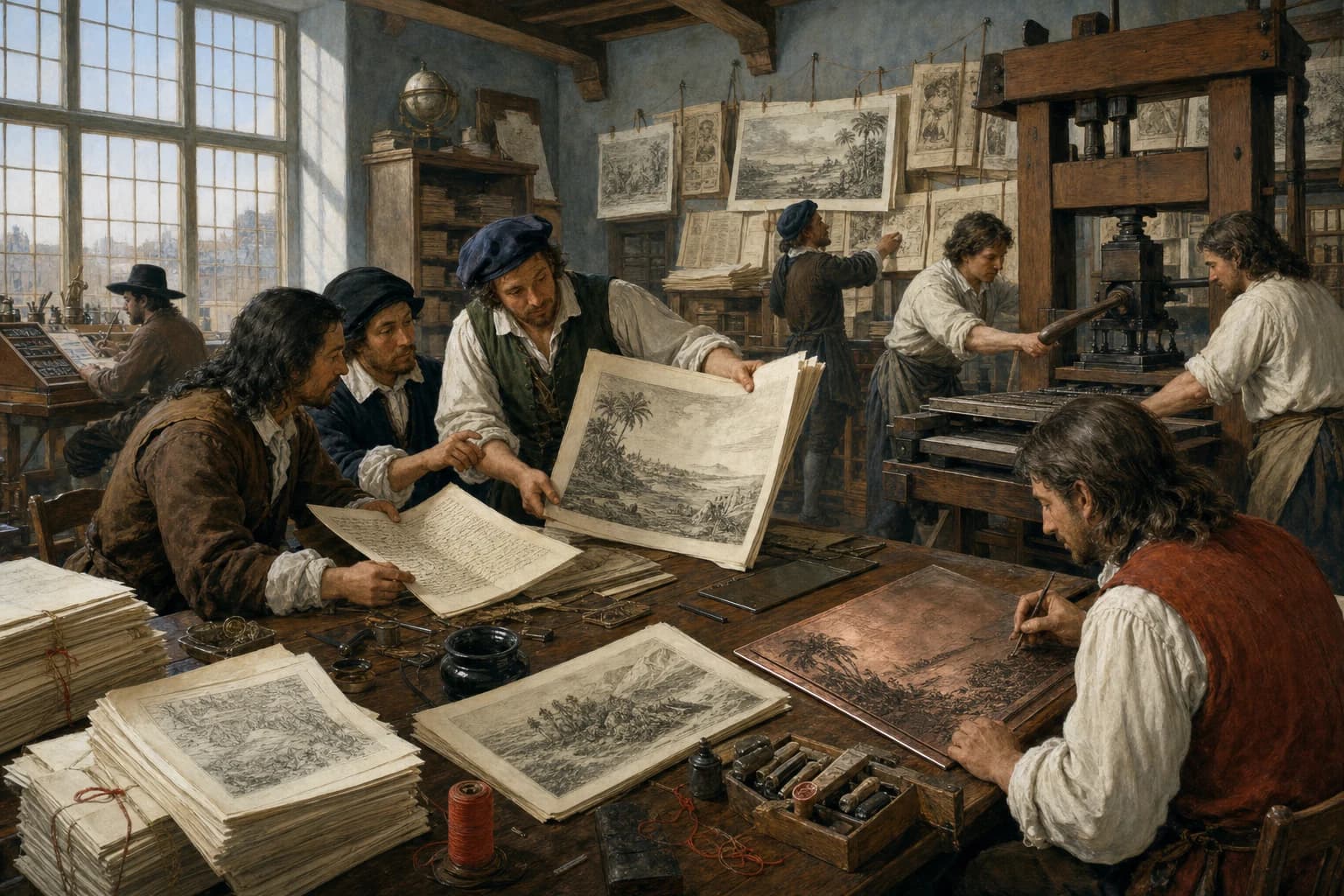
Manuscript, copperplate, and press carry Caribbean testimony into European markets; editing, translation, and illustration reshape the actors and actions a reader meets.
Evidence coordinates
Institutional detail, eyewitness range, edition comparison, and local materials answer different questions.
Tortuga’s economy and company articles
Indenture, hunters, supplies, written articles, occupational rewards, and injury compensation form a connected institutional record.
The author’s eyewitness range
The author promises witnessed ventures, yet early tales, commanders’ lives, and some campaigns include report. Companion accounts help test individual episodes.
Morgan and descriptions of violence
Dutch, Spanish, rival English, and French versions recast responsibility, judgment, and detail. Each translation has a publishing position.
Residents, enslaved people, and Indigenous communities
Colonial archives, local histories, and archaeology separate identities and choices compressed into the book’s broad populations.
Reading editions
Dutch first print, early English, a modern reading text, and French scholarship serve distinct uses.
Alexis Brown · translated from the Dutch edition
A readable modern English translation made directly from the 1678 Dutch, reissued by Dover. It is the strongest continuous entry to the three original parts.
Dutch first edition · Gallica and DBNL
Use the facsimile for the three-part architecture, title, and copperplates, and the searchable text for comparison. Jan ten Hoorn’s adaptation remains part of this witness.
Bucaniers of America · Library of Congress / EEBO-TCP
The historically influential early English branch is available as page images and searchable text. It came mainly through the Spanish edition and cannot transparently recover the manuscript.
Réal Ouellet and Patrick Villiers · French critical edition
A 595-page scholarly text with introduction and annotation for studying the French tradition, Caribbean context, and edition differences.
Reader questions
Author, articles, eyewitness range, English differences, and Morgan’s lawsuit.
What is The Buccaneers of America about?+
It begins with French colonization, Tortuga, and Hispaniola, explains written company articles, shares, and injury compensation, and narrates ventures by l’Olonnais and Henry Morgan. Its longest line runs through Puerto Bello, Maracaibo, Chagres, and Panama.
Who was Alexandre Exquemelin?+
He is generally identified as a Frenchman born around 1645. He reached Tortuga in 1666 as a West India Company indentured servant, was sold, served a surgeon, and joined buccaneers after becoming free. His name, dates, and medical training retain uncertainties.
Was Exquemelin a buccaneer or a surgeon?+
Both histories inform his identity. He served under a surgeon and is often called a surgeon or surgeon’s assistant, then travelled with buccaneering companies. Surviving records do not establish his exact duty in every operation.
Why is the book important to piracy history?+
It connects Tortuga’s economy, recruitment, written articles, occupational rewards, injury compensation, intelligence, ransom, and division of plunder. That institutional density allows productive comparison with colonial archives and companion accounts.
Did Exquemelin witness every venture?+
His address to the reader makes an eyewitness claim, but the book also contains early stories, commanders’ biographies, and reported material. The manuscript is lost and each surviving version has editorial and translational layers, so proximity must be judged chapter by chapter.
Did buccaneers have one pirate code?+
The book records articles negotiated and written before a particular departure. Terms varied with company, investment, and object, assigning rewards, shares, injury payments, and discipline. These were voyage contracts, not one permanent code shared by all pirates.
Why does the English text differ from the Dutch first edition?+
The early English was translated mainly through the Spanish version of 1681, which had already rearranged and altered the material. Rival London publishers then issued separate texts, changing names, wording, moral judgment, and Morgan’s representation.
Did Henry Morgan’s lawsuit prove the book false?+
No. Morgan brought a libel action against Thomas Malthus in 1685 and William Crooke settled separately. Pleadings and settlements survive, but the disputed statements were not tested in a completed factual trial.
Research sources
First editions, searchable texts, catalogues, and version history form one evidence chain.
- 01Bucaniers of America · 1684–1685 ↗
Library of Congress
Two-volume English facsimile, bibliography, three-part structure, and Ringrose’s 1685 second volume - 02The Buccaneers of America · interactive book ↗
Library of Congress
The 1678 Dutch title page, Exquemelin’s background, and the subjects of the three original parts - 03Bucaniers of America · 1684 searchable text ↗
EEBO-TCP / University of Michigan
Searchable early English and chapter locations used to verify the original-passage section - 04De Americaensche Zee-Roovers · 1678 ↗
Gallica · Bibliothèque nationale de France
Digital facsimile of the Dutch first edition and copperplates - 05De Americaensche Zee-Roovers ↗
DBNL
Searchable Dutch text, editorial introduction, and chapter structure - 06‘A certain false, malicious, scandalous and famous libel’ ↗
International Journal of Maritime History
Joseph Gibbs on Morgan’s 1685 legal action, rival publishers, and the plea roll - 07Exquemelin’s Buccaneers across early translations ↗
Early Modern Low Countries
Peer-reviewed study of the lost manuscript, ten Hoorn’s editing, and changes across editions of 1678–1686 - 08Histoire des aventuriers flibustiers · critical edition ↗
Bibliothèque nationale de France
Catalogue record for Ouellet and Villiers’s annotated French edition of 2005 - 09The Buccaneers of America ↗
Cambridge University Press
Biographical outline, the Tortuga arrival of 1666, and account scope - 10The Pirates of Panama · searchable old English ↗
Project Gutenberg
A 1914 reset of the old English tradition, useful for search while quotations return to the 1684 text
Sources checked and page updated 26 August 2026. Read our editorial and citation standards