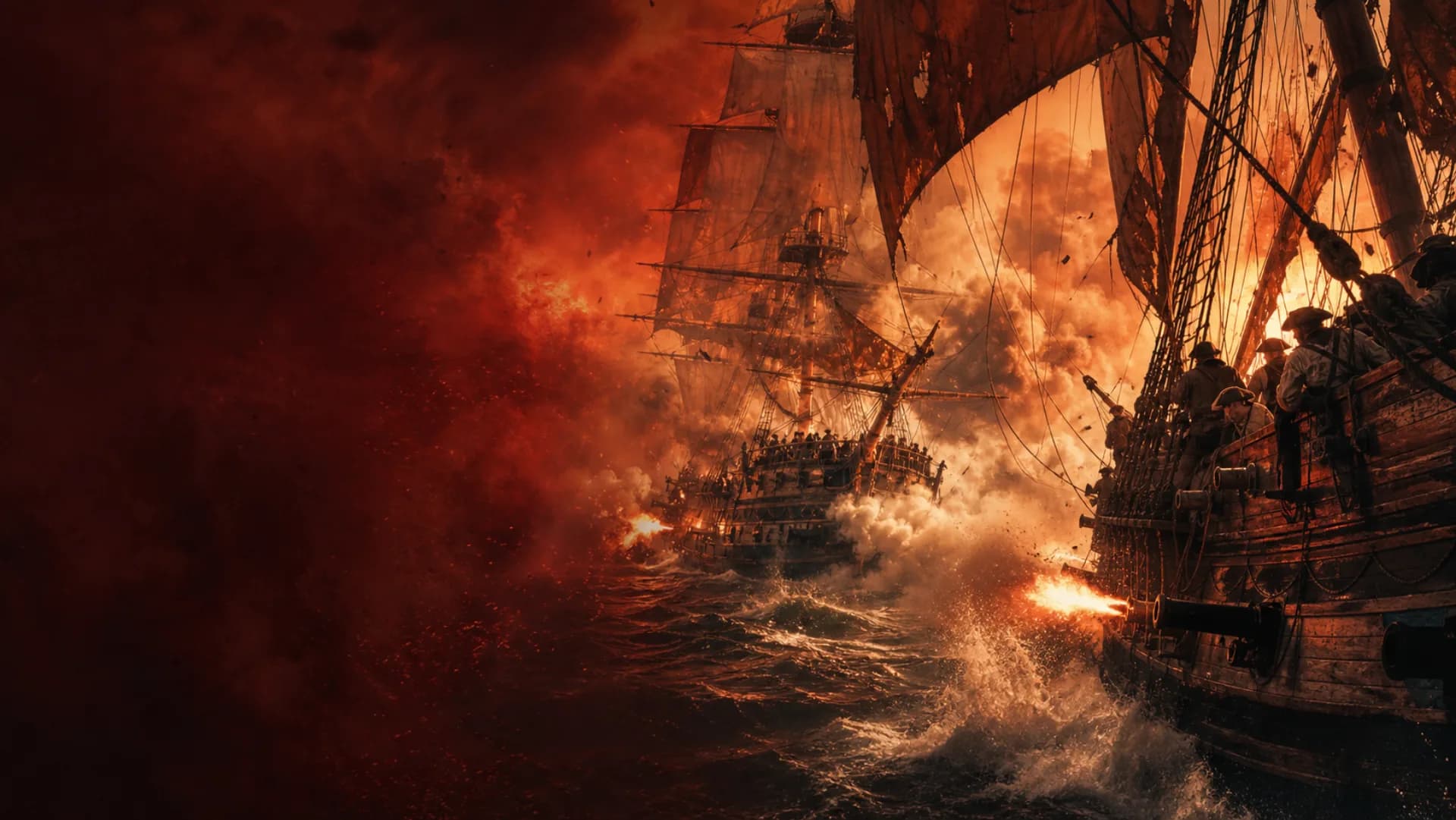
 cannon
The harbor officer slides a commission across the desk
Hull
Round shot concentrates damage on timber planking and structure.
Rigging
Chain shot is better suited to attacking masts, sails and rope.
Crew
Grapeshot spreads its effect across an exposed deck at close range.
Privateering was privately financed naval war, not a vessel type
Privateer described an authorized person and often the armed vessel. An ordinary merchant hull might be fitted with guns and crew at an owner's expense. The state expanded its force without buying every ship; investors and crew accepted outfitting costs, wounds and failed cruises in expectation of shares from property legally condemned as prize. No hull shape by itself identified a privateer.
Authority appeared as a commission, letter of marque and reprisal, or a comparable instrument whose wording varied by state and century. It was not a lifetime permission to rob. It depended on the issuer, a particular war and named enemies, and could impose a bond, crew list, expiration and reporting duties. No commission, a forgery or action outside its target scope could remove privateer protection.
Capture began a court case; it did not complete the taking
The captor normally placed a prize crew aboard and brought the vessel, cargo and original papers to a port with jurisdiction. A prize court examined whether war existed, who truly owned ship and goods, whether cargo was enemy property or contraband, and whether the commission and capture were valid. Dividing goods at sea bypassed the legal process the system claimed to require.
British High Court of Admiralty records contain registrations, manifests, bills of lading, logs, testimony, correspondence and intercepted mail. Only condemnation made the property a lawful prize for sale and distribution. American War of 1812 files add warrants, depositions, bills of sale and prize tickets. Privateering depended on a documentary chain as much as on cannon.
Neutral cargo, false flags and expired commissions made status contestable
A stern flag did not always reveal ownership. Enemy goods could travel in a neutral hull, neutral merchants traded across belligerent lines, and captains might carry several documentary identities. An owner could appear in prize court to assert neutral rights, forcing inquiry into route, beneficial ownership and contraband. A mistaken capture might lose its proceeds and create damages or diplomatic conflict.
Legal status also changed over time. Continuing after peace, revocation or expiration could not be excused by an old paper; attacking home, neutral or unauthorized targets crossed the commission's bounds. Recognition of the issuer mattered too. In 1861 the United States rejected Confederate statehood, called its letters of marque pretended authority, and threatened privateer crews with piracy prosecution. Legality was not a label all opponents automatically shared.
The American Revolution and War of 1812 show the machinery at work
After Britain's Prohibitory Act withdrew trade protection from the colonies in 1775, the Continental Congress issued letters of marque and reprisal for privately armed ships to seize British vessels and cargo. The Library of Congress records more than a thousand private vessels commissioned during the Revolution, supplementing the small Continental Navy. This was a system of wartime mobilization and finance, not a handful of colorful outlaws.
In 1812 Congress regulated commissions and confirmed federal district-court prize jurisdiction. Applications passed through the State Department or customs collectors, authorizing vessels to cruise against enemies of the United States. Yet southern court records include captures of Swedish, Spanish, Portuguese and Russian shipping as well as British. Such cases required adjudication of neutral claims and papers rather than the captor's unilateral declaration.
The 1856 Paris Declaration was a turning point, not one instant global ban
After the Crimean War, the Declaration Respecting Maritime Law stated first that privateering was and remained abolished. It also addressed enemy goods under neutral flags, neutral goods under enemy flags and effective blockade. Among participating powers, the agreement pushed legitimate maritime force toward state navies and sharply reduced the old privateering system.
The text expressly bound only powers that had acceded or later did so. It is therefore misleading to write that all privateering everywhere became illegal in 1856. The United States did not initially sign, and the Civil War soon produced another privateering dispute. Historical analysis must identify the applicable state, war, court and treaty. 'Legal pirate' can open a discussion, but it cannot replace that legal context or soften the violence experienced by captured crews.
Questions
Continue exploring this subject
What was a letter of marque?
It was a state commission authorizing a privately owned armed vessel to capture defined enemy shipping in a particular war, subject to the issuing system's limits and procedure.
Was a privateer simply a legal pirate?
That is only shorthand. Privateer status depended on effective authority, wartime scope, correct targets and prize adjudication; piracy lacked recognized authority under the applicable law.
Could privateers divide captured cargo immediately?
Under the usual system, no. Ship and goods first went to a prize court, which had to condemn the capture before sale and distribution.
Did privateering disappear worldwide in 1856?
Not instantly. The Paris Declaration abolished it among acceding powers, but expressly bound only those powers; the United States initially remained outside it.
Sources
Continue the research
- Federal Court Records: Prize Cases and Privateer PapersU.S. National Archives
- War of 1812 Papers of the Department of StateU.S. National Archives
- High Court of Admiralty recordsThe National Archives (UK)
- Organizing a WarLibrary of Congress
- Declaration Respecting Maritime Law, Paris, 1856International Committee of the Red Cross
 03
03