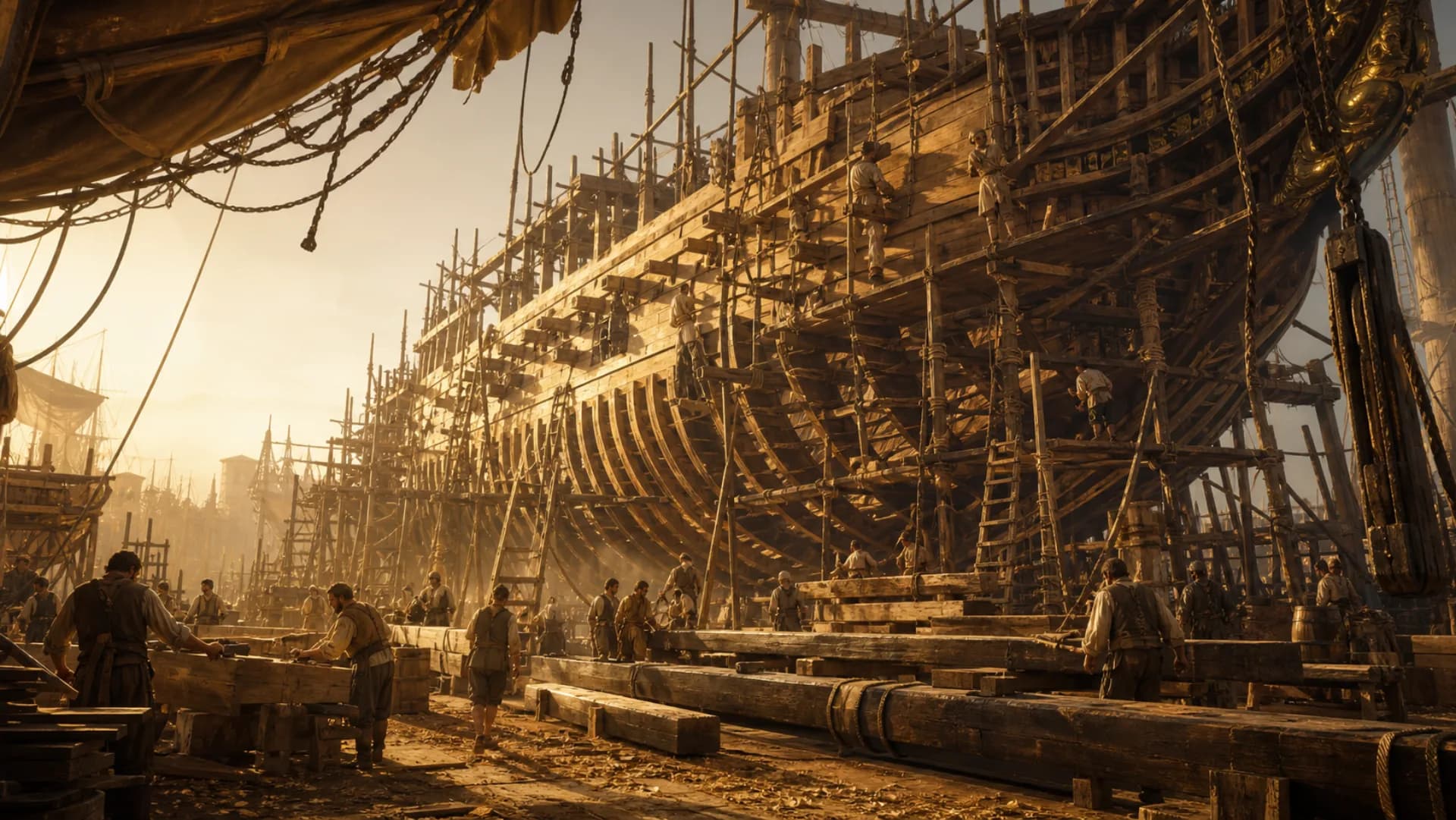
 galleon
The channel is shallow and the ocean lies beyond it
Square sails
The main sail plan provides power on long downwind passages.
Broadside
Rows of guns make the ship’s side its principal direction of fire.
Sterncastle
The raised stern contains command and living spaces.
A sloop concentrates work into a smaller hull and rig
In common age-of-sail usage, a sloop carried one mast and a fore-and-aft sail plan, although naval and regional labels could vary. Its smaller hull and simpler rig reduced crew demands and made frequent turns, coastal passages and dispatch work practical.
Small did not mean harmless or suitable only for leisure. Armed sloops served patrol, war and privateering, while trading craft used similar advantages in confined waters. Their strength lay in mobility and economy rather than cargo volume or a tall battery of guns.
A galleon distributed ocean endurance across more ship
The galleon carried multiple masts, larger stores and cargo, and guns arranged along the sides. Its size supported long passages and imperial trade or war, but also demanded more people, deeper water and more time to turn and maintain.
That capacity was never free. Guns, provisions, cargo and ballast competed for weight and space. A large hull could absorb more functions while becoming less nimble in shoal or narrow water.
The names do not form opposite boxes on one timeless chart
Galleon names a historical family that developed across several maritime powers. Sloop has been applied in different periods to a rig, a vessel type and, in naval usage, a class of command. Exact mast, tonnage and armament limits therefore shift with source and date.
The safest comparison begins with the particular vessel: when and where it was built, how it was rigged and what job it performed. As a broad contrast, sloop suggests concentrated agility; galleon suggests distributed capacity. Neither word alone supplies a complete specification.
Questions
Continue exploring this subject
Was a sloop always faster than a galleon?
No. A sloop was usually more agile and needed fewer hands, but actual speed depended on hull, rig, loading, wind and sea state.
Could a sloop fight a galleon?
Armed sloops could raid, scout or exploit position, but a large galleon generally carried far more sustained firepower and people. Circumstance mattered more than a simple duel ranking.
Did every galleon belong to Spain?
No. Spain made the type famous through oceanic fleets, but Portugal, England, the Netherlands and other powers also built and operated galleons.
Sources
Continue the research
- National Watercraft CollectionSmithsonian Institution
- GalleonThe Mariners' Museum and Park