 cannon
Put the choice into a real broadside
Hull
Round shot concentrates damage on timber planking and structure.
Rigging
Chain shot is better suited to attacking masts, sails and rope.
Crew
Grapeshot spreads its effect across an exposed deck at close range.
Because the guns faced sideways, aiming became an action of the whole ship
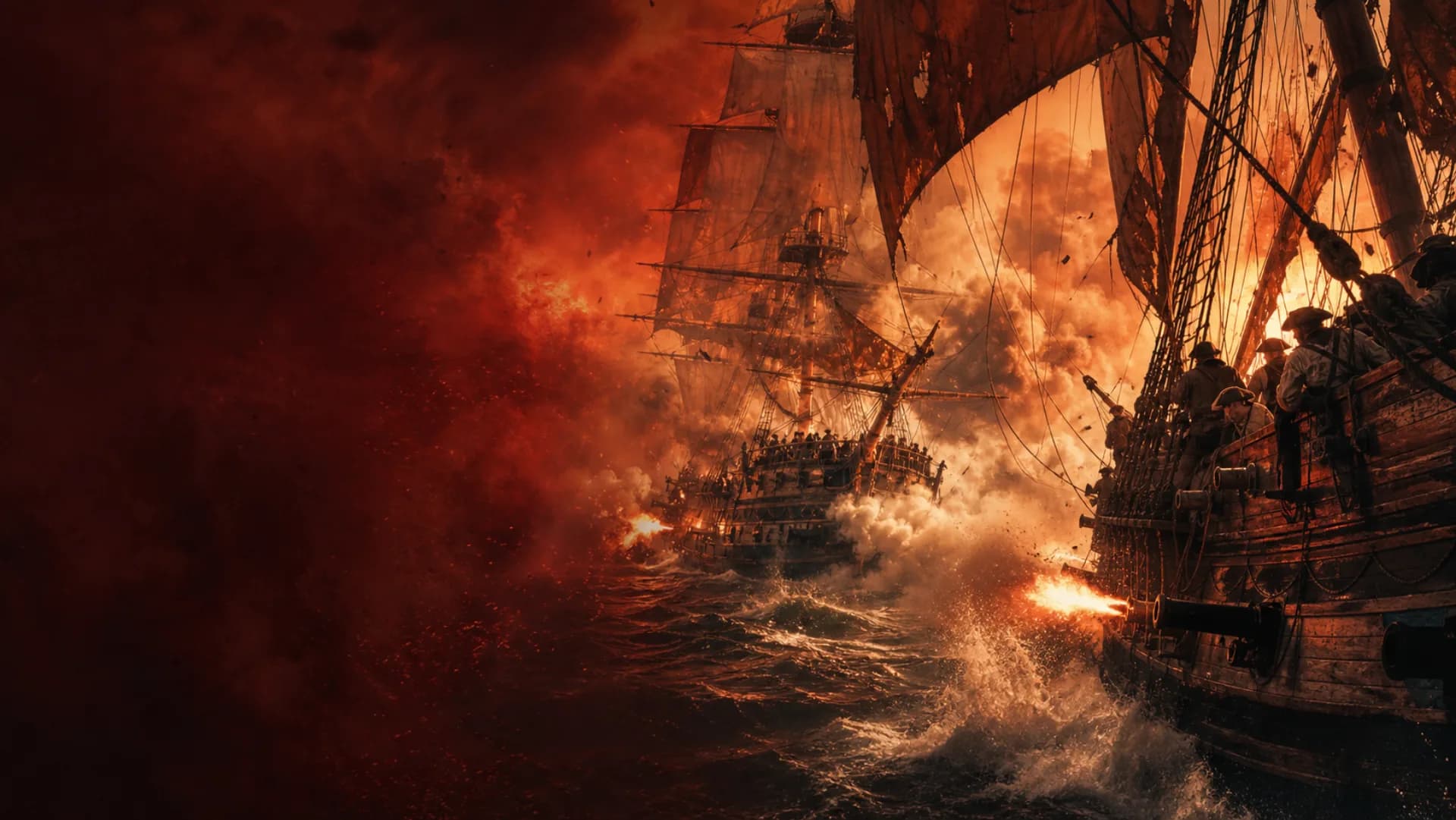
A field gun could be traversed on the ground. Heavy naval guns stood in rows along a hull. On the order to clear for action, the crew followed its ship's practice to remove partitions, furniture and obstructions from gun-working spaces, cast the guns loose, inspect breechings and tackles, and prepare ports when conditions allowed. The phrase did not itself authorize every gun to fire. To bring many muzzles onto one target, the ship still had to change course and position: helm and sail parties were moving the field of fire.
The shot lasted an instant. Recoil then ran the gun inboard, powder smoke closed the view, and the crew began again: swab the bore, load powder and projectile, then haul the gun back to the port. By the time it was ready, distance, wind and the target’s bearing might all have changed.
The weather gauge—the advantageous position relative to the wind—was therefore about more than speed. It shaped the approach, the moment of turning, the movement of smoke and the ability to keep a broadside bearing on the enemy. Seamanship and gunnery were continually trying to keep pace with each other.
The projectile revealed which ability the gunner meant to take away
Solid round shot drove its energy into wooden hulls. It could break planking, damage guns and send splinters through a crowded deck. A waterline hit was not the only useful result: damage to a gun position or structural timber could also reduce a ship’s ability to fight.
Grapeshot spread smaller balls at close range and threatened exposed crews. Chain and bar shot connected metal pieces so that their irregular flight might tear canvas and rigging, slowing the target or making it harder to steer.
Every choice exchanged one effect for another. A shape suited to catching lines usually flew less steadily and over a shorter useful range. Round shot travelled better but might not stop a manoeuvre quickly. Gunners were not choosing abstract maximum power; they were choosing what mattered most to disable at that moment.
Stopping a ship was often more practical than sending it to the bottom
A wooden warship did not necessarily sink after being hit. Holes above the waterline could kill crews and wreck equipment without causing immediate fatal flooding. Breaking spars, cutting rigging, suppressing a gun deck or damaging the rudder might change the battle sooner than trying to sink the hull outright.
A ship unable to hold course or formation lost control of the range. An opponent could take a better angle repeatedly, force a surrender or close for boarding. If hull, cargo and prisoners had value, disabling the vessel could be more profitable than destroying it.
Chain shot is consequently easy to turn into a cinematic mast-cutting weapon. Its real effects were less tidy: range, calibre, impact point, weather and luck all mattered. The ammunition stated an intention. It did not guarantee a scripted result.
Questions
Continue exploring this subject
What did clear for action mean on a sailing warship?
It meant converting the ship from cruising order to fighting readiness: clearing gun-working spaces, removing obstructions, casting guns loose, checking breechings and loading gear, and organizing ammunition passing. The exact drill varied by navy, date and ship, and firing still required a further order.
Did chain shot really join two cannonballs with a chain?
Some forms linked two hemispheres or metal pieces with chain; related bar shot used a rigid bar. Names and construction varied by period and source.
Why did sailing warships not always aim at the waterline?
Both platforms moved, naval guns had limited accuracy and rate of fire, and a commander might first need to destroy mobility, suppress crews or force a surrender.
Sources
Continue the research
- Naval weapons collectionsRoyal Museums Greenwich
- Military shipbuildingMuseo Naval de Madrid
 03
03 04
04 05
05 06
06