 logbook
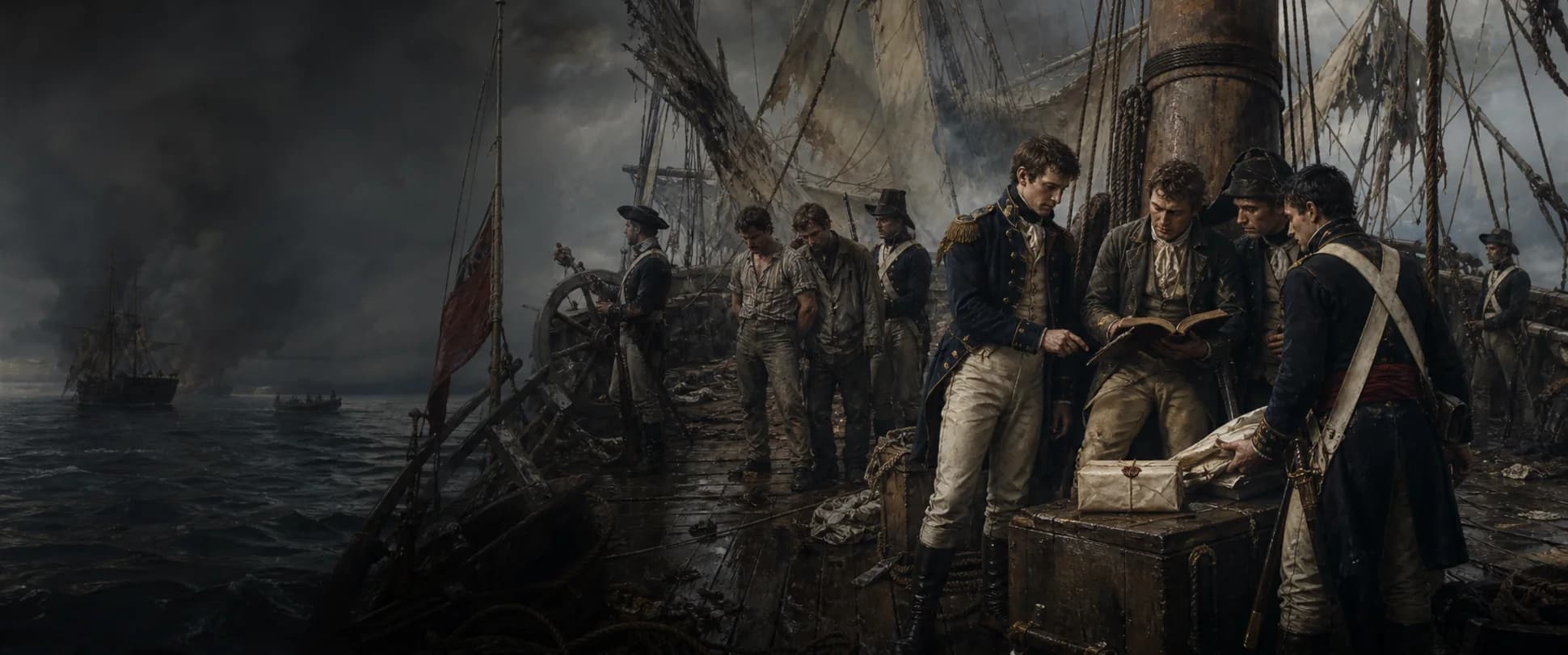
The enemy has struck, but her mast is sprung and prisoners outnumber guards three to one
Course WNW
A continuous course record supports dead reckoning.
Speed 6 kn
The knot comes from the historical use of a log line and timer.
Wind rising
Changing weather alters sail handling and watch decisions.
Striking colours ended resistance, not the work of control or ownership
The victor boarded a working machine still under way or drifting: sail and steering might be damaged, pumps failing, fire alive and wounded people mixed with weapons, powder and prisoners. The first party accepted surrender, disarmed resistance, occupied helm and hatchways and decided whether the hull would survive. A changed flag alone did not stabilize the vessel.
Capture also did not instantaneously transfer title. A commissioned warship or privateer could detain under wartime authority, but enemy character, neutral claims and procedure remained questions for prize jurisdiction. The crew's job was to preserve people, ship, cargo and evidence so that a court ashore could examine what violence at sea had produced.
A prize master took the small group the captor could least afford to lose
The captain appointed an officer, midshipman or trusted senior seaman as prize master and supplied people able to steer, work sail, repair, guard and navigate. There had to be enough for the captured ship without making the captor unfit for another battle or heavy weather. Several prizes could drain a cruiser of its best hands.
The assignment differed from the assault. Boarders seized positions for minutes; a prize crew kept watches, pumped, rationed, repaired and enforced order for days or weeks. Contemporary nautical law placed responsibility on the prize master as agent: negligence that lost a detained vessel could make the actual captors answer for compensation.
Ship papers and mail were sealed because the case travelled inside them
Captors gathered registry, muster, manifest, bills of lading, charter parties, log, instructions and correspondence, noting where possible how they were found and preventing destruction or addition. Initial answers from master and crew addressed ports, destination, flag, owners and cargo. These were legal exhibits rather than souvenirs.
Britain's Prize Papers preserve original materials from ships captured between roughly 1600 and 1860 because sea officers delivered them into proceedings. Opening private bundles for loot, concealing cargo or altering a log weakened discipline and potentially the entire claim. Hold, seals and documents had to reach port in a condition another authority could audit.
Sailing a strange damaged vessel could be harder than defeating it
A tiny crew had to learn unfamiliar rig, steering, labels and store locations while maintaining a full watch. Battle damage changed the usual lead of lines, and pumps and wounded people took more hands. Retaining some original crew supplied knowledge but also created a risk of recapture.
Capturing ship and prize might sail together or appoint a rendezvous, yet different speeds, fog, weather and enemy cruisers easily separated them. Alone, the prize master chose route, guarded prisoners, conserved food and protected cargo value. Separation made written orders, charts and independent seamanship more important, not optional.
When delivery was unsafe, people and evidence took priority over the hull
Some prizes were too badly damaged, and sometimes no sound escort could be spared. Captors then removed prisoners, wounded people, papers, useful stores and weapons and burned or scuttled the vessel to deny recovery. Constitution destroyed the shattered Guerriere and Java after removing their people, a reminder that winning a ship did not guarantee sailing it home.
A vessel that reached port still faced separate claims to hull and cargo and could be condemned, restored or charged with costs. Prize money followed judgment and lawful sale, not boarding. The prize crew connected armed seizure to documented custody, navigation and evidence instead of authorizing an immediate division of spoils.
Questions
Continue exploring this subject
Was a prize crew the same as a boarding party?
No. Boarders seized control. A prize crew under a prize master then handled days or weeks of watches, navigation, guard, custody and evidence.
Who became prize master?
Depending on service and circumstance, an officer, midshipman or trusted senior seaman could receive the task. He needed to command a small crew and navigate the captured vessel.
Why seize mail and cargo papers?
They could establish flag, route, ownership, destination and enemy connection, allowing a prize court to judge hull and each cargo interest.
Could captors divide cargo at sea?
Not under a regular prize process. Court adjudication and lawful disposal came first; concealment or damage could undermine the claim and create liability.
Why were some captured ships burned?
Severe damage, enemy proximity or lack of an escort could make delivery impossible. Captors removed people and evidence before denying the hull to the enemy.
Sources
Continue the research
- The Prize PapersThe National Archives
- Prize Papers Research ProjectThe National Archives
- The Sailor's Word-BookProject Gutenberg
- The HMS Guerriere BattleUSS Constitution Museum
- William Bainbridge’s Account of the Engagement with HMS JavaUSS Constitution Museum
- The Puerto Plata PrizeUSS Constitution Museum
 01
01