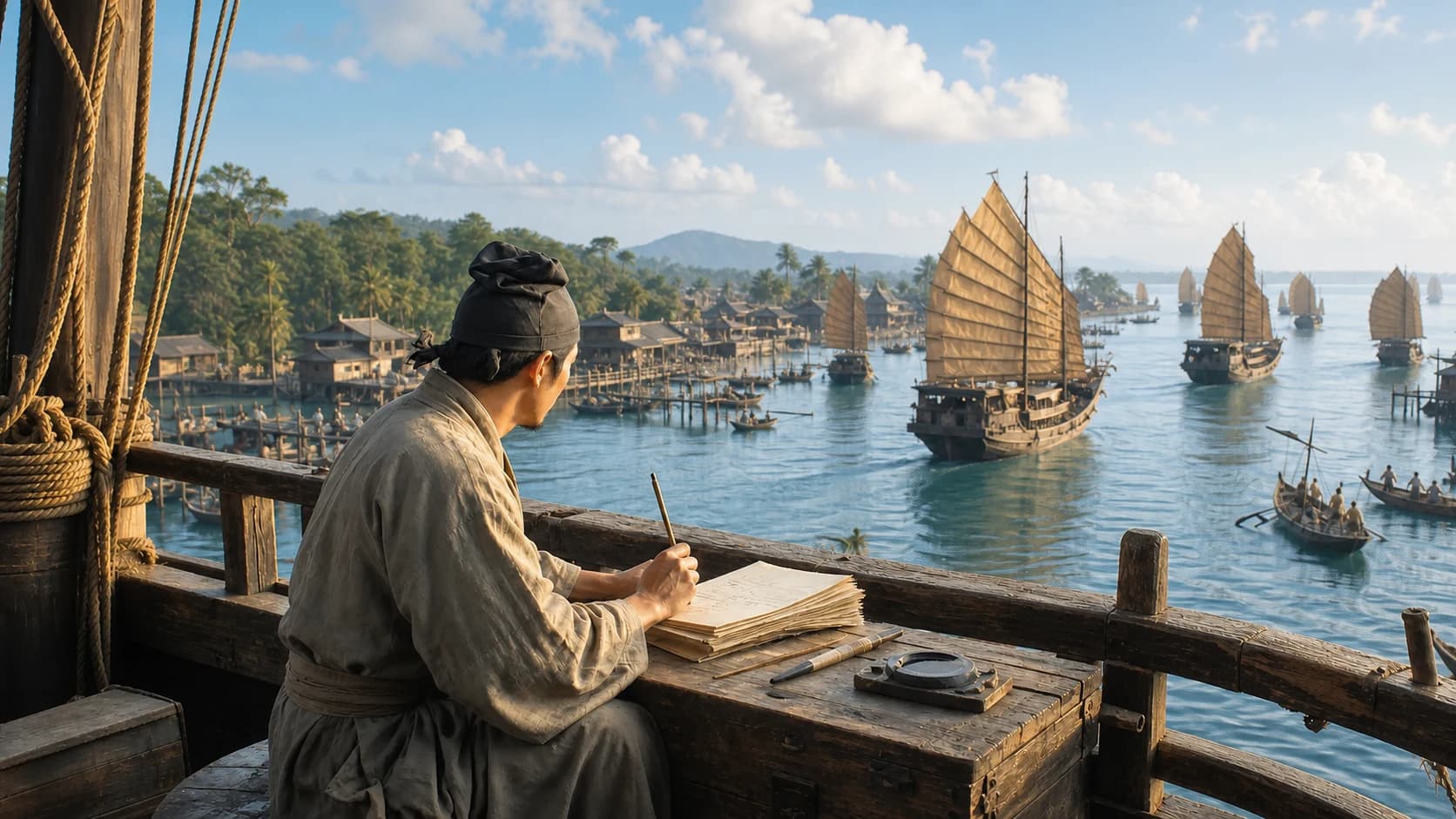
BOOK OVERVIEW
What is Yingya Shenglan?
Yingya Shenglan is Ma Huan’s account of maritime Asia, compiled and expanded from observations made on three voyages with Zheng He’s fleets. Twenty port and polity chapters form its structure, moving through geography, government, religion, clothing, food, law, products, currencies, weights, and trade. Its form is a maritime gazetteer rather than a daily log; some material also reflects companions’ reports and later revision. Firsthand observation, an interpreter’s institutional viewpoint, and a layered transmission history together define the book’s historical value.
“目擊而身履之Ma Huan’s preface · his account of eyewitness method and composition
- Author’s role
- Interpreter
- Formation
- About 35 years
- Structure
- 20 chapters
- Evidence
- Witness + compilation
He sailed, went ashore, and worked across languages.
From the preface of 1416 to the printing tradition around 1451.
A maritime gazetteer organized by ports and polities.
Observation, companions’ notes, and earlier knowledge meet in the text.
OPENING THE TEXT · ORIGINAL CHINESE
Six passages reveal Ma Huan’s scale of observation and language.
The Chinese excerpts retain traditional characters and add modern punctuation, with translations for fluent reading. The first printed edition is lost, and surviving witnesses differ in wording, punctuation, and chapter division.
- 01Method《瀛涯勝覽》 · Ma Huan’s preface
歷涉諸邦,其天時、氣候、地理、人物,目擊而身履之。
TranslationI travelled through many countries, and their seasons, climates, geography, and peoples I saw with my own eyes and experienced in person.
This is the book’s central statement of method, but each chapter still requires a separate judgment about what Ma Huan personally witnessed.
- 02Navigation《瀛涯勝覽》 · Voyage poem
欲投西域遙凝目,但見波光接天綠。舟人矯首混西東,惟指星辰定南北。
TranslationGazing westward, we saw only green waves meeting the sky. Sailors strained to tell east from west and looked to the stars to fix north and south.
The verse preserves the bodily experience of sailors facing open water and fixing direction by the stars.
- 03Picture telling《瀛涯勝覽》 · Java
以紙畫為人物、鳥獸鷹蟲之冊……眾人圍坐而聽之,或笑或哭,便如說平話一般。
TranslationA storyteller unfolded pictures of people, birds, beasts, and insects while explaining the scenes; the audience sat around him, laughing or weeping with the tale.
This unusually vivid performance record is often connected with Javanese picture-telling traditions. The ellipsis marks an excerpt.
- 04Market space《瀛涯勝覽》 · Melaka
王於溪上建立木橋,上造橋亭二十餘間,諸物買賣皆從其上。
TranslationThe ruler built a wooden bridge over the stream, with more than twenty roofed stalls upon it, and all kinds of goods were traded there.
In one sentence, the book turns port commerce into a visible urban space instead of merely listing commodities.
- 05Pepper trade《瀛涯勝覽》 · Calicut
胡椒,山鄉住人置園多種。到十月間椒熟,採摘曬乾而賣,自有收椒大戶收買上官庫盛貯。
TranslationPeople in the hill country planted pepper gardens. When the crop ripened in the tenth month, they picked and dried it; large dealers bought it and stored it in government warehouses.
Cultivation, processing, wholesale purchase, and official storage appear here as one commercial chain—a signature example of the book’s economic observation.
- 06Mutual aid《瀛涯勝覽》 · Hormuz
其國中風俗淳厚,無貧苦之家。有一家遭禍致貧者,眾皆贈以衣食、錢本而救濟之。
TranslationIf a household was reduced to poverty by misfortune, the community gave clothing, food, and capital to help it recover.
This outsider’s summary of mutual aid in Hormuz gains institutional context from local evidence.
TEXTUAL WAKE · 1413–2005
Three voyages and generations of transmission shaped the text we read.
Voyages, additions, prefaces, copying, printing, and modern collation all contributed to its present form.
- 01
Fourth expedition
Ma Huan first sailed as an interpreter, reaching Southeast Asia, Ceylon, Calicut, Hormuz, and other ports.
- 02
Preface and early draft
After returning, he organized observations made by himself and Guo Chongli and composed a preface and voyage poem; the surviving preface also bears signs of later revision.
- 03
Sixth expedition
A second journey through the Melaka–India–Persian Gulf corridor probably supplied material for chapters such as Dhofar and Aden.
- 04
Seventh expedition
Ma Huan travelled with Hong Bao’s squadron to Bengal and then Calicut; whether he personally continued to Mecca remains disputed.
- 05
The text continues to circulate
Material from the final expedition entered the manuscript. The precise date of this stage is a later scholarly reconstruction.
- 06
Preface by Ma Jing
Ma Jing states that Ma Huan joined three expeditions and praises the breadth and integrity of his record.
- 07
Gu Po’s postface and an early edition
The postface is commonly used to date an early printing to about 1451, but no copy of that edition survives.
- 08
Jilu huibian edition
One important surviving Ming edition preserves the main text, preface, poem, and postface while also containing omissions and copying or cutting errors.
- 09
Modern collation and translation
Feng Chengjun’s annotated text, J. V. G. Mills’s English translation, and Wan Ming’s study of a Ming manuscript are major modern points of entry.
A TABLE OF CONTENTS AS OCEAN · TWENTY SHORES
Twenty places form a map of port knowledge.
The sequence follows the book and adds modern identifications; notes distinguish place-name research from detached-squadron routes.
South China Sea and straits
From Champa into the Java Sea and the Strait of Melaka.
- 01Champa · 占城国Central Vietnam
- 02Java · 爪哇国Java
- 03Old Port · 旧港国Palembang region
- 04Siam · 暹罗国Thailand
- 05Melaka · 满剌加国Melaka
Sumatra and offshore islands
Not every historical place-name has a certain modern identification.
- 06Aru · 哑鲁国Northeastern Sumatra
- 07Samudera · 苏门答剌国Northern Sumatra
- 08Nakur · 那孤儿国Often linked to a Nicobar entry
- 09Lide · 黎代国North Sumatran coast
- 10Lambri · 南浡里国Lamuri / Aceh
- 11Ceylon · 锡兰国Sri Lanka
India and island seas
The densest accounts of trade, currency, and social division appear here.
- 12Quilon · 小葛兰国Kollam
- 13Cochin · 柯枝国Kochi
- 14Calicut · 古里国Kozhikode
- 15Liushan · 溜山国Maldives and nearby islands
Arabian Sea and the far west
Chapter order organizes knowledge; squadron routes follow a separate chronology.
- 16Dhofar · 祖法儿国Dhofar
- 17Aden · 阿丹国Aden
- 18Bengal · 榜葛剌国Bengal
- 19Hormuz · 忽鲁谟斯国Hormuz
- 20Mecca · 天方国Mecca
Form and genre
Twenty port chapters turn voyage experience into a maritime gazetteer.
Yingya Shenglan divides maritime experience into country chapters: first position and sailing time, then rulers, clothing, religion, food, marriage and funerals, punishment, products, currency, measures, and trade. Some chapters occupy less than a page; major entrepôts such as Java and Calicut receive much longer treatments.
The structure expands attention from arrival to the workings of port society. For a modern reader, the book resembles an Indian Ocean port dossier written by an interpreter. Chapter order organizes knowledge; reconstructing an actual itinerary requires separate squadron records.
In his preface Ma Huan says that he saw and experienced the countries in person, then arranged their peoples, customs, products, and territories after returning home. That statement begins the source analysis; voyage records, companions’ reports, and textual layers clarify the eyewitness basis of each chapter.
A port in cross-section
The Calicut chapter sets a fifteenth-century Indian Ocean market in motion.
In Calicut, Ma Huan notices government and administration, religious communities, dietary rules, currency and weights, pepper cultivation, gem trading, and the arrival of foreign ships. Together these details form a multilingual and multireligious commercial city.
He pays particular attention to procedure: how goods were priced, who handled scales and weights, and how cargo from visiting ships was supervised. His work as an interpreter placed him close to negotiation and translation. His Muslim background may also have helped him recognize Islamic communities around the Indian Ocean, while shaping how he divided populations and explained religion.
Zheng He’s fleets entered a sea already connected by monsoons, merchant networks, and local politics. Melaka, Calicut, and Hormuz had mature port systems in which the Ming armadas anchored, provisioned, traded, and communicated.
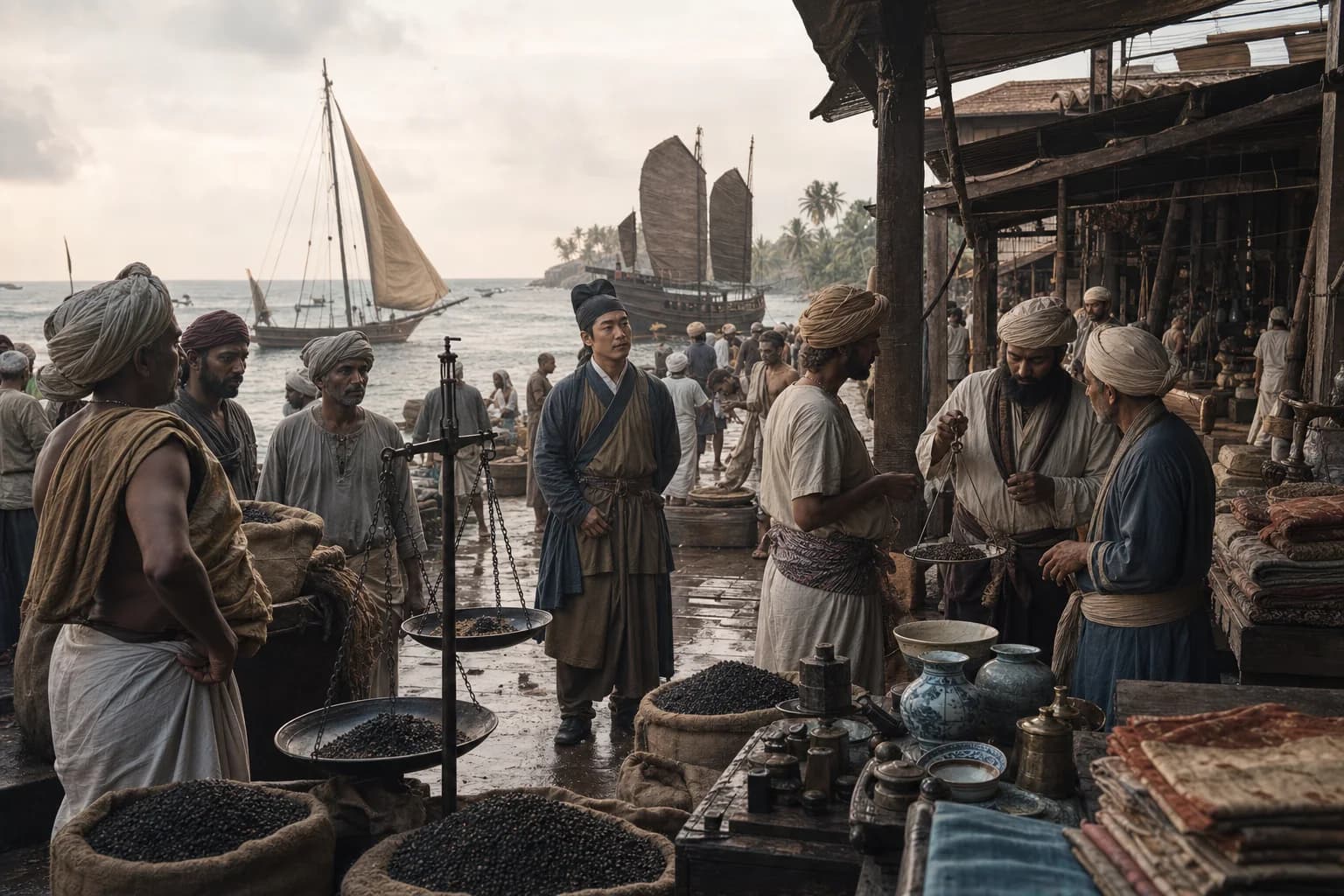
Pepper, scales, textiles, and several vessel traditions turn the Calicut chapter’s trading procedures into a port scene.
Limits of eyewitness testimony
Ma Huan travelled widely, but the claim that he saw all twenty places must be tested chapter by chapter.
Modern research generally accepts that Ma Huan joined the expeditions of 1413–1415, 1421–1422, and 1431–1433. The first carried him through major ports including Champa, Java, Old Port, Melaka, Samudera, Ceylon, Calicut, and Hormuz. On his last voyage he went with Hong Bao’s squadron to Bengal and then Calicut.
Mecca is the best-known dispute. Drawing on textual detail, Gu Po’s postface, and Ma Huan’s Muslim identity, Mills considered him a likely member of the mission that sailed onward from Calicut; J. J. L. Duyvendak and others remained unconvinced. The chapter’s eyewitness attribution depends on this combination of indirect evidence.
Equally important, Ma Huan did not visit East Africa. The book illuminates the edge of the East Africa–Arabia–India trading world, but it should not be presented as his travelogue of Mogadishu or Malindi. Squadron reports, companions’ notes, earlier writings, and later revision together produced the scope of the surviving text.
Layers of transmission
A 1416 draft reached the present through two later voyages and generations of transmission.
Ma Huan composed a preface and an early draft in 1416, then joined two further expeditions and continued adding material. The surviving preface uses a posthumous title granted to the Yongle emperor only in 1424, itself evidence of later revision. An early edition from about 1451 is lost; access now depends on later Ming printed copies, manuscripts, and collectanea.
Mills grouped the principal witnesses into C, S, and K lines and found many variants, omissions, and contradictory readings. Zhang Sheng’s 1522 recasting compressed Ma Huan’s relatively plain prose into a more literary style and was once mistaken for the original. A variant can change a place-name, an animal, or even whether a port used Chinese copper cash.
For that reason, dating the book ‘1416–c. 1451’ is more honest than assigning a single publication year: the first date begins a process of writing and expansion, while the second marks a textual node suggested by the postface and printing tradition. Readers of modern editions should also distinguish the base text from the interventions of collator and translator.
How to read it
Treat it as situated observation—with language, interests, and bias.
Ma Huan is often strongest in concrete details that can be checked against other evidence: the relative position of ports, sailing times, commodities, weights, money, food, and market practice. Legends, strange animals, punishments, and sweeping descriptions of whole populations require comparison with local sources, archaeology, and other travellers.
His vocabulary belongs to a Ming tributary order. Accounts of rulers offering tribute, emperors granting gifts, and distant peoples receiving civilizing influence are not neutral terms of international relations. His categories of people, complexion, and religion likewise carry fifteenth-century Chinese assumptions and the author’s own frame. Preserving the original wording does not require adopting its judgments.
The best reading keeps three questions together: what did Ma Huan observe, how could he know it, and why did he write it this way? That approach prevents Yingya Shenglan from collapsing into a cabinet of curiosities—or being elevated into an error-free imperial navigation report.
EVIDENCE LAYERS
Four uses, from port observation to textual dispute
Port life and exchange
Products, currencies, measures, clothing, food, market procedures, and sailing relationships form the book’s densest layer of observation.
Historical place-names and institutions
Transliterated names, royal titles, religious vocabulary, and social categories cross several languages and are easy to misidentify from a single edition.
The exact size of the treasure ships
The largest-ship debate draws on the Ming History, shipbuilding records, archaeology, naval architecture, and textual history. Yingya Shenglan contributes chiefly to the study of overseas societies and ports.
Whether Ma Huan personally reached Mecca
The book contains a Mecca chapter, but scholars do not fully agree about who travelled there with the detached squadron or mission.
READING PATHS · EDITIONS
Editions, base texts, and reading purposes
Chinese collation, English reading, and online search each have an entry point with its textual basis and best use.
J. V. G. Mills · The Overall Survey of the Ocean’s Shores
The fullest English entry point, with a long introduction, maps, notes, and nautical appendices. Some language and conclusions should still be read in the context of scholarship published in 1970.
Wan Ming · Ming chaoben Yingya Shenglan jiaozhu
A major Chinese collation centered on a Ming manuscript and the wider version system; especially useful for checking variants and later scholarship.
Feng Chengjun · Yingya Shenglan jiaozhu
A foundational modern Chinese annotated edition and an important base for a great deal of later Chinese and international research.
Chinese Text Project
Useful for finding chapters and phrases in the Chinese text. Formal citation should return to an edition that identifies its base witness and collation principles.
FURTHER QUESTIONS
Frequently asked questions about Yingya Shenglan
Who wrote Yingya Shenglan?+
The work is attributed to Ma Huan, courtesy name Zongdao, from Kuaiji. He served as an interpreter on the fourth, sixth, and seventh expeditions associated with Zheng He. Guo Chongli contributed observations and notes, but the surviving prefaces and textual tradition identify Ma Huan as the principal author.
What does Yingya Shenglan describe?+
The book is organized around twenty ports and polities, describing location, government, religion, clothing, food, marriage and funerals, punishment, products, currencies, measures, trade, and relations with the Ming court. It is not a continuous dated ship’s log.
When was Yingya Shenglan written?+
Ma Huan dated his preface and early draft to 1416, then added material after voyages in 1421–1422 and 1431–1433. About 1451 is conventionally treated as an early printing point, so ‘1416–c. 1451’ better describes the book’s formation.
Is the surviving text Ma Huan’s original manuscript?+
No. The early edition from around 1451 is lost. The work survives through later Ming printed copies, manuscripts, and collectanea that modern editors compare and collate.
Did Ma Huan personally visit all twenty countries?+
That cannot be assumed. Strong evidence supports firsthand experience at many major ports, but individual chapters may also contain companions’ reports, earlier writing, and later editorial additions. The contents list is not a continuous personal itinerary.
Did Ma Huan reach Mecca?+
The book contains a Mecca chapter, and Gu Po’s postface plus several details support an eyewitness hypothesis. Mills regarded a visit as probable, while other scholars remained cautious. It is best presented as an open attribution rather than a settled fact.
How does Yingya Shenglan differ from Xingcha Shenglan?+
Both were written by participants in the Ming expeditions. Yingya Shenglan concentrates on twenty ports and is usually more detailed; Xingcha Shenglan covers a wider range but draws more heavily on copied and earlier material. Any close comparison must identify the editions being used.
Can Yingya Shenglan prove the size of Zheng He’s treasure ships?+
Not by itself. Ship dimensions must be evaluated through the Ming History, shipbuilding records, archaeology, naval architecture, and version history. This book’s distinctive value lies in its observations of overseas societies and ports, not precise hull engineering.
RESEARCH SOURCES
Texts, editions, and scholarship
Original text, version catalogues, collection records, and specialist studies appear in separate layers, with disputed claims labelled accordingly.
- 01Yingya Shenglan: searchable Chinese text ↗
Chinese Text Project
Chapter structure and searchable original text - 02Yingya Shenglan: punctuated Chinese text ↗
Wikisource
Online reference used to check the quoted passages; formal citation should identify a critical edition - 03Ying-yai Sheng-lan: The Overall Survey of the Ocean’s Shores ↗
Hakluyt Society / Cambridge University Press, 1970
J. V. G. Mills’s translation, introduction, notes, and appendices - 04Bibliography of the Hakluyt Society Extra Series ↗
Hakluyt Society
Bibliographic record and scope of the 1970 edition - 05Ming chaoben ‘Yingya shenglan’ jiaozhu ↗
Archipel / Persée
Review of Wan Ming’s 2005 collation of a Ming manuscript - 06Ying ya sheng lan / Ma Guan ↗
Smithsonian Libraries and Archives
Catalogue record for a manuscript copy dated approximately 1650–1750 - 07Ma Huan, Yingya shenglan ↗
Ethnic Identity in Imperial China · Online Sourcebook
Travel writing, ethnic observation, and comparison with other expedition accounts - 08China and Calicut in the early Ming period ↗
Journal of the Royal Asiatic Society / Cambridge University Press
Critical research on Calicut’s relations with Ming China and the Chinese sources - 09Zheng He’s seventh expedition to Melaka ↗
Chinese Academy of Social Sciences
Chinese research on Melaka, the voyage, and Ming textual evidence
The scene illustrations draw on the book’s ports, commodities, and trading procedures.Read our editorial and corrections policy