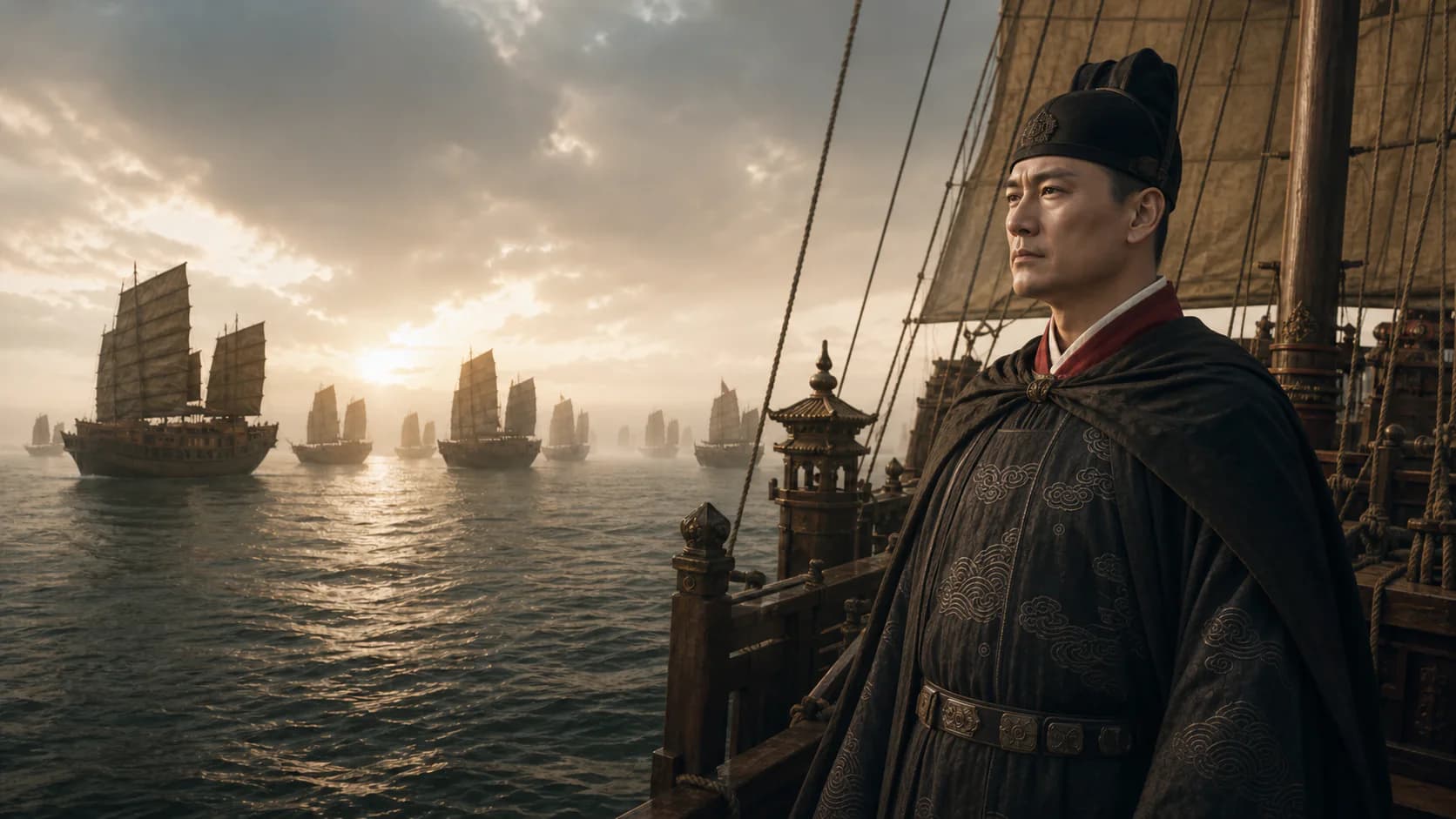
Opening portrait
Who was Zheng He?
Zheng He was a Ming court eunuch, diplomat and commander. Between 1405 and 1433, he, Wang Jinghong and other officers led seven state-sponsored voyages through Southeast Asia and the Indian Ocean toward the Persian Gulf, Red Sea and East African coast. These were not solitary voyages of discovery: diplomacy, tributary exchange, trade, military display and the management of maritime order travelled together in a vast organization.
- Principal activity
- Seven voyages, 1405—1433
- Other senior commanders
- Wang Jinghong and others
- Core waters
- The South China Sea and Indian Ocean
- Major hubs
- Calicut, Melaka and Hormuz
Defining moment
1405–1433 · Seven voyages
Seven times, he carried an imperial fleet to the far side of the monsoon world.
From the lower Yangtze, Zheng He’s fleets crossed the South China Sea, moved through Melaka and the Indian Ocean, and reached Arabia and East Africa. The treasure ships were astonishing in scale; greater still was the repeated orchestration of hundreds of vessels, tens of thousands of people, shifting monsoons and distant ports across nearly three decades.
Life at a glance
Zheng He · career timeline
Key dates connect biography, expeditions and later consequences across a career longer than any one ‘discovery’.
- 01
The first fleet sails
A Ming imperial order sends a large expedition from China's southeast coast into South China Sea and Indian Ocean networks.
- 02
The fourth voyage reaches the Persian Gulf
The route extends beyond the fleet's earlier circuit to Hormuz and prepares later western detachments.
- 03
Voyages range farther west
The fifth and sixth expeditions intensify the movement of envoys toward Arabia and East Africa.
- 04
The seventh voyage closes the sequence
The final major expedition revisits Calicut and other hubs after nearly three decades of state fleet operations.
The life in sequence
Follow the voyage from its beginnings to its aftermath.
These chapters follow the order of a life and its expeditions, and are designed to be read as one continuous narrative.
Each voyage began with a court order and thousands of coordinated tasks
The Ming court mobilized personnel, documents, gifts and trade goods. Zheng He and Wang Jinghong held senior command, while pilots, interpreters, physicians, artisans and soldiers kept ships moving and missions functioning. Diplomacy and transport shared deck space with military force.
Calicut remained a major Indian Ocean hinge. On later voyages, detachments continued toward Hormuz, the Arabian Peninsula and ports in East Africa. The most distant calls were parts of a branching fleet system, not necessarily places visited by Zheng personally.
A large fleet survived through division of labour
Different ships carried horses, grain, troops, water and senior envoys. Every impressive hull depended on provisioning, medicine, spare rope and timber, harbour negotiations and communication across a fleet at sea.
Inscriptions, court records and writings by participants reveal this organization, but famous maximum estimates for the treasure ships remain debated. One celebrated dimension should not be mistaken for the size of every vessel.
Diplomacy and exchange travelled with coercive power
The fleet defeated Chen Zuyi's forces at Palembang and later carried the Sri Lankan ruler Alakeshvara to the Ming court after armed conflict. These episodes show that the voyages did not simply offer peaceful gifts around an empty ocean.
They entered ports with their own rulers, merchants and monsoon knowledge. Ming power could alter local relationships, while local choices determined access, alliance and resistance. The voyages were an encounter between a state fleet and a mature Asian maritime world.
Beyond the voyage
Some histories come into focus outside the timeline.
Local societies, navigation, surviving records and later consequences each open a separate path into the story.
Records and evidence
How do the sources support these claims?
Confirmed facts, disputed questions and common misconceptions appear as distinct parts of the record.
Seven voyages formed a long state project
Inscriptions, participant accounts and official records broadly establish their dates, core ports and diplomatic missions, though details sometimes differ.
Ship dimensions and personal itineraries remain uncertain
Maximum treasure-ship figures and whether Zheng joined every distant detachment are debated; the largest claim never describes the whole fleet.
The voyages entered an inhabited ocean
Monsoon routes, port cities and transregional trade already connected Asia and Africa. Ming military power met societies with their own knowledge and objectives.
Questions to carry forward
Common questions
How many voyages did Zheng He make?
The conventional count is seven state expeditions between 1405 and 1433. Their departures, detachments and ports were not identical.
How far did the voyages reach?
The fleet system reached East Africa, ports toward the Red Sea and the Persian Gulf. Records do not always show whether Zheng himself or a detached squadron made each distant call.
Was Zheng He searching for an unknown continent?
No. His fleets operated mainly through established South China Sea and Indian Ocean routes on diplomatic, commercial and military assignments.
Why did voyages on this scale end?
Court priorities, cost, northern military pressure and changing approaches to tribute and maritime policy all reduced support. There was no single switch that simply banned the ocean.
Sources
Sources and further verification
The institutions below support the account; disputed numbers, place identifications and claims of ‘first discovery’ retain their uncertainty.
- Group I: Zheng and XiyangNational Museum of China
- Zheng and Lower Ocean and Chinese ancient navigation technologyInstitute of Natural Sciences History, Chinese Academy of Sciences
- Zheng and Lower Ocean: Light from the history of human civilization Fai. SealNational Office for Philosophy Social Science Work
- The Chinese Section of the Sea Route of the Silk RoadsUNESCO World Heritage Centre
Age of Seas editorial research distinguishes documentary facts, scholarly disputes and narrative judgments.Editorial standards and corrections ↗