INPUT
→Receive declaration
Register vessel, master, route, manifest and importer entries before discharge begins.
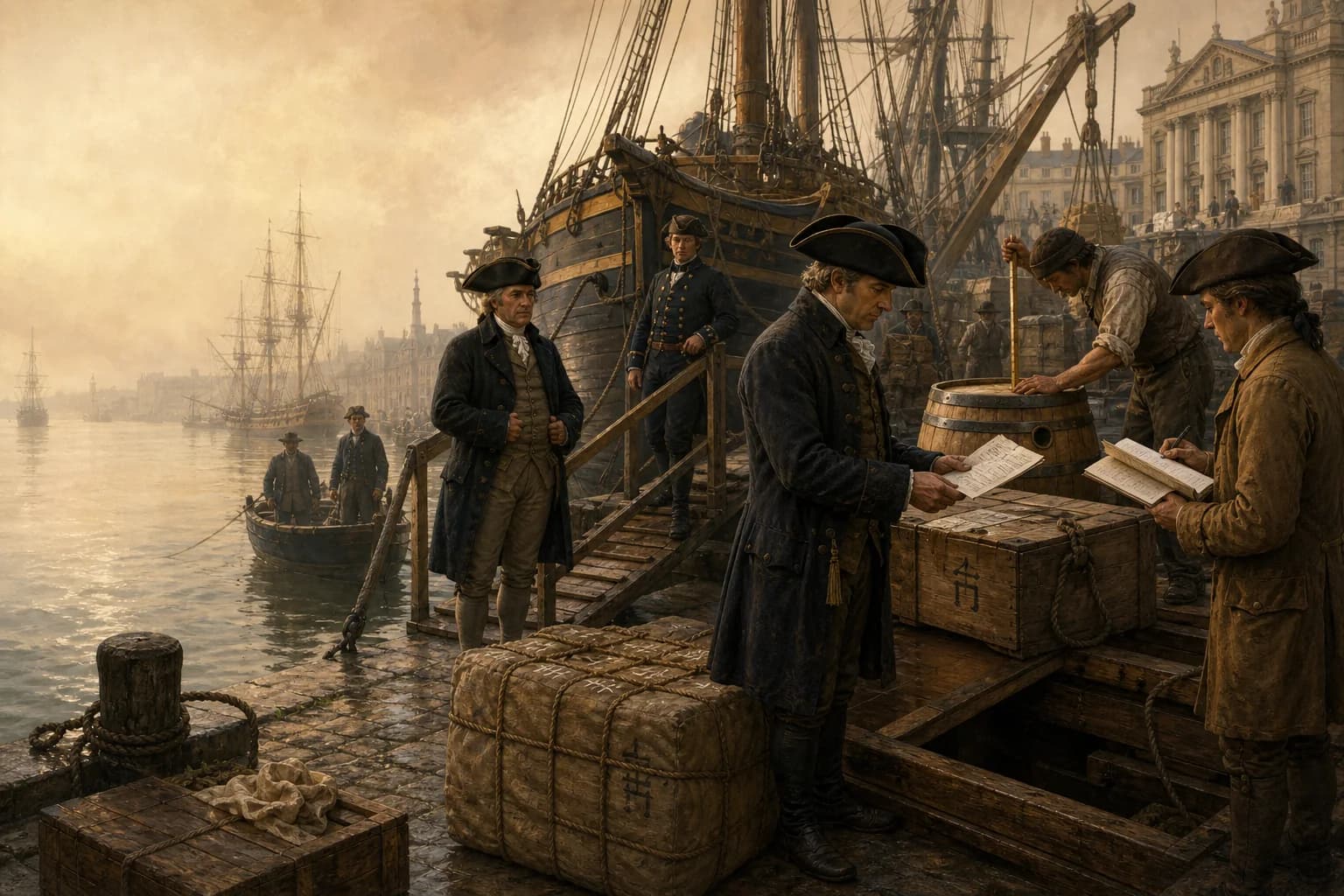
A real Age of Sail career dossier · 25
Customs Officer · Searcher · Inspector · Landing Waiter
The official who turns manifests, invoices and packages into auditable duty and lawful release.
Customs officer names a port-revenue occupation group, not one timeless office. A Collector or Customer received duties and kept the principal account; a Controller or Naval Officer supplied an independent check; Surveyors, Searchers, Inspectors, Landing Waiters, Weighers and Gaugers inspected ships, supervised discharge and measured goods. A master first reported and submitted a manifest. Importers then entered goods with invoices and bills of lading. Officials reconciled those papers with package marks, number, weight, quality and actual landing before issuing a delivery permit after duty, bond or warehousing. They could seize unreported or prohibited goods, but condemnation normally required legal process. Revenue cutters and other preventive forces, not a desk officer alone, performed much offshore pursuit.
Information arrives, judgment forms, and work passes on through a complete watch.
Register vessel, master, route, manifest and importer entries before discharge begins.
Compare papers with capacity, marks, quantity, weight, measure and condition.
Calculate duty and arrange bond, warehouse, transfer, drawback or appraisal.
Issue landing and release or inventory a seizure for independent adjudication.
Receive manifests, entries, invoices, bonds and duties while preserving parallel books and numbered permits.
Board, guard the hatch, reconcile marks and supervise each parcel landed under permit.
Use boats, shore patrols and intelligence against illicit transfers, usually as a separate field force.
Join manifest, invoice, bill of lading, entry, permit and warehouse receipt into custody.
Identify class, packing, marks, weight, capacity, quality, origin and common concealment.
Distinguish ad valorem from specific duty and know when an appraiser, weigher or gauger is required.
Search, seal, seize and hold under law while preserving independent review and appeal.
Institutions, experience, patronage, and opportunity shaped each person’s route.
Learn local tariffs and quay procedure through copying, guarding and supervised landing.
Board vessels, control hatches, identify cargo and preserve evidence.
Direct inspectors and decide measurement and difficult valuation questions.
Manage revenue, staff, audits, litigation and central returns.
English port books distinguish the Collector or Customer, Controller, Searcher and later Surveyor. One received money and recorded trade, another kept a parallel check, the Searcher examined goods and made a warrant, and the Surveyor reviewed execution. Large eighteenth- and nineteenth-century ports added landing waiters, tidewaiters, inspectors, weighers, measurers, gaugers, clerks and warehouse keepers.
American collection districts after 1789 similarly divided Collector, Naval Officer and Surveyor, with inspectors under survey. Other empires, colonies, free ports and municipal customs used different names. This dossier uses Customs Officer for the core job of turning ship-and-cargo evidence into revenue and release status; it does not let one character collect money, inspect goods and judge the same seizure.
Within a stated time, an arriving master reported vessel, origin, calls, tonnage and cargo manifest to the collector, surveyor or equivalent and swore to its truth. American acts of 1789 and the 1790s placed the manifest before a landing permit. English port books long recorded ship, master, merchant, goods, movement and duties paid.
A ship-level manifest did not replace the entry of each importer or consignee. The owner could also produce original invoice, bill of lading, package marks and numbers, quantity, quality and cost. Officials first fixed who declared what and when, then decided whether a mismatch meant clerical error, sea damage, short landing or concealment.
An inspector or landing officer could remain aboard after arrival to supervise the opening of hatches and each parcel discharged. The United States collection act of 1799 prohibited landing without a written collector and naval-officer permit and required the inspector's book to record consignee, permit, marks, numbers, kind and description.
Inspection was therefore more than opening random boxes. Manifest, entry, invoice and bill of lading were linked, then crate, cask, bale and bulk marks, seals, condition and destination checked at the hatch. Stevedores controlled safe lifting, clerks supplied commercial tallies and customs preserved regulatory custody. Night lightering, altered marks or premature opening broke that chain.
Tariffs could be ad valorem or specific by number, weight, capacity or commodity. Cloth type and length, cask capacity and spirit strength, sugar or tobacco weight and vessel tonnage demanded different expertise. Major ports employed appraisers, weighers, measurers and gaugers rather than asking one collector to value everything by instinct.
Missing invoices, voyage damage or unstable currency could trigger sworn appraisal. The American 1799 act let collector and importer each choose a merchant for damaged or uninvoiced goods; Treasury instructions in 1792 addressed how depreciated French assignats distorted invoice value. Valuation is a contest of evidence and rules, not a perfect hidden price.
In the English example, the Controller kept a second record without receiving payment, the Searcher warranted examination and the Surveyor reviewed it. In the United States, the Naval Officer checked collector accounts and manifests while the Surveyor directed inspectors. Details differed, but declaration, entry, physical tally, receipt and permit had to reconcile.
Much customs fraud lived on paper: undervaluation, misclassification, reused permits, fictitious re-export or one bale deleted between quay book and ledger. Corrections, receipt numbers, seals and handover times mattered. Hamilton's 1792 manifest circular also required allowance for misunderstanding, inadvertence or hurry, distinguishing error from fraud.
Imported goods did not always pay cash and enter market at once. Duty might be secured by bond, goods held under customs control, transferred to another delivery port or re-exported in original packages for a drawback. Custom-house records therefore preserved entries, bonds, warehouse returns, permits, clearances and re-export certificates.
Each transition depended on stable marks, numbers, quantities and seals. Warehoused did not mean abandoned; unpaid did not itself mean smuggled; drawback was not an informal refund. A keeper held the goods, a merchant bore delay and damage, and customs controlled removal. Those states make lawful trade a game of route, cash and time.
Warnings included unmanifested packages, false bottoms, unlicensed night discharge, coastal boats collecting goods, false coastwise certificates, undervaluation, prohibited cargo and quantity inconsistent with capacity. An officer could search, seal or seize under law and record packages, witnesses and sequence.
Seizure was not automatically guilt or forfeiture. An owner might prove duties paid, mis-shipment or authority exceeded. Exchequer, admiralty, district or another competent court commonly determined condemnation, penalty and sale. The file had to prove place, custody, law and notice or a celebrated seizure could collapse as unlawful detention.
A tidewaiter boarded with the tide, riding officers watched remote coasts, and customs boats or revenue cutters intercepted transfers. Britain had a small anti-smuggling fleet by the late seventeenth century and expanded it during the eighteenth. American collectors later administered relationships with revenue cutters. Chase, navigation, arms and reinforcement belonged to teams, not a custom-house clerk transformed into a universal fighter.
Night weather, armed gangs, local protection and reprisals made the work dangerous. High duties on tea, spirits and tobacco financed bribery and intimidation and exposed innocent coastal residents to suspicion. Paired searches, staff rotation, public seizure accounts, conflict controls and defined jurisdiction limited both corruption and force.
Customs governed cross-border goods, tonnage, duties, prohibition and vessel papers. Excise commonly taxed selected domestic production or consumption. Quarantine controlled health contact and pratique. The harbourmaster managed anchorage, berth and traffic. One historical office might combine tasks and a collector might sign a health bill, but each power retained its legal basis.
A ship could hold pratique yet remain detained for a cargo discrepancy, or pay duty and still lack a berth. A good officer did not maximize penalties; he made like facts receive like treatment, gave a route to correction and appeal, and preserved each seizure for independent review. The gameplay comes from scarce hands, incomplete evidence and competing pressure—not arbitrary confiscation.
career.customs-officer
Received vessel and importer declarations, reconciled manifests, invoices and bills of lading with actual goods, supervised landing, assessed or checked duties, controlled bonds and warehouses and documented suspicious or prohibited cargo.
Usually not. Collectors received revenue, Searchers examined goods and Surveyors supervised or checked inspection. Controllers, Naval Officers, Inspectors and Landing Waiters added further separation, with names varying by system.
A manifest summarized the vessel's cargo for the master, while a bill of lading recorded receipt and carriage for a particular shipper. Customs reconciled both with importer entry, invoice and packages.
No. Duties could turn on value, weight, capacity or class. Appraisers, weighers, measurers and gaugers supplied specialist evidence, and sworn merchants could appraise disputed goods.
Officers could seize under law, but final forfeiture commonly required a court or prescribed proceeding. Seizure secured evidence and property; it did not by itself prove guilt.
Customs controlled duties, prohibition and cargo legality. Quarantine controlled health contact, detention and pratique. They exchanged documents and sometimes shared officers, but neither clearance replaced the other.