INPUT
→Frame the collection
Set priorities and containers from sponsor, landfall, season, space and preservative.
A real Age of Sail career dossier · 37
Voyage Naturalist · Botanist · Natural-History Collector
The specialist who turned a brief landing into durable evidence with place, number and verifiable object, then escorted it through an ocean voyage.
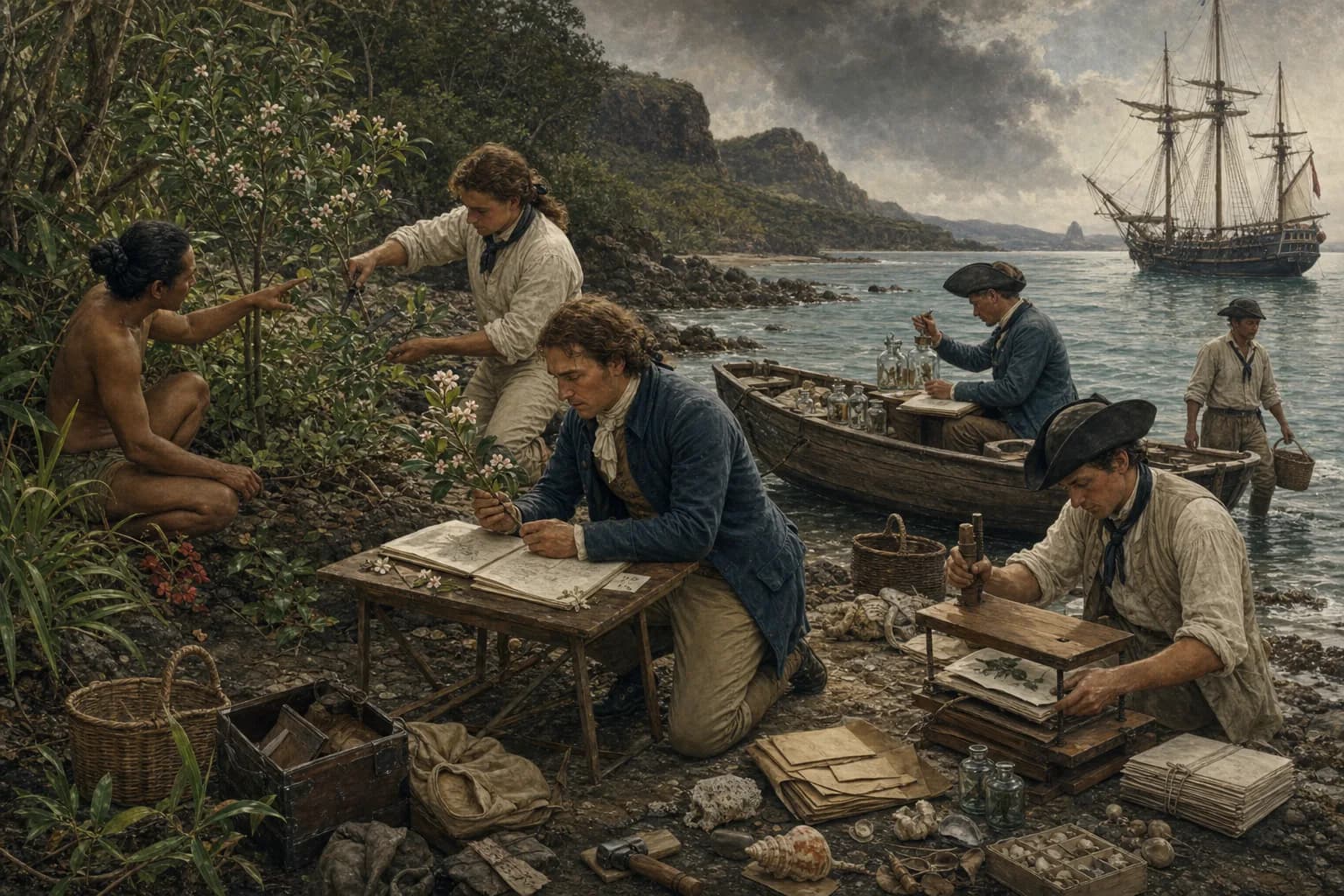
A voyage naturalist in the Age of Sail was neither an ordinary seaman's rating nor always a salaried shipboard office. Some were self-funded gentlemen, some appointed by crown, navy, academy, museum or garden, and others served formally as surgeon, gardener, clerk or attendant while doing much of the collecting. Their occupational core was to set priorities before each landing, observe habitat with a shore party, gather flowering and fruiting plants, seed, insects, shells, fish, birds, minerals or soils, give each lot a field number, and keep specimen, label, journal and image connected. Plants were commonly pressed between paper, re-papered and dried in sun or near a stove. Objects whose colour, form or behaviour would vanish required immediate description and drawing; some animal material went into spirits. Before the Wardian case developed after 1829, live plants struggled against spray, darkness, scarce fresh water and competition for deck space. The real product was not a cabinet of marvels but a chain of evidence stating who encountered what, where, when, in which habitat, under which local name or use, followed by a verifiable specimen that could be accessioned, compared, named, engraved and published. Banks and Solander's Endeavour party reveals a team—naturalists, field assistants, local knowledge holders, artists, clerks, sailors and later curators—even when credit collected around a few patrons.
Information arrives, judgment forms, and work passes on through a complete watch.
Set priorities and containers from sponsor, landfall, season, space and preservative.
Record habitat and local knowledge, collect duplicates and bind material to field number.
Press, re-paper, jar, seal, disinfest and triage through storm, illness and spatial conflict.
Reconcile shipment, compare collections, identify, distribute duplicates and align plates with text.
A patron paid for specialists, artists and servants around private collection, reputation and publication.
Official instructions sought materials useful to science, navigation, commerce and empire.
Centered seed, living plants, herbarium duplicates, accession records and a named institution's needs.
Read habitat, season, variation, behaviour and diagnostic structure within a short landing.
Keep field number, ticket, journal, drawing, jar or sheet and shipment list aligned.
Choose container, drying and triage for plant, insect, fish, bird, mineral, seed and living stock.
Compare literature and collections, separate novelty from duplicate, and record local and team contribution.
Institutions, experience, patronage, and opportunity shaped each person’s route.
Build foundations in local botany, medicines, anatomy, specimens or museum collections.
Master numbering, pressing, jarring, packing and landing discipline so material returns usable.
Own collecting brief, description and taxonomy while coordinating artist and crew.
Standing depended on accession, comparison, publication and accurate credit.
Seventeenth- and eighteenth-century natural history included plants, animals, shells, insects, minerals and fossils, often climate, soil and human-made objects too. An expedition might appoint a botanist or naturalist, or an educated surgeon, chaplain, officer or traveller might observe on the side. Assistants climbed, dug, trapped, carried, pressed and changed wet paper yet often vanished from a title page. Smithsonian research on Bougainville notes that eighteenth-century expeditions routinely valued astronomers while a professional naturalist remained unusual, especially where a surgeon supplied some natural-history knowledge.
Endeavour was a rich exception, not a universal staffing model. Joseph Banks paid his own way and brought Daniel Solander, two artists, a secretary and four servants. Banks was patron and collector; Solander brought Linnaean training and British Museum practice; Sydney Parkinson and Alexander Buchan made images; crew and shore parties supplied mobility. One person could cross functions, but authority, pay, credit and exposure remained distinct.
Sponsors issued instructions to seek plants useful for food, medicine, dye, timber or cultivation, secure seeds and living stock, and record soil, climate, abundance and local uses; birds, fish, minerals and curiosities entered too. Cook's secret instructions expressly requested soil, produce, beasts, birds, fish, minerals, seed and specimens for examination. Science, imperial rivalry and commercial utility occupied the same order, so the voyage cannot be reduced to disinterested discovery.
The naturalist entered cages, baskets, spades, knives, paper, boards, cord, jars, spirits, wax, labels, pigments and exchange goods in the stores, then negotiated cabin space, boat time and protection with the captain. Plans settled ownership of duplicate sets, exchange or sale rights, Crown, museum or patron claims, and what to save after an unscheduled landfall. Classification skill cannot bring home a collection without space and preservative.
A landing might last only between tides. The party divided beach and tide pool, stream valley, forest edge, wetland or high ground; assistants carried baskets and boxes while sailors guarded the boat and fixed a return signal. A useful note recorded date, place, habitat, growth form, abundance, flower or fruit, colour, smell, associates, local name and use. Colour, odour and behaviour would not survive in a dried specimen.
Residents, guides, fishers, hunters and healers knew season, location, danger, processing and names. Information and samples came through gift, trade, hire or diplomacy, and sometimes through colonial force and unequal permission. Responsible history identifies the knowledge source and original name, distinguishes first European scientific description from first human knowledge, and treats refused access, misunderstanding, covert collecting and seizure as operational events.
Each item or lot received a field number repeated on temporary ticket, field book and final label. The label joined collector, date, locality and habitat to description and local information. A ticket moved during overnight re-papering could attach a false place to a perfect plant; ink lost in spirits reduced an animal to a curiosity without provenance.
Naturalists took duplicates: flower, fruit, leaf and stem, or several individuals displaying variation. Sets went to patron, museum and specialists and survived mould, wreck or divided transport. More was not automatically better—wet paper, jars, weight and curatorial time saturated. A field leader triaged novelty, complete structures, representative variation, preservation odds and remaining hold space.
Kew describes a herbarium method close to that used by Banks and Darwin: select material preferably with flower and fruit, arrange both surfaces, press it in paper and dry it in sun or near a stove. Humid climates demanded dry replacement sheets, airflow and mould and insect control. Thick fruits, bulbs and fleshy tissue were split, separately dried or preserved another way. Specimen, field label and catalogue entry were mounted together only later.
Seed had to mature, dry, remain separated and resist rodents. Living plants required light, water, air, restraint and a claim on fresh water. A Kew inward record for 1793 lists three baskets arriving entirely dead. Nathaniel Bagshaw Ward's observation came in 1829 and trials followed in the 1830s, so a 1768 party used pots, boxes, seed, cuttings and labour—not the later self-cycling glazed case.
Shell, coral, insect, fish, bird and mammal demanded different treatment. Dryable matter was cleaned, posed, wrapped or boxed; soft animals and some anatomy entered alcohol or spirits, with strength, stopper, wax seal, evaporation and fire managed. A large animal might yield skin, skeleton, stomach contents or selected anatomy rather than travel whole. Minerals needed fresh breaks and geological context, then paper, cloth or boxes so their weight did not crush biology.
A preparator's craft mattered as much as identification. Knife, needle, historic pesticides and preservatives threatened health; spirits consumed stores and leaked; heat rotted tissue; rats and beetles ate skins and plants. This dossier does not turn hazardous recipes into instructions. Its system is choosing container, isolating infestation, topping up, resealing, and deciding which crate to save during casualty.
A cut plant wilted, fish and birds changed colour, and no press preserved movement. The Natural History Museum records Parkinson making careful outlines and colour notes for later finish; he drew more than four hundred plant studies in Australian waters. A naturalist called attention to floral parts, leaf order, gill, fin, bill or foot, while the artist translated three-dimensional form into comparable views.
The occupations remained separate even where one person combined them. The naturalist owned the observation question, specimen identity, description and classification; the draughtsman owned proportion, view, colour annotation and plate-ready image. Bad numbering could add the wrong colour to an outline or combine two specimens into a species that never existed. The next dossier treats voyage draughtsmanship in full; here it remains an evidence-chain partner.
In port the party collected almost daily, then worked late changing paper, cleaning, numbering, writing temporary descriptions, replenishing fluid and drawing. Long passages allowed fuller Latin descriptions, comparison with books and catalogue work. The naturalist needed dry space, stove time, boat crew and water from the captain while keeping presses, jars and living plants clear of guns, sails, provisions and emergency work. Science did not automatically outrank ship safety.
Reef, drowning, exposure, disease, poison, conflict and ordinary ship illness set the risk. Solander collapsed during cold collecting in Tierra del Fuego while two companions died; after Endeavour visited Batavia, dysentery and malaria killed Parkinson, Sporing, Reynolds and others. A lost field book, the death of the only identifier or a flooded label chest could strip months of material of context.
After crates landed, curators reconciled shipment list and field number, disinfested and mounted dry specimens, replenished spirits and sent duplicates to specialists. Solander continued cataloguing at the British Museum and in Banks's collection. Roughly thirty thousand specimens and about thirteen hundred species new to European science did not turn themselves into a book. Description required comparison with collections and literature, a judgment of novelty, a Latin diagnosis and a stable reference specimen.
Reward included official salary, voyage allowance, patronage, collection sale, garden or museum post, subscription publication and social standing—or little money and no credit. Banks and Solander prepared more than seven hundred plates and Latin descriptions but did not complete the Florilegium in their lifetimes. Jeanne Baret collected as Commerson's assistant while gender exclusion constrained role and recognition. A historical system records collector, identifier, author, artist, patron, local source, owner and publisher separately instead of crediting every find to the expedition commander.
career.voyage-naturalist
They observed plants, animals, minerals and habitat ashore; collected and numbered evidence; recorded place, form, local name and use; and organized preservation, cataloguing, identification and publication.
No. A dedicated naturalist was not standard on every eighteenth-century expedition. Surgeons, officers, clergy and travellers often combined the work; only some well-funded voyages carried a full party.
Flowering or fruiting material was arranged in paper, pressed, repeatedly given dry sheets and dried in sun or near a stove while its field number, date and location stayed attached.
No. Ward's observation came after 1829 and sea trials followed in the 1830s; Cook's first voyage ran from 1768 to 1771.
One person could combine them, but their liabilities differed. The naturalist framed observation and specimen identity; the draughtsman preserved visible form, colour and proportion.
Without time, place, habitat and collector it is weak evidence for distribution, taxonomy or historical audit. A number also reunites object, journal, image, catalogue and duplicates.