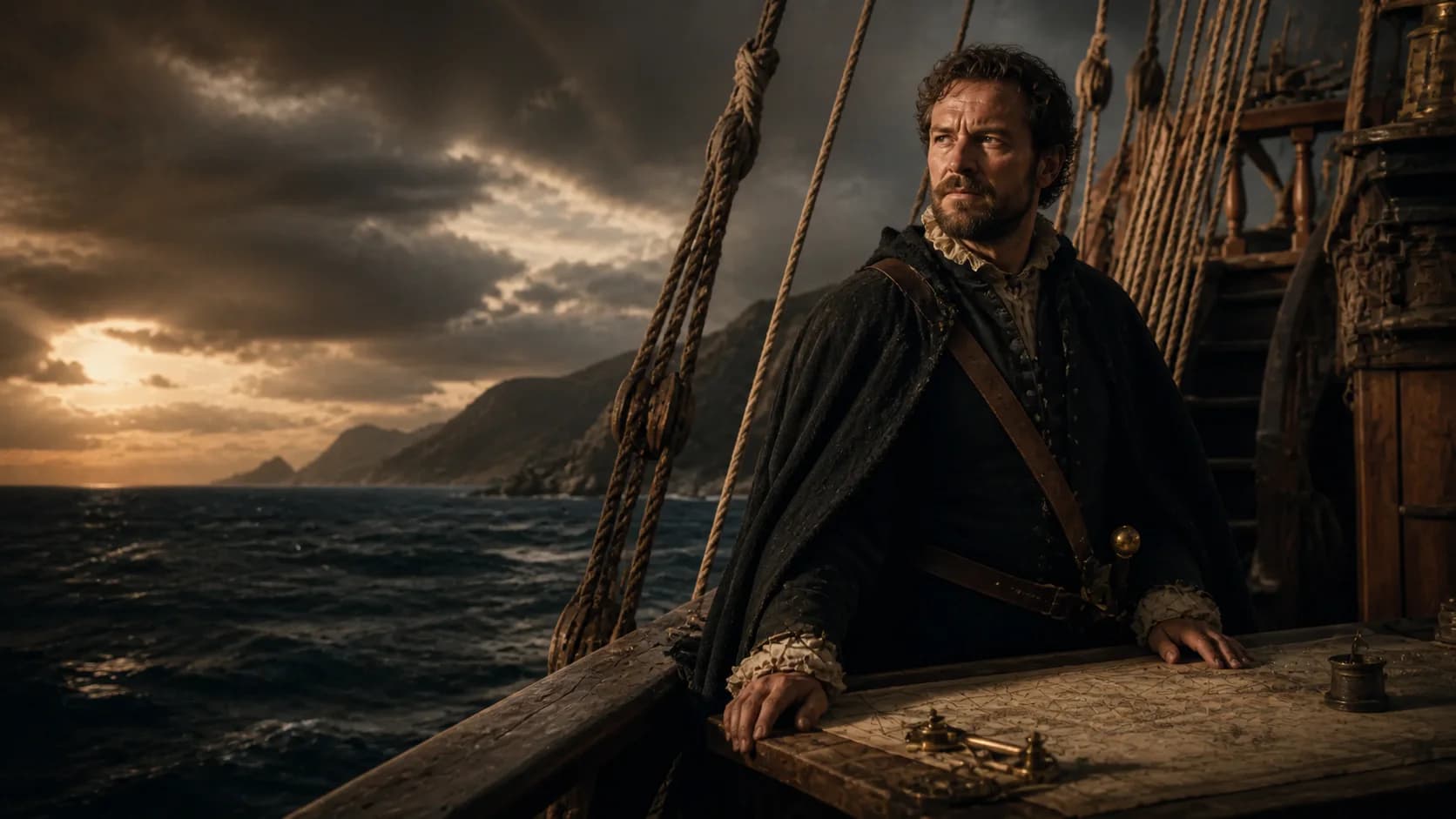
Opening portrait
Who was Francis Drake?
Francis Drake was an English privateer and naval commander. From 1577 to 1580, he led the second recorded circumnavigation, attacking Spanish vessels and settlements under covert royal protection. The prizes made him wealthy and politically useful. Earlier in his career, he had also taken part in John Hawkins's slaving voyages between West Africa and the Caribbean.
- Circumnavigation
- 1577—1580
- Returning ship
- Golden Hind
- Roles
- Privateer and naval officer
- Central controversies
- Raiding, plunder and participation in the slave trade
Defining moment
1577–1580 · Around the world
Golden Hind returned from the far side of the Pacific to complete England’s first circumnavigation.
Drake passed through the Strait of Magellan, sailed north along the Pacific coast of the Americas, then turned into an ocean without a familiar chain of ports. Golden Hind crossed the Pacific and Indian oceans and rounded the Cape of Good Hope. Nearly three years after departure, it became the expedition’s only ship to complete the circuit.
Life at a glance
Francis Drake · career timeline
Key dates connect biography, expeditions and later consequences across a career longer than any one ‘discovery’.
- 01
Drake joins slaving voyages
Sailing with Hawkins to West Africa and the Caribbean ties his early experience to England's emerging slave trade.
- 02
The global expedition leaves
The fleet sails from Plymouth to attack Spanish targets and search for new oceanic opportunities.
- 03
Golden Hind raids in the Pacific
After the Strait of Magellan, Drake seizes shipping and strikes settlements along Spanish South America.
- 04
Golden Hind returns
The completed circumnavigation and its treasure earn Drake royal favour and knighthood.
- 05
Drake fights the Armada
His naval role in England's defence further enlarges his national-hero image.
The life in sequence
Follow the voyage from its beginnings to its aftermath.
These chapters follow the order of a life and its expeditions, and are designed to be read as one continuous narrative.
One raid could be service to a state and piracy to its target
With English backing, Drake attacked Spanish shipping and colonial ports. Investors saw wealth and damage to a rival; people aboard captured ships saw armed robbery. Elizabeth's protection did not make Spain accept English jurisdiction.
Privateer and pirate are therefore not two separate careers here. They are rival legal descriptions of the same violence, produced by conflicting crowns and undeclared war.
Circumnavigation grew from an armed Pacific campaign
The voyage crossed the Strait of Magellan and entered waters Spain considered secure. Golden Hind seized immense treasure, then continued north and west rather than risk returning through the same defended route.
Its Pacific crossing, Moluccan calls and Cape passage required formidable seamanship. The achievement was real, but not neutral: prize-taking financed the route and supplied its political purpose.
Beyond the voyage
Some histories come into focus outside the timeline.
Local societies, navigation, surviving records and later consequences each open a separate path into the story.
The celebrated captain had already sailed in the slave trade
In the 1560s, Drake joined Hawkins's expeditions that seized or purchased Africans, transported them across the Atlantic and sold them in the Spanish Caribbean. The violence belongs to his maritime formation, not an unrelated footnote.
Later knighthood and Armada service turned Drake into an English national hero. A complete biography holds naval skill, royal rivalry, private profit and the trafficking of enslaved people in the same frame.
Records and evidence
How do the sources support these claims?
Confirmed facts, disputed questions and common misconceptions appear as distinct parts of the record.
The circumnavigation was a royal-protected raid
Attacks on the Spanish Pacific system produced prize wealth shared with English investors and the Crown.
Nova Albion and the total proceeds resist precision
Secrecy and conflicting later claims leave no uncontested North American site or single reliable sum for the prizes.
Slaving voyages remain part of the same career
Drake's later seamanship and command followed earlier participation in expeditions that trafficked enslaved Africans.
Questions to carry forward
Common questions
Was Drake a pirate?
England treated him as an authorized privateer; Spain regarded the same attacks as piracy. The facts of raiding and seizure do not depend on the label.
Was he the first person to circumnavigate?
No. The Magellan–Elcano expedition completed the first recorded circumnavigation. Drake commanded the second completed expedition.
Was Golden Hind always called that?
No. The ship began the voyage as Pelican and was renamed Golden Hind during the expedition.
How was Drake connected to slavery?
He sailed with John Hawkins on English slaving expeditions to West Africa and the Caribbean before his circumnavigation.
Sources
Sources and further verification
The institutions below support the account; disputed numbers, place identifications and claims of ‘first discovery’ retain their uncertainty.
- Sir Francis Drake factsRoyal Museums Greenwich
- Former Deptford Town Hall: historical note on Francis DrakeHistoric England
- Research guide: Exploration and discoveryRoyal Museums Greenwich
- Sir Francis Drake to Elizabeth IThe National Archives
Age of Seas editorial research distinguishes documentary facts, scholarly disputes and narrative judgments.Editorial standards and corrections ↗