In one minute
What did this event actually change?
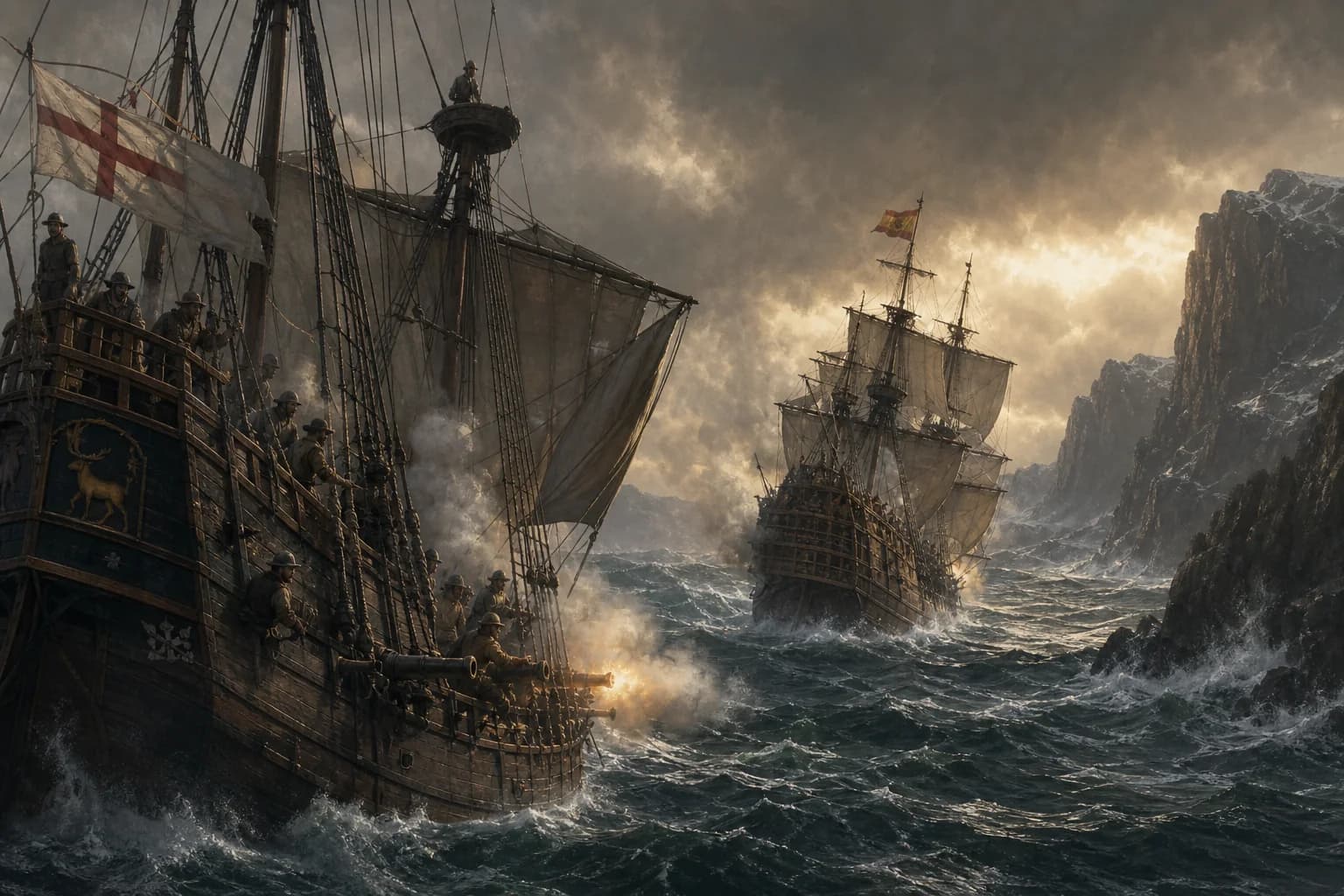
Francis Drake left England in 1577, passed through the Strait of Magellan and raided Spanish ships and ports along the Pacific coast of the Americas. Golden Hind then sailed north, crossed the Pacific by way of the Moluccas and Java, and returned around the Cape of Good Hope in September 1580. It was the second recorded circumnavigation—and a privateering campaign conducted with Queen Elizabeth I's covert support.
- Voyage
- December 1577—September 1580
- Ship that completed the circuit
- Golden Hind
- Character
- Reconnaissance, attempted trade, privateering and ocean navigation
- Principal targets
- Spanish shipping and ports on the Pacific coast
- Political result
- Enormous prize wealth and greater English confidence in oceanic competition
Chronology
A process, not a single date
Causes, turning points and aftermath form one process, far larger than a capital’s fall, a signed treaty or a company’s founding date.
- 01
The fleet leaves Plymouth
Its secretive instructions point toward Spanish possessions and commerce on South America's Pacific coast.
- 02
Command is violently asserted at San Julián
Drake tries and executes Thomas Doughty for alleged mutiny, exposing the expedition's internal political crisis.
- 03
The fleet enters the Pacific
After passing the Strait of Magellan, storms scatter the ships; Golden Hind becomes the vessel that continues the campaign.
- 04
Spanish Pacific shipping is raided
Drake attacks settlements and prizes, including the immensely valuable ship commonly called Cacafuego.
- 05
Golden Hind repairs on North America's coast
Drake claims Nova Albion for England, but the exact site remains disputed and local people did not consent to the claim.
- 06
Golden Hind returns to Plymouth
The ship has crossed the Pacific, called in the Moluccas and Java, and rounded the Cape to complete the circuit.
Why was this more than an exploration voyage?
Drake entered a Pacific that Spain treated as a protected imperial space. His fleet carried the capacity and intention to attack enemy commerce. The English Crown could benefit from the proceeds while secrecy kept the exact scope of royal orders deniable.
Privateering was privately organized maritime violence authorized or protected by a state. England could call Drake a lawful servant; Spain called him a pirate. The legal viewpoints differed, but the attacks, seizures and distribution of prize wealth are not in dispute.
How did a fleet become one returning ship?
The Atlantic descent brought supply problems, severe weather and a struggle over authority. Doughty's execution turned command into a matter of life and death. After the strait, storms scattered ships, drove one back and left Golden Hind to proceed.
Drake then struck Spanish traffic that expected little hostile presence on the Pacific side. Captured wealth fulfilled the expedition's financial purpose—and made returning by the original route dangerous. Continuing west became both a navigational opportunity and a way to evade pursuit.
Where was Nova Albion?
Golden Hind stopped somewhere on the Pacific coast of North America to repair. Drake named the place Nova Albion and staged an English claim. Drake's Bay in present-day California is the usual candidate, but incomplete and deliberately guarded records leave room for dispute.
A European naming ceremony cannot stand for the agreement of the Indigenous people who lived there. Whatever the precise cove, the claim belonged to rivalry on imperial maps, not a neutral creation of sovereignty.
What did the circumnavigation change?
The prizes produced spectacular returns, Elizabeth knighted Drake, and Golden Hind became a national emblem. The voyage showed that English ships could penetrate Spain's Pacific routes and survive a global return.
It did not establish an instant British world empire or destroy Spanish maritime power. Its nearer consequence was to make privateering, long-distance investment and naval rivalry more attractive—and to deepen the hostility that became open war in the 1580s.
Evidence boundary
Fact, interpretation and uncertainty
The evidence reveals where imperial claims diverged from reality and where heroic stories compressed complex wars.
Circumnavigation and privateering were the same voyage
The route, captured prizes and royal reception are well attested. Celebrating only navigation would remove a central purpose of the expedition.
Nova Albion has no universally accepted coordinate
The California coast is the usual setting, but secrecy, later claims and incomplete material evidence prevent absolute identification.
Pirate and privateer are political descriptions
English authorization did not bind Spain. The stable facts are armed seizure, royal protection and profit from enemy property.
Questions
Common questions
Was Drake a pirate or a privateer?
England treated him as an authorized or protected privateer; Spain rejected that authority and treated him as a pirate. Both labels reflect a state's position toward the same raids.
How many of his ships circumnavigated?
Only Golden Hind completed the circuit. The other vessels were lost, separated or returned.
Was Drake the second person around the world?
It is safer to call his expedition the second recorded completed circumnavigation. Several people completed the first, so the feat cannot be reduced to a numbered list of lone individuals.
Where exactly did he land in North America?
Probably on the California coast, with Drake's Bay a common identification. The surviving evidence has not produced a universally accepted exact site.
Sources
Sources and further verification
Archives, museums, international organizations and academic publications support the facts and interpretive limits in this account.
- Sir Francis Drake factsRoyal Museums Greenwich
- Research guide: Exploration and discoveryRoyal Museums Greenwich
- Former Deptford Town Hall: historical note on Francis DrakeHistoric England
- Sir Francis Drake to Elizabeth, 1588The National Archives
Age of Seas editorial research distinguishes verifiable facts, historical interpretation and potentially misleading simplifications.Editorial standards and corrections ↗