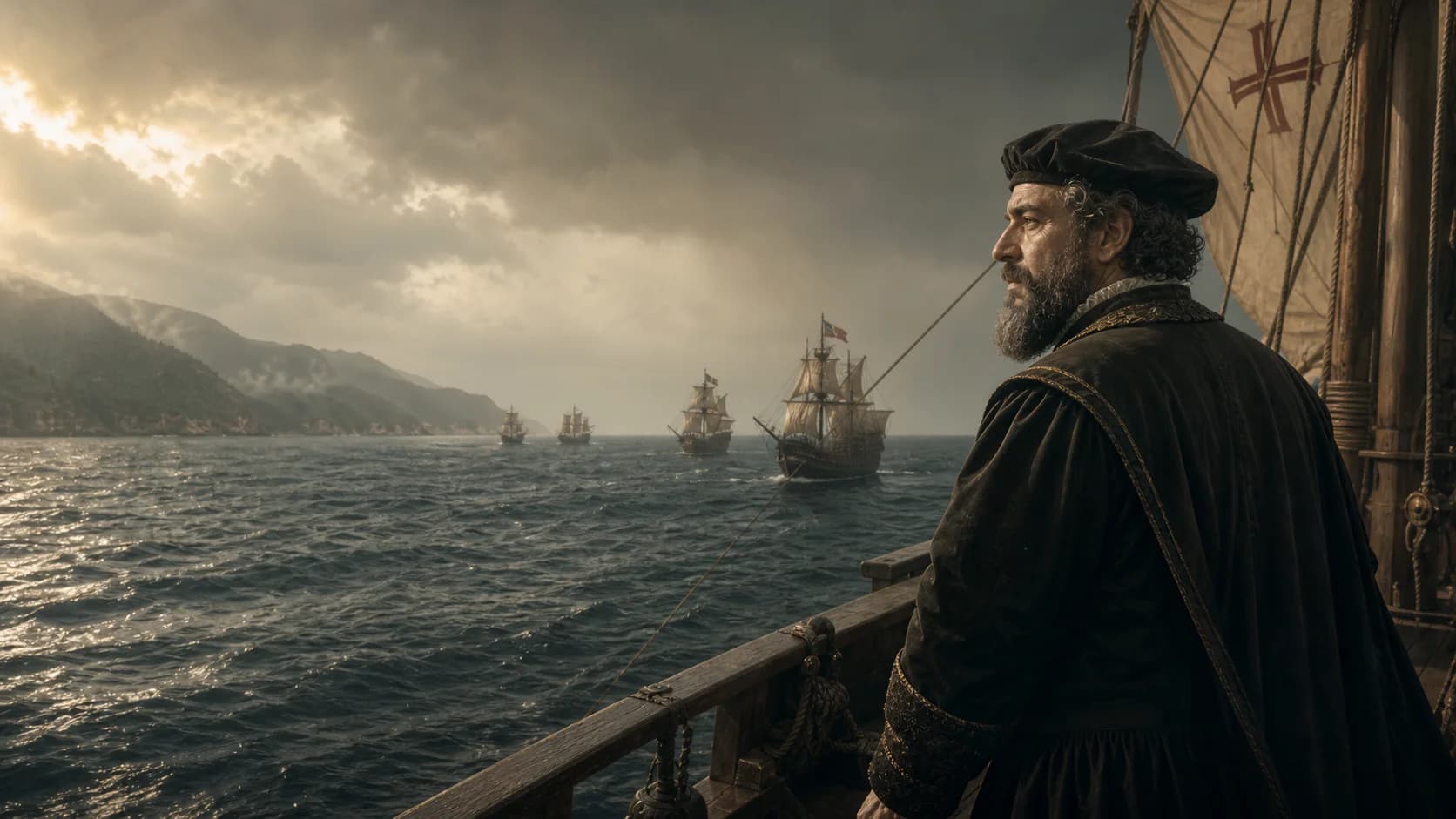
Opening portrait
Who was Pedro Álvares Cabral?
Pedro Álvares Cabral commanded a large Portuguese fleet to India in 1500. Its broad South Atlantic route reached the coast of present-day Brazil before crossing back to round the Cape. Portugal used the landfall to assert possession, but Brazil was neither empty nor waiting to be claimed: Indigenous societies had lived along its coast for millennia.
- Principal voyage
- 1500—1501
- Fleet at departure
- Thirteen ships
- Brazilian landfall
- April 1500
- Later destinations
- Calicut and Cochin in India
Defining moment
1500–1501 · Brazil and India
One voyage joined Brazil, the Cape of Good Hope and India on a single sea road.
Cabral led thirteen ships toward India and first met an unfamiliar coast on the far side of the South Atlantic. From the land later called Brazil, the fleet set out again, crossed the southern ocean, rounded the Cape and reached India. Places scattered across separate horizons had been traversed in one continuous expedition.
Life at a glance
Pedro Álvares Cabral · career timeline
Key dates connect biography, expeditions and later consequences across a career longer than any one ‘discovery’.
- 01
Thirteen ships sail for India
The Crown tries to turn da Gama's experimental route into stable commerce and diplomatic presence.
- 02
The fleet reaches Brazil
It pauses near present-day Bahia, sends news home and then resumes the India mission.
- 03
A Cape storm destroys four ships
Dias and the crews of several vessels are lost.
- 04
Trade in India turns to armed conflict
After violence at Calicut, Cabral trades with Cochin and returns with only part of the original fleet.
The life in sequence
Follow the voyage from its beginnings to its aftermath.
These chapters follow the order of a life and its expeditions, and are designed to be read as one continuous narrative.
An India fleet entered the history of Brazil
After da Gama returned, Portugal sent Cabral with a larger force to establish durable Indian trade and display royal power. Beyond Cape Verde, the ships opened southwest into the Atlantic and sighted South America's east coast in April 1500.
The turn may reflect the South Atlantic wind system, a deliberate wider sweep and information already held at court. The surviving documents leave room between pure accident and secret plan.
The survivors had to rebuild a fleet on the East African coast
A storm near the Cape sank four ships and killed Dias among many others. Scattered survivors entered the Mozambique Channel and searched for provisions and news of one another around Sofala, Mozambique and Kilwa.
Those calls reconnected a damaged force to the monsoon world. By the time Cabral reached India, the fleet was smaller and its mission increasingly armed. His career sits at the junction between a claim in Brazil and violent commercial intervention in Asia.
Beyond the voyage
Some histories come into focus outside the timeline.
Local societies, navigation, surviving records and later consequences each open a separate path into the story.
Ten days held exchange, observation and possession
Near present-day Bahia, sailors traded hats, beads, food and other objects with coastal residents. Mass, a cross and a royal claim accompanied the exchange, while Pero Vaz de Caminha wrote a long report about people, bodies, forests and shore.
The two sides watched one another through limited gestures and objects. The fleet then resumed its India mission; a dispatch ship carried the letter and samples toward Lisbon. A Portuguese ceremony did not convey Indigenous land.
Records and evidence
How do the sources support these claims?
Confirmed facts, disputed questions and common misconceptions appear as distinct parts of the record.
Brazil and India belonged to one expedition
The India-bound fleet stayed briefly in South America, sent a report and continued east under the same royal mission.
The western sweep may combine plan and circumstance
Wind strategy explains an Atlantic arc but not conclusively whether the Crown expected land there. The surviving evidence supports no single answer.
A royal claim did not make the coast ownerless
Portuguese texts record one side's possession ceremony. Indigenous communities already held histories, territories and political relationships there.
Questions to carry forward
Common questions
Was Cabral sailing to Brazil or India?
India was the expedition's main official destination. The fleet reached eastern South America on the way and then continued around Africa.
Why is he associated with the discovery of Brazil?
His was the first securely documented Portuguese royal fleet to arrive and assert a claim. Indigenous history in Brazil, of course, began thousands of years earlier.
Did Bartolomeu Dias sail with Cabral?
Yes. He commanded one ship and died when it sank in the storm near the Cape.
What records the Brazilian landfall?
Caminha's letter to the king is the best-known eyewitness text. It is rich evidence from within a colonial expedition, not an Indigenous account.
Sources
Sources and further verification
The institutions below support the account; disputed numbers, place identifications and claims of ‘first discovery’ retain their uncertainty.
- Pedro Álvares CabralThe Mariners’ Museum and Park
- Pedro Álvares CabralVisit Portugal
- Bartolomeu DiasThe Mariners’ Museum and Park
- Early Brazil: The ‘Discovery’ and First EncountersCambridge University Press
- Portuguese Oceanic Expansion, 1400–1800Cambridge University Press
Age of Seas editorial research distinguishes documentary facts, scholarly disputes and narrative judgments.Editorial standards and corrections ↗