In one minute
What did this event actually change?
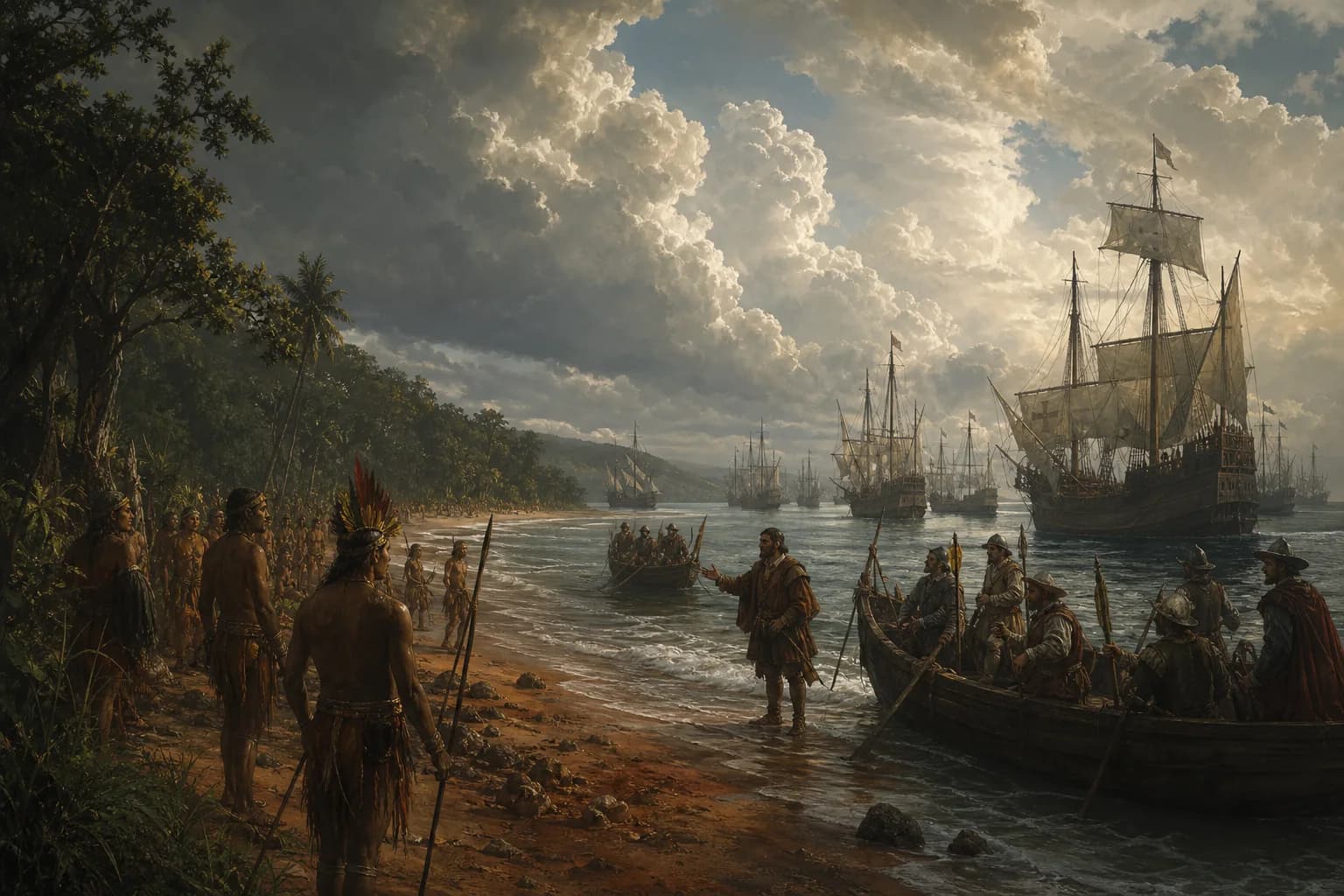
Pedro Álvares Cabral left Lisbon for India in March 1500 with thirteen ships. After making a broad South Atlantic turn, the fleet reached the coast of present-day Bahia on 22 April. It stayed about ten days, performed ceremonies of possession and sent a report home, then continued to India. Four ships sank near the Cape, and a deadly clash at the Portuguese factory in Calicut led Cabral to bombard the port and trade with its rivals.
- Departure
- 9 March 1500
- Fleet
- Thirteen ships
- Brazilian landfall
- 22 April 1500, on the coast of present-day Bahia
- Cape losses
- Four ships sank in a storm
- Indian outcome
- Conflict at Calicut, followed by trade with Cochin and Cannanore
Chronology
A process, not a single date
Causes, turning points and aftermath form one process, far larger than a capital’s fall, a signed treaty or a company’s founding date.
- 01
The fleet leaves Lisbon
Its main mission is to enlarge the commercial and diplomatic foothold created by da Gama's India voyage.
- 02
Land appears on the Brazilian coast
The Portuguese name the country they see, meet Indigenous residents and begin documenting the land.
- 03
A dispatch vessel sails home
One ship carries the news while the main fleet resumes its planned passage toward the Cape and India.
- 04
A Cape storm sinks four ships
Bartolomeu Dias is among the dead, a reminder that knowing a route did not tame its weather.
- 05
Violence erupts at Calicut
After an attack on the Portuguese factory, Cabral bombards shipping and the city, then turns to rival ports for alliances and cargo.
- 06
Surviving ships return
Spices make the venture commercially defensible, while the Brazilian report supports later mapping, extraction and settlement.
Was the Brazilian landfall planned or accidental?
An India-bound sailing route naturally opened southwest into the Atlantic before turning toward the Cape. That makes a western track understandable. It does not tell us whether Cabral's exact sweep reflected a secret instruction or prior Portuguese knowledge.
Neither a helpless ship blown off course nor a fully documented covert discovery plan fits all the evidence. What is secure is that the fleet sailed under an Indian mission and quickly translated its unexpected—or at least undeclared—landfall into a royal and Christian claim.
What happened during the ten-day stay?
The crews exchanged objects and observed coastal people whose languages belonged to the Tupi family. Pero Vaz de Caminha's celebrated letter preserves sharp descriptions, but also a European gaze already imagining conversion, labour and resources.
Mass, a cross, naming and possession rituals expressed Portugal's intention. They did not obtain a transfer of land from Indigenous communities. With no permanent settlement built, the fleet sent its report and moved on.
The voyage did not end in Brazil
The main force crossed back over the South Atlantic. Near the Cape, a storm destroyed four ships—including the vessel commanded by Dias, who had first established the rounding. Scale and experience could reduce some risks, not abolish them.
At Calicut, an attack killed many people in the new Portuguese factory. Cabral answered with seizure and bombardment, then traded at Cochin and Cannanore, rivals of Calicut. Cannon, commerce and local alliance now operated together.
One route, two forms of empire
To the west, the landfall and the Tordesillas framework supported a Portuguese claim to Brazil. Timber extraction, sugar, settlement and mass enslavement built the colony only over later decades.
To the east, fleets pursued access to existing markets through fortified trade and selective violence. Cabral's expedition matters because the same ships, finance and royal authority joined territorial possession in one ocean to armed commercial intervention in another.
Evidence boundary
Fact, interpretation and uncertainty
The evidence reveals where imperial claims diverged from reality and where heroic stories compressed complex wars.
Brazil and India were stages of one expedition
Caminha's letter and voyage records support the April landfall, brief stay, homeward dispatch and onward crossing to India.
Accident and secret design both remain hypotheses
Atlantic wind strategy explains a westward sweep, but the surviving evidence proves neither prior royal knowledge nor a purely unintended drift.
A ceremony did not transfer Indigenous land
The cross, mass and naming articulated a Portuguese claim. They did not erase existing political communities or secure their consent.
Questions
Common questions
Did Cabral discover Brazil?
He led the first securely recorded official Portuguese fleet to reach it. Brazil was already home to numerous Indigenous societies, and possible slightly earlier European contacts remain debated.
Why did an India fleet sail so far west?
The South Atlantic wind route required a broad western arc. Whether the extent of Cabral's arc also reflected reconnaissance or prior knowledge cannot be proved.
Did the fleet colonize Brazil in 1500?
No. It stayed briefly and asserted a claim. Sustained extraction, settlement and plantation colonization developed later.
How did Bartolomeu Dias die?
He commanded one of Cabral's ships and was lost with it in a storm near the Cape of Good Hope in May 1500.
Sources
Sources and further verification
Archives, museums, international organizations and academic publications support the facts and interpretive limits in this account.
- Pedro Álvares CabralThe Mariners’ Museum and Park
- Pedro Álvares CabralVisit Portugal
- Bartolomeu DiasSouth African History Online
- A Concise History of Brazil: excerptCambridge University Press
Age of Seas editorial research distinguishes verifiable facts, historical interpretation and potentially misleading simplifications.Editorial standards and corrections ↗