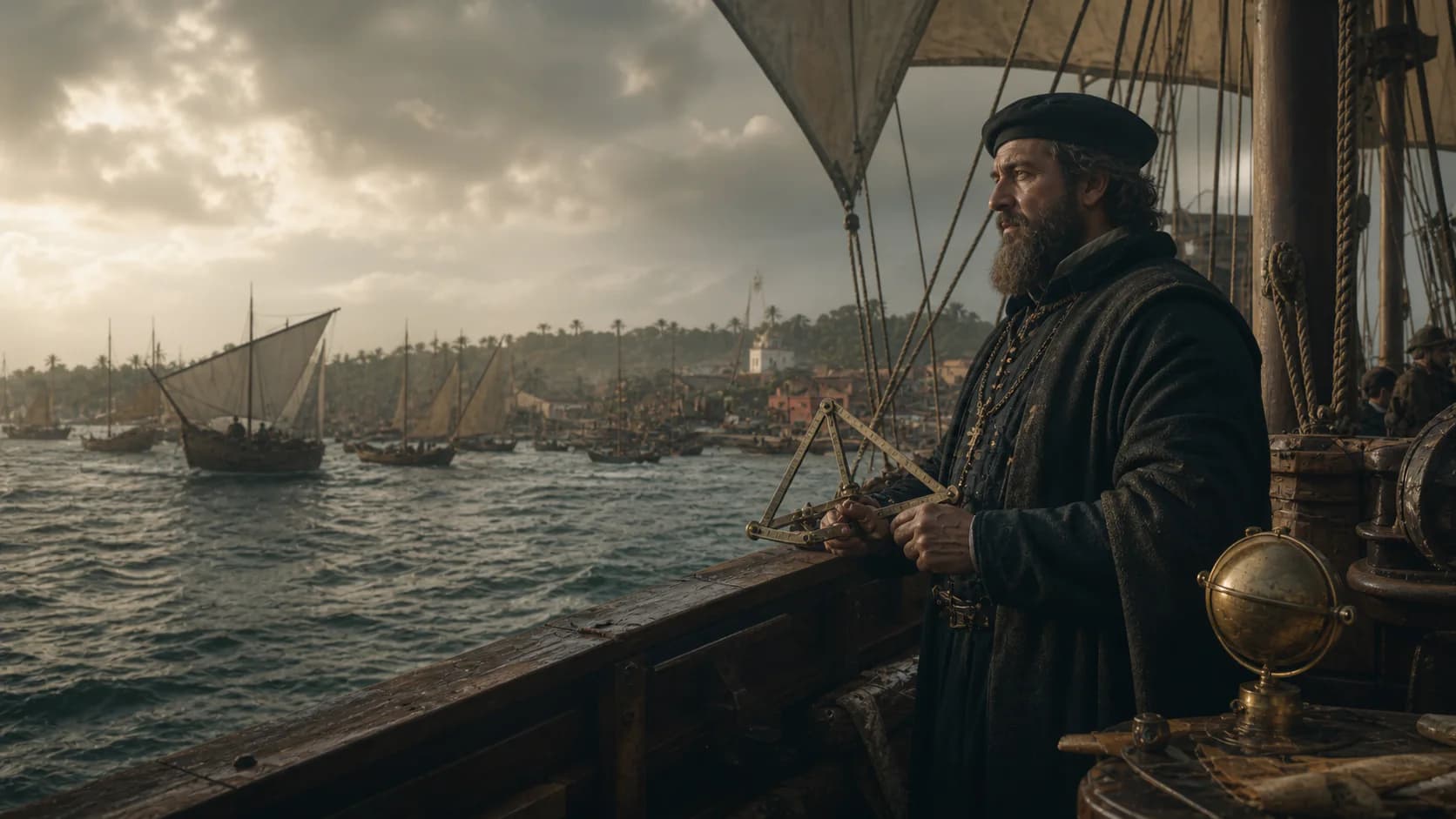
Opening portrait
Who was Vasco da Gama?
Vasco da Gama commanded the 1497–1499 expedition that sailed from Lisbon around the Cape, called at East African ports and crossed the Indian Ocean to Calicut. It was the first recorded European fleet to complete the ocean route to India. The achievement depended on Dias's cape experience and on established Swahili and Indian Ocean knowledge of ports, pilots and monsoon seasons.
- First India voyage
- 1497—1499
- Flagship
- São Gabriel
- Arrival in India
- May 1498
- Destination
- Calicut
Defining moment
1497–1499 · First voyage to India
He joined an Atlantic route to the Indian Ocean in one continuous voyage.
Da Gama’s fleet sailed south from Lisbon, rounded the Cape of Good Hope, gathered provisions, intelligence and piloting knowledge along East Africa, then crossed the Arabian Sea with the monsoon. When Calicut appeared in 1498, a shipborne route from Europe around Africa to India had been completed from end to end.
Life at a glance
Vasco da Gama · career timeline
Key dates connect biography, expeditions and later consequences across a career longer than any one ‘discovery’.
- 01
The first India voyage leaves
The fleet sails from Lisbon and uses the South Atlantic wind system on its approach to southern Africa.
- 02
Da Gama reaches Calicut
East African calls and a monsoon crossing bring the ships to India's southwest coast.
- 03
A costly return ends
Disease, monsoon timing and too few crew members turn the homeward journey into an ordeal.
- 04
Armed voyages lead to colonial office
Da Gama returns with a heavily armed fleet and dies at Cochin in 1524 after appointment as viceroy.
The life in sequence
Follow the voyage from its beginnings to its aftermath.
These chapters follow the order of a life and its expeditions, and are designed to be read as one continuous narrative.
An Atlantic route entered a monsoon world
The fleet swept away from the Gulf of Guinea to use South Atlantic winds, then turned back toward southern Africa. Beyond the Cape lay an Indian Ocean network maintained for centuries by African, Arab, Persian, Indian and Southeast Asian merchants.
East African ports supplied information, provisions and a pilot for the monsoon crossing. Da Gama held command, but the final passage succeeded where Atlantic experience met local oceanic knowledge.
Calicut taught the newcomers how little they understood
Portuguese gifts looked poor in a market accustomed to high-value commerce. The expedition misread court ceremony, religious identities and the influence of established merchants. Its geographical result was sensational; its immediate trading result was slight.
An unfavourable return season, scurvy and death raised the price further. Portugal answered by sending larger armed fleets. On his second voyage, da Gama helped turn commercial frustration into bombardment and coercion.
The route redistributed power; it did not create trade
Commerce across the Indian Ocean flourished long before the Portuguese arrived. The new capability belonged to Lisbon: ships could now enter that system directly from the Atlantic without relying on Mediterranean intermediaries.
Forts, cannon and a pass system later pushed selected sea lanes toward Portuguese control. The navigational breakthrough came first; sustained violence and alliance made its political consequences.
Beyond the voyage
Some histories come into focus outside the timeline.
Local societies, navigation, surviving records and later consequences each open a separate path into the story.
Records and evidence
How do the sources support these claims?
Confirmed facts, disputed questions and common misconceptions appear as distinct parts of the record.
The fleet reached southwest India in 1498
It connected Dias's cape route to the East African and monsoon passage, while its return losses reveal the difficulty of sustaining a round trip.
The Indian Ocean pilot cannot be named with confidence
Sources confirm local assistance but do not securely identify a celebrated Arab navigator; a Gujarati pilot is often considered more plausible.
A new route changed power, not the existence of trade
Indian Ocean commerce was already mature. Portugal's innovation was direct Atlantic entry followed by armed attempts at control.
Questions to carry forward
Common questions
When did da Gama reach India?
His first fleet reached Calicut on India's southwest coast in May 1498.
Was he the first European to reach India?
Europeans had travelled to Asia by land and Mediterranean routes. His expedition was the first recorded European fleet to sail the entire ocean route around Africa.
Who piloted the fleet across the Indian Ocean?
Malindi's ruler supplied a pilot familiar with the monsoon. His name is uncertain; the famous Ahmad ibn Mājid identification is not securely supported.
Whose trading world did he enter?
Swahili, Arab, Persian, Gujarati, Malabari and other merchants worked with port rulers across a mature system. Portugal later tried to change its rules through force.
Sources
Sources and further verification
The institutions below support the account; disputed numbers, place identifications and claims of ‘first discovery’ retain their uncertainty.
- Vasco da GamaThe Mariners’ Museum and Park
- Vasco da GamaPanteão Nacional de Portugal
- Bartolomeu DiasThe Mariners’ Museum and Park
- The Portuguese in the Indian OceanCambridge University Press
- Portuguese Oceanic Expansion, 1400–1800Cambridge University Press
Age of Seas editorial research distinguishes documentary facts, scholarly disputes and narrative judgments.Editorial standards and corrections ↗