In one minute
What did this event actually change?
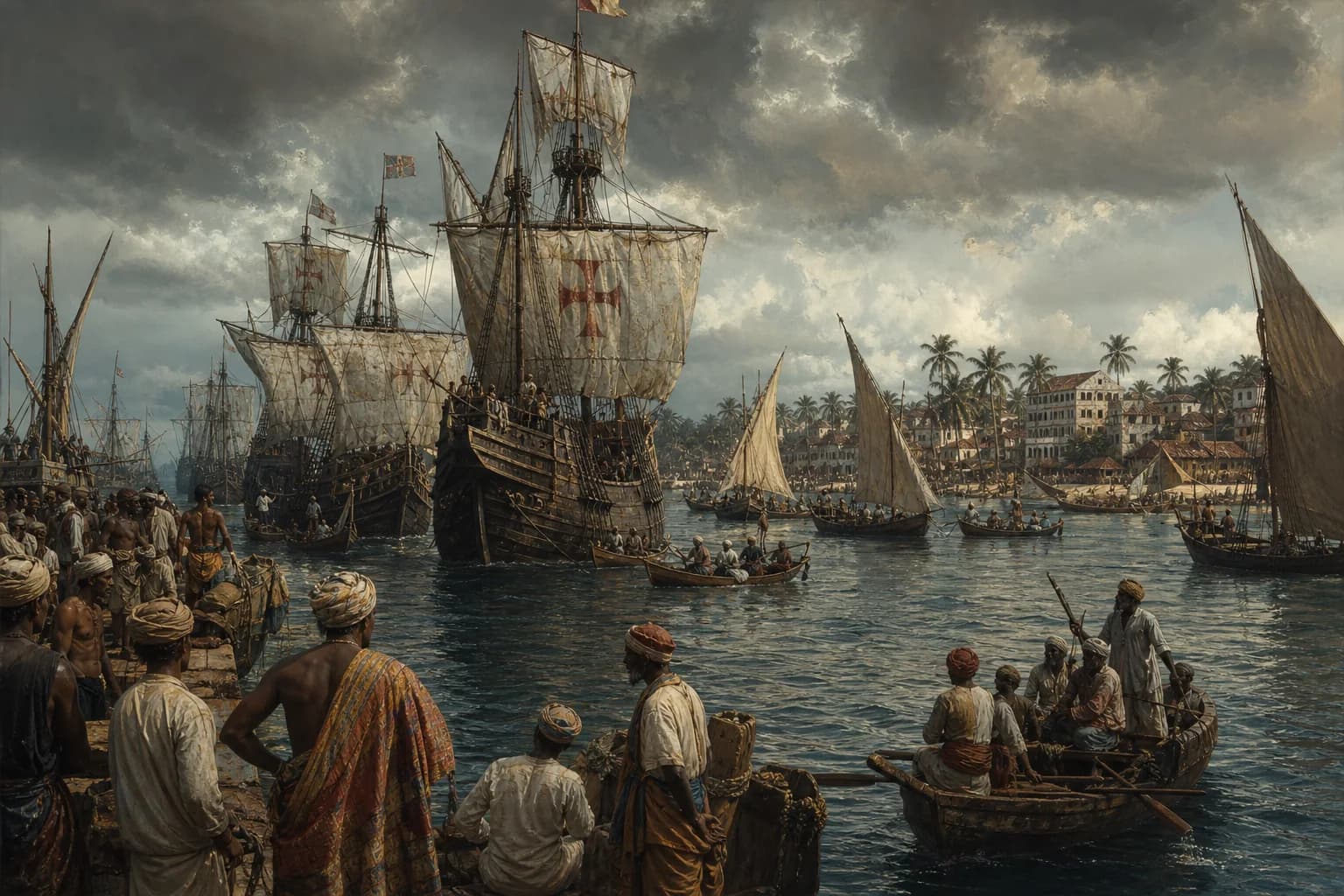
Vasco da Gama left Lisbon with four vessels in July 1497, swept far into the South Atlantic to round the Cape of Good Hope, and called at Mozambique, Mombasa and Malindi. With Indian Ocean piloting knowledge, the fleet crossed the monsoon route and reached Calicut in May 1498. The navigation succeeded, but diplomacy and trade produced little. An ill-timed return crossing brought scurvy and severe loss of life.
- Departure
- 8 July 1497, Lisbon
- Arrival
- May 1498, near Calicut on India's southwest coast
- Fleet
- São Gabriel, São Rafael, Berrio and a supply ship
- Essential assistance
- East African ports and Indian Ocean piloting knowledge
- First result
- A viable route, but weak trade and diplomacy with heavy human losses
Chronology
A process, not a single date
Causes, turning points and aftermath form one process, far larger than a capital’s fall, a signed treaty or a company’s founding date.
- 01
Four vessels leave Lisbon
The royal mission combines trade and diplomacy, building on Bartolomeu Dias's knowledge of the cape route.
- 02
The fleet makes a South Atlantic sweep
Instead of following the Gulf of Guinea coast, it turns far southwest to use the wind system before bending back toward Africa.
- 03
The ships pass the Cape of Good Hope
They continue beyond the section Dias had proved and begin working up Africa's eastern coast.
- 04
Calls at Mozambique, Mombasa and Malindi
The Portuguese enter Swahili and Muslim commercial politics; at Malindi they secure help for the ocean crossing.
- 05
The fleet reaches Calicut
Its gifts and demands do not suit the conventions of a rich trading port, and relations with the Zamorin remain unsettled.
- 06
The return voyage takes a severe toll
A poor monsoon departure and scurvy kill many crew members; São Rafael is burned because too few sailors remain.
Why sail west in order to reach the East?
A ship hugging West Africa would meet difficult winds and currents. Da Gama's fleet stood far into the South Atlantic, using a broad volta do mar before turning east toward the cape. The detour on a map was a practical route under sail.
This manoeuvre rested on decades of Atlantic experiment, island bases and Dias's 1488 rounding. Da Gama closed the remaining gap in a cumulative system; he did not produce the entire route from a single insight.
East African ports were part of the voyage, not scenery
Mozambique, Mombasa and Malindi belonged to sophisticated Swahili city-states tied to Muslim commerce across the ocean. The newcomers had to negotiate rulers, rivalries, language and identity. Some encounters ended in suspicion or conflict; Malindi offered cooperation.
The open-water crossing required the timing and route knowledge of the monsoon world. The pilot's exact identity remains debated, and the popular claim that he was the famous Ahmad ibn Mājid is not securely supported. Local expertise itself is not in doubt.
Arrival at Calicut was not commercial triumph
Calicut was a major market accustomed to high-value goods and established merchant communities. Portuguese gifts appeared modest, while religious misreadings and competition complicated the audience with the Zamorin. The fleet secured neither a durable alliance nor the terms it wanted.
It returned with small quantities of goods and priceless information: the route could be repeated. Later fleets came larger and more heavily armed, using bombardment, blockade and selective alliance to force a place in commerce.
What did the sea route change?
It did not begin Europe–Asia trade or empty the Red Sea and Mediterranean routes overnight. It gave the Portuguese Crown a direct Atlantic shipping option and the ability to send armed fleets regularly into the Indian Ocean.
The deeper change came after 1498, through the carreira da Índia, fortified ports and a coercive pass system. The voyage is best understood as Europe's entry into a mature oceanic world—and the beginning of a violent attempt to reshape it.
Evidence boundary
Fact, interpretation and uncertainty
The evidence reveals where imperial claims diverged from reality and where heroic stories compressed complex wars.
The fleet reached Calicut in May 1498
Portuguese narratives and route evidence support the principal stages, while the complete expedition continued until the ships' staggered return in 1499.
The Malindi pilot cannot be securely named
The crossing clearly depended on Indian Ocean expertise, but identifying the pilot as Ahmad ibn Mājid is a later and weakly supported tradition.
The voyage did not open an unused ocean
African, Arab, Persian, Indian and Southeast Asian merchants already sustained dense networks. The new element was a recurring, armed Portuguese intrusion.
Questions
Common questions
When did da Gama reach India?
The fleet arrived near Calicut in May 1498. The full round trip ran from 1497 into 1499.
Was he the first European to reach India?
Europeans had travelled to Asia through overland and Mediterranean networks. His expedition made the first recorded European fleet voyage all the way around Africa to India.
Why did the first trading mission go badly?
Its gifts and goods did not match local expectations, while diplomatic status, religion and competition with established merchants created friction.
Why did so many die on the return?
The ships left in an unfavourable monsoon window, stretching the crossing. Scurvy and other disease then devastated already exhausted crews.
Sources
Sources and further verification
Archives, museums, international organizations and academic publications support the facts and interpretive limits in this account.
- Vasco da GamaThe Mariners’ Museum and Park
- Vasco da GamaPanteão Nacional de Portugal
- Bartolomeu DiasSouth African History Online
- The Islamic World and the Making of the Portuguese EmpireCambridge University Press
Age of Seas editorial research distinguishes verifiable facts, historical interpretation and potentially misleading simplifications.Editorial standards and corrections ↗