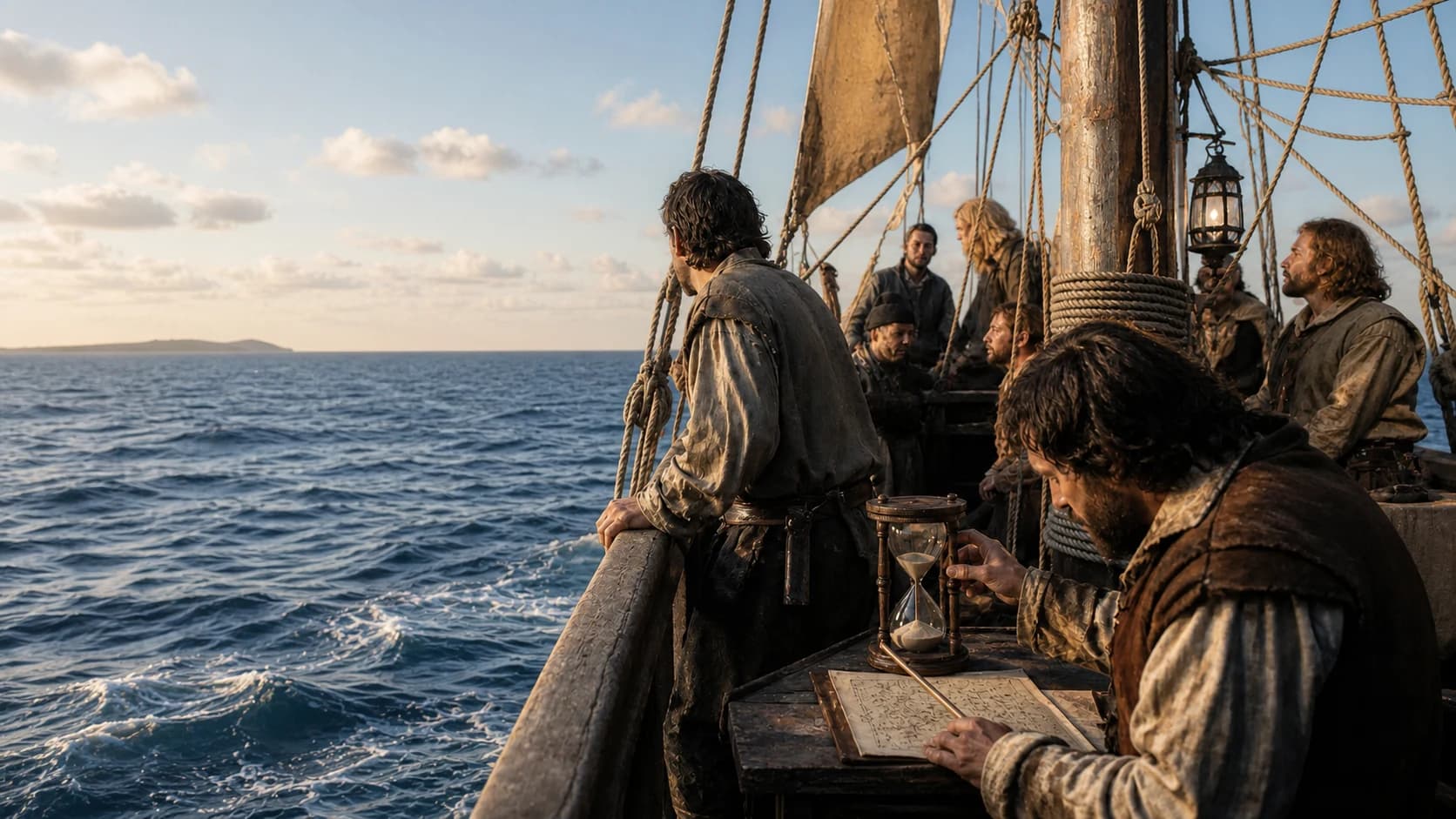
Log contents ↓
LOGBOOK / DIRECT ANSWER
Who actually wrote Columbus’s journal?
The text commonly called the Journal of Columbus’s First Voyage follows the expedition from its departure at Palos on 3 August 1492 to its return on 15 March 1493. It records courses, distances, weather, weeds and birds, Caribbean islands, encounters with Native inhabitants, the search for gold, the wreck of Santa María, and the stormy homeward crossing. Columbus’s shipboard original and the complete Castilian court copy are lost. The central surviving witness is a mid-sixteenth-century manuscript by Bartolomé de las Casas: most entries are third-person summaries, about one fifth is marked as Columbus’s own words, and hindsight, criticism, and marginal notes run through it. Columbus, an earlier copy, and Las Casas therefore speak in layers across the daily record. The landfall took place in a Caribbean already settled, navigated, and connected; friendly gifts, royal possession, conversion, desire for gold, and the detention of islanders appear together from the first days of contact.
“puesto sumariamente”Title of the surviving witness · puesto sumariamente identifies a digestVOICE REGISTER
At least three voices share the page.
- 01
Columbus’s voyage record
Lost; recoverable only through copy and digest
- 02
Las Casas’s summary
Third-person compression of most daily entries
- 03
Margin and hindsight
Criticism, indexing, and revised interpretation
DATED WAKE · 1492–1825
The voyage ended after 225 days; the journal took three centuries to become print.
- 01
The Capitulations of Santa Fe define office and reward
The crown and Columbus agree on admiralty, government, revenue, and jurisdiction if the voyage succeeds. It begins as an enterprise of royal power.
- 02
Santa María, Pinta, and Niña leave Palos
The three ships first make for the Canaries. Pinta’s damaged steering and a change of rig delay the ocean crossing.
- 03
Westward from La Gomera across the Atlantic
The entries accumulate course, wind, sea, compass, weed, birds, and two mileage accounts as unease grows among the crews.
- 04
A night light and landfall at Guanahani
Rodrigo de Triana aboard Pinta formally reports land. Ashore, Europeans claim possession for the crown and exchange objects with islanders.
- 05
Through the Bahamas and along Cuba
Columbus keeps fitting the islands into Asian geography and sends men to find the Great Khan, cities, spices, and gold.
- 06
Pinta separates; the other ships reach Hispaniola
Martín Alonso Pinzón searches independently for gold while Santa María and Niña meet several coastal political communities.
- 07
Santa María grounds in a calm sea
A failed watch carries the flagship onto a bank. Guacanagarí’s people help unload it, and its timbers are used at Navidad.
- 08
Thirty-nine men remain; Niña and Pinta turn home
The ships reunite. After the voyage’s first armed clash, they leave Hispaniola on a northeasterly course.
- 09
Storm, detention in the Azores, Lisbon, and Palos
A sealed report goes overboard during a storm. Niña calls at the Azores and Lisbon before returning to Palos on 15 March.
- 10
The court keeps the original and makes a copy
Columbus presents his journal to the monarchs. They retain it and give him a full copy; both later disappear.
- 11
Las Casas produces the surviving digest
The 67-folio manuscript mixes third-person summary, long first-person quotations, marginalia, and more than a thousand corrections.
- 12
Navarrete’s first printing and modern critical editions
Publication, translation, route reconstruction, and recollation gradually produce the modern object known as Columbus’s journal.
SIX TRANSCRIPT LEAVES · ORIGINAL SPANISH
Six early Spanish passages hold course, power, and desire on the same page.
- ENTRY 01A westward routePrologue
Ordenaron que yo no fuese por tierra al Oriente por donde se costumbra de andar, salvo por el camino de Occidente, por donde hasta oy no sabemos por çierta fe que aya passado nadie.
TranslationThey ordered that I should not travel eastward by the customary land route, but by way of the west, where to this day we do not know with certainty that anyone has passed.
The prologue binds Asia, conversion, royal commission, and the westward route together. The destination was the Indies, not an unknown continent awaiting discovery.
- ENTRY 02Two distances9 September 1492
Anduvo aquel día 15 leguas y acordó contar menos de las que andava porque si el viaje fuese luengo no se espantase y desmayase la gente.
TranslationThat day he made fifteen leagues and decided to reckon fewer than he travelled, so that if the voyage proved long the people would not be frightened and lose heart.
The entry preserves a difference between estimated progress and the number disclosed to the crew. It reveals command strategy and complicates every later route reconstruction.
- ENTRY 03A light in the night11 October 1492
Esta tierra vido primero un marinero que se dezía Rodrigo de Triana, puesto que el Almirante a las diez de la noche, estando en el castillo de popa, vido lumbre.
TranslationA sailor called Rodrigo de Triana first saw this land, although at ten that night the Admiral, standing on the sterncastle, had seen a light.
The light remained uncertain; the formal sighting came from Pinta. One sentence compresses the order of discovery, entitlement to the reward, and the commander’s reputation.
- ENTRY 04Love and force12 October 1492
Cognoscí que era gente que mejor se libraría y convertería a nuestra sancta fe con amor que no por fuerça, les di a algunos dellos unos bonetes colorados y unas cuentas de vidro.
TranslationI perceived that they were a people who would better be freed and converted to our holy faith by love rather than force, so I gave some of them red caps and glass beads.
Gift exchange and conversion follow the ceremony of possession. The same entry soon proposes carrying islanders to Castile so that they can learn the language.
- ENTRY 05Looking for gold13 October 1492
Y yo estava atento y trabajava de saber si avía oro, y vide que algunos dellos trayýan un pedaçuelo colgado en un agujero que tienen a la nariz.
TranslationI watched closely and worked to learn whether there was gold, and saw that some wore a little piece hanging from a hole in the nose.
Cotton, parrots, canoes, and exchange goods have barely entered the record before its focus contracts to gold. Gestures and place-names repeatedly become clues to a mine.
- ENTRY 06Casting the record into the sea14 February 1493
Este pargamino enbolvió en un paño ençerado atado muy bien, y mandó traer un gran barril de madera y púsolo en él sin que ninguna persona supiese qué era.
TranslationHe wrapped the parchment in waxed cloth, bound it securely, ordered a large wooden barrel brought, and placed it inside without anyone knowing what it was.
Fearing the ship would founder, Columbus wrote a voyage summary for the sea and kept another copy aboard. The journal here records the possibility of its own disappearance.
LOG COORDINATES · 01—15
Eleven voyage entries. Four textual voices.
The westward crossing
Daily numbers make a route, but those numbers include estimation, concealment, and transcription.
- 01Palos to the CanariesFitting out, rudder damage, and rerigging
- 02West of La GomeraTrade winds and a latitudinal route
- 03Weed, birds, and compassReading every sign as land
- 04Night of 11 OctoberLight, reward, and formal sighting
The Caribbean passage
European naming overlays existing place-names, routes, and political communities.
- 05GuanahaniLanding, possession, and first exchange
- 06Bahamian channelsCanoes, cotton, and detained islanders
- 07Cuba / JuanaMistaking an island for the Asian mainland
- 08HispaniolaGold reports and local alliances
Wreck and return
One failed watch turns an exploratory voyage into the first colonial outpost.
- 09Wreck of Santa MaríaShoal, watchkeeping, and rescue
- 10NavidadThirty-nine men and an unstable alliance
- 11Atlantic returnStorm, sealed report, and homecoming
Four voices inside the text
Continuous dates carry several authors and forms of writing.
- 12Verbatim prologueColumbus states his plan to the monarchs
- 13Third-person digestLas Casas compresses daily entries
- 14First-person quotationsPassages marked as the Admiral’s words
- 15Margins and correctionsCriticism, indexing, and hindsight
TEXTUAL CROSS-SECTION
The daily record reached us through a court copy and Las Casas’s digest.
The prologue says Columbus would write the voyage day by day, from morning into evening. On his return he presented the journal to Ferdinand and Isabella; the court retained the original and returned a complete copy. The original disappears from records after Isabella’s death, while the Columbus family copy was never published. No surviving page can be identified as Columbus’s autograph shipboard journal.
The Madrid manuscript was written by Las Casas and runs to sixty-seven folios and roughly sixty thousand words. Most entries compress events under ‘the Admiral says’; others switch to first person and are marked as Columbus’s own words. Margins contain subject signposts, factual comments, criticism of Columbus, and prompts for Las Casas’s Historia de las Indias.
More than a thousand corrections reveal a working document shaped over time. The most accurate attribution acknowledges three successive layers: a shipboard record, a court copy, and a sixteenth-century digest.
NAVIGATIONAL NUMBERS
One day can carry two distances: one estimates position, the other manages fear.
During the Atlantic crossing, the journal repeatedly distinguishes estimated progress from distance announced. On 9 September it says fifteen leagues were made but fewer reported; the next day sixty were estimated and forty-eight disclosed. Columbus did not receive a continuous instrument position. Course, estimated speed, elapsed time, and pilot judgment accumulated into dead reckoning.
Birds, driftwood, cloud forms, and sargassum became signs of nearby land and repeatedly disappointed. Compass behaviour caused alarm in mid-September. Instrument readings, Polaris, transmitted wording, and later scientific categories together place the familiar ‘discovery of magnetic variation’ claim in its historical setting.
A modern track must assume a league, variation, current, speed, and which mileage account is in use. It can test whether a candidate route is plausible, but it cannot extract a unique longitude for every day or identify Guanahani from the figures alone.
LANDFALL AND NAMING
Guanahani had an island-going society; 1492 introduced a new power to rename it.
At dawn on 12 October, the ships reached an island its inhabitants called Guanahani. Europeans named it San Salvador, summoned a notary and witnesses, and declared possession for the Castilian monarchs. The journal moves from a local name to Christian renaming and legal ceremony in a few lines, turning sight into a claim of title.
The exact island remains disputed. Modern San Salvador, Samana Cay, Grand Turk, and other candidates have been made to fit course, distance, lagoon, island form, and the next legs of the voyage. Transcription uncertainty and fifteenth-century navigation resist a single conclusive solution.
Nor was the sea an obstacle isolating islands. Indigenous mariners used large dugout canoes to move goods, information, and people. Long before the European fleet arrived, the Greater Antilles contained multilingual communities, chiefdoms, and long-distance connections. A maritime history beginning with three European ships misses the traffic already on the water.
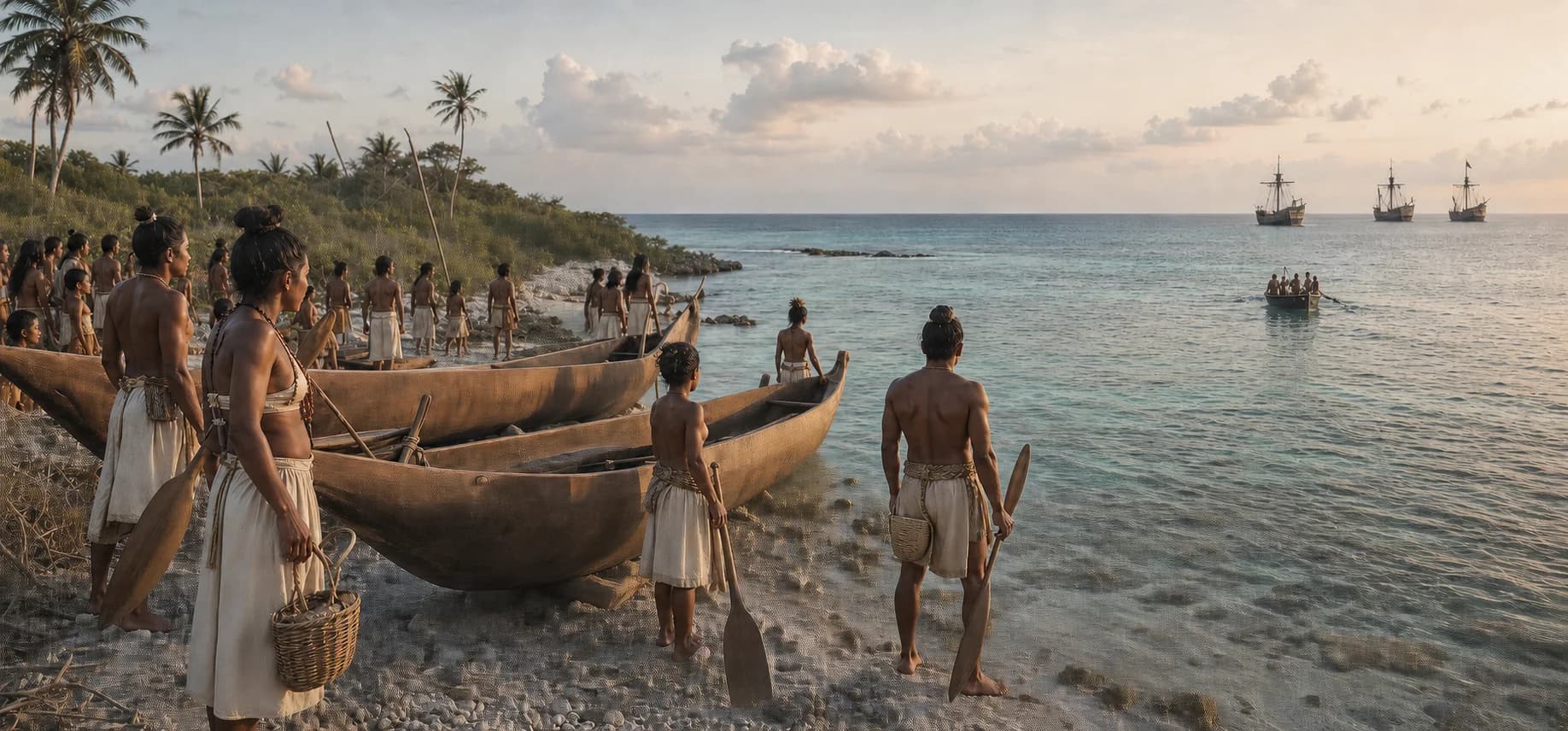
Dawn at Guanahani: large dugout canoes, island navigation, and a shore community return the landfall to a Caribbean already inhabited and connected.
THE GRAMMAR OF ENCOUNTER
Glass beads, cotton, gold, and detained people exchange places within the same pages.
On the first day, Columbus records red caps and glass beads producing pleasure and closeness, then says the islanders could be converted by ‘love rather than force.’ This is not simply a declaration of tolerance: it already places them within a projected order of conversion and crown, immediately followed by the judgment that they would make ‘good servants.’
The next day, canoes, spun cotton, parrots, and spears reveal local technology and exchange. Columbus’s attention quickly narrows to tiny gold ornaments. He questions by gesture and repeatedly turns uncertain answers into directions to another gold-rich island, while the Great Khan, Japan, and spices remain mapped onto Caribbean geography.
Exchange soon becomes control: islanders are carried away to learn Castilian and serve as guides; men, women, and children are later detained. When Las Casas rewrote the material in his Historia, he omitted some damaging passages. Trade, possession, conversion, gold, and captivity must be read together rather than reducing the contact to friendly gifts.
RETURN AND TEXTUAL AFTERLIFE
The parchment in the barrel was never recovered, but another textual chain reached Europe.
In the storm of February 1493, Columbus feared Niña would sink. He wrote a summary of the discoveries, sealed it in waxed cloth inside a barrel, cast it into the sea, and kept another aboard. The barrel has no known afterlife. News arrived through the surviving ship, the journal presented to the monarchs, and a voyage letter rapidly printed in several languages.
Niña returned to Palos on 15 March, with Pinta arriving the same day. The voyage ended, but its texts began new political work: proving performance, securing title and revenue, organizing colonization, and continuing to identify Caribbean islands as Asia’s edge. A ‘New World’ is not the conclusion Columbus has reached in this journal.
After Navarrete first printed Las Casas’s digest in 1825, translators, geographers, and navigation historians repeatedly regularized it into modern logbook pages. Dunn and Kelley’s facing Spanish and English edition restores cancellations, insertions, and marginalia, allowing the act of textual formation to remain visible beside the sea story.
EVIDENCE SOUNDING
Daily detail, textual layers, and Caribbean evidence
Sequence, weather, and shipboard decisions
Continuous dates, courses, estimates, winds, relations among ships, and concrete accidents provide the core evidence for the voyage’s rhythm.
Columbus’s words and Las Casas’s voice
Person and marginalia offer clues, but the complete original is lost and every surviving sentence passed through at least one transmission layer.
Island communities’ historical perspective
The journal records European observations and errors; archaeology, language, oral tradition, and Indigenous scholarship restore the longer Caribbean past.
The modern identity of Guanahani
League, current, heading, and terrain permit several reconstructions. The surviving text cannot eliminate every candidate.
READING DESK · EDITIONS
Continuous reading, facing translation, and manuscript study
Oliver Dunn & James E. Kelley Jr. · The Diario of Christopher Columbus’s First Voyage
Facing manuscript Spanish and English preserving insertions, cancellations, and marginalia, with navigation and landfall research. The best English research entry point.
Diario de Colón · BNE manuscript facsimile and transcription
A facsimile-centred edition of the Las Casas witness, useful for comparing the page, margins, revisions, and modern typesetting.
J. M. Cohen · The Four Voyages
A readable Penguin Classics translation setting the first journal beside later voyage documents. Use a critical edition for exact quotation.
Clements R. Markham · The Journal of Christopher Columbus
An early Hakluyt Society English translation with maps and related documents, now public. Its language and route judgments belong to nineteenth-century scholarship.
LOGBOOK QUESTIONS
Frequently asked questions about the first-voyage journal
Is the surviving journal in Columbus’s handwriting?+
No. Columbus’s shipboard original and the court copy are lost. The main surviving text is Las Casas’s mid-sixteenth-century manuscript digest, quotation, and annotation of an earlier copy.
Why does it switch between ‘I’ and ‘the Admiral’?+
First-person passages are generally marked as Columbus’s words, while third person usually signals Las Casas’s summary. The boundary is not always clean, so critical editions display person, insertion, and revision.
Did Columbus know in 1492 that he had reached the Americas?+
No. He repeatedly interpreted the islands through Asian geography and searched for the Great Khan, Japan, spices, and gold. A recognized ‘New World’ is later knowledge projected back onto the journal.
Who first saw land?+
The journal credits Pinta sailor Rodrigo de Triana with the formal sighting and also records Columbus’s uncertain light several hours earlier. The distinction later became entangled with royal reward and reputation.
Is Guanahani certainly modern San Salvador Island?+
San Salvador is the most familiar identification, but not uncontested. Samana Cay, Grand Turk, and others depend on different readings of heading, league, current, island form, and subsequent route.
Did Columbus deliberately underreport distance?+
The journal explicitly says on several days that he disclosed fewer leagues so the crews would not fear the voyage’s length. Public mileage and estimated progress functioned as instruments of command.
Why did Santa María wreck?+
On Christmas Eve the helmsman slept and left the tiller to a boy. Current carried the ship onto a shoal; falling water and failed recovery efforts left the hull stranded. Its timbers were used at Navidad.
Should this be called the record of the ‘discovery of America’?+
It records a transatlantic encounter of enormous consequence, but ‘discovery’ erases millennia of Caribbean settlement, navigation, and history. A precise account holds European oceanic achievement together with Indigenous encounter and colonial expansion.
DOCUMENT CHAIN
How was this record checked?
- 01Voyages of Christopher Columbus · Vitr/6/7 ↗
Biblioteca Nacional de España
Repository description, date, dimensions, and transmission of the Las Casas digest - 02Diario of 1492 · palaeographic transcription ↗
King’s College London · Early Modern Spain
Full early Spanish text, dated entries, and manuscript images - 03‘Si no está mentirosa la letra’: revisiting the text of the 1492 voyage ↗
King’s College London · Barry Ife
Transmission, digest practice, marginalia, and more than a thousand manuscript revisions - 04The Diario of Christopher Columbus’s First Voyage to America, 1492–1493 ↗
University of Oklahoma Press
Dunn and Kelley’s facing text and research on navigation and landfall - 05Personal narrative of the first voyage of Columbus to America ↗
Library of Congress
Digitized 1827 Kettell translation and bibliographic record - 06Bibliography of the Hakluyt Society · First Series 86 ↗
Hakluyt Society
Record for Markham’s 1893 translation, maps, and related documents - 07Santa Fe Capitulations ↗
UNESCO Memory of the World
Royal office, reward, and institutional setting of the 1492 enterprise - 08Mesoamerica / Caribbean · Infinity of Nations ↗
Smithsonian National Museum of the American Indian
Caribbean navigation, communities, chiefdoms, and long-distance links before European arrival - 09The Four Voyages ↗
Penguin Classics
Publication details and scope of J. M. Cohen’s modern reading edition
Quotations are checked by date; modern island identifications and Indigenous history are not inferred from the journal alone. Read our editorial and corrections policy