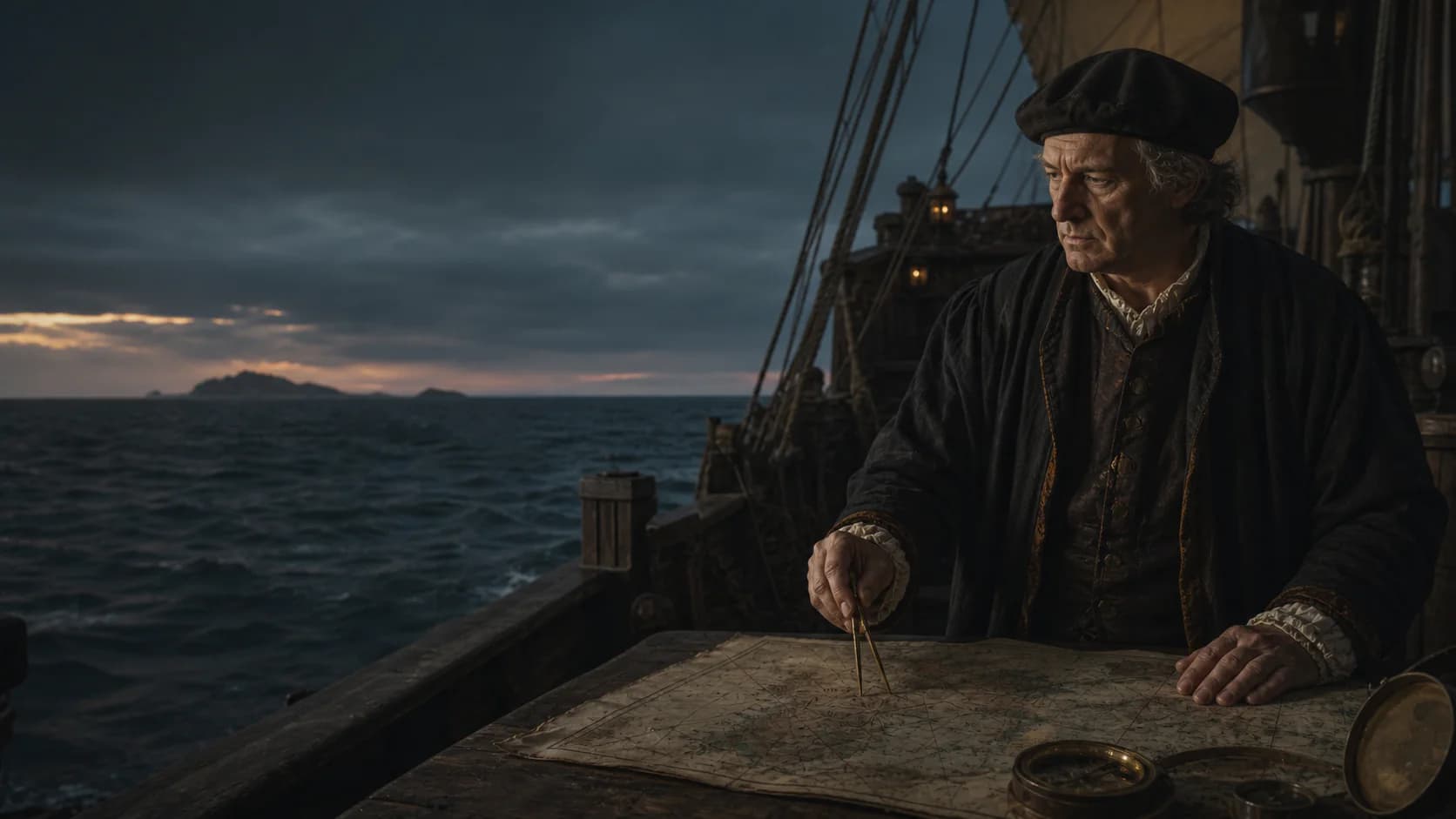
Opening portrait
Who was Christopher Columbus?
Christopher Columbus was a Genoese mariner sponsored by the Crown of Castile. Seeking a westward route to Asia, he reached Caribbean islands in 1492 and made four transatlantic voyages. Those crossings established sustained contact between Europe and the Americas and opened a long history of conquest, colonial government, forced labour, epidemic disease and ecological exchange.
- First voyage
- 1492—1493
- Sponsor
- The Crown of Castile
- First-voyage ships
- Niña, Pinta and Santa María
- Atlantic voyages
- Four
Defining moment
1492 · Across the Atlantic
Beyond the Canary Islands, three ships watched the known world disappear behind them.
There was no dependable timetable ahead and no known harbor waiting at the end. Columbus kept westward, reading weed, birds, clouds and wind as signs of land that had not yet appeared. The nighttime cry of land in October 1492 ended more than a month of ocean uncertainty and turned this crossing into a hinge in Atlantic history.
Life at a glance
Christopher Columbus · career timeline
Key dates connect biography, expeditions and later consequences across a career longer than any one ‘discovery’.
- 01
The first westward voyage begins
Niña, Pinta and Santa María leave Palos and enter the trade winds after calling at the Canaries.
- 02
The ships reach Caribbean islands
The first landfall lies in the Bahamas, though its exact modern island remains disputed.
- 03
Santa María is wrecked
A post at La Navidad turns a brief landing into the beginning of a colonial presence.
- 04
Three further voyages follow
Later expeditions enlarge Castilian control and deepen colonization, enslavement and violence in the Caribbean.
The life in sequence
Follow the voyage from its beginnings to its aftermath.
These chapters follow the order of a life and its expeditions, and are designed to be read as one continuous narrative.
Beyond the Canaries, the familiar coast vanished
In September 1492, three ships entered the northeast trade winds. Columbus used headings, elapsed distance and signs at sea to sustain confidence while crews wondered how long the westward emptiness would continue.
Driftwood, birds and changing water preceded landfall in October. Columbus interpreted the Caribbean through an Asian geography. His calculation was wrong, but the Atlantic route his fleet demonstrated would not close again.
Sustained contact brought two worlds into violent collision
The Americas held populous, varied political and trading societies before 1492, and Norse mariners had reached North America centuries earlier. The decisive change was the Castilian state's ability to keep ships, settlers and demands crossing the Atlantic.
Geographical knowledge, crops and goods moved with conquerors, forced labour and Old World pathogens. The resulting forces produced catastrophic loss for Indigenous societies while Indigenous resistance and survival continued.
The governor belongs beside the navigator
Monuments often isolate the ocean crossing from what followed. Journals, royal contracts and complaints from the colony instead show a man pursuing wealth, hereditary titles and authority over people and land.
His seamanship helped stabilize a route; his political program directed it toward possession. As governor on Hispaniola, Columbus participated in a colonial order of tribute, coercion and violence. Technique and consequence occupy the same biography.
Beyond the voyage
Some histories come into focus outside the timeline.
Local societies, navigation, surviving records and later consequences each open a separate path into the story.
Records and evidence
How do the sources support these claims?
Confirmed facts, disputed questions and common misconceptions appear as distinct parts of the record.
The intended destination remained Asian
The proposal, royal agreement and Columbus's geographical language consistently place the voyage within his understanding of Asia.
The first landing island is unresolved
The transmitted journal and route reconstructions establish the Bahamas, but not one universally accepted modern island.
Sustained contact is more accurate than discovery
The important change was continuous Atlantic connection and colonization, not a first human arrival on supposedly empty land.
Questions to carry forward
Common questions
When was Columbus's first voyage?
It left in August 1492, reached the Caribbean in October and returned to Iberia in 1493.
Did Columbus know he had reached America?
No. He continued to place the islands and continental coasts within an Asian geographical framework.
Why avoid saying he discovered America?
The phrase erases existing Indigenous societies and earlier Norse arrival. His distinctive role was to begin sustained European colonial contact.
Whom did the first voyage encounter?
The principal contacts in the Bahamas and Greater Antilles were with Taíno and related Caribbean communities. 'Indian' came from Columbus's mistaken geography.
Sources
Sources and further verification
The institutions below support the account; disputed numbers, place identifications and claims of ‘first discovery’ retain their uncertainty.
- 1492: An Ongoing VoyageLibrary of Congress
- Christopher Columbus Interactive MapThe Mariners’ Museum and Park
- Columbus and the TaínoLibrary of Congress
- Europe Claims AmericaLibrary of Congress
Age of Seas editorial research distinguishes documentary facts, scholarly disputes and narrative judgments.Editorial standards and corrections ↗