In one minute
What did this event actually change?
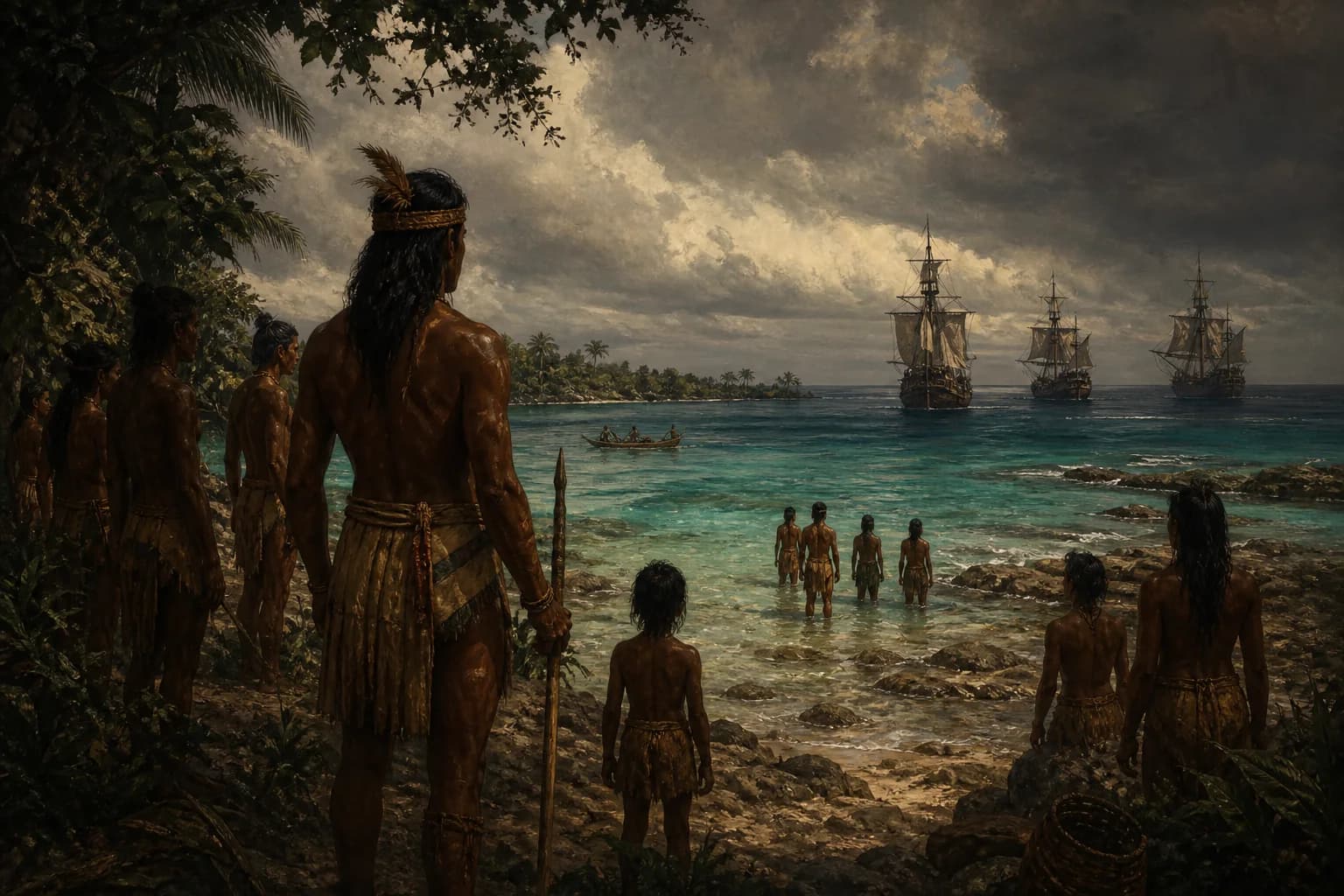
Christopher Columbus left Palos in August 1492 with the Niña, Pinta and Santa María. Using the northeast trade winds from the Canaries, the ships reached an island in the Bahamas on 12 October, then sailed to Cuba and Hispaniola. Columbus believed he had reached the fringes of Asia. The historical turning point was not a first human discovery, but the beginning of sustained Atlantic contact followed by seizure, forced labour, disease and settlement.
- Departure
- 3 August 1492, Palos
- Ships
- Niña, Pinta and Santa María
- First landfall
- 12 October, somewhere in the Bahamas; the exact island is disputed
- People encountered
- Indigenous Caribbean societies, including Taíno communities
- Immediate result
- A post at La Navidad and a return to Iberia in 1493
Chronology
A process, not a single date
Causes, turning points and aftermath form one process, far larger than a capital’s fall, a signed treaty or a company’s founding date.
- 01
The Capitulations of Santa Fe define rewards
The Castilian Crown promises Columbus titles and a share in the wealth and jurisdiction of lands he expects to reach.
- 02
Three ships leave Palos
After repairs and provisioning in the Canaries, the small fleet enters the northeast trade winds.
- 03
The expedition reaches the Bahamas
Columbus renames an inhabited island and claims it for Castile; its modern identification remains contested.
- 04
The ships search Cuba and Hispaniola
The expedition seeks gold and imagined Asian courts while exchanging with—and seizing people from—Taíno communities.
- 05
Santa María is wrecked and La Navidad is built
Timber from the flagship becomes a small post, turning a temporary visit into the beginning of a colonial presence.
- 06
News of the voyage reaches Iberia
Objects and forcibly transported Indigenous people accompany the report; a much larger colonizing fleet is soon prepared.
What was Columbus looking for?
He proposed reaching Asian markets by sailing west. His calculation underestimated both Earth's circumference and the ocean distance between Europe and Asia. Castile accepted the gamble after the conquest of Granada, combining hopes of commerce, Christian mission and territorial rivalry.
The route depended on Atlantic wind systems. The fleet sailed west from the Canaries with the trades, then returned farther north to find the westerlies. The crossing was neither a straight line along one latitude nor proof that Columbus knew an American continent stood in the way.
Whose encounter took place on 12 October?
The ships entered a Caribbean world with inhabitants, languages, canoe routes and political relationships. Taíno communities gave food, guidance and information; they also faced demands for gold, abduction and the threat of European weapons.
Columbus performed possession in Castile's name and replaced an island's name with San Salvador. That ceremony recorded a European claim. It did not ask for Indigenous consent or turn inhabited land into legitimate royal property.
Colonization was already present in the first voyage
The surviving account repeatedly evaluates gold, labour and conversion. After Santa María grounded off Hispaniola, the crew built La Navidad and left men there. Exchange was already sliding toward taking people and resources by force.
The 1493 return was a beginning, not a conclusion. The second voyage carried far more people, animals and supplies for settlement. Warfare, tribute and forced labour followed, while pathogens from the Old World contributed to catastrophic Indigenous population loss.
Why is 1492 still a global turning point?
Norse mariners had reached North America centuries earlier, and the Americas held tens of millions of people with histories stretching back millennia. What changed after Columbus was the continuity and accelerating scale of the connection.
Plants, animals, pathogens, people and silver crossed the Atlantic in flows later called the Columbian Exchange. Its world-changing force cannot be separated from colonial violence, enslavement and Indigenous survival. Removing the discovery myth makes the event more—not less—historically consequential.
Evidence boundary
Fact, interpretation and uncertainty
The evidence reveals where imperial claims diverged from reality and where heroic stories compressed complex wars.
The broad route, ships and dates are well supported
A surviving abstract of the journal, royal records and early maps establish the sequence from Palos through the Bahamas and Hispaniola to the 1493 return.
The exact island of the first landfall is unresolved
Several Bahamian islands fit parts of the recorded bearings and distances; no reconstruction has achieved universal acceptance.
1492 was not the human discovery of America
Indigenous societies had inhabited and known the continents for millennia, and Norse voyages reached North America earlier. The distinctive change was sustained colonial contact.
Questions
Common questions
Did Columbus first land in the present-day United States?
No. The first landfall was on an island in the Bahamas, and the 1492 voyage remained in the Caribbean.
Did he know he had reached a new continent?
No. Columbus continued to interpret the islands and nearby coasts as parts of Asia or its approaches.
Why is 'discovered America' disputed?
The wording makes existing Indigenous peoples disappear and ignores earlier Norse arrival. 'Reached the Caribbean and began sustained Atlantic contact' states the documented change more precisely.
Did all three ships return?
No. Santa María grounded off Hispaniola. Niña and Pinta returned to Europe, carrying news of the voyage.
Sources
Sources and further verification
Archives, museums, international organizations and academic publications support the facts and interpretive limits in this account.
- 1492: An Ongoing VoyageLibrary of Congress
- Explorations and EncountersLibrary of Congress
- Christopher Columbus Interactive MapThe Mariners’ Museum and Park
- Europe Claims AmericaLibrary of Congress
Age of Seas editorial research distinguishes verifiable facts, historical interpretation and potentially misleading simplifications.Editorial standards and corrections ↗