Case file ↓
Short answer
It turns distant atrocities into one institutional problem that royal power must confront.
A Short Account of the Destruction of the Indies is a compact indictment written by the Dominican friar and former bishop of Chiapas Bartolomé de las Casas to stop Spanish warfare, enslavement, forced labour, and plunder in the Americas. An early version was completed in 1542; Las Casas revised it and published it at Seville in 1552 with a dedication to the future Philip II. From Hispaniola, Cuba, and Nicaragua through Mexico, Peru, and New Granada, twenty regional sections repeat a connected process: conquest and the search for gold destroy political resistance, then coerced labour continues the loss of life. Las Casas possessed direct experience in the Caribbean but depended heavily on friars, officials, returning colonists, letters, and legal testimony for distant regions. His enormous death totals also functioned as an urgent appeal to the Crown and gain context from regional demographic research. Dutch, French, English, German, and Latin editions later reframed the work for conflicts with Spain; the engravings added to Theodor de Bry’s Latin edition of 1598 became especially influential in the history of the Spanish Black Legend. Original wording, source layers, demographic reconstruction, translation, and visual afterlife form five connected histories of the work.
“injustas, crueles, sangrientas y tiránicas guerras”The general opening: coercive labour follows warClassic passages
Six Spanish passages connect war, labour, gold, law, and the purpose of print.
- 01Purpose of the accountArgument of the epitome
Entre éstas, son las matanzas y estragos de gentes inocentes y despoblaciones de pueblos, provincias y reinos que en ellas se han perpetrado.
TranslationAmong these are the massacres and devastation of innocent peoples, and the emptying of towns, provinces, and kingdoms that has been carried out there.
The prefatory argument states what the court must be made to know. The book is not a neutral chronology but a body of accusations selected and compressed to force intervention.
- 02Mechanism of destructionGeneral opening
Dos maneras generales y principales han tenido los que allá han pasado que se llaman cristianos… La una, por injustas, crueles, sangrientas y tiránicas guerras; la otra… oprimiéndolos con la más dura, horrible y áspera servidumbre.
TranslationThose who crossed over and call themselves Christians have used two main ways to destroy those nations: unjust, cruel, bloody, tyrannical wars, followed by oppression under the hardest and most terrible servitude.
War and labour are not separate lists of atrocity. The passage joins them as a sequence: destroy the capacity to resist, then extract labour from those who remain.
- 03Gold and advancementGeneral opening
La causa porque han muerto y destruido… ha sido solamente por tener por su fin último el oro y henchirse de riquezas en muy breves días y subir a estados muy altos.
TranslationThe cause of so much death and destruction has been to make gold the final end, to fill themselves with riches in very few days, and to rise to the highest stations.
Las Casas places individual greed beside a colonial route to rapid status. Together they explain why successive expeditions reproduced violence rather than merely inheriting isolated abuses.
- 04Hatuey’s judgmentChapter on Cuba
Veis aquí el dios de los cristianos; hagámosle, si os parece, areítos… y quizá le agradaremos y les mandará que no nos hagan mal.
TranslationHere is the god of the Christians. Let us perform areítos for it, if you agree; perhaps we shall please it and it will order them not to harm us.
Las Casas attributes this speech to the Taíno leader Hatuey. Gold becomes a bitterly ironic deity, setting colonists’ religious claims against the purpose visible in their actions.
- 05A legal performanceMainland chapter · the Requerimiento
Estando los indios en sus pueblos y casas seguros, íbanse de noche… y allí aquella noche entre sí mesmos apregonaban o leían el dicho requerimiento.
TranslationWhile the people rested securely in their towns and homes, the raiders went out by night and there, among themselves, proclaimed or read the said Requirement.
The intended audience could neither hear nor understand the document. Las Casas uses that absurd scene to show written law manufacturing formal justification for an attack at dawn.
- 06Date of the early textConclusion dated 1542
Acabéla en Valencia, a ocho de diciembre de mil y quinientos y cuarenta y dos años, cuando tienen la fuerza y están en su colmo actualmente todas las violencias, opresiones, tiranías, matanzas, robos y destruiciones.
TranslationI finished it at Valencia on 8 December 1542, when all the violence, oppression, tyranny, slaughter, robbery, and destruction were at their greatest force and height.
The conclusion dates an early version. The edition of 1552 adds later news and material on resistance to the New Laws, so the stated completion date is not the closing date of the printed text.
Author × text × print
Behind a small book of 1552 lie fifty years of change and four centuries of reuse.
- 01
Las Casas reaches Hispaniola
He enters the Caribbean as a member of colonial society and later receives land and an allocation of Indigenous labour. His criticism begins inside the system he will attack.
- 02
Cuba campaign and encomienda
Serving as a chaplain around the conquest and sharing in encomienda returns gives him his closest experience of the violence later described in the Cuba chapter.
- 03
Renunciation and petition at court
He relinquishes his claim to Indigenous labour and carries the problem of colonial abuse into royal and ecclesiastical administration.
- 04
Entry into the Dominican Order
Dominican study, theology, and natural-law argument broaden personal witness into a sustained dispute about war, slavery, conversion, and legitimate rule.
- 05
The early Short Account takes shape
He compresses material gathered alongside his much longer History of the Indies and dates completion at Valencia on 8 December 1542.
- 06
The New Laws are promulgated
The Crown attempts to limit Indigenous slavery and hereditary encomienda within the same reform movement. Las Casas mattered, but the legislation was not the work of one author or book.
- 07
Bishop of Chiapas, then return to Spain
He tries to use rules of confession against holders of coerced Indigenous labour, meets fierce colonial resistance, and returns to continue his campaign at court.
- 08
The Valladolid controversy
Las Casas and Juan Ginés de Sepúlveda dispute conquest, evangelization, Indigenous political capacity, and the grounds of just war.
- 09
The first Seville edition
Sebastián Trujillo prints the quarto as one of eight Las Casas tracts issued in a concentrated publishing campaign between 1552 and 1553.
- 10
Dutch, French, and English political reframing
The Dutch revolt and Anglo-Spanish rivalry alter titles, prefaces, and audiences, turning an internal reform tract into evidence against Spain.
- 11
De Bry’s illustrated Latin edition
The Frankfurt volume adds atrocity images designed by Joos van Winghe. The artist never visited America, and the plates do not belong to the 1552 first edition.
- 12
Reprints, critical texts, and modern translations
A Barcelona reprint, modern English versions, and Martínez Torrejón’s critical work allow readers to compare the 1542 manuscript stage, the princeps, and later alterations.
Regional testimony
Twenty regional chapters reveal recurring mechanisms of conquest.
Caribbean beginnings
The region of densest firsthand experience and the earliest laboratory of Spanish colonial rule.
- 01The island of HispaniolaHaiti and the Dominican Republic
- 02The kingdoms of HispaniolaFive principal Taíno political regions
- 03San Juan and JamaicaPuerto Rico and Jamaica
- 04The island of CubaCuba · the Hatuey narrative
- 05The MainlandDarién and the Caribbean mainland coast
Central America and Mexico
Letters, friars’ reports, testimony, and other participants increasingly supplement direct experience.
- 06The province of NicaraguaNicaragua and neighbouring regions
- 07New Spain · first sectionOpening conquest of Mexico
- 08New Spain · second sectionViolence after the initial conquest
- 09The province and kingdom of GuatemalaGuatemalan highlands and adjacent regions
- 10New Spain, Pánuco, and JaliscoGulf coast and western Mexico
Yucatán and the Caribbean mainland
Ports, pearl fisheries, slave raiding, and movement into the interior form connected fronts.
- 11The kingdom of YucatánYucatán Peninsula
- 12The province of Santa MartaCaribbean coast of present-day Colombia
- 13The province of CartagenaCartagena and the route toward Urabá
- 14Pearl Coast, Paria, and TrinidadNortheastern Venezuela and Trinidad
- 15The river YuyapariOrinoco basin
Continental north and south
The scale expands from Florida through the Andes to the great southern estuary.
- 16The kingdom of VenezuelaVenezuela · including Welser rule
- 17The provinces called FloridaRepeated expeditions into southeastern North America
- 18The Río de la PlataSoutheastern South American estuary
- 19The great kingdoms and provinces of PeruThe Andes
- 20The New Kingdom of GranadaInterior highlands of present-day Colombia
Form of the indictment
It advances by region while trying the same mechanism again and again.
The Short Account resembles a case register opening outward from the Caribbean. Place-names change while the narrative structure returns: hospitality is followed by demands for gold, seizure, or war; resistance is renamed rebellion; survivors enter mines, transport work, pearl fisheries, and household service. Repetition is the method by which Las Casas argues that violence is systemic.
He reduces the process to two trunks—war and servidumbre, coercive service—from which other abuses branch. An atrocity no longer appears as one commander losing control. Gold, office, conquest licence, encomienda, and failed justice form a reproducible economy of advancement.
Regional arrangement serves an immediate political purpose. A court reader can move from Hispaniola to New Granada in a short volume and see that the problem did not remain in an early colony. Brevísima means compressed, not slight: an unpublished long history becomes a tract that can be presented, printed, and read quickly.
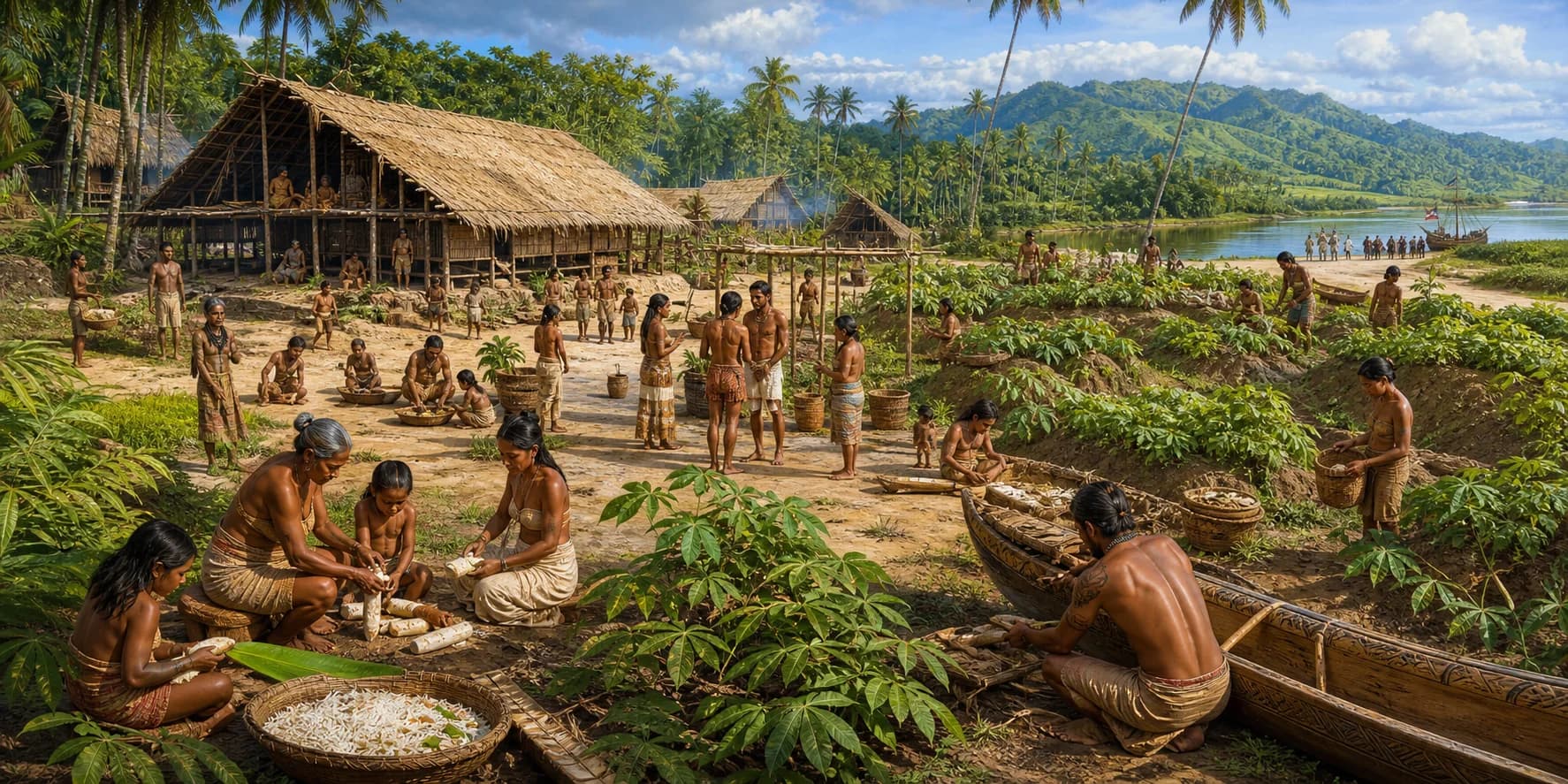
Las Casas repeatedly describes supposedly empty lands as populated worlds of farming, settlement, and political order. The scene centres cassava cultivation and community labour before colonial disruption.
Layers of testimony
Across twenty regions, ‘I saw’ rests on different chains of information.
Las Casas entered Hispaniola in 1502 and knew Caribbean colonial society at close range. He served as a chaplain around the conquest of Cuba. When the Cuba chapter says that a massacre occurred in his presence, the claim is explicitly local; his time as an encomendero also gave him inside knowledge of labour, food, and power in a colonial settlement.
For Mexico, Venezuela, Peru, and New Granada, his source base widens to returning witnesses, friars, letters, court papers, and judicial inquiries, sometimes copied at length. The achievement is to gather material that official victory reports could obscure. The authority of his first person does not turn each distant event into an eyewitness scene.
This dossier therefore separates direct experience, near-contemporary report, and cross-regional compilation. A particular incident should be checked against testimony, Indigenous traditions, local records, archaeology, and other chronicles. Las Casas’s politics, meanwhile, lie in how he selects, compresses, and orders those materials.
Numbers and population
The tract turns demographic collapse into numbers with the force of an alarm.
Las Casas writes of twelve, fifteen, and further millions of deaths to bring a continental emergency to the scale of royal attention. The estimates emerged without consistent censuses, borders, or categories of cause, and they served urgent persuasion. Adding them directly produces overlaps of territory and time and claims beyond the surviving evidence.
Disputed totals do not erase the catastrophe. Warfare, massacre, hunger, flight, social disruption, forced migration, and labour all caused death, while pathogens from Eurasia and Africa spread through communities without prior immunity. The pace and balance of causes varied by region. Disease is not an alternative story that removes human decisions from the record.
A careful reading treats the numbers as sixteenth-century alarms, then turns to tribute lists, baptismal and burial records, settlement archaeology, ecological evidence, and demographic models for regional estimates. Las Casas is strongest not as a final census-taker, but in recognizing how war and labour produced depopulation.
The print intervention of 1552
Publication ten years after the first draft was itself a political act.
The version of 1542 belongs to Las Casas’s campaign for reform at court. The New Laws of the same year tried to limit Indigenous slavery and the inheritance of encomiendas. They arose from a larger field of theology, law, administration, and material interest—not from one tract alone. Resistance in the Americas helps explain why Las Casas kept revising and then printed his arguments.
At Seville in 1552 he launched eight tracts in a concentrated publishing effort. The Short Account addresses Prince Philip and assumes that a just ruler permits evil only because the truth has been hidden from him. The strategy preserves hope in royal correction while placing the consequences of inaction before the monarchy.
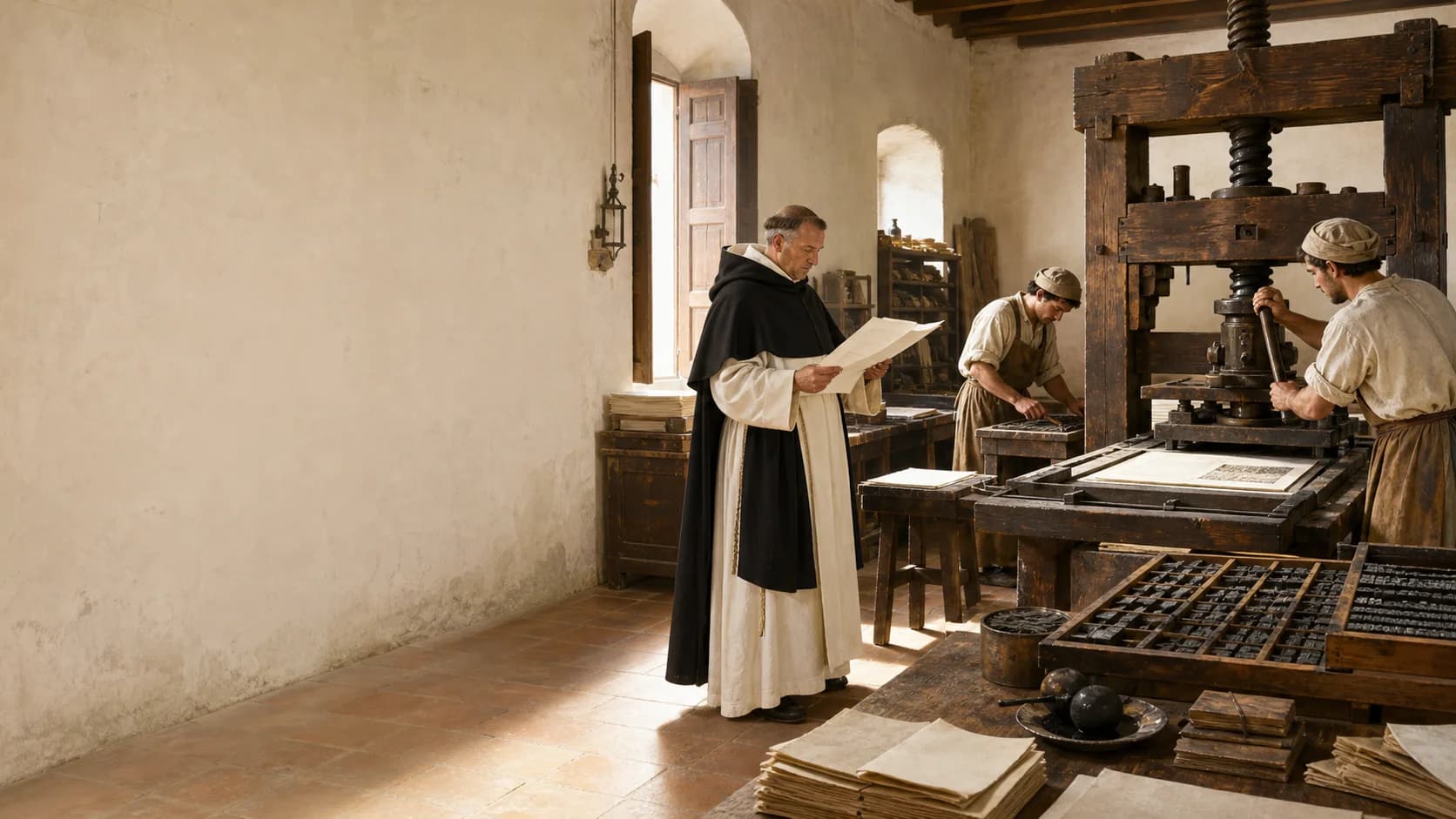
Print changed the audience. Once a court report became a quarto, it could be sold, copied, excerpted, and translated. Las Casas sought to control conquest and government within the Spanish monarchy. The market carried his words into the Dutch revolt, Anglo-Spanish war, confessional conflict, and later anti-colonial thought.
The image after the text
The famous atrocity engravings appeared forty-six years after the first edition.
The Seville edition of 1552 did not contain the violence plates now repeatedly attached to the book online. In 1598 the Frankfurt publisher Theodor de Bry joined a Latin translation to images designed by Joos van Winghe. The artist had not visited America and drew on European visual languages of martyrdom, warfare, torture, and punishment.
The plates make Las Casas’s dense verbs visible at a glance, while compressing different places, years, and actors into a consistent visual system. They are evidence for how late-sixteenth-century European publishers imagined and circulated the account. They are not eyewitness pictures of a specific event in Cuba, Mexico, or Peru.
Northern translations also altered headings and terms, sometimes changing the author’s religiously charged ‘Christians’ into the national category ‘Spaniards.’ The Short Account thus entered the Spanish Black Legend through an overlap of documented accusation, interstate rivalry, and selective repackaging. Separating those layers is more useful than reducing the work to either truth or propaganda.
A witness who changed
The fiercest critic had once shared in the colonial system he condemned.
Las Casas was not a modern reporter standing outside empire. He once held an encomienda and lived around the conquest of Cuba before renouncing the returns and beginning a lifetime of petition. The transformation gave him access to colonial reasoning and institutions, while requiring his early responsibility to remain part of the biography.
He also once proposed greater importation of enslaved Africans as a way to reduce Indigenous labour. In his later History of the Indies he regretted that advice and judged African enslavement unjust as well. The change cannot erase the proposal, and his proposal did not create the Atlantic slave trade. It reveals a moral boundary shifting over decades rather than a flawless position present from the beginning.
The Short Account insists that Indigenous peoples possess reason, political communities, and rights, yet it still speaks within sixteenth-century missions, paternalism, Christianity, and royal authority. It is neither a modern declaration of equality nor an ordinary colonial chronicle. Its singular force lies in an imperial actor converting access to institutions into a public accusation that later readers repeatedly repurposed.
Limits of evidence
Use indictment, demographic history, and visual reception as distinct kinds of evidence.
Mechanisms of colonial violence and contemporary protest
The repeated connection among war, demands for gold, enslavement, labour, and failed justice is the work’s central historical argument.
Eyewitness, report, and judicial testimony
Caribbean experience, reports from Mexico, and Andean testimony follow different information chains that can be examined event by event.
Regional estimates running into millions
The figures act as alarms and petitions across overlapping territories; independent regional studies supply quantitative context for collapse.
The De Bry violence plates of 1598
The later engravings document European reception, reinterpretation, and the visual formation of the Black Legend.
Reading editions
Critical Spanish text, translation, and first-edition facsimile
José Miguel Martínez Torrejón · Biblioteca Virtual Miguel de Cervantes
A critical Spanish text based on the 1552 princeps and informed by the 1542 manuscript stage and an intermediate version. Best for searchable wording, chapter structure, and variants.
Nigel Griffin trans. · A Short Account of the Destruction of the Indies
A widely used English reading edition with Anthony Pagden’s introduction. Return to the Spanish for precise quotation and historically charged terminology.
Herma Briffault trans. · The Devastation of the Indies
The Johns Hopkins edition republishes an earlier translation with an introduction by Bill Donovan and is useful for comparing English titles and reception.
University of Valladolid / University of Seville collections
Consult the first quarto directly for title page, order, spelling, and colophon—the clearest way to separate the princeps from later illustrated editions.
Reader questions
Eyewitness, numbers, the New Laws, slavery, and the Black Legend.
What is A Short Account of the Destruction of the Indies about?+
Its twenty regional sections denounce war, massacre, enslavement, forced labour, and plunder in the Spanish conquests, connecting those acts to gold, office, conquest licences, and encomienda.
Did Las Casas witness everything in the book?+
No. He had direct experience in Hispaniola and Cuba. For more distant regions he relied on friars, officials, conquistadors, returning witnesses, letters, and judicial testimony, which must be assessed event by event.
Was the book written in 1542 or 1552?+
An early version was completed on 8 December 1542. The Seville edition of 1552 was revised and expanded, including material written after resistance to the New Laws. The dates refer to textual formation and first printing.
Did the Short Account cause the New Laws of 1542?+
Las Casas’s petitions and writings mattered to reform, but the New Laws emerged from a much broader legal, theological, administrative, and political process. The printed edition followed them by ten years.
Are Las Casas’s death totals reliable?+
They show his understanding of catastrophic scale and function as urgent persuasion, but overlap, uneven sources, and premodern calculation prevent them from serving as a modern total. Regional demographic research provides separate evidence of collapse.
Were De Bry’s engravings in the 1552 first edition?+
No. The famous plates appeared in a Frankfurt Latin edition of 1598 and were designed by an artist who had never visited America. They belong to the book’s visual reception, not to its first printing.
What is the Spanish Black Legend in relation to this book?+
Spain’s Dutch, English, and other rivals repackaged Las Casas’s internal reform indictment through new titles, prefaces, translations, and images. Political use is part of the reception history; it does not make the colonial violence imaginary.
Did Las Casas support African slavery?+
He initially proposed importing more enslaved Africans to relieve Indigenous labour, then later regretted the advice and condemned African enslavement as unjust. Both stages matter, and the Atlantic slave trade cannot be attributed to one individual.
Research sources
First edition, critical text, author, translation, and image
- 01Brevísima relación de la destruición de las Indias · critical edition ↗
Biblioteca Virtual Miguel de Cervantes
Critical text based on the 1552 princeps and informed by the 1542 version, with chapter text and notes - 02Breuissima relacion de la destruycion de las Indias · 1552 ↗
University of Valladolid · UVaDOC
Catalogue record and digital facsimile of Sebastián Trujillo’s Seville edition - 03Breuissima relación · 1552 edition record ↗
University of Seville · América exhibition
Physical format, complete order of contents, printer, and surviving copies of the princeps - 04Interpreting the Conquest ↗
Library of Congress · Exploring the Early Americas
The 1552 book, its appeal to the Crown, and its place in early American collections - 05Bartolomé de las Casas · authority record ↗
PARES · Portal de Archivos Españoles
Spanish archival authority record covering his early colonial, encomendero, and episcopal career - 06A brief account ↗
Cambridge University Library · 800 Years of Dominican Books
Publication in 1552, the Latin edition of 1598, Joos van Winghe’s images, and European reception - 07Narratio regionum Indicarum · 1598 ↗
Claremont Colleges Library Special Collections
Collection description of the first illustrated Latin edition and the non-eyewitness status of its images - 08A Short Account of the Destruction of the Indies ↗
Penguin Classics
Nigel Griffin’s English translation with an introduction by Anthony Pagden - 09The Devastation of the Indies ↗
Johns Hopkins University Press
Herma Briffault’s translation, Bill Donovan’s introduction, and edition history - 10Mercancía, gentes pacíficas y plaga ↗
University of Pittsburgh · D-Scholarship
Research on Las Casas’s movement from early support for importing African captives to criticism of the slave trade
Sources checked and page updated 25 August 2026. Read our editorial and citation standards