Epic score ↓
Short answer
It raises a sea route into national myth, then writes dissent inside the myth.
The Lusiads (Os Lusíadas) is a Portuguese epic by Luís de Camões, printed in Lisbon in 1572. Its ten cantos and 1,102 ottava-rima stanzas take Vasco da Gama’s voyage of 1497–99 as their narrative axis, but the poem begins with the fleet already off East Africa and expands through retrospection, prophecy, and spectacular episodes into a history of Portugal. Venus protects the fleet and Bacchus works against it; the Old Man of Restelo calls honour an empty name; Adamastor turns the Cape into an offended giant; and Tethys finally shows da Gama the Machine of the World. Imperial purpose, experienced seascapes, classical myth, memories of war, and distrust of greed drive the same poem while continually colliding with one another.
Classic passages
Six complete ottavas let the song alter its pitch from within.
- OTTAVA 01Epic propositionCanto I · stanza 1
As armas e os barões assinalados, Que da ocidental praia Lusitana, Por mares nunca de antes navegados, Passaram ainda além da Taprobana, Em perigos e guerras esforçados, Mais do que prometia a força humana, E entre gente remota edificaram Novo Reino, que tanto sublimaram;
Working translationArms are my theme, and the distinguished heroes who left Lusitania’s western shore, passed over seas never sailed before, and travelled beyond Taprobana; tested by dangers and wars beyond what human strength promised, they built among distant peoples a new realm which they raised so high.
The first stanza gives the poem its scale. Its subject is not one captain but a collective, and navigation, warfare, and the building of a new realm enter the same epic proposition. - OTTAVA 02The death of InêsCanto III · stanza 120
Estavas, linda Inês, posta em sossego, De teus anos colhendo doce fruito, Naquele engano da alma, ledo e cego, Que a Fortuna não deixa durar muito, Nos saudosos campos do Mondego, De teus fermosos olhos nunca enxuito, Aos montes ensinando e às ervinhas O nome que no peito escrito tinhas.
Working translationLovely Inês, you rested quietly, gathering the sweet fruit of your years in that happy, blinded dream of the soul which Fortune never lets endure. In the longing fields of the Mondego, never dry of tears from your beautiful eyes, you taught the hills and grasses the name written in your heart.
As da Gama narrates Portuguese history at Malindi, a court killing becomes lyric tragedy. The nation’s epic memory is made from more than expeditions and victories. - OTTAVA 03The price of fameCanto IV · stanza 95
Ó glória de mandar! Ó vã cobiça Desta vaidade, a quem chamamos Fama! Ó fraudulento gosto, que se atiça C'uma aura popular, que honra se chama! Que castigo tamanho e que justiça Fazes no peito vão que muito te ama! Que mortes, que perigos, que tormentas, Que crueldades neles experimentas!
Working translationO glory of command! O empty craving for this vanity we call Fame! O fraudulent pleasure, kindled by a popular breath that people call honour! What punishment and justice you work upon the hollow heart that loves you; what deaths, dangers, torments, and cruelties you make it undergo.
Before the fleet sails, the Old Man of Restelo reverses the epic’s brightest vocabulary. The poem does not settle his argument for us; it places the question directly beside departure. - OTTAVA 04The Cape speaksCanto V · stanza 50
Eu sou aquele oculto e grande Cabo, A quem chamais vós outros Tormentório, Que nunca a Ptolomeu, Pompónio, Estrabo, Plínio, e quantos passaram, fui notório. Aqui toda a Africana costa acabo Neste meu nunca visto Promontório, Que para o Pólo Antárctico se estende, A quem vossa ousadia tanto ofende.
Working translationI am that hidden and enormous Cape which you call the Cape of Storms, unknown to Ptolemy, Pomponius, Strabo, Pliny, and all who went before. Here I end the whole African coast in this promontory never seen before, reaching towards the Antarctic Pole and so deeply offended by your daring.
Adamastor is at once a geographical obstacle and a memory device for shipwreck, war, and death. At the moment the Cape is overcome, it acquires a voice of its own. - OTTAVA 05The Machine of the WorldCanto X · stanza 80
Vês aqui a grande máquina do Mundo, Etérea e elemental, que fabricada Assi foi do Saber, alto e profundo, Que é sem princípio e meta limitada. Quem cerca em derredor este rotundo Globo e sua superfície tão limada, É Deus: mas o que é Deus, ninguém o entende, Que a tanto o engenho humano não se estende.
Working translationHere you see the great Machine of the World, ethereal and elemental, fashioned by the high and profound Wisdom that has no beginning and no bounded end. God surrounds this round globe and its polished surface; but what God is no one understands, for human ingenuity cannot reach so far.
Tethys reduces the cosmos to a visible model, joining geography, prophecy, and theology. The world appears surveyable, but the limits of human understanding are stated just as clearly. - OTTAVA 06The untuned lyreCanto X · stanza 145
No mais, Musa, no mais, que a Lira tenho Destemperada e a voz enrouquecida, E não do canto, mas de ver que venho Cantar a gente surda e endurecida. O favor com que mais se acende o engenho Não no dá a pátria, não, que está metida No gosto da cobiça e na rudeza Duma austera, apagada e vil tristeza.
Working translationNo more, Muse, no more: my lyre is out of tune and my voice grown hoarse—not from singing, but from seeing that I have come to sing to a deaf and hardened people. My country gives none of the favour that most enkindles genius; it is sunk in the taste for greed and brutishness, in an austere, dim, and abject sadness.
The fleet is back in the Tagus, but the epic does not close with uncomplicated triumph. Camões calls his audience deaf and hardened, allowing exhaustion and criticism to govern the cadence of the end.
Voyage × poet × book
A voyage of 1497 became a book in 1572, then changed with every reset and translation.
- 01
Da Gama’s first India voyage
Four ships leave Restelo, round southern Africa, reach Calicut, and return. The historical voyage provides the epic’s narrative frame.
- 02
Camões is born
Neither year nor birthplace is secured by a full contemporary record. Details in later biographies carry different levels of certainty.
- 03
Passage to India
A royal pardon records that Camões was about to leave for India. He reached Goa that year and entered the military and administrative world of Portuguese Asia.
- 04
Asia and Mozambique
He lived in Goa and the wider Indian Ocean world, then spent a difficult period in Mozambique before his return. The poem’s seas, ports, and imperial disappointments emerge from this long experience.
- 05
Return to Lisbon
After friends helped him leave Mozambique, Camões returned to Portugal and sought the censorship approval, privilege, and means needed to print the poem.
- 06
Royal privilege
The printed preliminaries preserve approval and privilege, bringing pagan gods, Christian mission, and contemporary politics into a licensed print framework.
- 07
The Lusiads printed in Lisbon
The quarto attributed to António Gonçalves contains 186 leaves. Surviving copies dated 1572 involve independent settings and mixed sheets, not a problem solved by pelican direction alone.
- 08
The poet dies amid dynastic crisis
Camões died in June. The succession crisis after King Sebastian’s death soon drew Portugal into the Iberian Union and changed the political mood of the epic’s reception.
- 09
Early reprints and censorship
The so-called Piscos edition and later printings altered wording and passages. A modern text sits beyond several rounds of resetting and correction.
- 10
First complete English translation
Richard Fanshawe’s The Lusiad brought the poem into English and opened a continuing argument about how to remake its metre, mythology, and imperial language.
- 11
William Julius Mickle’s translation
Mickle’s expansive version shaped Anglophone readers for generations while carrying eighteenth-century commercial-imperial language into a sixteenth-century poem.
- 12
Modern translation and bibliographical reassessment
Landeg White supplied a fresh English route into the poem. Optical collation later confirmed two independently set editions bearing the date 1572, while their sequence remains debated.
Score of ten cantos
Four movements, ten changes of scene: epic time never moves only forward.
Divine council and East Africa
The action begins in mid-voyage: the gods debate Portuguese fortunes before the fleet moves from Mozambique and Mombasa to Malindi.
Canto I · An opening at sea
Proposition, dedication, council of the gods; the fleet is already off East Africa
Canto II · Arrival at Malindi
Bacchus plots, Venus intervenes, and Malindi becomes a narrative harbour
Portuguese history and departure
Da Gama tells the king of Malindi a national history in which dynasty, war, the tragedy of Inês, and the departure from Restelo share one memory.
Canto III · Founding and Inês
From the myth of Lusus to royal history; lyric tragedy breaks the sequence of victory
Canto IV · Dynasty and Restelo
Aljubarrota, Manuel I, and the departure of 1497
Ocean experience and India
Maritime wonders, Adamastor, Calicut diplomacy, and history painted on flags interlock; knowledge and misrecognition grow together.
Canto V · Adamastor
The South Atlantic, the Cape, the East African coast, and arrival at Malindi
Canto VI · Across the Indian Ocean
Bacchus provokes the sea gods; a storm ends in the sight of India
Canto VII · Calicut
Landing, the Zamorin’s court, and Monçaide as linguistic intermediary
Canto VIII · Banners and negotiation
Paulo da Gama interprets heroes; trade and detention intensify
Reward, cosmos, and return
Venus creates the Isle of Love as an allegorical reward; the Machine of the World becomes a cosmic panorama before the poet’s exhausted close.
Canto IX · The Isle of Love
Nymphs receive the sailors; desire, fame, and immortality become reward
Canto X · The Machine of the World
Future Asian history, cosmic model, the Tagus return, and final counsel
Genre coordinates
It uses one voyage to organize history, but refuses a logbook’s daily sequence.
When the narrative opens, da Gama’s fleet has already passed the Cape and is sailing off East Africa. Crises at Mozambique and Mombasa, the welcome at Malindi, and a council on Olympus unfold together; the departure itself waits until the end of Canto IV, where the captain narrates it retrospectively. This in-medias-res design answers Homer and Virgil and gives success the aura of destiny from the first canto.
The voyage is a load-bearing beam rather than the whole building. Da Gama recounts Portuguese history from mythical ancestry to Manuel I; Paulo da Gama adds heroes by interpreting the fleet’s banners; and a nymph’s prophecy carries events into the sixteenth-century Estado da Índia. Past, the action of 1497, and the author’s future coexist because speakers keep changing.
The Journal of the First Voyage to India supplies dates, winds, provisions, and negotiation detail. The Lusiads shows with unique force how a poet in 1572 selected facts, staged memory, and turned a sea route into the form of national destiny.
A double theology
Venus and Bacchus drive the plot while Christian providence fixes its destination.
The poem’s most visible engine is a division among the classical gods. Venus admires Portuguese courage and language and repeatedly protects the fleet. Bacchus fears that newcomers will displace his fame in the East, so he disguises himself, incites resistance, and builds ambushes. Councils of Jupiter and the sea gods make storms, diplomacy, and accident into supernatural politics.
This machinery does not mean that Camões adopted ancient religion. Canto X calls the pagan gods poetic fictions and presents Jupiter as a figure for providence. Classical myth supplies character, conflict, and spectacle; Christian history writes expansion as mission and royal purpose. The friction between these systems is part of the poem’s energy.
Myth also beautifies political relationships. Muslim merchants in East Africa and India are repeatedly linked to Bacchus’s plots, compressing local politics into whether it assists or impedes the Portuguese. Reading the gods as narrative technology, rather than event explanation, reveals how epic allocates moral direction across complex port cities.
Canto IV in counterpoint
Just as the fleet is becoming legend, a man on shore asks who pays for the legend.
The departure from Restelo begins with the grief of mothers, wives, and children. Sailors avoid looking back, and da Gama suppresses customary farewells lest feeling weaken resolve. The old man then speaks from the crowd. His target is not nautical technique but the political language that dresses command, wealth, and applause as honour.
His objections remain those of a sixteenth-century Portuguese critic. He fears depopulation, ruptured households, and weakened defence at home; he would prefer war in nearby North Africa and offers no modern programme of anticolonial peace. Because his voice belongs within that world, it is not a later disclaimer pasted onto the poem but a conflict the work deliberately creates.
The section image keeps the old man, families, and sailors in the same bright public space. No one is hidden in a moral shadow. The fleet departs, but the shore’s question reaches the water intact; disease, storm, and death make it resonate through the cantos that follow.
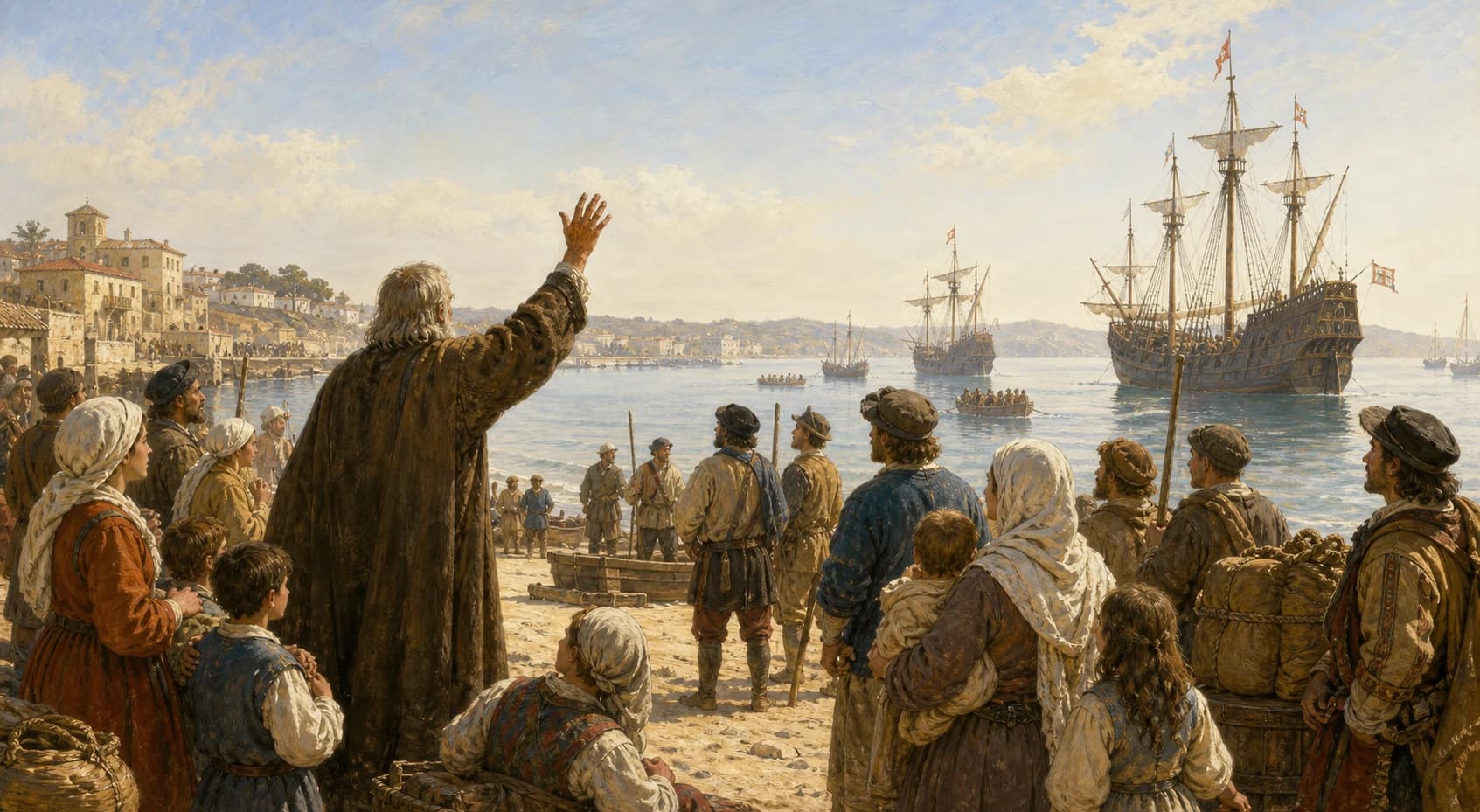
Canto IV makes departure a public scene in which royal purpose, sailors’ resolve, family separation, and dissent exist at once.
The Cape in Canto V
Adamastor gives the Cape a body, a voice, and a historical memory.
A colossal figure gathers from cloud as the fleet approaches and foretells later wrecks and deaths around southern Africa and the Indian Ocean. Only when da Gama demands his identity does the monster say that he is the Cape of Storms, unknown to ancient authorities. Nature, classical giant, and future history fold into one body.
Adamastor then recounts how desire for Tethys led to deception and transformation into stone. He threatens the navigators but is also a failed lover trapped in his own story. The Portuguese cross the Cape and win the route, yet offended geography speaks, placing loss and retaliation inside the victory.
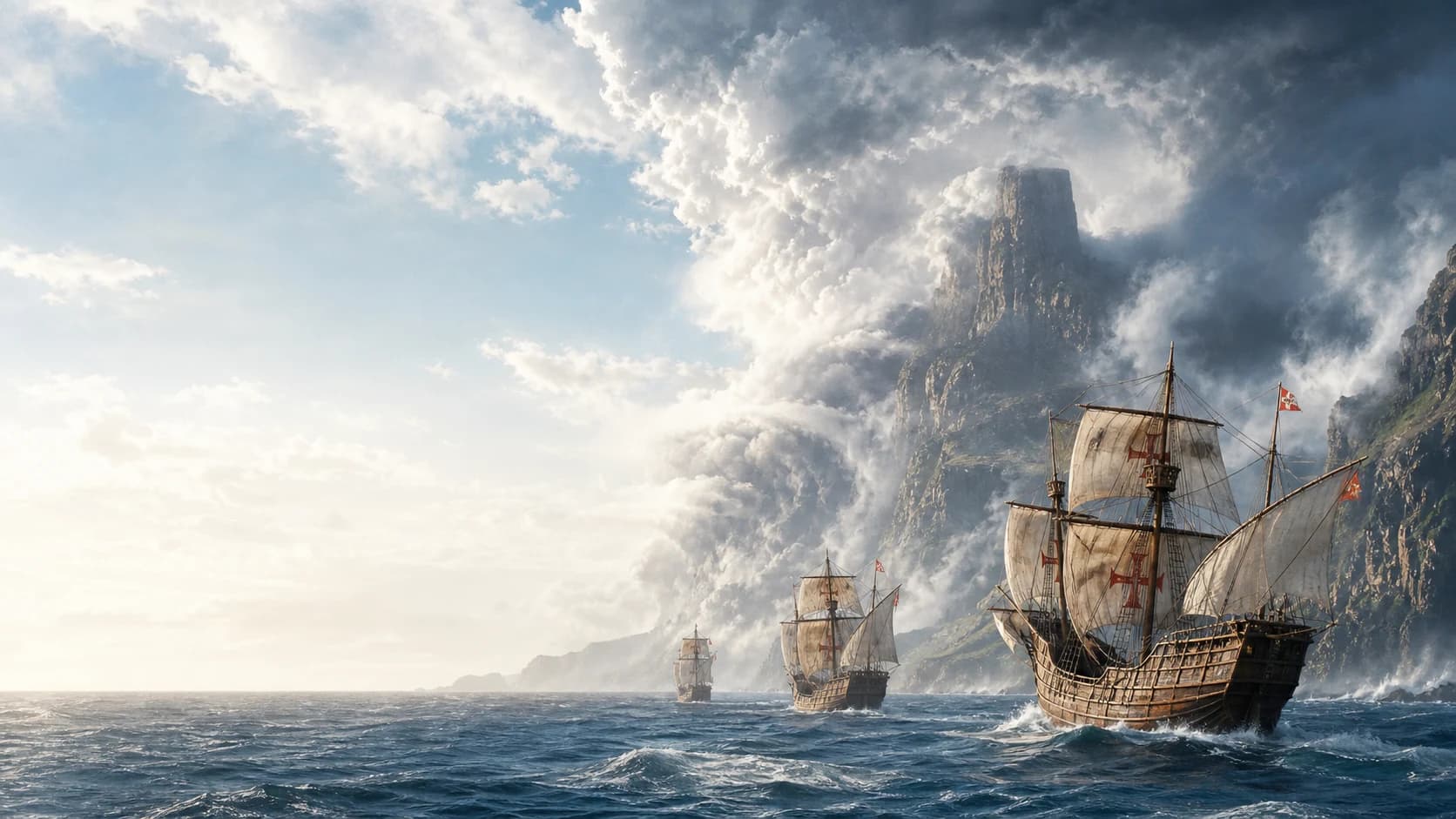
The hero image holds the giant to an ambiguous contour of cloud, spray, and rock. It is not a biological portrait added to the real Cape. It spatializes Camões’s rhetoric: small ships face a headland made enormous by unknown water, risk, and retrospective knowledge.
The scale after arrival
Negotiation at Calicut expands into a world made visible.
In Calicut the poem stages audience, gifts, merchant advice, interpretation, and the seizure of goods and people. Monçaide mediates languages; the Zamorin and his officers are placed within the Portuguese embassy’s objectives. The first voyage’s diplomatic problems remain recognizable, but epic categories of Christian, Muslim, ally, and enemy repeatedly simplify local motives.
On the return, the Isle of Love turns desire and fame into an allegorical reward. Tethys then displays the Machine of the World, moving down through celestial spheres to Asian coasts and future Portuguese strongholds and wars. Travellers once enclosed by ocean become viewers looking down upon routes and futures.
This panorama is the poem’s grandest and most political form of knowledge: the world is reduced, named, and handed to a captain’s gaze. Yet the poem immediately admits that humanity cannot comprehend God. A modern reading can study the precision of its geography, its inherited cosmology, and the way an elevated view makes other people’s homes resemble an imperial map.
1572 and after
National praise and poetic disappointment collide through the close.
Camões spent many years inside Portuguese Asia, taking part in imperial action while encountering poverty, conflict, and the difficulty of return. He presents observed seas as surpassing ancient fable, then criticizes failed command, neglect of poets, and obsession with money. Imperial vision and disappointment in imperial routine come from the same life.
The material book of 1572 is not seamless either. Copies carrying that date differ in type setting, stanza initials, title-page pelicans, and mixed sheets. Optical collation published in 2022 supports two independent settings, but which came first, who reset the other and when, and why mixed copies survive cannot be answered by a pelican facing left or right.
Canto X returns the fleet to the Tagus quickly, but devotes more space to future wars and counsel for the king. In stanza 145 the poet declares his lyre out of tune and his voice hoarse because the country has sunk into greed and brutishness. The poem that made a national myth also preserved some of that myth’s earliest, strongest internal fractures.
Reading layers
Epic form, voyage history, and imperial vision as three bodies of evidence
How 1572 imagined navigation, nation, and empire
Narrative layers, classical myth, counsel, and geographic panorama show how a voyage became collective memory, not merely what occurred.
The day-by-day voyage of 1497–99
Retrospection, prophecy, and divine action alter time and cause; the voyage journal and archives supply dates, bearings, cargoes, and negotiation details.
Traditions about Camões’s life
His Asian service and return in 1570 have documentary support; the Macau office, grotto composition, and swimming ashore with the manuscript carry less equal evidential weight.
Praise and criticism coexist
Restelo, the final rebuke, and the poem’s ideals of conquest remain together as a sustained conflict of values.
Reading editions
Searchable Portuguese, facsimile, commentary, and translation
Biblioteca Nacional de Portugal digital copy
Inspect title page, approvals, royal privilege, original setting, and all 186 leaves. Best for the material edition, not as a beginner’s only reading interface.
Project Gutenberg Portuguese text
All ten cantos are searchable with stanza numbers. Use it to locate a passage, then check wording in a facsimile or annotated critical edition.
Landeg White · Oxford World’s Classics
Clear modern English with introduction, maps, and notes: a strong route into the whole poem for Anglophone readers. Scholarly quotation should still identify the translator.
Historical translations by Fanshawe and Mickle
These show Restoration and eighteenth-century readers remaking metre and imperial meaning. They are valuable reception documents, not transparent substitutes for Portuguese.
Reader questions
Title, length, old man, giant, gods, and two pelicans.
What is The Lusiads about?+
It uses Vasco da Gama’s first voyage to India as an axis for Portuguese history, then enlarges the journey with pagan gods, Adamastor, the Isle of Love, and the Machine of the World into a national and cosmic epic.
What does Os Lusíadas mean?+
The title means the people descended from the mythical Lusus—the Lusitanians or Portuguese. The English title The Lusiads preserves the collective plural rather than naming da Gama alone.
Is it Vasco da Gama’s voyage journal?+
No. Historical navigation gives the poem its frame, but it begins in mid-voyage and uses flashback, prophecy, and divine action. Route details should be checked against the anonymous Journal of the First Voyage to India and archives.
How long is The Lusiads?+
It has ten cantos and 1,102 eight-line stanzas, or 8,816 lines. The usual form is decasyllabic ottava rima with an ABABABCC rhyme scheme.
Does the Old Man of Restelo oppose overseas expansion?+
He attacks fame, command, wealth, and expeditionary cost, and fears depopulation and weak defence at home. Yet he favours nearby North African war, so he is an imperial countervoice without being a modern pacifist.
Was Adamastor a real sailors’ legend?+
Adamastor is Camões’s poetic personification of the Cape. Classical giant mythology joins storm, unknown geography, and later Portuguese disasters in one invented speaker.
Why does a Christian epic use pagan gods?+
They supply conflict and spectacle and connect a Renaissance epic to classical form. Canto X also labels them poetic fictions and figures of providence, rather than proposing a second religious truth.
What is the dispute over the two pelicans of 1572?+
Copies differ in title-page pelican direction, the opening stanza, initials, and setting. Recent bibliographical work supports two independent editions dated 1572, but their sequence and mixed sheets remain more complex than a single cover emblem.
Research sources
The physical book of 1572, the full poem, bibliography, and interpretation
- 01Os Lusiadas, Lisboa, 1572 ↗
Biblioteca Nacional de Portugal · Biblioteca Nacional Digital
Digitized 1572 quarto attributed to António Gonçalves, with catalogue and physical description - 02Os Lusíadas · Visão Genérica ↗
Camões, I.P. · Centro Virtual Camões
Ten-canto structure, the friction of pagan machinery and Christian expansion, principal figures, and themes - 03Os Lusíadas · Portuguese full text ↗
Project Gutenberg
The complete poem with stanza numbers, used to check the six Portuguese passages on this page - 04The Lusiads · 1572 copy ↗
Library of Congress · World Digital Library
Collection account of a 1572 copy, title-page pelicans, and the long first-edition debate - 05Os Lusíadas, 1572: the exemplars and the editions ↗
Zeitschrift für romanische Philologie · De Gruyter
Optical collation demonstrating two independent settings and the limits of pelican and E/Ee labels - 06The question of paper in Os Lusíadas, 1572 ↗
University of Oxford · Oxford Research Archive
Bibliographical research on paper, watermarks, and staged printing - 07Pietas and the ‘Other Camões’ ↗
Classical Receptions Journal · Oxford University Press
Peer-reviewed study of the Restelo passage, Virgilian allusion, and anti-imperial dissent inside the epic - 08The First English Translation of Camões’s The Lusiad ↗
University of Kent · Kent Academic Repository
Historical and textual research on Richard Fanshawe’s complete English translation of 1655 - 09The Lusíads · Landeg White translation ↗
Oxford University Press · Open British National Bibliography
Bibliographic record for the 1997 Oxford World’s Classics translation - 10First edition of Os Lusíadas ↗
Fundação Biblioteca Nacional · Brazil
Collection note for the Brazilian National Library’s rare 1572 copy
Sources checked and page updated 25 August 2026. Read our editorial and citation standards