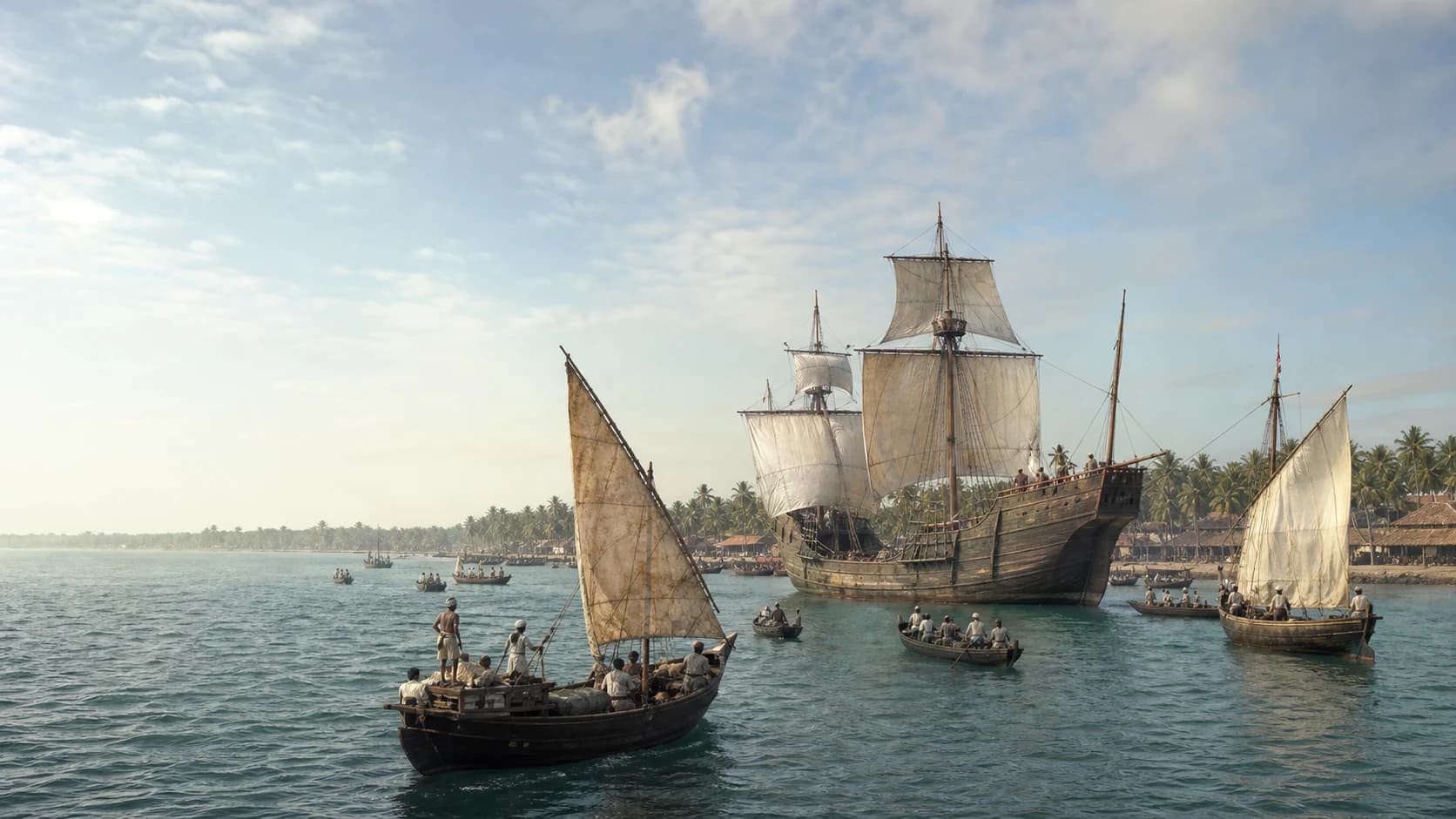
Voyage folio ↓
Short answer
It records a European route breakthrough—and the fleet’s ignorance on entering a mature Indian Ocean.
The Journal of Vasco da Gama’s First Voyage is an eyewitness narrative by an unnamed participant in the expedition of 1497–1499. It begins with four vessels leaving Restelo, follows their great South Atlantic turn around the Cape of Good Hope, and carries the fleet through Mozambique, Mombasa, and Malindi into an established Indian Ocean route before its arrival at Calicut in May 1498. The account records court audiences, a mismatch in the value of gifts and merchandise, a serious misreading of Indian religion, hostage-taking, and the contrary winds and scurvy of the return. The voyage record itself is lost. Its sole surviving witness, Porto MS 804, is an anonymous copy from the first half of the sixteenth century. The main narrative breaks off near the coast of Guinea in April 1499; appendices add information on kingdoms south of Calicut, commodities and prices, and a vocabulary. Álvaro Velho remains the customary attribution, while the document leaves its author unnamed. The voyage joined generations of Portuguese Atlantic practice to Swahili port politics, multilingual intermediaries, local pilotage, and monsoon knowledge, completing the first recorded all-sea passage by a European fleet from Europe around Africa to India.
“iam em busca da espiçiaria”The opening: four vessels ‘in search of spices’Manuscript register
One text, three strengths of evidence
- 01
Eyewitness
Route, audience, shipboard illness, and specific actions.
- 02
Collected
Kingdoms, commodities, prices, and some language material.
- 03
Editorially supplied
Dates and reception after the main narrative breaks off.
Classic passages
Six Portuguese passages hold purpose, error, bargaining, and disease in one book.
- FOLIO 01The commissionOpening for 1497
Em nome de Deus, Amem. Na era de 1497 mandou El-Rei Dom Manuel, o primeiro deste nome em Portugal, a descobrir quatro navios, os quaees iam em busca da espiçiaria.
TranslationIn the name of God, amen. In 1497 King Manuel, the first of that name in Portugal, sent out four ships on discovery, and those ships went in search of spices.
Kingship, four ships, and spices share the opening sentence. In this context descobrir describes a commissioned reconnaissance; it does not mean that India was unknown to the world.
- FOLIO 02The question on arrival21 May 1498 · Calicut
E preguntaram-lhe que vínhamos buscar tam longe, e ele lhes respondeu: ‘Vimos buscar christãos e especiaria’.
TranslationThey asked what we had come to seek so far away, and he answered: ‘We have come in search of Christians and spices.’
This compact answer joins religious alliance to trade. It passed through Tunisian Muslim merchants who spoke Castilian and Genoese: the first conversation was itself made possible by an older network.
- FOLIO 03Eyewitness position28 May 1498 · The royal audience
Foi o Capitam a falar a El-Rei, e levou consigo dos seos treze homens, dos quaees eu fui hum deles.
TranslationThe captain went to speak to the king and took thirteen of his men with him, of whom I was one.
The first person securely places the writer in the audience party. No surviving list, however, can identify the unnamed observer uniquely as Álvaro Velho.
- FOLIO 04Religious misrecognition28 May 1498 · A temple at Calicut
Aqui nos levaram a hũa grande igreja… Em esta igreja fez oraçam o Capitam-moor e nós outros com ele.
TranslationHere they took us to a great ‘church’ … In this church the captain-major prayed, and we did so with him.
The writer recoded a Hindu temple, images, and Brahman practice in Christian terms. The passage is valuable not because the identification is right, but because it shows expectation shaping sight.
- FOLIO 05Gifts and status30 May 1498 · Second audience
E disse entam El-Rei: que era o que ele vinha descobrir, pedras ou homens? Que pois vinha descobrir homens como dizia, porque nom trazia algũa cousa?
TranslationThe king then asked what he had come to discover, stones or men. If he had come to discover men, as he said, why had he brought nothing?
The question exposes the diplomatic failure. Portugal claimed the status of a rich kingdom, but had not prepared gifts that made sense at Calicut’s commercial and courtly scale.
- FOLIO 06Contrary monsoon and diseaseOct 1498–Jan 1499 · Return across the Arabian Sea
Andámos tanto tempo em esta travessa que três meses menos três dias gastamos nela… adoeçeo toda a gente das gingivas, que lhe creçiam sobre os dentes em tal maneira que nom podiam comer.
TranslationWe spent so long on this crossing that it took three months less three days … everyone fell ill in the gums, which grew over the teeth so that they could not eat.
The outward crossing took roughly three weeks with a favourable wind; the return approached three months. The journal does not use the modern diagnosis scurvy, but records its characteristic bodily signs.
Voyage × text
Departure in 1497; centuries of transmission keep changing the reading.
- 01
Four vessels leave Restelo
São Gabriel, São Rafael, Bérrio, and a store ship depart the Tagus to seek spices and eastern Christians for the Portuguese crown.
- 02
The fleet turns deep into the South Atlantic
Rather than coast straight down West Africa, the ships seek the oceanic wind system. Nearly three months pass before land returns.
- 03
The Cape of Good Hope is rounded
Dias had already shown that the cape could be passed. This expedition must connect that Atlantic result to an Indian Ocean passage.
- 04
Provisioning and encounters along southeast Africa
At São Brás, Natal, the Copper River, and the River of Good Signs the fleet waters, repairs, trades, captures people, and fights.
- 05
Mozambique, Mombasa, and Malindi
The crews repeatedly misread Swahili religion and politics. Malindi ultimately supplies a pilot for the ocean crossing.
- 06
The monsoon carries the fleet to Malabar
The run from Malindi to India takes about twenty-three to twenty-seven days and depends on pilotage familiar with the sea and season.
- 07
Anchorage near Calicut and the first shore mission
A Portuguese envoy assigned to dangerous shore work reaches Tunisian Muslim merchants who can speak European languages.
- 08
Entry into Calicut and two audiences with the Samudiri
Thirteen men accompany da Gama. A temple is mistaken for a church, and gifts provoke an argument about ambassadorial status.
- 09
Limited trade, mutual detention, and a worsening relationship
Merchandise finds little favour; customs, men ashore, and hostages become bargaining instruments. No stable factory or treaty results.
- 10
Departure from Calicut and a contrary crossing
The fleet carries local captives away. The westward passage lasts about ninety days as scurvy and other illness kill many aboard.
- 11
São Rafael is burned; the journal stops off West Africa
Too few hands remain to work three vessels. São Rafael is abandoned in East Africa, and the record breaks off near Rio Grande in Guinea.
- 12
The sole surviving copy, MS 804, is made
It preserves the narrative, commercial-geographical appendices, and a vocabulary. An interpolation proves that it is not the author’s original.
- 13
First print, Memory of the World, and a bilingual edition
Köpke and Paiva first print the text; UNESCO registers the manuscript, followed by a modern Portuguese-English facsimile edition.
Route books
Four maritime regions form a system of seaborne collaboration.
The South Atlantic turn
The fleet first moves southwest into open water to reach Africa’s southern end.
- 01Restelo to Cape VerdeAssembly, separation, and rendezvous
- 02Open South AtlanticLong absence of land and a broken yard
- 03St Helena BaySoundings, water, and first shore encounter
- 04Cape to São BrásRounding, weather, and fleet ceremony
The East African port chain
Provisions, captives, interpreters, and local rivalry determine whether the fleet can continue.
- 05Natal to the River of Good SignsWater, repairs, and sickness
- 06MozambiqueMistaken identity and pilotage conflict
- 07MombasaDistrust, escape, and port politics
- 08MalindiAlliance, pilot, and monsoon window
One hundred and two days at Calicut
Geographical success does not automatically become commercial success.
- 09Pandarani anchorageThe first multilingual exchange
- 10Procession into the cityTemple, crowd, and eyewitness author
- 11The Samudiri’s courtGifts, letters, and diplomatic rank
- 12Trade on the coastSamples, customs, detention, and withdrawal
Return and textual remainder
A missed seasonal window becomes the voyage’s heaviest measure.
- 13Calicut to MalindiNearly three months of headwinds and scurvy
- 14Malindi to Rio GrandeLost ship, reduced crews, broken ending
- 15Appendices and vocabularyA commodity world beyond eyewitness sight
Manuscript anatomy
The author appears in the word ‘I’ but leaves no name that can be proved.
The surviving witness is Porto Municipal Public Library MS 804. Its voyage narrative occupies roughly folios 1r–40r, followed by information on kingdoms and commodities south of Calicut and by a vocabulary. Palaeography generally dates it to the first half of the sixteenth century. Preserved for centuries at Santa Cruz in Coimbra, it entered Porto’s public library in 1834 and was first printed in 1838.
The writer certainly sailed. He identifies himself as one of the thirteen men who accompanied da Gama to the Samudiri, and repeatedly marks his shipboard position and direct experience. The name is absent. Nineteenth-century editors attributed the work to Álvaro Velho through elimination and comparison with later Guinea material; João de Sá and others have also been proposed, without a decisive identification.
One sentence remarks that the author’s pen failed to describe how certain weapons were made. It plainly comes from another hand and proves that MS 804 is a copy, not the shipboard original. The responsible byline is therefore ‘anonymous eyewitness,’ with Álvaro Velho retained as a traditional attribution rather than promoted into certainty.
Relay of knowledge
Atlantic practice, Swahili ports, and monsoon pilotage meet along the route.
The Atlantic leg rested on decades of Portuguese experience with islands, winds, currents, and latitude sailing. Dias had rounded the African end in 1488, while pilots such as Pêro de Alenquer brought accumulated practice aboard. The southwest volta do mar looked indirect on a chart but avoided the hostile winds and currents of the Gulf of Guinea and sought westerlies for the cape.
Beyond the cape, the problem changed from entering the Indian Ocean to operating within it. Mozambique, Mombasa, and Malindi were not scenery but Swahili port cities with rulers, mosques, merchants, and regional rivalries. Water, interpretation, anchorage, and pilotage all required local relationships; the expedition also used captivity, gunfire, and exchange to force bargaining positions.
The pilot supplied at Malindi made the last connection. The journal does not name him. A later tradition identified the famous Arab navigator Ahmad ibn Mājid, but modern scholarship is generally sceptical; a Gujarati pilot familiar with the western Indian Ocean is often preferred. What the evidence proves is suitable local pilotage, not a famous name inserted into a silence.
Chain of translation
The first words at Calicut travelled through Tunis, Castilian, and Genoese before they reached India.
The fleet did not speak directly to the Samudiri on arrival. Its first emissary met two Muslim merchants from Tunis whom the journal says could speak Castilian and Genoese. Their astonished question—who brought you here?—reveals Mediterranean commercial mobility already reaching the Indian Ocean and immediately fixes the Portuguese as newcomers.
‘Christians and spices’ compresses religious alliance and commerce. The Portuguese had long expected to find eastern Christians who might oppose Islamic powers. That expectation made them call a Hindu temple a church, images saints, and Brahman marks Christian signs. The journal preserves close observation and deep classificatory error at the same time.
The appended vocabulary extends contact into ordinary words, though catalogues have called it by different linguistic labels and its forms still require philological care. It is not an untouched recording. What survives passed through speakers, interpreters, a writer, and a later copyist.
Market and court
Portugal arrived with an oceanic achievement but without the credit needed to enter Calicut’s market.
Before the Portuguese arrival, Calicut already linked the Malabar hinterland to the Red Sea, Persian Gulf, East Africa, and Southeast Asia. Pepper, ginger, precious stones, cottons, and metals moved through specialized merchant communities, while the Samudiri managed competition, customs, and port order. Three strange ships attracted attention but did not deserve automatic priority.
Da Gama’s proposed gifts included cloaks, hats, coral, brass basins, sugar, oil, and honey. Objects adequate in some African shore exchanges appeared poor at a wealthy commercial court. Officials refused to forward them, merchants disparaged them, and the Samudiri asked why an envoy from a rich kingdom had come empty-handed. The failure concerned rank and commercial credibility, not merely taste.
The impasse moved into bodily control. Portuguese and shore personnel were detained in turn, and the fleet carried local men away in hopes of managing later relations. Geographical success, failed negotiation, and escalating coercion occupied the same hundred days. A clean landfall story cannot contain them.
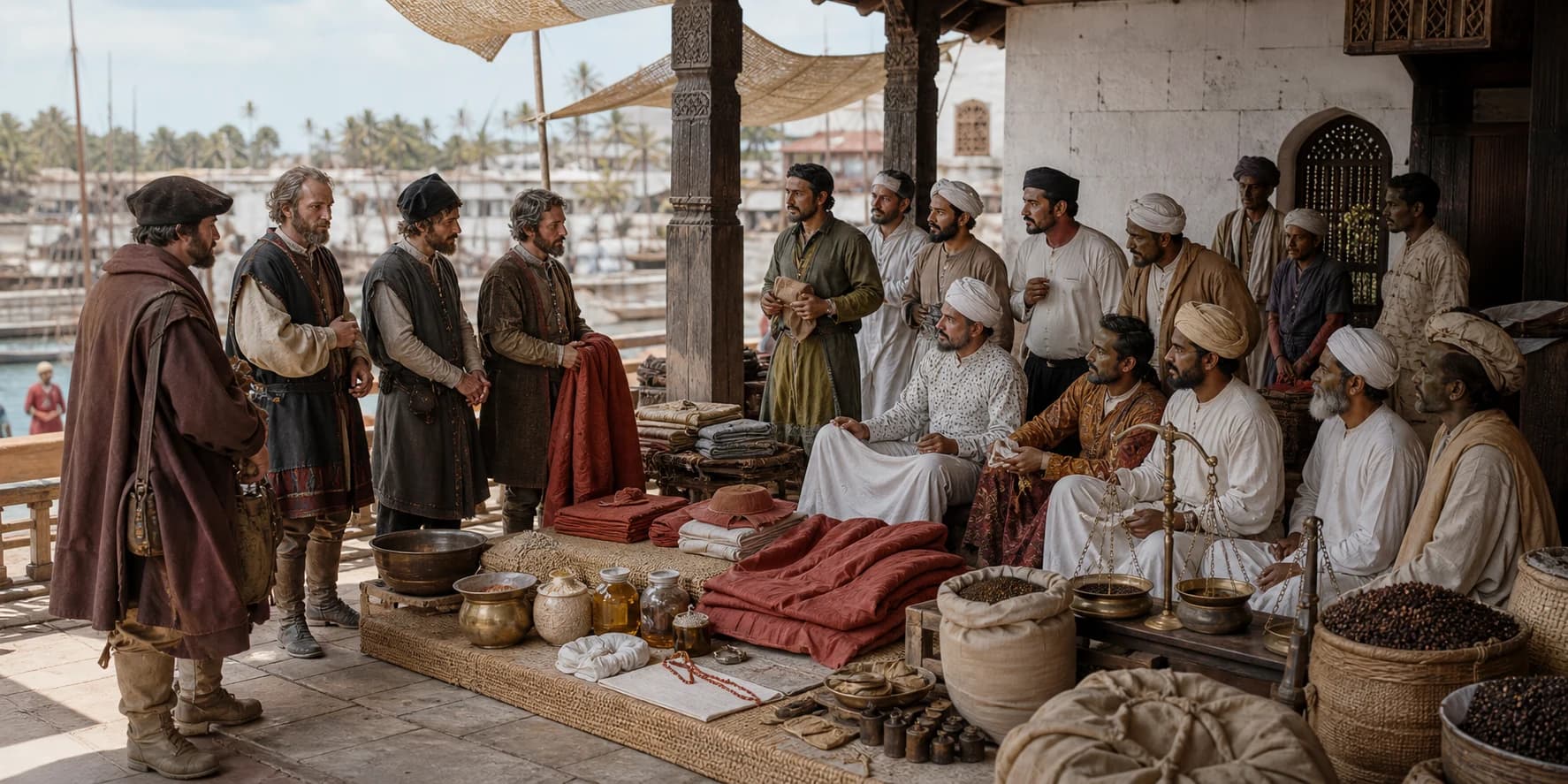
Negotiation at Calicut turned on visible things: Portuguese gifts, locally valued commodities, measures, and multilingual intermediaries together established whether an envoy was credible.
The monsoon ledger
Roughly three weeks outward, nearly three months back: direction transformed the same sea.
A useful seasonal wind carried the fleet from Malindi to India in roughly three weeks. After a hurried departure from Calicut in late August 1498 and work along the Indian coast, the ships began the westward crossing in early October. Calms and contrary winds stretched it to ‘three months less three days.’
The writer describes gums swelling over the teeth, legs and bodies enlarging, an inability to eat, and death. Today the signs can be connected to scurvy, but the voyagers did not know vitamin deficiency. They experienced an unnamed bodily collapse that steadily removed hands from the watch bill.
By East Africa only seven or eight men per ship were able to work. The shortage forced the burning of São Rafael. Paulo da Gama later died, while Bérrio and São Gabriel reached Portugal separately. Arrival in India is only the midpoint: a sustainable route also needs a return season, provisions, and enough redundancy to bring ships home.
The text sails on
The vessels returned to Europe; the journal stops abruptly off Rio Grande.
The main narrative reaches the Guinea coast around 25 April 1499 and then breaks without explanation. Bérrio entered Cascais on 10 July, São Gabriel followed, and da Gama was delayed while caring for his dying brother. Familiar endings of the voyage are editorial continuations built from chronicles and royal documents, not pages in MS 804 running through the reception in Lisbon.
The appendices widen the work beyond a daily route: kingdoms south of Calicut, commodities and prices, stones, spices, and vocabulary include knowledge collected from intermediaries such as Gaspar da Gama. The book is both eyewitness journey and gathered commercial geography. Those two kinds of evidence cannot carry equal weight.
The 1838 edition turned a long-shelved codex into a national maritime classic. Ravenstein’s 1898 Hakluyt Society translation shaped English reading for a century; Glenn J. Ames’s 2009 version and the 2016 Porto bilingual facsimile brought newer historiography and manuscript attention back to the text. Each edition decides whether readers first see heroic route, diplomatic confusion, or an encounter made by several maritime worlds.
Evidence layers
Eyewitness detail, authorship, religious misreading, and corroboration
Sequence, encounters, and bodies at sea
Dates, anchorages, separations, repairs, shore parties, negotiations, and illness form the densest eyewitness evidence for the first voyage.
Álvaro Velho is an attribution, not a proven author
The writer sailed and joined the audience party, but never supplies his name. Elimination and later Guinea material produce a strong conjecture, not identification.
Calling Hindus ‘Christians’
The vocabulary records Portuguese expectation and misrecognition; local religious sources are needed to describe Malabar communities’ identities.
The identity of the Malindi pilot
The contemporary journal gives no name. The Ibn Mājid identification lacks a direct contemporary link, while the Gujarati attribution should also remain a scholarly preference rather than fact.
Reading editions
Manuscript, modern bilingual edition, and classic translation
Fardilha & Fernandes · Roteiro / Journal
A large-format Portuguese-English edition based on the sole manuscript, combining transcription, translation, and facsimile. It is the best modern entry for checking words against the physical text.
Glenn J. Ames · Em Nome de Deus
A complete updated English translation with historiographical introduction, notes, and appendices, especially useful for placing expansion beside local response.
E. G. Ravenstein · A Journal of the First Voyage
The classic Hakluyt Society translation, now public domain, with substantial study of route, people, and early maps. Exact arguments should be checked against newer editions.
Köpke & Paiva first edition / Herculano revision
These brought MS 804 into print and established the Álvaro Velho attribution. Their Old Portuguese text and nineteenth-century editorial decisions both deserve attention.
Reader questions
Authorship, pilotage, gifts, and the phrase ‘discovery of India.’
Who wrote the Journal of Vasco da Gama’s First Voyage?+
The manuscript is anonymous. Its author was certainly a participant and one of thirteen men who accompanied da Gama to the Samudiri in 1498. Álvaro Velho is the customary attribution; João de Sá and others have been proposed, but decisive proof is absent.
Is the surviving manuscript the original shipboard journal?+
No. MS 804 is a copy from the first half of the sixteenth century. An interpolated remark explicitly reveals another hand and therefore an earlier textual stage.
Why did da Gama sail southwest into the Atlantic before turning east?+
The volta do mar used a wind system familiar to Portuguese mariners. Moving offshore could find winds more favourable to a sailing vessel than following the West African coast against current and breeze.
Who piloted the fleet from Malindi to India?+
The journal says Malindi supplied a suitable pilot but gives no name. The once-popular Ahmad ibn Mājid identification lacks direct contemporary evidence. Many modern studies favour a Gujarati navigator, still as an attribution rather than certainty.
What does ‘Christians and spices’ mean?+
Spices name the crown’s commercial objective, while eastern Christians belong to a search for potential religious allies. The phrase shows economic, diplomatic, and crusading expectations working together.
Why did the Portuguese gifts fail at Calicut?+
Cloaks, hats, coral, brass basins, sugar, oil, and honey did not meet the value and protocol expected of a foreign envoy at a wealthy commercial court. They also exposed the fleet’s shortage of marketable cargo and local credit.
Why was the return crossing so much longer?+
A favourable monsoon carried the outward fleet across in about three weeks. The westward return began in an unfavourable season; calms and headwinds prolonged it to nearly three months, while disease steadily reduced the crews.
Does the journal prove that da Gama ‘discovered India’?+
Not in a literal sense. India and an ocean-wide trading system already connected Africa, Arabia, and Asia. The expedition completed the first recorded all-sea voyage by a European fleet from Europe around Africa to India.
Research sources
The sole manuscript, route research, port history, and editions
- 01Journal of the First Voyage of Vasco da Gama to India, 1497–1499 ↗
Library of Congress · World Digital Library
Digital images of MS 804 and authoritative information on the sole witness, date, contents, and provenance - 02Journal of the first voyage of Vasco da Gama to India ↗
UNESCO Memory of the World
2013 Memory of the World registration and manuscript images - 03Roteiro / Journal of the First Voyage, 1497–1499 ↗
U.Porto Press
Record of the 2016 bilingual facsimile, transcription, and translation - 04Relação da viagem de Vasco da Gama ↗
Jeremy Lawrance · University of Manchester
Old Portuguese transcription, English translation, textual commentary, and glossary - 05Roteiros portugueses dos séculos XV e XVI ↗
RUTTER Project · NOVA University Lisbon
Manuscript catalogue covering MS 804 foliation, structure, appendices, and modern editions - 06Álvaro Velho ↗
Encyclopaedia of Portuguese Expansion · NOVA FCSH
Authorship controversy, the thirteen-man party, and the journal’s broken ending - 07A Journal of the First Voyage of Vasco da Gama, 1497–1499 ↗
Project Gutenberg · Hakluyt Society 1898
Public-domain Ravenstein translation, appendices, route table, and early-map study - 08Em Nome de Deus: The Journal of the First Voyage ↗
Brill
Glenn J. Ames’s 2009 translation, historiographical introduction, and notes - 09Calicute ↗
Encyclopaedia of Portuguese Expansion · NOVA FCSH
Historical background on Calicut’s politics, commerce, and Portuguese relations - 10History of Kozhikode ↗
Kozhikode District · Government of India
Local institutional overview of the Malabar port, Samudiri rule, and Arab trade
Sources checked and page updated 25 August 2026. Read our editorial and citation standards