In one minute
What did this event actually change?
The European conquest of the Canary Islands lasted about ninety-four years, from the establishment of a base on Lanzarote in 1402 to the suppression of the last major resistance on Tenerife in 1496. Private actors and lords backed by Castile first took Lanzarote, Fuerteventura and El Hierro and gradually imposed control over La Gomera. After 1478, the Crown directly pursued Gran Canaria, La Palma and Tenerife. Each island had different political units, populations, terrain and alliances, so there was no single, uniform 'Spanish conquest battle.' Resistance and collaboration could occur at the same time, but agreements and baptism did not reliably protect persons, land or freedom in a profoundly unequal military, legal and slave-trading environment.
 View the complete scene ↗
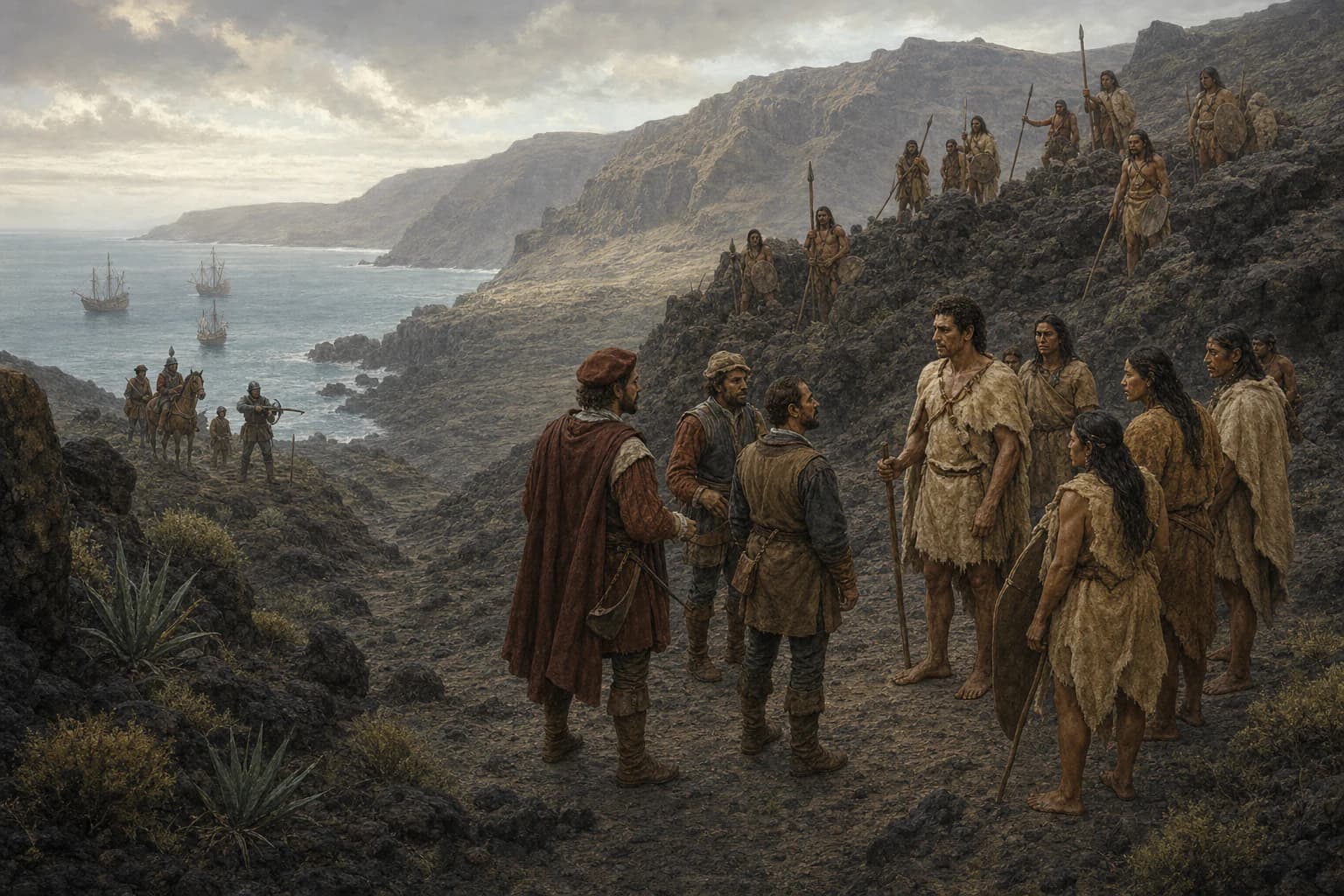
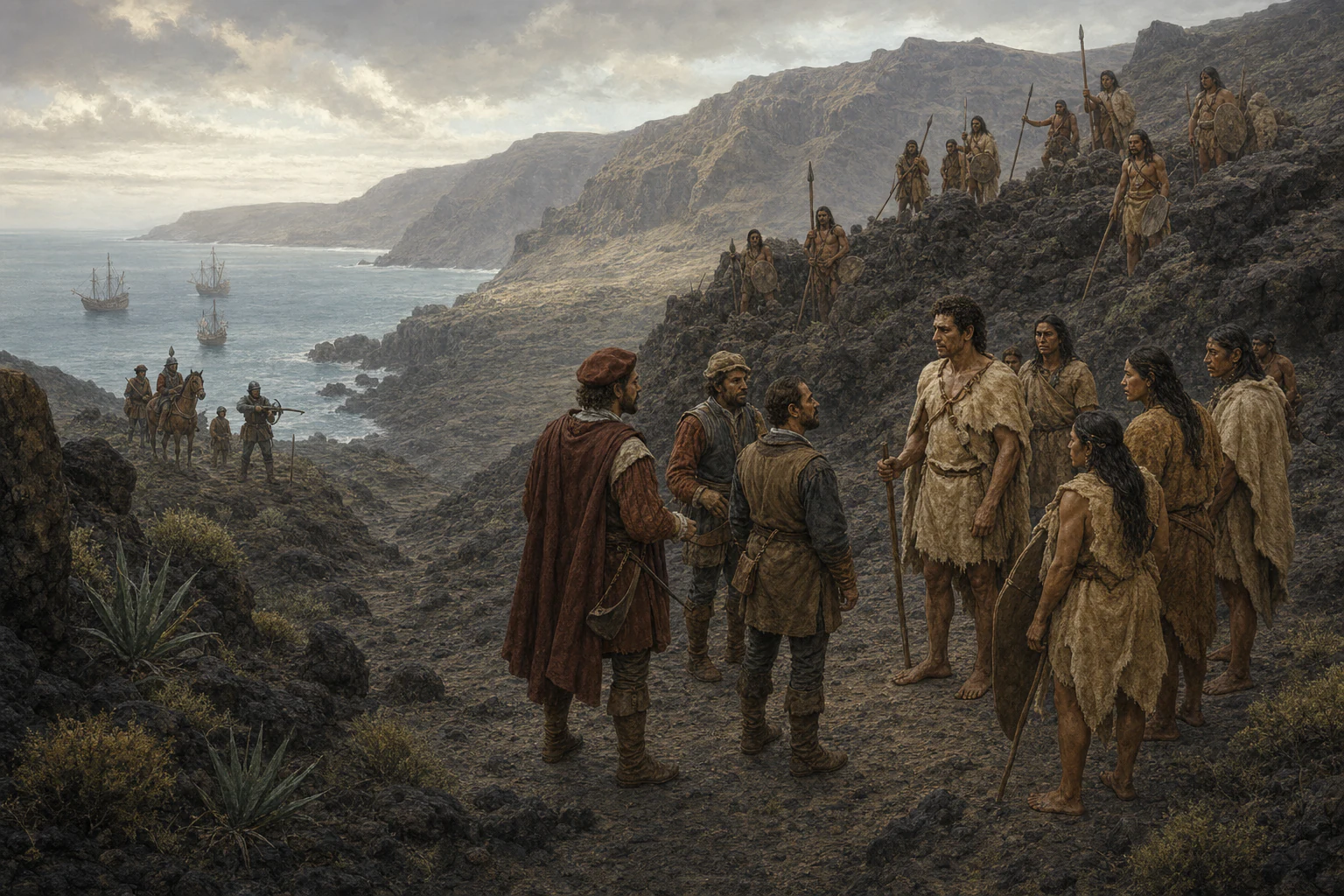
The reconstruction places negotiation between an armed landing and resistance in the high ground. A pact did not remove war, the threat of enslavement or unequal power. This is an evidence-led composite, not a frame-by-frame record of one meeting.
- Span
- 1402—1496, about ninety-four years
- First phase
- Private and seigneurial conquest: Lanzarote, Fuerteventura, El Hierro and La Gomera
- Second phase
- Royal conquest: Gran Canaria, La Palma and Tenerife
- Indigenous responses
- Armed resistance, negotiation, alliance, baptism and movement coexisted
- Structural outcome
- Enslavement, deportation, land redistribution, settlement and institutional rupture
Chronology
A process, not a single date
Causes, turning points and aftermath form one process, far larger than a capital’s fall, a signed treaty or a company’s founding date.
- 01
A Norman expedition establishes a base on Lanzarote
Jean de Béthencourt and Gadifer de La Salle arrive in the Castilian king's name and build at Rubicón. Initial negotiation gives way to control, captivity and forced submission.
- 02
Fuerteventura and El Hierro enter seigneurial rule
Small populations, internal divisions and military pressure shape the outcome, while supposedly peaceful submission also involves captivity, coerced conversion and settlement.
- 03
Pacts, lordship and resistance overlap for decades on La Gomera
The island cannot be reduced to one decisive campaign. In 1488, an Indigenous rising kills the lord Hernán Peraza and is answered by brutal repression, killing and enslavement.
- 04
The Castilian Crown conquers Gran Canaria
Royal troops, missionary networks and local intermediaries all intervene. Tenesor Semidán is captured, baptized and used in negotiations, but resistance does not immediately end.
- 05
La Palma falls amid war and a broken safe-conduct
Alonso Fernández de Lugo's force advances across the island. Tanausú leaves the Caldera de Taburiente under assurances for negotiation and is captured, a stark example of pact-making without security.
- 06
Tenerife defeats the first invasion at Acentejo
Some menceyatos ally with the invaders while others resist. Bencomo's side uses mountain terrain to inflict a severe defeat and force Alonso de Lugo to withdraw for support.
- 07
Reinforcements, local allies and disease alter the Tenerife campaign
A rebuilt Castilian army wins at Aguere and the second battle of Acentejo. Major resistance is suppressed in 1496, followed by expanded captivity and land grants.
Why did the conquest of seven islands take ninety-four years?
The 'conquest of the Canary Islands' is a retrospective name, not one army fighting continuously for ninety-four years. Sea separated communities that had developed independently; population, political units, landing places and mountainous refuges differed by island. Conquerors changed too. Norman knights launched the 1402 expedition and framed private investment through Castilian royal authorization. Rights later passed among seigneurial families while Portugal and Castile contested claims to the archipelago.
After the 1470s, the Castilian Crown acquired the rights to islands not yet conquered and brought Gran Canaria, La Palma and Tenerife into more direct royal war. This phase could mobilize larger finance, professional soldiers, cavalry, crossbowmen, seaborne supply and auxiliaries from already conquered islands. A story in which 'the Spanish landed and quickly unified the Canaries' confuses private lordship with royal action and erases nearly a century of failed expeditions, negotiation and resistance.
Why can war, pact-making and mission not be separated into three clean routes?
Conquerors might first make agreements of friendship or submission and then demand baptism, tribute, labour or military assistance. They also used raids, siege, livestock seizure and the sale of captives to finance conquest. Missionaries sometimes opposed illegal enslavement and sought protection for converts, yet also made conversion part of an order of submission. Alliance, evangelization and violence could therefore reinforce one another in the same campaign.
The labels 'bands of peace' and 'bands of war' require particular care. They come chiefly from the Tenerife conquest context and distinguish menceyatos that allied with Alonso de Lugo from those that continued resistance. They were not permanent Indigenous ethnic names, nor do they prove that allies freely accepted every consequence of conquest. For small polities already exposed to slave-raiding, military threat or hostile neighbours, alliance could be a constrained strategy of survival, retained authority or older rivalry.
Why did Indigenous Canarians resist, negotiate and sometimes assist conquest?
The archipelago had no single central government, and leaders and communities faced different risks. Gran Canaria's Tenesor Semidán was captured, taken to Castile and baptized as Fernando Guanarteme before returning as a mediator. Several Tenerife menceyatos allied with the invaders, whose forces also included Indigenous auxiliaries from Gran Canaria. Recognizing political calculation is more accurate than sorting every actor into hero or traitor.
Indigenous allies do not turn conquest into an equal civil war. The Castilian side commanded transmarine finance, metal weapons, cavalry, repeated reinforcement, slave markets and the legal machinery that ultimately allocated land. Most surviving prose also comes from conquerors, missionaries and later chroniclers. It can establish battles, pacts and intermediaries, but it cannot let us hear exactly how every community understood each promise.
After 1496, what ended—and what did not?
Military conquest ended Indigenous sovereignty and immediately opened repartimiento land grants, settler migration, sugar expansion and deeper coerced labour. Indigenous people were made war captives, sold in Iberia or moved between islands; some baptized people were still enslaved unlawfully. Freedom suits heard between 1496 and 1512 expose the gulf between royal protection orders and local practice. Disease, hunger and displacement further reorganized the population.
This was not the disappearance of every Indigenous descendant. Language, religion and political institutions suffered devastating rupture, while asymmetric unions between European men and Indigenous women reshaped ancestry. Genetic research still finds substantial Indigenous maternal continuity. Calling the Canaries a 'laboratory' for later American conquest can identify links among treaties, mission, slavery and plantation settlement, but the archipelago was not merely a prelude to somebody else's history. It was a colonial history in its own right.
Evidence boundary
Fact, interpretation and uncertainty
The evidence reveals where imperial claims diverged from reality and where heroic stories compressed complex wars.
Conquest had seigneurial and royal phases and ended in 1496
Government, museum and current archaeological syntheses share the 1402—1496 frame, while emphasizing that islands were not controlled by one method or a single battle.
Conquest chronicles are not transparent records of Indigenous politics
Le Canarien and later narratives are indispensable, but they served patrons, knights and missions. Numbers, motives for surrender and reported speech need comparison with archaeology, legal records and modern scholarship.
Pact or baptism did not automatically prevent enslavement
Crown and Church issued protections, but broken terms, reclassification and illegal sale continued. Later freedom litigation demonstrates that protection was not self-enforcing.
Questions
Common questions
When were the Canary Islands conquered?
Not in one year. Conquest began with the Lanzarote expedition in 1402 and ended when major resistance on Tenerife was suppressed in 1496, a span of about ninety-four years.
Were the conquerors royal Spanish troops from the beginning?
No. Private actors and lords authorized by Castile drove the first phase. The Castilian Crown more directly organized the conquest of Gran Canaria, La Palma and Tenerife after 1478.
Were all Indigenous Canary Islanders Guanches?
No. Guanche primarily names the Indigenous people of Tenerife. Indigenous Canarians is more accurate for the archipelago, whose islands also had specific names and identities.
Did Tenerife's 'bands of peace' freely support conquest?
That is too simple. Several menceyatos allied with Alonso de Lugo, but decisions occurred amid slave-raiding, military pressure, disease and inter-polity rivalry. Alliance did not mean consent to subsequent dispossession and colonial rule.
Did Indigenous Canarians disappear after 1496?
No. Political, linguistic and religious institutions were violently broken and many people died, were enslaved or displaced, but descendants did not vanish. Genetic and social history both demonstrate continuity.
Was the conquest of the Canaries a rehearsal for the Americas?
There are significant connections in private finance, pact-making, mission, slavery and land grants. Yet 'rehearsal' can erase the Canaries' own century-long history and project later American institutions backward onto a distinct fifteenth-century setting.
Sources
Sources and further verification
Archives, museums, international organizations and academic publications support the facts and interpretive limits in this account.
- Archaeological Research in the Canary IslandsJournal of Archaeological Research / Springer Nature
- The French Conquest of the Canary Islands, 1402–1405 (Le Canarien): IntroductionCambridge University Press
- The Spanish Destruction of the Canary IslandsThe Cambridge World History of Genocide
- La conquista de CanariasMuseo de Historia y Antropología de Tenerife
- Prehistoria e historia de CanariasGobierno de Canarias
- Un enfrentamiento desigualAnuario de Estudios Atlánticos
- Añadir un nuevo capítulo a la historia del derecho internacional: la conquista de las Islas CanariasColoquios de Historia Canario-Americana
- Los procesos judiciales de liberación de esclavos palmeses y guanches en Sevilla (1496–1512)Universidad de La Laguna
Age of Seas editorial research distinguishes verifiable facts, historical interpretation and potentially misleading simplifications.Editorial standards and corrections ↗