In one minute
What did this event actually change?
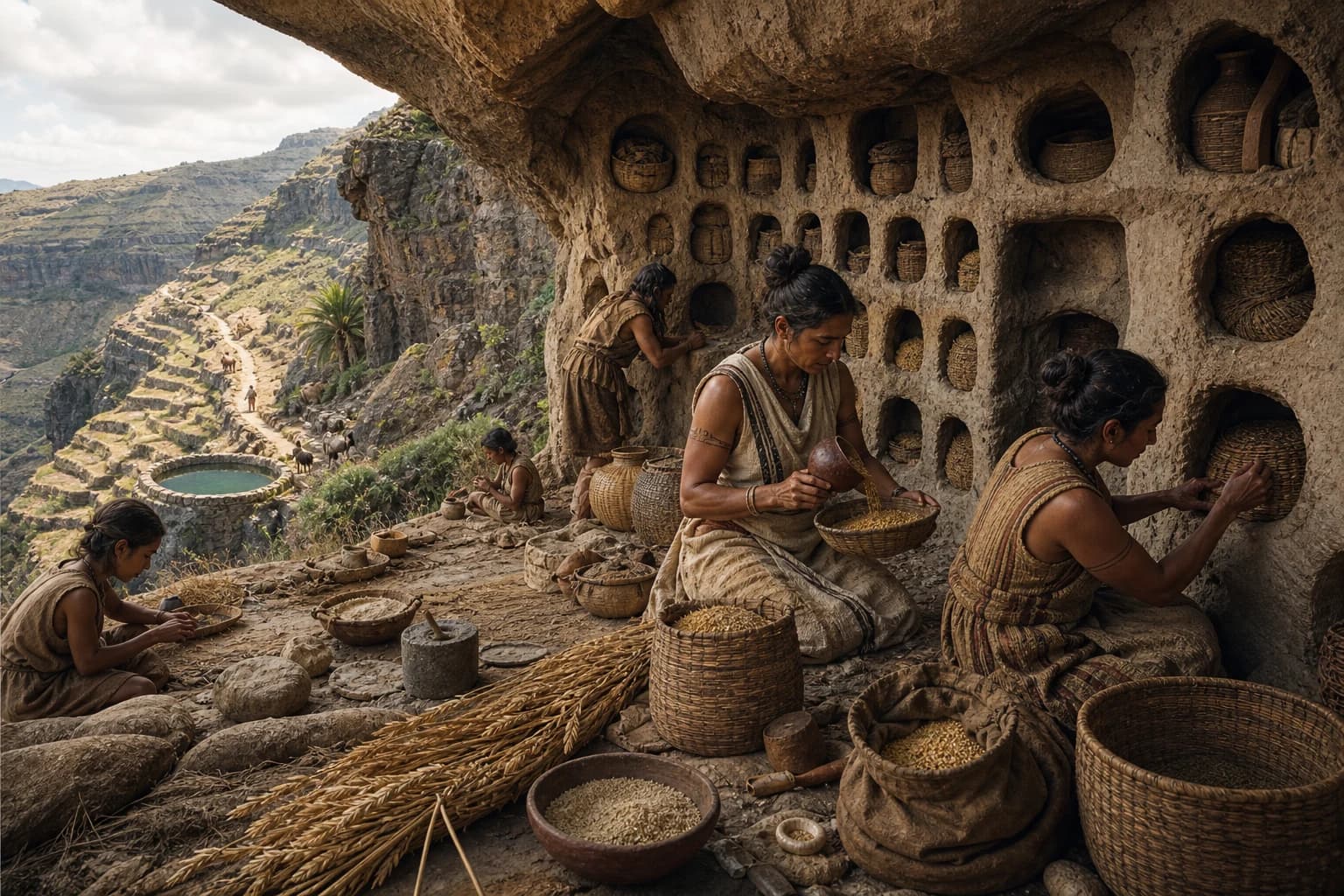
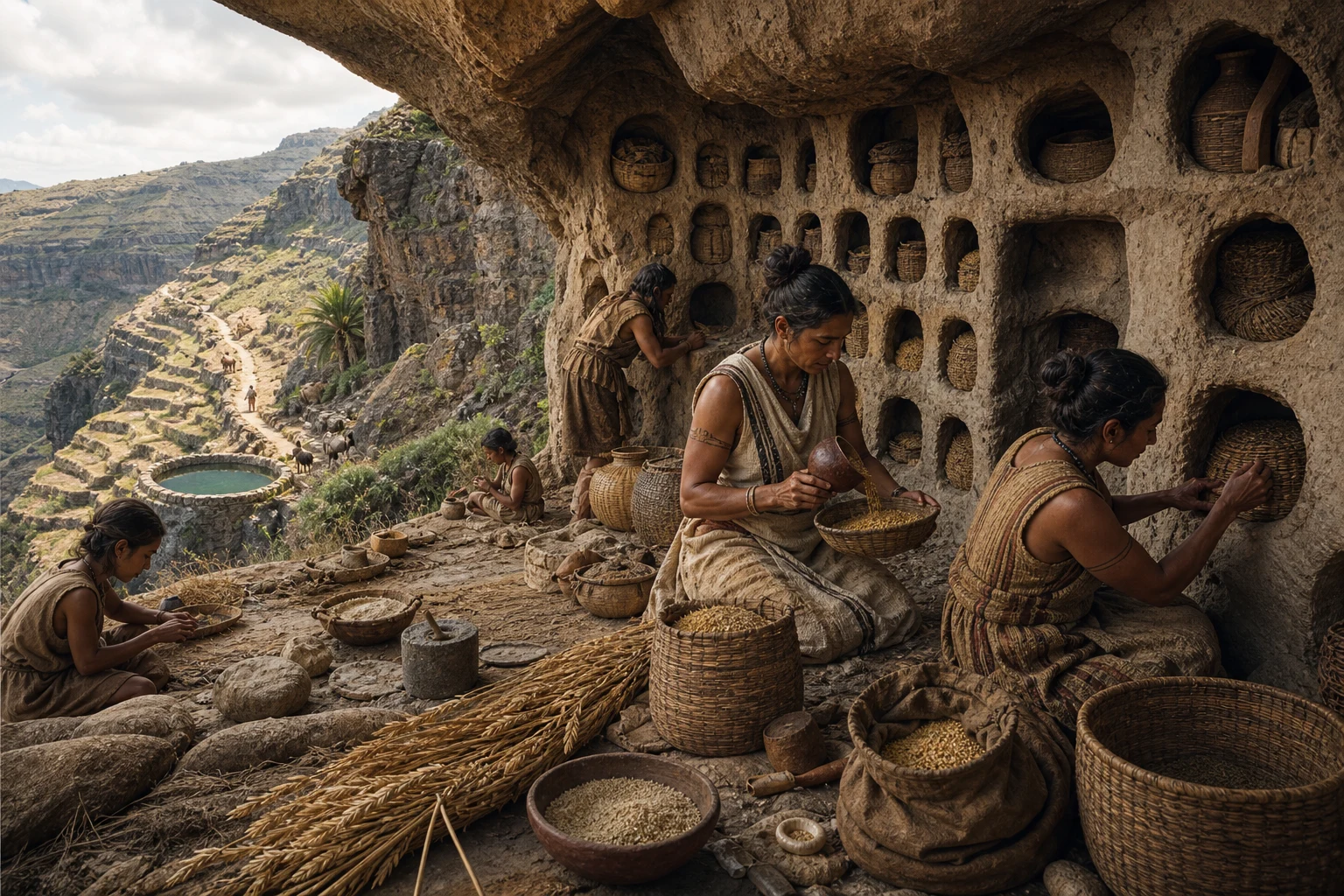
Indigenous communities on Gran Canaria cut clusters of storage cells into volcanic-tuff caves and cliffs, creating dry, protected spaces where access could be controlled and barley, wheat, legumes, figs and other foods preserved. Sites including Risco Caído, Mesa de Acusa and Cenobio de Valerón belonged to landscapes of cave settlements, cisterns, terraces, paths and seasonal herding. They were not one uniform 'cave civilization' shared unchanged by every Canary Island. Archaeological syntheses identify large communal cave granaries as especially characteristic of Gran Canaria, while cultivation, pastoralism and other resources varied between islands.
 View the complete scene ↗
The full scene reconnects storage cells and crop processing to terraces, water and herding paths. It is an evidence-led reconstruction, not a photograph of one archaeological site.
- Core distribution
- Gran Canaria, not one uniform system across every island
- Architecture
- Storage cells and passages cut into volcanic tuff, with controlled entries
- Plant evidence
- Barley, wheat, legumes and figs among recorded foods
- Connected landscape
- Terraces, water management, paths and seasonal pastoralism
- Historical rupture
- Fifteenth-century Castilian conquest transformed people, land and institutions
Chronology
A process, not a single date
Causes, turning points and aftermath form one process, far larger than a capital’s fall, a signed treaty or a company’s founding date.
- 01
Settlers of North African Imazighen ancestry reach the islands
The earliest date differs by island and remains under study. Settlers carried cereals, legumes, sheep, goats and pigs into environments that developed separately.
- 02
Cultivation and herding appear across several islands
Barley, wheat and livestock were not unique to Gran Canaria, but each island came to rely on cultivation, gathering and herding in different proportions.
- 03
Gran Canaria develops communal cave granaries
Sites such as Cenobio de Valerón and El Álamo-Acusa preserve clustered cells and desiccated plant remains, evidence of surplus and long-term management.
- 04
Castile conquers Gran Canaria
War, forced migration, enslavement, disease and colonial landholding break the former political order and transform agriculture and language transmission.
- 05
Risco Caído enters the World Heritage List
UNESCO recognizes the relationships among settlements, granaries, cisterns, terraces, paths and ceremonial spaces across a cultural landscape.
Why are the cells inside the cliff identified as granaries rather than tombs or a monastery?
Archaeologists use form and residue, not cave setting alone. Cenobio de Valerón retains an old name that once encouraged a monastic interpretation, but the site consists of many small storage chambers. Granaries such as El Álamo-Acusa have also preserved barley and other desiccated plant material. Clustered cells, access, sealing arrangements and food remains support the storage interpretation together.
Volcanic tuff could be worked with stone and bone tools. A dry, relatively stable cavity protected produce while a cliff location limited animals, pests and unauthorized entry. Individual cells may have represented household shares, but passages, guarding, closures and withdrawals required collective organization. Archaeology reveals infrastructure; it cannot supply one identical property regime for every site and period.
What was stored, and how did a harvest reach the rock chambers?
Pre-Hispanic Gran Canaria cultivated barley, wheat and legumes and used plants including figs. Barley from El Álamo supports a North African crop origin and long continuity in some island varieties. Harvesting, threshing, winnowing, drying and transport all came before storage, making the granary the final station in a long labour chain.
Terraces and water management reduced risk without abolishing rainfall uncertainty. Stored harvest could last between seasons and also created authority over distribution: who opened a cell, when grain came out and how scarcity was met could become social and political questions. The granary was therefore risk-management infrastructure rather than a picturesque cavity.
How did different island environments shape livelihoods and political organization?
Sheep, goats and pigs reached all seven principal islands, and crops were widespread. Yet recent synthesis finds communal tuff-cut granaries only on Gran Canaria, where cultivation was more diverse and important than on several neighbouring islands. Evidence for wheat, barley, legumes and intensive herding is strong on Tenerife and Gran Canaria; Fuerteventura, La Palma and others combined resources differently.
Insular difference did not mean one ruler per island. Archaeological synthesis describes multiple chiefdoms at contact, with varying internal cohesion. Conquest-era sources list nine menceyatos on Tenerife, while Gran Canaria shows more centralized resource management and uses different titles. Mencey and guanarteme belong to particular islands and source traditions; they are not interchangeable. Guanche likewise refers primarily to Tenerife.
Paths, pasture, water and landing places necessarily shaped access inland, but the evidence cannot recover one archipelago-wide council that routinely appointed pilots for unfamiliar ships. Contact and conquest accounts instead show Europeans negotiating, allying, deceiving and fighting with particular leaders, communities and intermediaries. Because conquerors and later chroniclers produced much of that record, it is not a transparent transcript of Indigenous institutions.
Why does the history of storage have to include Castilian conquest?
These were not abandoned structures awaiting European discovery. Before the fifteenth-century conquest, granaries belonged to island societies with their own political, kinship, religious and resource institutions. The 1478—1483 war for Gran Canaria brought killing, captivity, enslavement, forced movement and land redistribution. Treating the site only as a marvel seen by navigators erases its builders again.
UNESCO calls the archaeological insular culture extinct, meaning that its former institutional complex ended; it does not mean that Indigenous ancestry or descendants vanished. Colonial society absorbed, suppressed and transformed language and practice, while some land-use knowledge continued through transhumance, terraces and water management. The dossier distinguishes political rupture, demographic continuity and present identity rather than telling a total-disappearance story.
Evidence boundary
Fact, interpretation and uncertainty
The evidence reveals where imperial claims diverged from reality and where heroic stories compressed complex wars.
Gran Canaria preserves communal cave granaries and actual crop remains
UNESCO documentation, Cabildo site records and archaeobotanical research support the storage function and identify barley, wheat, legumes and other foods.
Communal architecture does not reveal the owner of every cell
Compartmentalization, restricted access and capacity imply social management, while household share, chiefly control and public redistribution may have varied by site and date.
Guanche is not a precise universal name for all Indigenous Canary Islanders
Guanche primarily belongs to Tenerife. Indigenous Canarians is appropriate for the archipelago; this dossier focuses on the Ancient Canarians and specific sites of Gran Canaria.
Questions
Common questions
Was Cenobio de Valerón a monastery?
No. Cenobio is a legacy of an older misinterpretation. Archaeologists understand the many tuff-cut chambers as a large pre-Hispanic communal granary.
Did all Indigenous Canarians live in caves?
No. Cave dwellings and stone-built settlements differed by island and place. Caves could also serve separately as granary, cistern, ceremonial space or tomb, so setting alone does not establish function.
Which foods have been found in the granaries?
Archaeobotanical remains include barley, wheat, legumes and figs, with the combination varying by site. Dry cave conditions preserve seeds unusually well.
Why not call every Indigenous islander Guanche?
Guanche primarily names the Indigenous people of Tenerife. Indigenous Canarians is better for the archipelago, while Ancient Canarians or Canarios identifies Gran Canaria more precisely.
Did one ruler govern the Canary Islands before conquest?
No. The islands developed separately and each contained multiple political units whose scale and cohesion differed. Tenerife sources use mencey and menceyato; Gran Canaria sources include guanarteme. These are not archipelago-wide interchangeable offices.
Did the Indigenous population disappear after conquest?
No. War, enslavement, migration and disease shattered institutions and reduced and reorganized the population, but descendants did not vanish biologically or socially, and some land-use practices continued.
Sources
Sources and further verification
Archives, museums, international organizations and academic publications support the facts and interpretive limits in this account.
- Risco Caído and the Sacred Mountains of Gran Canaria Cultural LandscapeUNESCO World Heritage Centre
- Risco Caído nomination dossier: documented cultural uses of plantsUNESCO World Heritage Centre
- Archaeological Research in the Canary IslandsJournal of Archaeological Research / Springer Nature
- Agriculture and crop dispersal in the western periphery of the Old WorldVegetation History and Archaeobotany
- Cenobio de Valerón o Cuevas de ValerónCabildo de Gran Canaria
- An Evolutionary Approach to the History of Barley Cultivation in the Canary IslandsJournal of Ethnobiology and Ethnomedicine
- Organización política: los nueve menceyatos de TenerifeMuseo de Naturaleza y Arqueología de Tenerife
Age of Seas editorial research distinguishes verifiable facts, historical interpretation and potentially misleading simplifications.Editorial standards and corrections ↗