In one minute
What did this event actually change?
Portuguese settlers developed large-scale sugar production on Madeira from the mid-fifteenth century, drawing on Mediterranean techniques, irrigation, European capital and both free and enslaved labour. Farther south, Portuguese merchants entered West African gold networks and built São Jorge da Mina at Elmina in 1482 after negotiating with local authorities. The fort was founded mainly for the gold trade, though it later became deeply involved in the Atlantic slave trade.
 View the complete scene ↗
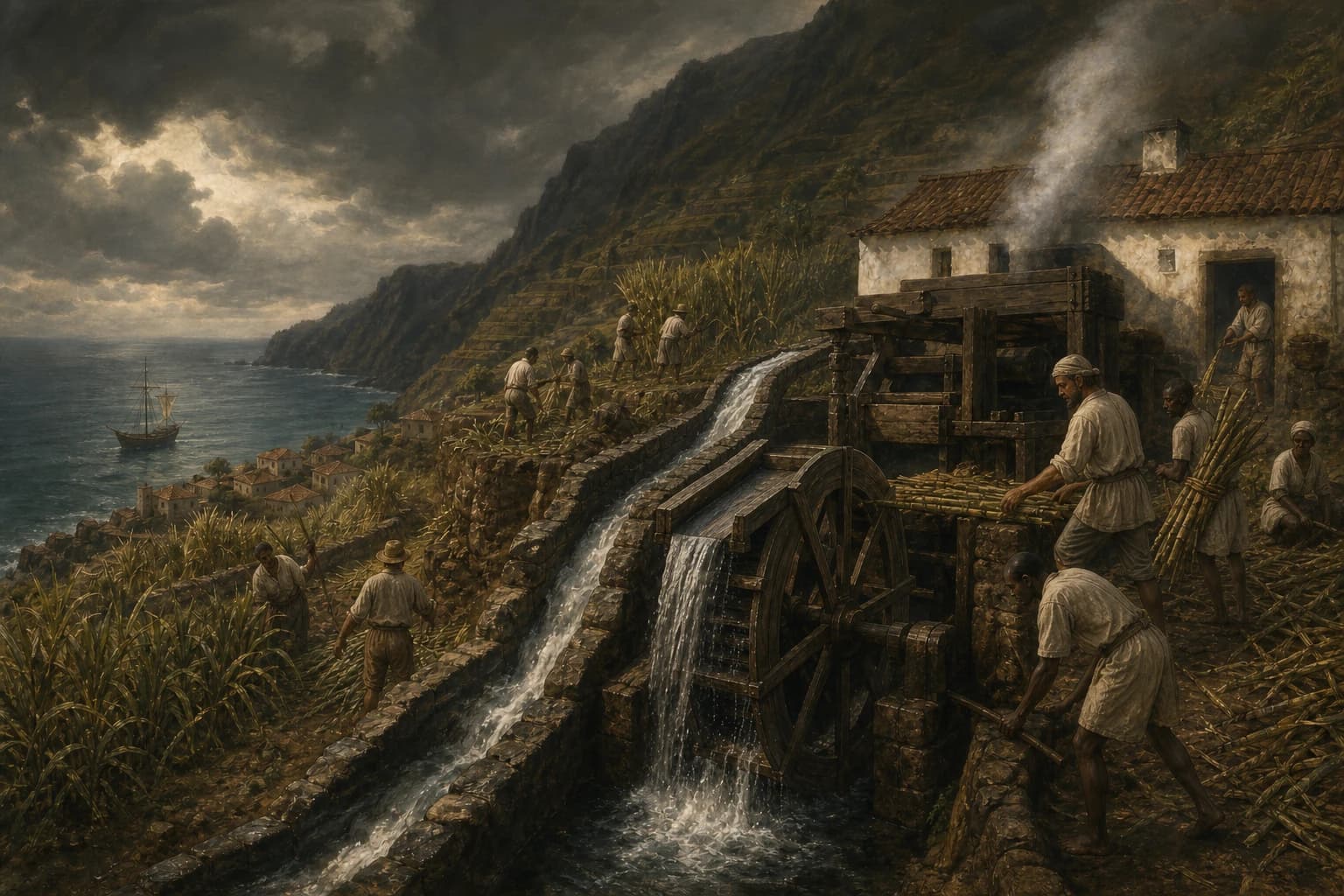
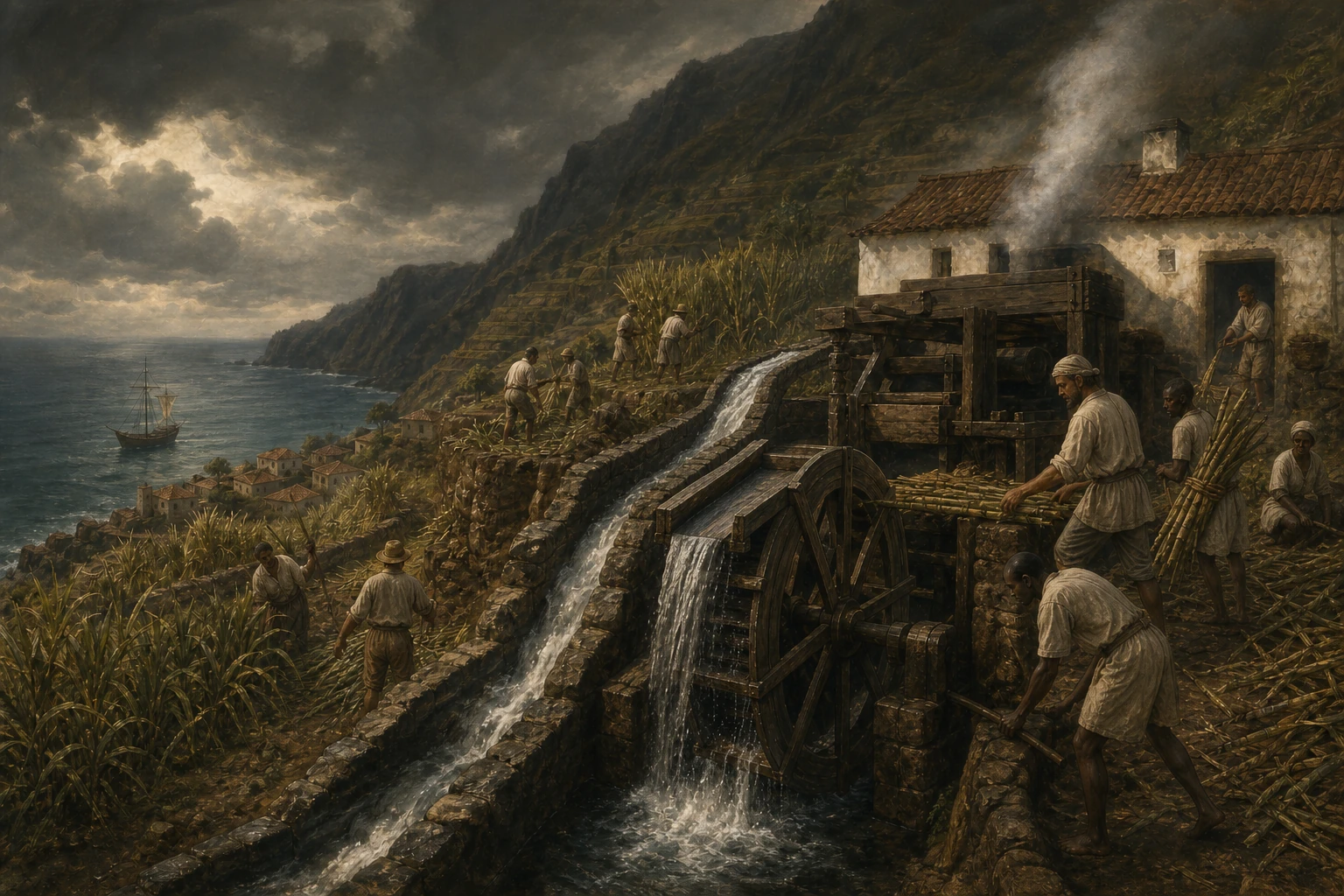
The levada irrigates cane and powers the mill; the full scene preserves the spatial chain from hillside cultivation and crushing to export by sea.
- Water-powered sugar mill
- Contracted by 1452
- Sugar expansion
- Especially the 1450s—1470s
- Recorded captive sale at Lagos
- 1444
- Elmina fort founded
- 1482
- Founding trade at Elmina
- Primarily West African gold, exchanged through African commercial networks
Chronology
A process, not a single date
Causes, turning points and aftermath form one process, far larger than a capital’s fall, a signed treaty or a company’s founding date.
- 01
Portuguese settlement begins on Madeira
Settlers clear land and build irrigation channels to adapt agriculture to the island's steep terrain.
- 02
Captive Africans are transported to Portugal
Raiding, purchase and a documented sale at Lagos reveal how quickly coastal exploration becomes tied to enslavement.
- 03
Madeiran sugar grows rapidly
Water power, irrigation, merchant credit and coerced labour make the island an important European supplier.
- 04
Portuguese ships enter Gulf of Guinea gold exchange
Trade depends on African merchants, rulers and inland networks rather than direct European access to mines.
- 05
São Jorge da Mina is built at Elmina
After negotiation with local authority, Portugal establishes a fortified warehouse to secure its position in the gold trade.
How did levadas, mills and boiling houses form one production line?
Rainfall varies sharply across Madeira. Levadas gradually carried water from wetter northern and upland sources toward farmland that included the drier south, while also delivering mechanical power to some mills. Cane had first been handled with manual presses; by 1452, a surviving contract records Prince Henry commissioning Diogo de Teive to build a water-powered sugar mill. Greater crushing capacity made diversion rights, maintenance, mill ownership and processing dues part of the sugar regime.
At an engenho, cane moved from crushing and juice extraction to clarification, boiling, concentration and crystallization. Mills depended on channels, boiler fuel, vessels, storage and shipping. An island 'sugar industry' was therefore a connected system of agriculture, machinery, heat processing and export.
Not every worker in that system was enslaved: growers, tenants, wage labourers, merchants and specialist craftspeople all took part. Yet records from 1466 onward explicitly identify enslaved Canary Islanders, North Africans and sub-Saharan Africans brought to work in sugar. It is inaccurate either to label the entire workforce enslaved or to remove slavery from the production line.
How did human trafficking enter the island production system?
After Portuguese ships passed Cape Bojador, some early expeditions raided coastal communities directly. African resistance and commercial choices forced the newcomers in many regions to deal with rulers, brokers and merchants instead, but people sold through those exchanges still suffered violent dispossession.
This was not the absolute beginning of slavery: African, Mediterranean and Islamic societies already contained different systems of enslavement. The shift was that Portuguese shipping, royal licences and Atlantic-island demand increasingly organized West African trafficking around an expanding ocean route.
Elmina joined an African trade that already existed
Gold moved from inland producing regions toward the coast through African political and commercial networks. Portuguese ships brought metals, cloth and other goods, but they could not simply command supply. They negotiated with local rulers and merchants who pursued their own interests and controlled access on land.
In 1482, Diogo de Azambuja's expedition built São Jorge da Mina after negotiation at Elmina. Stone walls, cannon and a royal monopoly gave Portugal a durable maritime base, while daily exchange still depended on African brokers, languages and regional politics.
Gold first, slavery later—but the histories converge
Elmina is now widely remembered as a slave-trade site. At its founding, however, gold was the main Portuguese objective. Keeping that chronology clear prevents the fort's entire history from collapsing into one function.
It also does not absolve the system. Portuguese trafficking of enslaved Africans already existed elsewhere, and Elmina later became a major node in Atlantic enslavement under Portuguese and then Dutch rule. Island plantations, fortified commerce and forced migration became parts of the same expanding oceanic economy.
Evidence boundary
Fact, interpretation and uncertainty
The evidence reveals where imperial claims diverged from reality and where heroic stories compressed complex wars.
A water-powered mill and enslaved sugar labour appear in fifteenth-century records
The 1452 mill contract and records from 1466 onward support both mechanized processing and enslaved labour, while workforce composition still varied by estate and period.
Elmina was founded chiefly as a gold-trade fort
Its later importance in the slave trade should not be projected unchanged onto the purpose of the 1482 foundation.
African participants were not passive suppliers
Rulers and merchants negotiated terms and linked the coast to inland markets, even within an exchange increasingly shaped by European demand, weapons and violence.
Questions
Common questions
Did every Madeira levada simply carry north-slope water south?
That is a useful overview, not one route shared by every channel. The network tapped wetter areas and upland sources for drier farms and settlements, and some channels powered mills. Each channel had its own date, direction, rights and maintenance arrangements.
Was Madeira the first place to grow sugar on plantations?
No. Mediterranean and Middle Eastern precedents were much older. Madeira became an important Atlantic adaptation and a bridge toward later plantation systems.
Was all Madeiran sugar produced by enslaved labour?
No. The workforce was mixed, but enslaved Africans supplied a significant and increasingly important part of the labour. Their presence should neither be universalized nor minimized.
Was Madeiran sugar really called 'white gold' at the time?
Madeiran museums, cultural institutions and modern scholarship use 'white gold' to summarize sugar's scarcity and value. The surviving evidence does not justify presenting it as a fixed phrase heard on every fifteenth-century quay or as a direct contemporary quotation.
Was Elmina built for the slave trade?
Its principal founding objective in 1482 was the gold trade. The fort later became deeply implicated in the transatlantic traffic in enslaved people.
Did Portugal control the West African gold mines?
No. Portuguese merchants reached coastal markets. African states, traders and transport networks controlled inland production and movement, and negotiated from their own positions.
Sources
Sources and further verification
Archives, museums, international organizations and academic publications support the facts and interpretive limits in this account.
- Levadas of Madeira IslandUNESCO World Heritage Centre
- Forts and Castles of GhanaUNESCO World Heritage Centre
- A Concise History of Brazil: excerptCambridge University Press
- The Forgotten Diaspora: excerptCambridge University Press
- General History of Africa, Volume VUNESCO
- Museu A Cidade do AçúcarMadeira Regional Directorate for Culture
- Three Sugar Islands: The Sugar Economy of Madeira and the Canaries, 1450–1650Oxford Academic
Age of Seas editorial research distinguishes verifiable facts, historical interpretation and potentially misleading simplifications.Editorial standards and corrections ↗