In one minute
What did this event actually change?
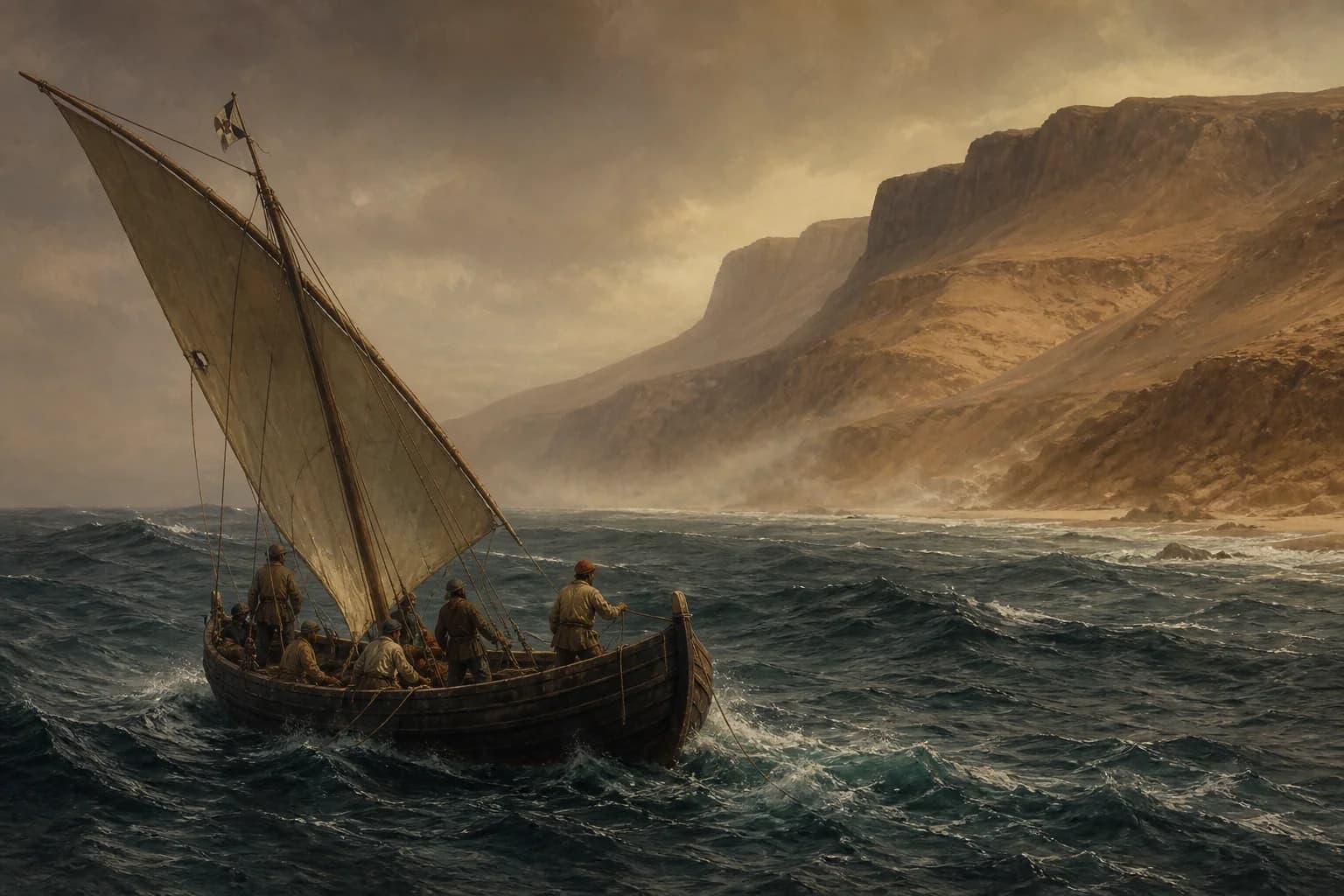
Gil Eanes passed Cape Bojador, on the coast of present-day Western Sahara, in 1434. The achievement was not sailing beyond the edge of the world. It was finding a workable offshore approach and return past a coast of shoals, surf, haze and awkward winds. A chronicle says he brought plants back as evidence. The voyage opened the way for further Portuguese expeditions, soon followed by raiding and the trafficking of enslaved Africans.
- Voyage
- 1434
- Mariner
- Gil Eanes
- Location
- Cape Bojador, on the coast of present-day Western Sahara
- Vessel in the early account
- A barca—not securely the mature caravel of later decades
- Significance
- The first recorded Portuguese passage and return beyond the cape
Chronology
A process, not a single date
Causes, turning points and aftermath form one process, far larger than a capital’s fall, a signed treaty or a company’s founding date.
- 01
Repeated expeditions turn back
Portuguese crews approach the cape but do not establish a repeatable passage and return.
- 02
Eanes returns without passing
The expedition fails in its stated purpose; the chronicle instead records captives brought to Portugal.
- 03
Eanes stands farther out to sea
He passes the cape, lands beyond it and returns with plants presented as physical proof.
- 04
A follow-up voyage pushes onward
Eanes and Afonso Gonçalves Baldaia travel farther south, turning one success into a developing route.
- 05
Exploration becomes entangled with enslavement
Portuguese voyages raid, purchase and transport captive Africans; a public sale is recorded at Lagos in 1444.
What made the cape difficult?
Cape Bojador was not a supernatural wall. Shoals extend from a low, hard-to-read coast; breaking surf, haze and unfamiliar current made close sailing dangerous. Winds that helped a vessel southward could also make the homeward leg uncertain.
The solution was practical and psychological: give the coast more room, accept a period without a familiar shoreline, then recover land beyond the cape. The passage belonged to a growing body of Atlantic route knowledge rather than one miraculous instrument.
Fear was real, but later storytelling magnified it
Gomes Eanes de Zurara, writing years later for a princely audience, portrayed earlier hesitation as fear of monsters, boiling seas and an unreturnable zone. Such images communicated the courage and providential mission of Henry's mariners.
They should not be read as a transcript of every sailor's beliefs. Crews had good material reasons to turn back: wreck, thirst, uncertain pay, loss of bearings and the possibility that a favourable outward wind would deny a safe return.
Why bring plants home?
A report could be dismissed; unfamiliar plants made the landing tangible. According to the chronicle, Eanes gathered them beyond the cape and presented them after his return. The gesture tied geographical knowledge to courtly verification.
The account calls his vessel a barca. Later retellings often replace it with a caravel because caravels became central to Portuguese exploration, but that back-projects a better-known ship type into evidence that does not require it.
A navigational opening also opened a violent frontier
The 1434 passage made further reconnaissance more regular. It did not make the coast empty or newly existent: Saharan and West African communities already inhabited and understood these regions, while long-distance commerce linked them inland.
Within a decade, Portuguese expeditions were capturing and buying Africans for transport to Iberia and Atlantic islands. The passage itself was not a slave voyage, but its consequences cannot be told only as technological progress. Route-making, commerce, raiding and coercion advanced together.
Evidence boundary
Fact, interpretation and uncertainty
The evidence reveals where imperial claims diverged from reality and where heroic stories compressed complex wars.
The early narrative records a passage in 1434
Zurara's chronicle identifies Gil Eanes, the offshore manoeuvre and plants returned as evidence, although it was composed after the event and served princely commemoration.
The monster-filled barrier is partly a literary construction
Physical hazards were genuine, but the most theatrical account was designed to contrast earlier fear with Henry's success.
The vessel need not have been a caravel
The source uses barca. Calling it a caravel imports the characteristic exploration ship of a somewhat later phase.
Questions
Common questions
Did Europeans think Cape Bojador was the edge of the world?
Some geographical fears circulated, but the cape's practical dangers were enough to deter crews. The familiar edge-of-the-world story owes much to later celebratory writing.
Did Eanes sail a caravel?
The principal early chronicle calls the vessel a barca. A caravel is possible only through broader inference, not secure wording in that account.
Why were a few plants important?
They served as portable evidence that the crew had landed beyond the cape. Their value was proof, not commercial profit.
Did the slave trade begin on this voyage?
No. The 1434 voyage established a passage. Portuguese capture and transport of enslaved Africans intensified in voyages of the early 1440s, within the route system that followed.
Sources
Sources and further verification
Archives, museums, international organizations and academic publications support the facts and interpretive limits in this account.
- The Chronicle of the Discovery and Conquest of Guinea: Chapter IXCambridge University Press
- Wine and Portugal: A Brief HistoryCambridge University Press
- A Concise History of Brazil: excerptCambridge University Press
- The Forgotten Diaspora: excerptCambridge University Press
- The Formation of the Portuguese Colonial EmpireLibrary of Congress
Age of Seas editorial research distinguishes verifiable facts, historical interpretation and potentially misleading simplifications.Editorial standards and corrections ↗