In one minute
What did this event actually change?
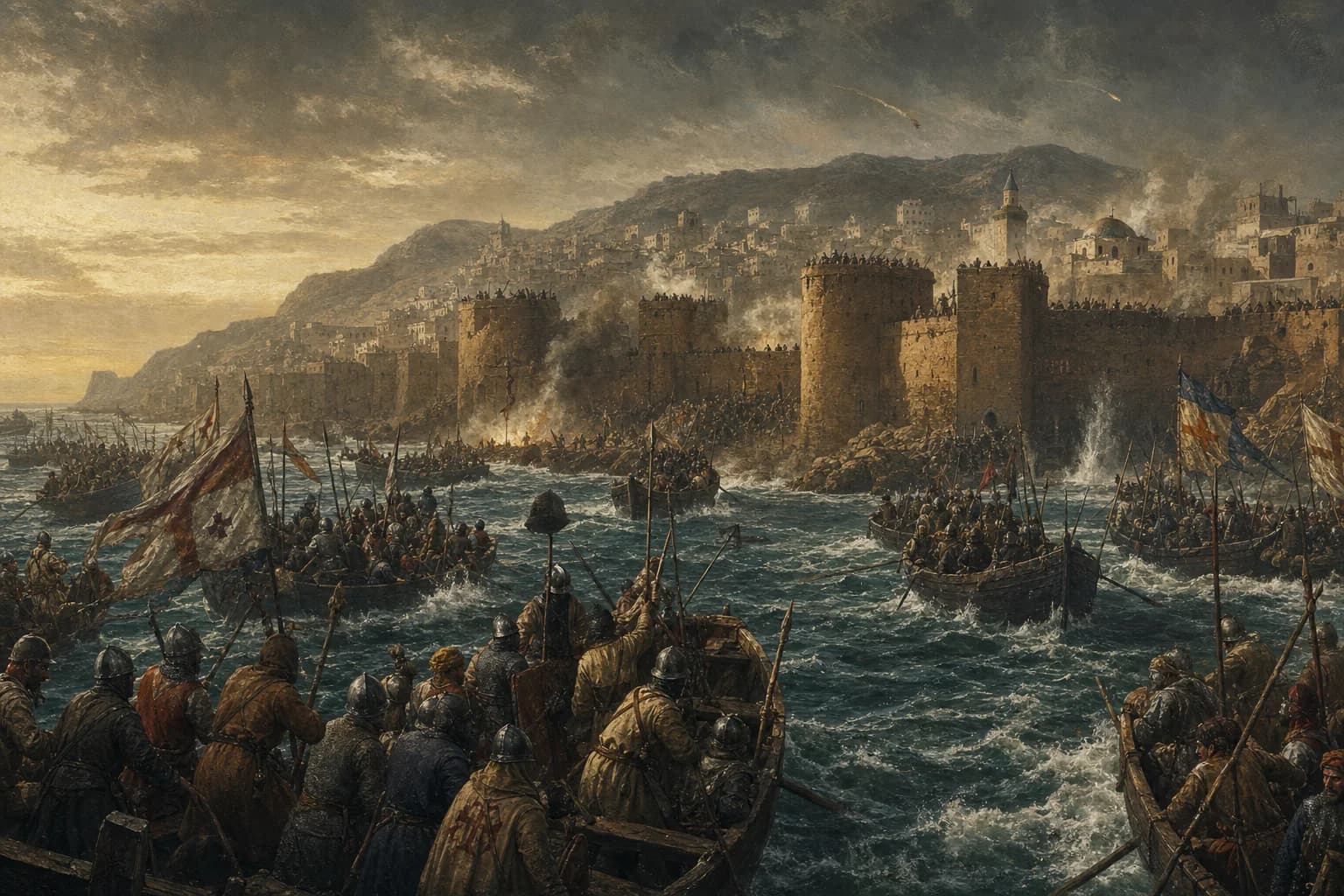
On 21 August 1415, a fleet led by King João I of Portugal captured Ceuta on the North African shore. The expedition gave the monarchy a defensible base across the Strait of Gibraltar and later became a conventional starting point for Portuguese overseas expansion. It did not, however, deliver automatic control of Saharan gold or Mediterranean trade: merchants could change routes, while the garrison depended on expensive supply from Portugal.
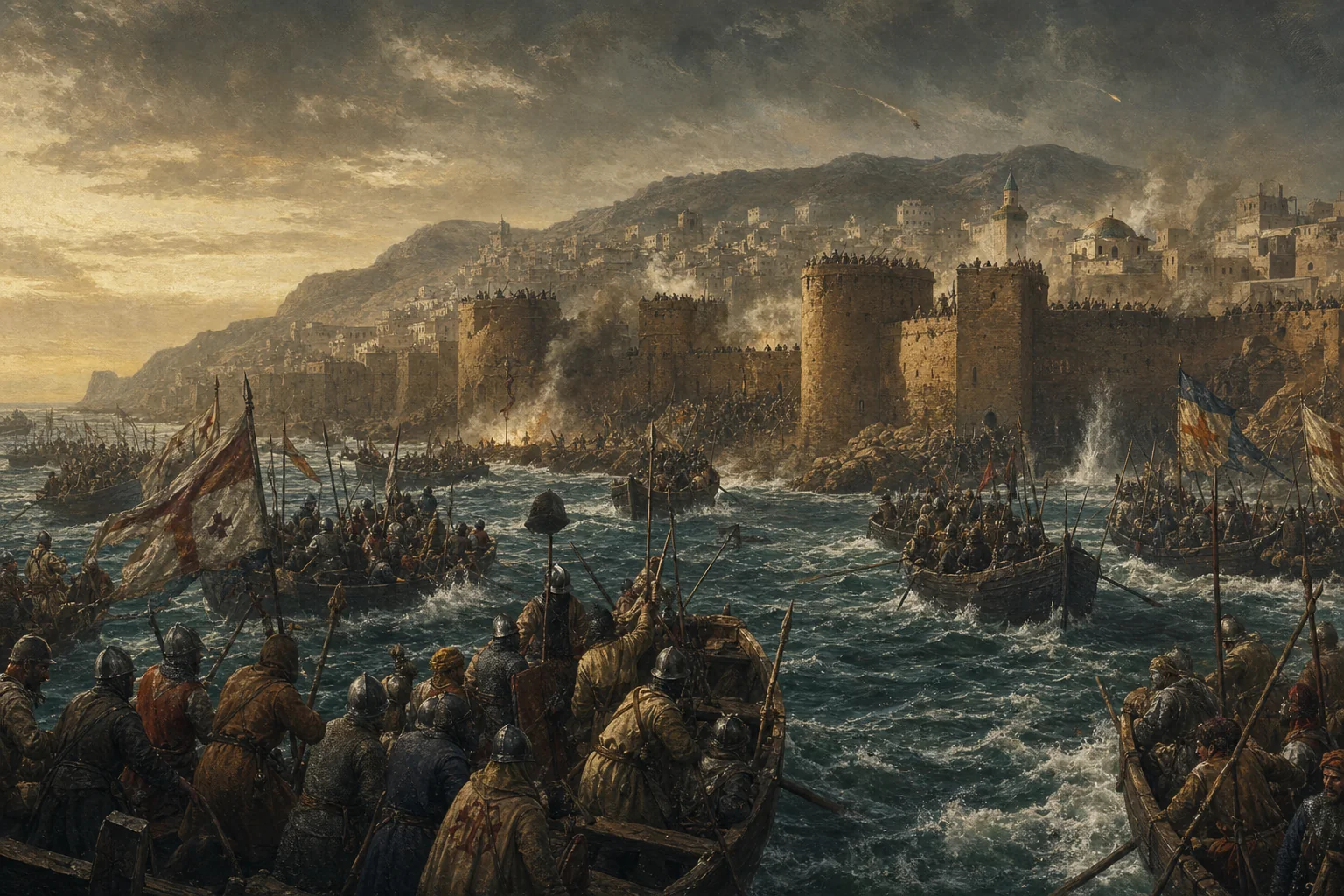 View the complete scene ↗
The banner crops and darkens this artwork. This plate preserves the complete composition; click the image to view it on its own.
- Captured
- 21 August 1415
- Location
- Ceuta, on the North African side of the Strait of Gibraltar
- Leadership
- King João I and the royal princes, including the future Henry the Navigator
- Immediate result
- A permanent Portuguese garrison outside Europe
- Long-term status
- Spain retained Ceuta; Portugal formally recognized that possession in 1668
Chronology
A process, not a single date
Causes, turning points and aftermath form one process, far larger than a capital’s fall, a signed treaty or a company’s founding date.
- 01
Peace with Castile frees royal attention
The settlement at Ayllón helps stabilize João I's dynasty and makes a large expedition across the strait politically possible.
- 02
A fleet assembles at Lagos
A large royal force gathers ships, troops and supplies. Contemporary figures vary, so its exact size remains uncertain.
- 03
Portuguese forces take Ceuta
The assault succeeds quickly; the city's Muslim population is killed, displaced or driven out as the victors occupy and plunder it.
- 04
Occupation becomes a supply problem
Trade can bypass the captured city, while Portugal must provision and defend an exposed garrison across the sea.
- 05
The Tangier expedition fails
An attempt to enlarge the North African position ends in defeat, and Prince Fernando is left as a hostage.
- 06
Portugal recognizes Spanish possession
Ceuta remains with Spain after the Iberian Union; the Treaty of Lisbon confirms the separation.
Why did João I attack Ceuta?
No single motive explains the expedition. Ceuta offered a crusading war against a Muslim city, land and honour for a warrior aristocracy, and a public achievement for a dynasty that had won the Portuguese throne only a generation earlier.
Commercial expectations mattered too. Ceuta stood near the strait and was linked, indirectly and variably, to Mediterranean and Saharan exchange. Yet the campaign was not a simple business investment aimed at one warehouse of gold; royal prestige, religion, noble politics and strategy reinforced one another.
The landing was decisive; the occupation was harder
João I commanded the undertaking, accompanied by his sons Duarte, Pedro and Henrique. After delays and illness, the fleet crossed from southern Iberia. Portuguese troops entered Ceuta on 21 August and overwhelmed its defence. The speed of the victory later encouraged a heroic national story, but for the inhabitants it meant violent conquest, plunder and displacement.
A harbour could be seized in a day; a commercial network could not. Caravans and merchants had alternatives, and surrounding powers remained hostile. Food, soldiers, repairs and money had to cross the strait to keep the city Portuguese.
Ceuta did not unlock African trade
Caravan trade and the Moroccan interior did not depend on one harbour. NOVA's Encyclopaedia of Portuguese Expansion states that the Saharan commerce formerly reaching Ceuta largely ceased to frequent the city after 1415. Grain, wool and horses could continue through wider Moroccan markets, but that is not evidence of a steady caravan manifest inside occupied Ceuta.
The garrison instead depended on maritime supply organized from Portugal. Research on the fifteenth-century Casa de Ceuta finds that cereals and wine were largely collected in the Tagus valley, channelled through Lisbon and shipped to North Africa. Holding a coastal node did not compel inland producers or caravan leaders to use it; the logistical cost reveals the limit of conquest.
Why 1415 still matters
Ceuta placed overseas conquest, garrisoning and regular maritime supply inside Portuguese royal policy before sustained voyages far down the West African coast. The techniques of occupation and the costs of empire therefore accompanied exploration from an early stage.
It is reasonable to use 1415 as a turning point, not as the single birth date of oceanic sailing. Atlantic island voyages, fishing, commerce and navigational knowledge had longer histories, while Henry was one prince within a royal expedition—not its lone architect.
Evidence boundary
Fact, interpretation and uncertainty
The evidence reveals where imperial claims diverged from reality and where heroic stories compressed complex wars.
The conquest was a crown-led military operation
Royal chronicles and later scholarship agree on João I's leadership, the participation of the princes and the capture on 21 August 1415.
The expedition had no single proven motive
Crusading ideals, dynastic legitimacy, aristocratic opportunity, strategy and commercial hopes all appear in the evidence; reducing them to gold alone is misleading.
Capturing Ceuta did not capture its trade
Merchants and caravans could avoid the occupied port, leaving Portugal with a valuable but expensive garrison.
Questions
Common questions
Is Ceuta Portuguese today?
No. Ceuta is a Spanish autonomous city. It remained with Spain after the Iberian Union, and Portugal recognized Spanish possession in 1668.
Did Henry the Navigator conquer Ceuta?
Henry fought there and the victory became important to his reputation, but King João I led a royal expedition involving several princes and a large military organization.
Was Saharan gold the reason for the attack?
Commercial hopes, including access to African trade, formed part of the calculation. The surviving evidence supports a bundle of religious, political, social and strategic motives rather than one cause.
Did Moroccan caravans keep supplying grain to Portuguese Ceuta?
That is not the overall pattern. Saharan commerce largely bypassed Ceuta after conquest, while the Portuguese garrison received regular cereals and wine gathered mainly in the Tagus valley and shipped through Lisbon. Local exchange may have occurred, but it cannot replace that supply structure.
Did the Age of Discovery begin on 21 August 1415?
The date is a useful period marker because it began a durable Portuguese overseas occupation. It did not create Atlantic navigation from nothing, and sustained coastal reconnaissance developed afterward.
Sources
Sources and further verification
Archives, museums, international organizations and academic publications support the facts and interpretive limits in this account.
- A History of Portugal and the Portuguese Empire: The Conquest of CeutaCambridge University Press
- The Portuguese in MoroccoCambridge University Press
- Portuguese Oceanic Expansion, 1400–1800Cambridge University Press
- The Islamic World and the Making of the Portuguese EmpireCambridge University Press
- Portugal: A Country StudyLibrary of Congress
Age of Seas editorial research distinguishes verifiable facts, historical interpretation and potentially misleading simplifications.Editorial standards and corrections ↗