In one minute
What did this event actually change?
Tenochtitlan and Cusco did not fall because a few Spaniards defeated two empires alone. Hernán Cortés relied on tens of thousands of Indigenous allies, especially Tlaxcalans, while smallpox compounded siege and war. Francisco Pizarro exploited an Inca civil war and captured Atahualpa in an ambush at Cajamarca. The capitals changed hands in 1521 and 1533, opening colonial rule without ending Indigenous resistance.
- War in Mexico
- 1519—1521; further conquest continued
- War in the Andes
- 1532—1533; organized resistance continued to 1572
- Crucial allies
- Tlaxcala and other powers opposed to Mexica rule
- Crucial fracture
- The Inca succession war and regional political rivalries
- Shared mechanisms
- Alliance, epidemic disease, captured rulers, siege and violence
Chronology
A process, not a single date
Causes, turning points and aftermath form one process, far larger than a capital’s fall, a signed treaty or a company’s founding date.
- 01
Cortés enters central Mexico
Malintzin serves as interpreter and political intermediary; Spaniards fight and then ally with Tlaxcala against Mexica power.
- 02
Retreat, smallpox and renewed war
The Spaniards retreat from Tenochtitlan; epidemic disease devastates the population while Cortés rebuilds his coalition.
- 03
Tenochtitlan falls after a long siege
Lake blockade, starvation, disease and sustained attack destroy the city's defence; Cuauhtémoc is captured.
- 04
Atahualpa is captured at Cajamarca
After the Inca civil war, Pizarro's ambush uses cavalry, steel and firearms to seize the ruler and political leverage.
- 05
Atahualpa is killed and Cusco occupied
The Spaniards install Manco Inca before entering Cusco, but their authority remains fragile.
- 06
The siege of Cusco and Neo-Inca resistance
Manco Inca leads a major uprising; a successor state survives at Vilcabamba until 1572.
Why are 'a few hundred Spaniards conquered an empire' stories the wrong beginning?
Cortés and Pizarro brought relatively small Spanish forces, but they did not fight alone. Tlaxcala, Texcoco and other political communities supplied large armies, provisions, intelligence and local experience. Without them, the siege of Tenochtitlan could not have been sustained.
Indigenous allies were not passive auxiliaries. They sought to alter tribute systems, defeat regional enemies and protect their own interests. Their choices later met new colonial oppression, but they still belonged to existing political struggles rather than to a simple European plan.
Tenochtitlan: alliance, epidemic and siege
The 1519 advance depended heavily on Malintzin's translation, negotiation and political knowledge. Cortés temporarily controlled Moctezuma II, then retreated after fighting in the city. Smallpox brought catastrophic mortality as he reconstructed a large allied force.
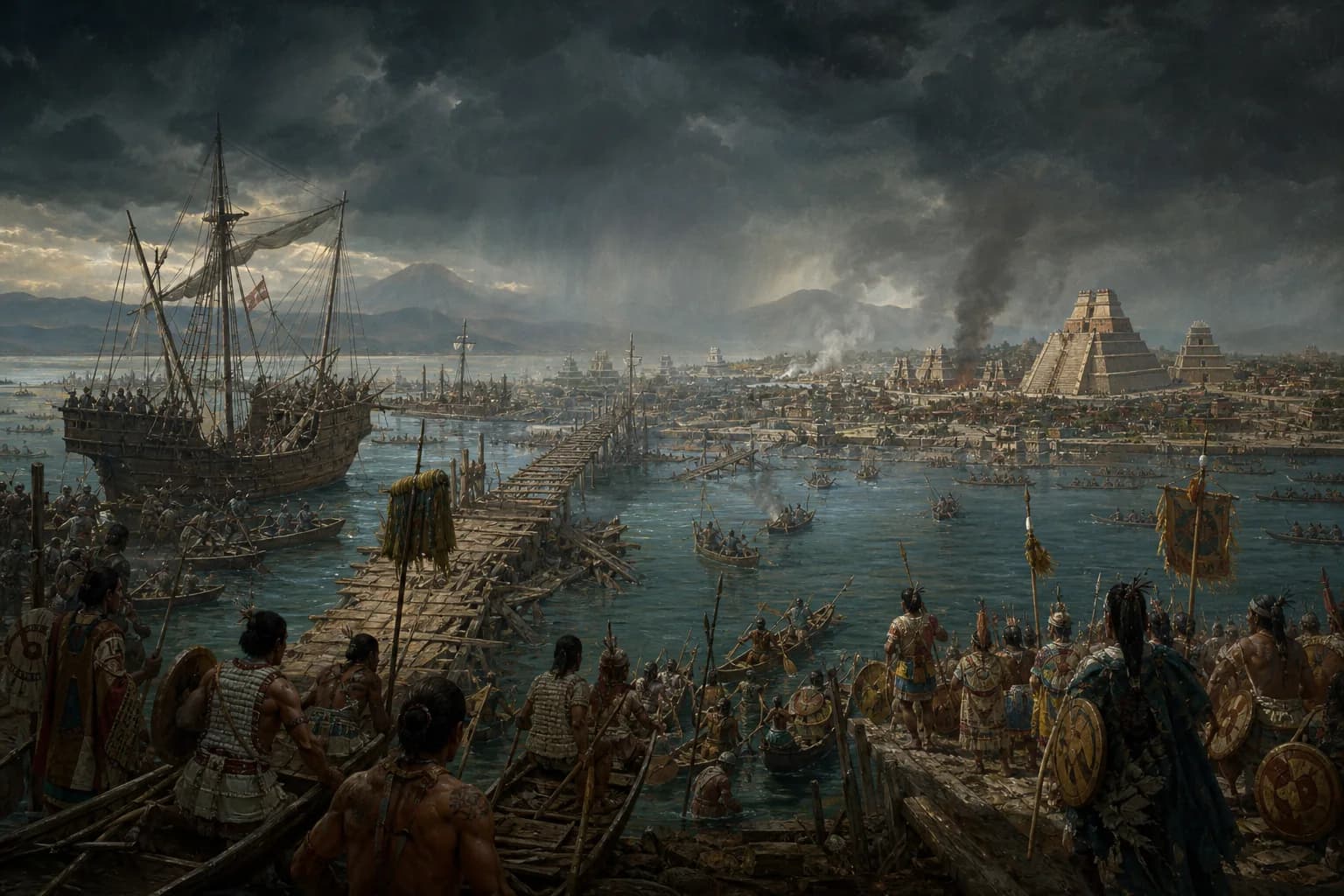
The 1521 campaign became a months-long siege. Brigantines contested the lake, supplies were cut and fighting moved street by street. Cuauhtémoc's capture on 13 August marked the city's defeat; destruction, forced labour and colonial rebuilding followed.
Cajamarca and Cusco: seizing authority after a civil war
Atahualpa had just defeated his brother Huáscar when Pizarro entered the Andes. The succession war had divided armies and elites. At Cajamarca in 1532, a prepared ambush captured Atahualpa; weapons created shock, but control of the ruler magnified a tiny force's influence over an existing system.
Atahualpa was executed despite the ransom. The Spaniards installed Manco Inca and entered Cusco in 1533, but proxy rule collapsed. Manco's 1536 uprising and the Vilcabamba state extended organized resistance for decades. Ending the conquest in 1533 erases that continuing war.
Similar mechanisms acted on different political worlds
Both conquests involved local alliances, crises of rule, disease, religious justification and severe violence. Capturing a sovereign converted a small expedition into outsized leverage. Yet the Mexica tributary system and the Inca road, labour and provincial structures were not the same, so war and colonial reorganization followed different paths.
The capitals' defeat did not make Indigenous societies disappear. War, epidemic disease and exploitation brought demographic catastrophe while languages, communities, memory and resistance endured. A fallen capital was a turning point in colonization, not the instant erasure of an old world.
Evidence boundary
Fact, interpretation and uncertainty
The evidence reveals where imperial claims diverged from reality and where heroic stories compressed complex wars.
Indigenous allies were central, not incidental
Spanish and Indigenous accounts record the enormous role of Tlaxcalan and other allied forces in the campaign and siege.
Disease was devastating but not a complete explanation
Smallpox acted alongside siege, starvation, alliance and political fracture; no single factor explains the result.
1533 did not complete conquest of the Andes
Manco Inca's revolt and the Vilcabamba state continued organized resistance until 1572.
Questions
Common questions
How could Cortés take Tenochtitlan with only a few hundred Spaniards?
The besieging army included very large Indigenous allied forces. Smallpox, starvation, control of the lake and political rivalries also shaped the outcome.
Was Malintzin only Cortés's translator?
No. She interpreted languages and political relationships, negotiated between groups and supplied knowledge crucial to the expedition.
Did Pizarro defeat Atahualpa in a conventional battle?
No. Cajamarca was a planned ambush that seized Atahualpa and used control of the ruler to exert political leverage.
Did the inhabitants of the two empires disappear?
No. Population fell catastrophically, but Indigenous communities, languages and cultures persisted and remain central to Mexico and the Andes.
Sources
Sources and further verification
Archives, museums, international organizations and academic publications support the facts and interpretive limits in this account.
- Cortés and the AztecsLibrary of Congress
- Pizarro and the IncasLibrary of Congress
- Mexican America: HistorySmithsonian Institution
- Europe Claims AmericaLibrary of Congress
- Florentine Codex, Book XIILibrary of Congress
Age of Seas editorial research distinguishes verifiable facts, historical interpretation and potentially misleading simplifications.Editorial standards and corrections ↗