In one minute
What did this event actually change?
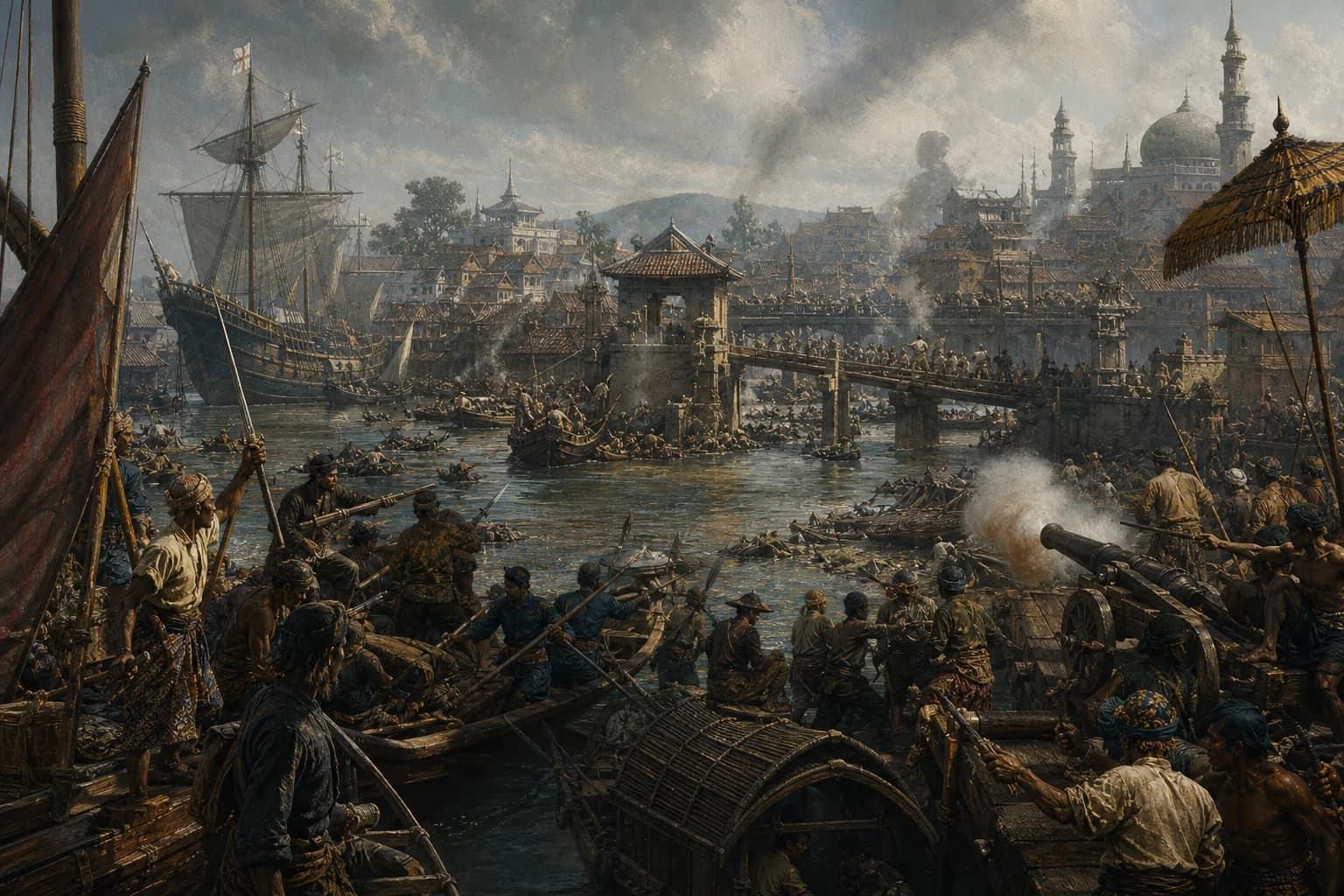
Afonso de Albuquerque attacked Goa twice in 1510, establishing firmer Portuguese control in November, and captured Malacca the following year. The ports gave Portugal a base on India's west coast and a position beside the strait linking the Indian Ocean to the South China Sea. Naval artillery mattered, but so did Timayya's assistance, politics in Bijapur and divisions around Malacca. Merchants also redirected trade toward other ports.
- Goa
- First occupied February 1510; lost in May; retaken in November
- Malacca
- Captured after fighting in July–August 1511
- Portuguese commander
- Afonso de Albuquerque
- Local powers
- Timayya and allies, Bijapur forces, the Malacca Sultanate
- Strategy
- Hold ports, straits and passage—not the Asian interior
Chronology
A process, not a single date
Causes, turning points and aftermath form one process, far larger than a capital’s fall, a signed treaty or a company’s founding date.
- 01
The Battle of Diu strengthens Portugal's fleet position
Portugal gains greater freedom of naval action off western India, while coastal politics and commerce remain in many hands.
- 02
Portugal first occupies Goa
Albuquerque works with the local maritime figure Timayya and exploits political instability and discontent around Bijapur rule.
- 03
Bijapur forces retake Goa
The Portuguese withdraw to their ships, showing that the first victory created no durable control.
- 04
Goa is captured again
Reinforced forces take the city on 25 November; it gradually becomes a centre of the Estado da Índia.
- 05
Malacca falls after sustained fighting
Sultan Mahmud Shah withdraws and continues resistance as commerce begins shifting toward Johor, Aceh and other ports.
- 06
Hormuz becomes another stronghold
Goa, Malacca and Hormuz reveal Albuquerque's plan to influence major routes from a limited number of ports.
Why Goa and Malacca?
Portugal entered an Indian Ocean already joined by Gujarati, Arab, Persian, Malay, Javanese, Chinese and other merchants. With limited people and ships, occupying vast interiors was impossible. Ports where fleets could repair, provision, tax shipping and issue passes offered greater leverage.
Goa connected the Arabian Sea with western India and Deccan politics. Malacca stood beside the strait between the Indian Ocean and South China Sea and served a multilingual trading population. Together they allowed diplomacy, forts, fleets and armed commerce to operate as a network of nodes.
Goa was secured only after the first conquest failed
The February 1510 success depended on a particular moment. Timayya supplied knowledge and assistance while Bijapur faced political change. The city was not proof that European ships could take any Indian port: Bijapur forces returned within months, and monsoon conditions helped trap the Portuguese into retreat.
With reinforcements, Albuquerque attacked again in November and established lasting control. Mass killing, redistribution of property and years of institutional investment followed. Naval guns were one part of a conquest also built on alliance, rival weakness and continued occupation.
Malacca changed hands; the trading network did not disappear
Negotiations over prisoners and a trading position broke down before Albuquerque attacked in 1511. Malacca possessed defences, firearms and a complex urban society; its capture was not a simple demonstration of European technology. Sultan Mahmud Shah withdrew and kept resisting.
Nor did Portugal acquire a master switch for Asian spice trade. Merchants could bypass a hostile or heavily taxed port, redirecting activity toward Aceh, Johor and northern Java. Malacca gave Portugal intelligence and reach, but it still had to bargain and fight within regional politics.
What did this maritime empire actually control?
The Estado da Índia rested on selected cities, forts, fleets and pass systems. It could tax, escort or attack some shipping without administering the whole Indian Ocean.
Its significance lies in turning arrival into a continuing armed presence. Local rulers, merchants, interpreters, converts, workers and hostile coalitions shaped what that presence could accomplish. A story centred only on Albuquerque's strategy erases the Asian political world that enabled and constrained it.
Evidence boundary
Fact, interpretation and uncertainty
The evidence reveals where imperial claims diverged from reality and where heroic stories compressed complex wars.
Goa passed through occupation, loss and reconquest
The February victory did not last. Portuguese forces withdrew in May and returned for the second conquest in November 1510.
Timayya and local politics mattered alongside naval guns
Local allies supplied intelligence, boats and political access, while instability in Bijapur created opportunity.
Capturing Malacca did not monopolize Asian trade
Resistance continued and merchants shifted routes toward competing ports. Portugal gained a major node, not absolute command of an ocean.
Questions
Common questions
Did Portugal hold Goa after its first attack?
No. Bijapur forces pushed the Portuguese out in May 1510. The November attack established the more durable occupation.
Who was Timayya?
Timayya, also written Timoja or Timaya, was a local maritime and political figure who provided Albuquerque with intelligence and assistance.
Did the Malacca Sultanate end when the port fell?
No. Sultan Mahmud Shah and successor powers continued resistance, and Johor became an important rival to Portuguese Malacca.
Why did Portugal not conquer all of India?
Its manpower was far too limited. Early Portuguese power depended on coastal forts, fleets and regulation of selected routes rather than broad inland rule.
Sources
Sources and further verification
Archives, museums, international organizations and academic publications support the facts and interpretive limits in this account.
- The Cambridge History of Southeast Asia: excerptCambridge University Press
- The Islamic World and the Making of the Portuguese Empire, 1450–1520Cambridge University Press
- Interwoven GlobeThe Metropolitan Museum of Art
- Portuguese Administration in Malacca, 1511–1641Cambridge University Press
Age of Seas editorial research distinguishes verifiable facts, historical interpretation and potentially misleading simplifications.Editorial standards and corrections ↗