Field guide · 01
The deck is the ship's vocabulary of orders.
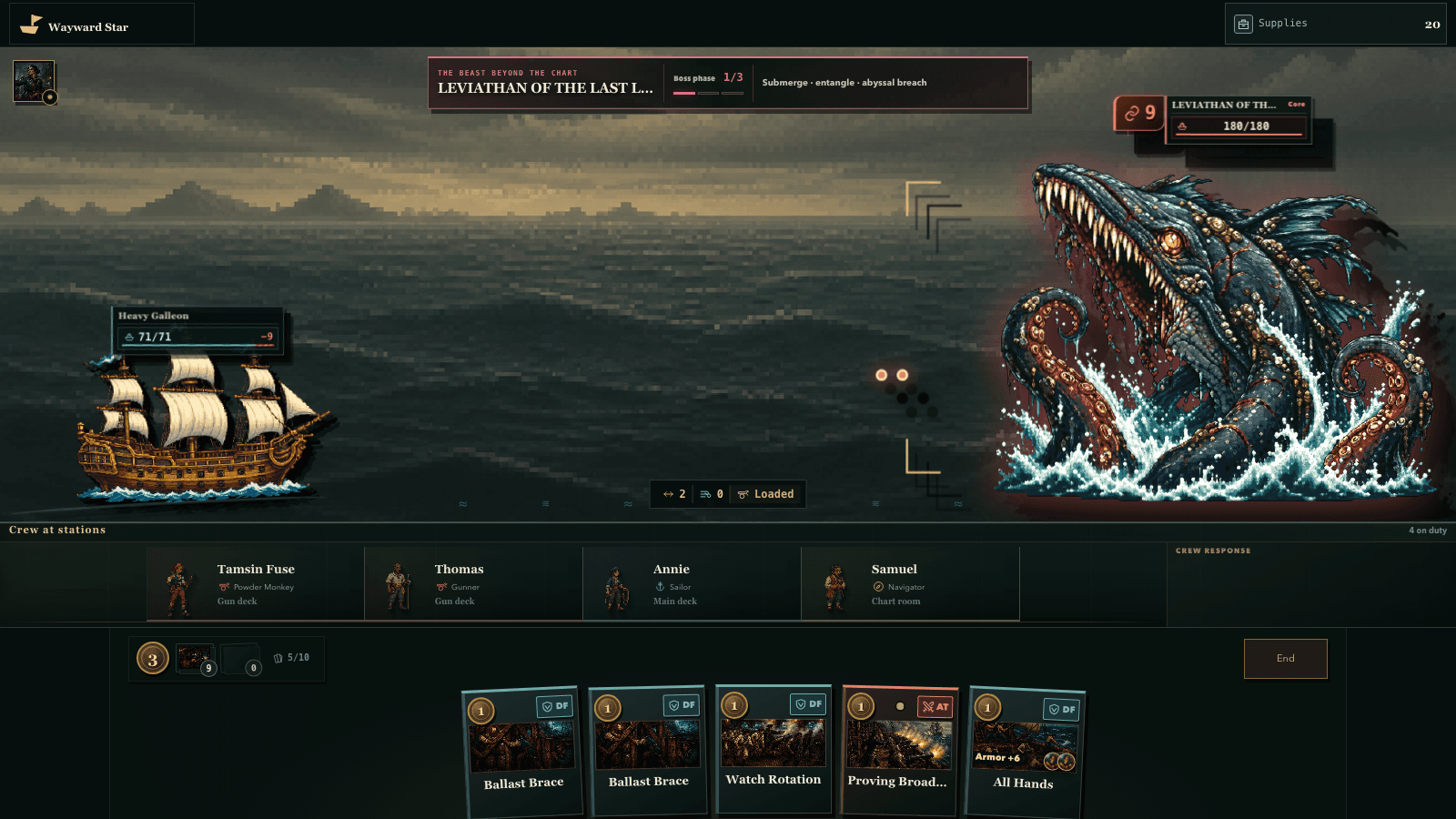
Combat reveals what the enemy formation intends to do next, then asks you to assemble an answer from the cards in hand. Attacks convert an opening into damage. Skills protect, reposition or prepare. Powers change the rules of the remaining fight. Status and Curse cards occupy attention, timing or resources you would rather spend elsewhere.
Because the next hostile action is readable, the challenge is not memorizing a hidden script. It is deciding how much of the current hand should answer the immediate threat and how much should prepare a stronger turn before damage carried through the voyage becomes unaffordable.
Field guide · 02
Captain, hull and deck describe the same build from different sides.
The captain establishes a doctrine: storm rites, sea beasts, gunnery, privateering or curse-driven power. The hull supplies physical limits. Crew and modules make particular orders more practical, while relics can bend a rule far enough to become the center of a run.
That means a rare card can still be the wrong reward. If it asks for support the ship cannot provide, it reduces the chance of drawing the smaller sequence that already works. A modest card that completes the existing engine may preserve more hull across the next three encounters.
- Start by identifying the captain's repeatable action, not the flashiest finisher.
- Treat defense and draw consistency as part of damage output across a whole voyage.
- Take a reward only when it improves a real hand, encounter or weakness.
Field guide · 03
Four broad build languages help you read a reward.
Broadside builds prepare volleys and exploit exposed targets. Ramming and boarding builds accept proximity and hull pressure for decisive contact. Hunter builds turn harpoons, marks and living threats into a focused pursuit. Curse builds exchange safety for effects that become profitable only when the deck can control their cost.
These are reading tools rather than rigid classes. A voyage can cross their boundaries when a crew member, module or relic supplies the missing connection. The test is whether the new card strengthens the plan that survives the next encounter—not whether its label matches the captain portrait.
Field guide · 04
Use a reward screen as a build test.
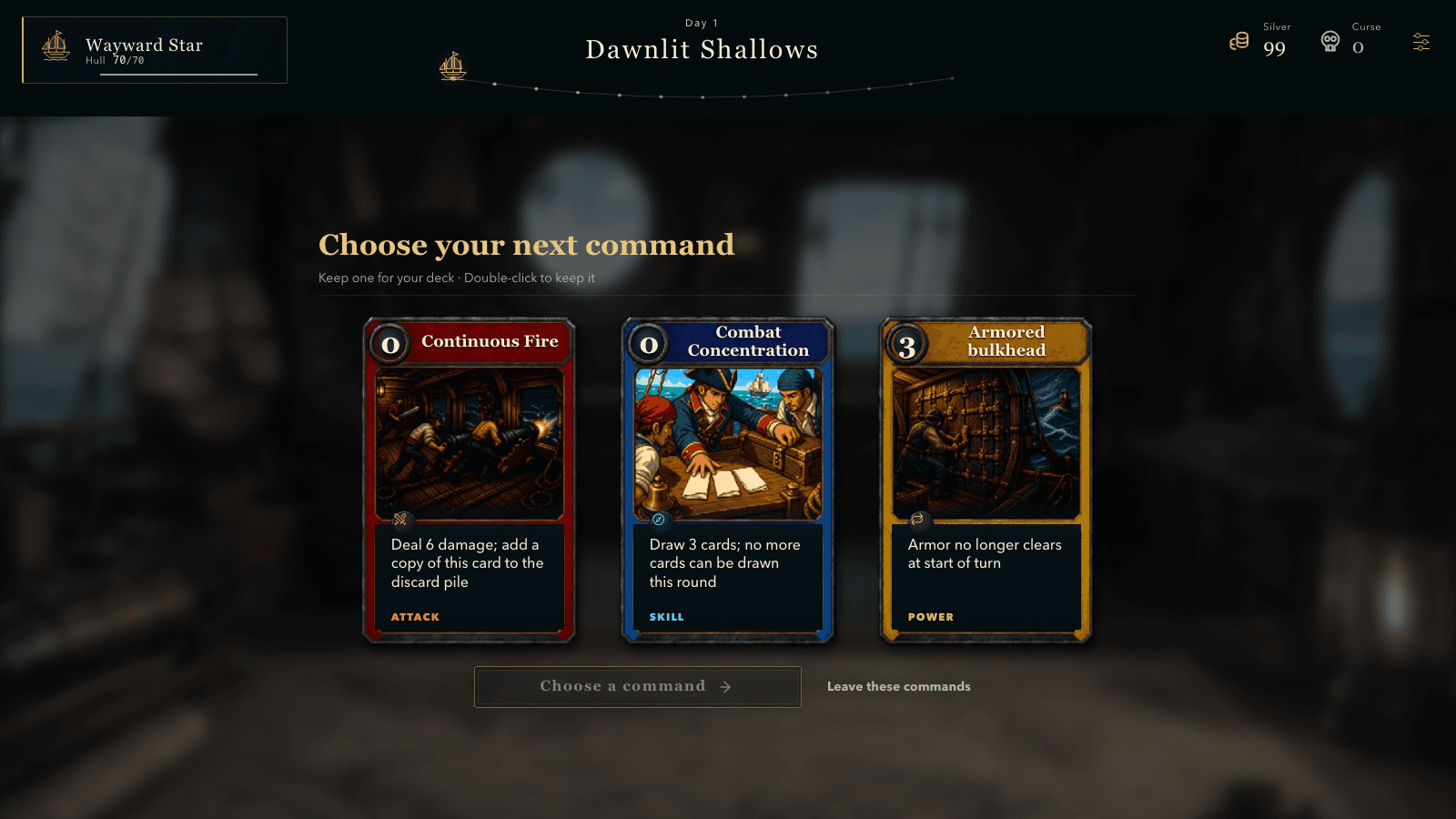
The version 0.2.2 reward below offers Continuous Fire, Combat Concentration and Armored Bulkhead. Continuous Fire can reward a deck that wants repeated attacks, Combat Concentration trades later draw for immediate access, and Armored Bulkhead asks for a costly setup turn in exchange for armor that persists. None is automatically correct just because it is offered after a victory.
Read the choice against the ship that reached it. A vessel already generating armor may turn Armored Bulkhead into a defensive engine; a deck missing access to its working sequence may value Combat Concentration instead. If neither solves a real hand or route problem, leaving the reward behind protects draw consistency.
Field guide · 05
Build for the voyage, not only the current battle.
Hull, morale, supplies and other consequences persist between encounters. Spending every resource to win one broadside can create a deck that reaches the next signal without the capacity to answer it. Route choice therefore belongs inside deckbuilding: the best reward depends on which water the vessel is likely to enter next.
This guide stays at the level of durable decision principles. Exact costs, damage values and individual card pools may change during active development; the version label above records the public build used for the current review.