 compass
The harbor lies directly upwind
North
Magnetic north still differs from geographic north.
East
Compass points divide the circle into usable steering commands.
South
A stable reading can still be affected by the ship’s motion.
West
Heading must be recorded together with speed and time.
Sailing upwind does not mean pointing straight at the wind
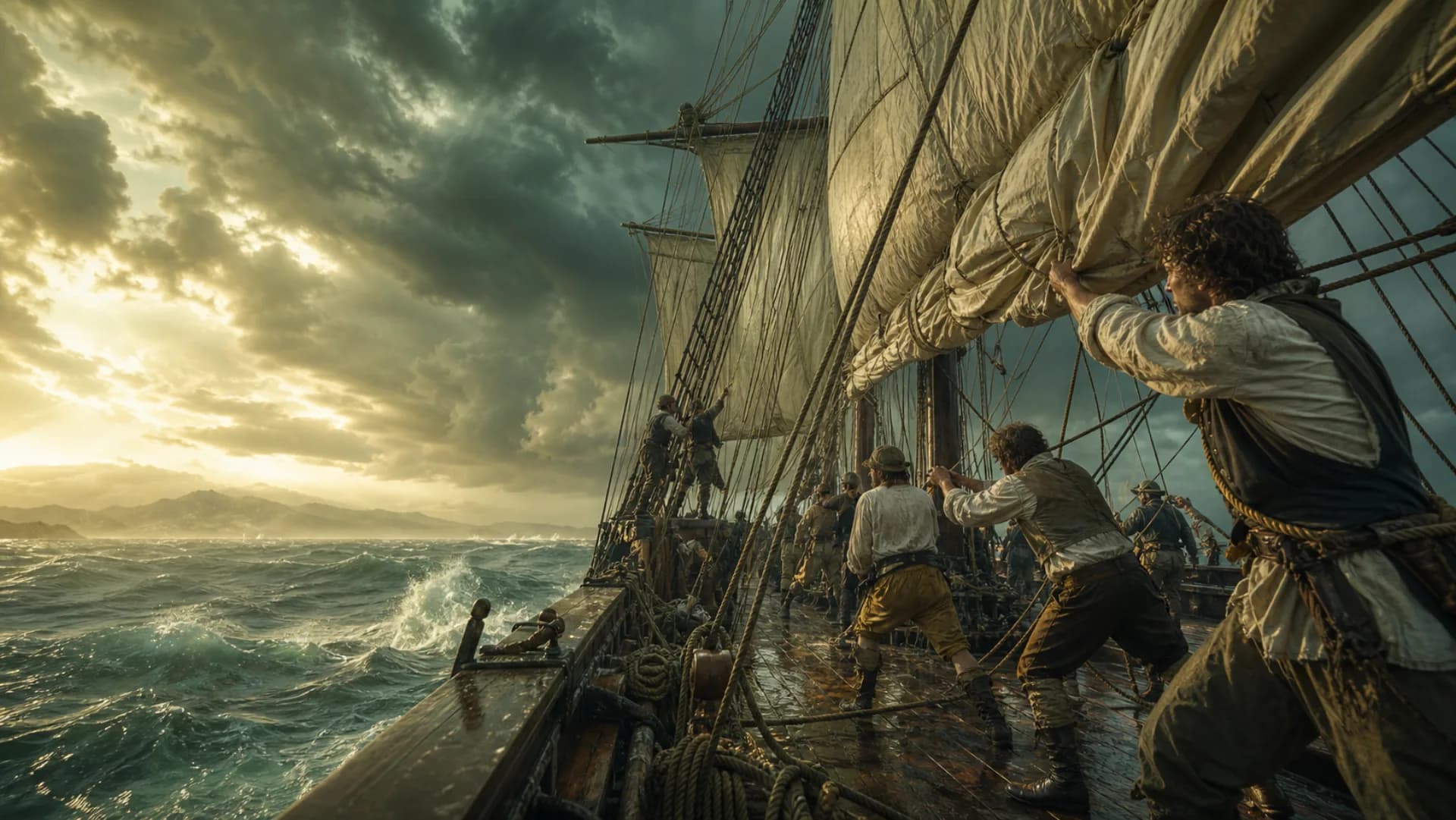
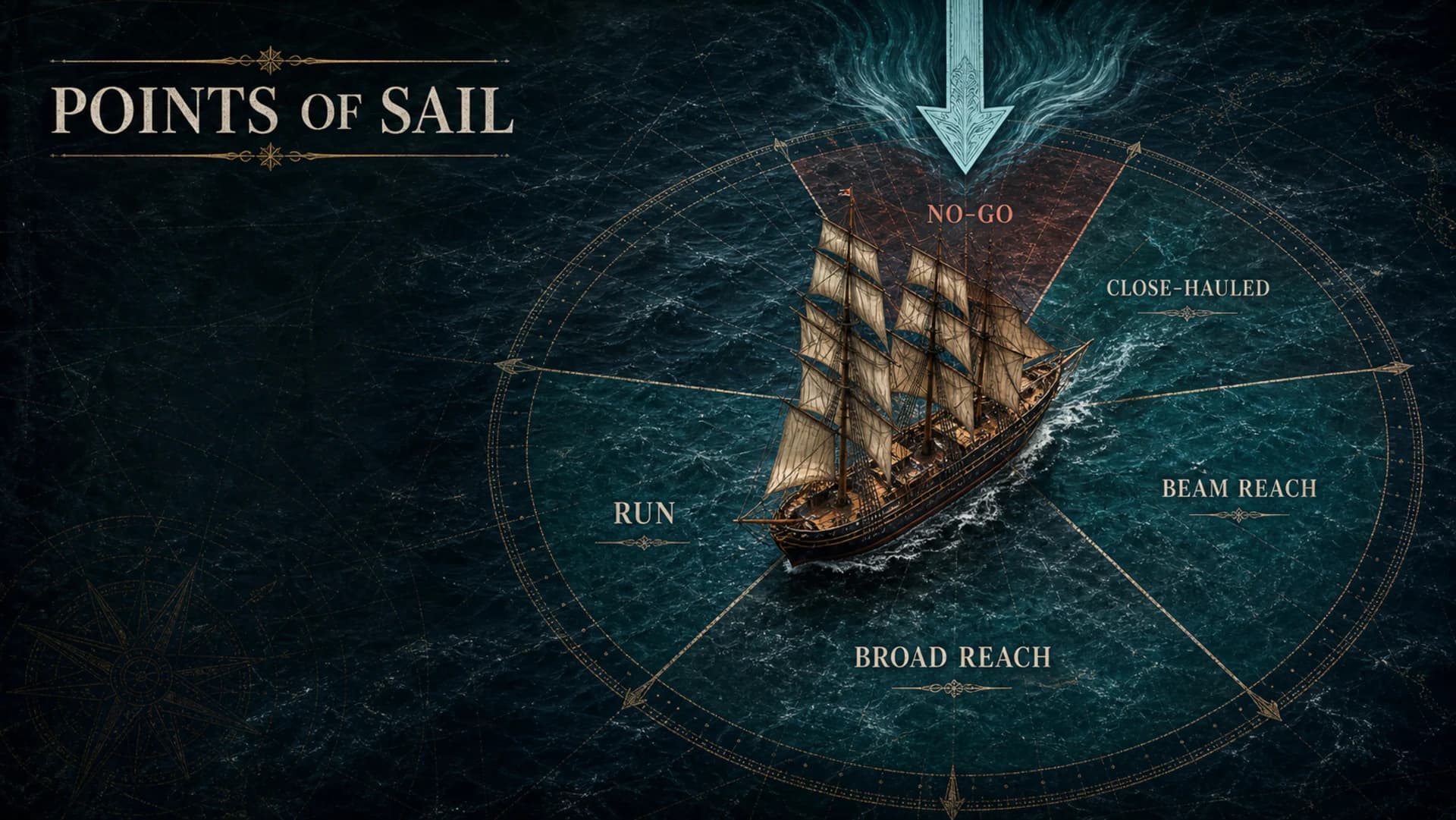
In seamanship, sailing upwind means making net progress to windward, not holding the bow exactly into the source. When the bow points too close, attached flow and useful sail shape break down, the cloth luffs, and the vessel loses speed. It may stop head to wind, a condition called being in irons. The unsailable sector on either side of the wind is the no-go zone.
Instructional diagrams often put an ordinary modern dinghy's close-hauled course near 45 degrees from true wind. That is a teaching value, not a natural constant. Rig, underwater shape, sea state and handling change the angle. High-performance modern craft can point closer, while heavy historical square-riggers generally needed a wider sector. One number cannot describe every sailing vessel.
Upwind sail force is not merely a push from astern
A direct-push model explains much of downwind sailing but not close-hauled motion. Airflow changes speed and direction around a curved, trimmed sail, producing a resultant force that can be separated into forward and transverse components. NASA uses an aircraft-wing analogy to introduce this lift-producing behavior.
The analogy has limits. A sail is flexible, multiple sails interact, and real airflow is viscous, turbulent and three-dimensional. Explanations based solely on Bernoulli pressure or solely on Newtonian reaction are incomplete. For the sailor, the practical result is to trim for an effective shape in the apparent wind, not simply haul every sheet as hard as possible.
Apparent wind is the vector combination of true wind and the airflow created by the vessel's own motion. Its direction and strength change as the boat accelerates, requiring another trim adjustment. The same shore-measured wind therefore reaches a stationary, slow and fast vessel at different apparent angles. A single fixed wind arrow omits this feedback.
Underwater resistance keeps the transverse force from becoming pure drift
The sideways component from the sails can be substantial. Keels, centerboards, leeboards and the immersed side of the hull develop an opposing water force, limiting lateral motion. The aerodynamic and hydrodynamic systems together leave a forward component along the usable course. A shallow or rounded hull with little lateral plane can make much more leeway.
Leeway separates compass heading from track. A bow pointing 45 degrees off the wind does not guarantee a 45-degree path over Earth; current, waves and downwind slip alter the result. Historical navigators estimated the error from subsequent fixes, while a modern crew can compare heading, speed through water and GPS track. Windward ability belongs to the whole vessel in its environment, not to the sail alone.
Tacking joins two oblique courses into windward progress
With the destination directly upwind, the vessel sails close-hauled on one side, then turns its bow through the wind and fills the sails on the other side. That maneuver is a tack or coming about. The map shows a zigzag; only the component of each leg toward the destination counts as useful windward progress. Excessively frequent tacks waste speed, while very long legs can lead outside the safe channel.
Momentum carries the hull through the no-go zone. Too much rudder adds drag; too little may fail to turn the bow. Headsails, mainsail and helm must work in sequence, and a stalled vessel can remain in irons. A gybe instead turns the stern through the wind on an off-wind course. Its load changes and hazards are different, so not every movement of a sail from side to side is an upwind tack.
A square-rigger could beat to windward, but paid a higher handling cost
Square yards could be braced around, allowing a vessel to sail obliquely to windward and tack. Yet yard angle, sail shape and windage generally widened the no-go zone. A large crew had to coordinate many yards and sails, sometimes working aloft. If the heavy hull lost momentum while crossing the wind, it might fail to fill on the new side. Constricted water, adverse current and a lee shore made the maneuver especially demanding.
The replica of the 1797 merchant ship Friendship gives the system scale: eleven square and six fore-and-aft sails, nearly a quarter acre of canvas, and roughly fifty miles of line. Its fore-and-aft sails helped it point and turn, but did not erase hull, draft and square-rig limits. Historical masters also waited for a wind shift, used tide, warped, anchored or accepted delay. The ability to sail upwind was never a promise of direct or rapid arrival.
Questions
Continue exploring this subject
Can a sailboat sail directly into the wind?
Normally no. Its sails luff and propulsion collapses, so it must sail on either side of the no-go zone and alternate tacks.
Does the sail or the keel make upwind sailing possible?
Both. The sail produces aerodynamic force; the keel, centerboard or hull resists transverse motion in the water. Their combined forces determine the course.
Can every sailboat point 45 degrees from the wind?
No. Forty-five degrees is a common teaching approximation. Rig, hull, load, waves and crew technique change both pointing angle and leeway.
Could square-rigged ships sail upwind?
Many could sail obliquely to windward and tack, but they generally pointed less closely and needed more people, momentum and sea room than a suitable fore-and-aft craft.
Sources
Continue the research
- How It Works: SailboatsNASA Goddard Space Flight Center
- Sailing and the Tech DinghyMIT Sailing
- Learning to SailUCLA Recreation
- Friendship's Rigging Fully in Place for the First TimeU.S. National Park Service
- Great Lakes Shipwrecks of WisconsinU.S. National Park Service
 01
01 02
02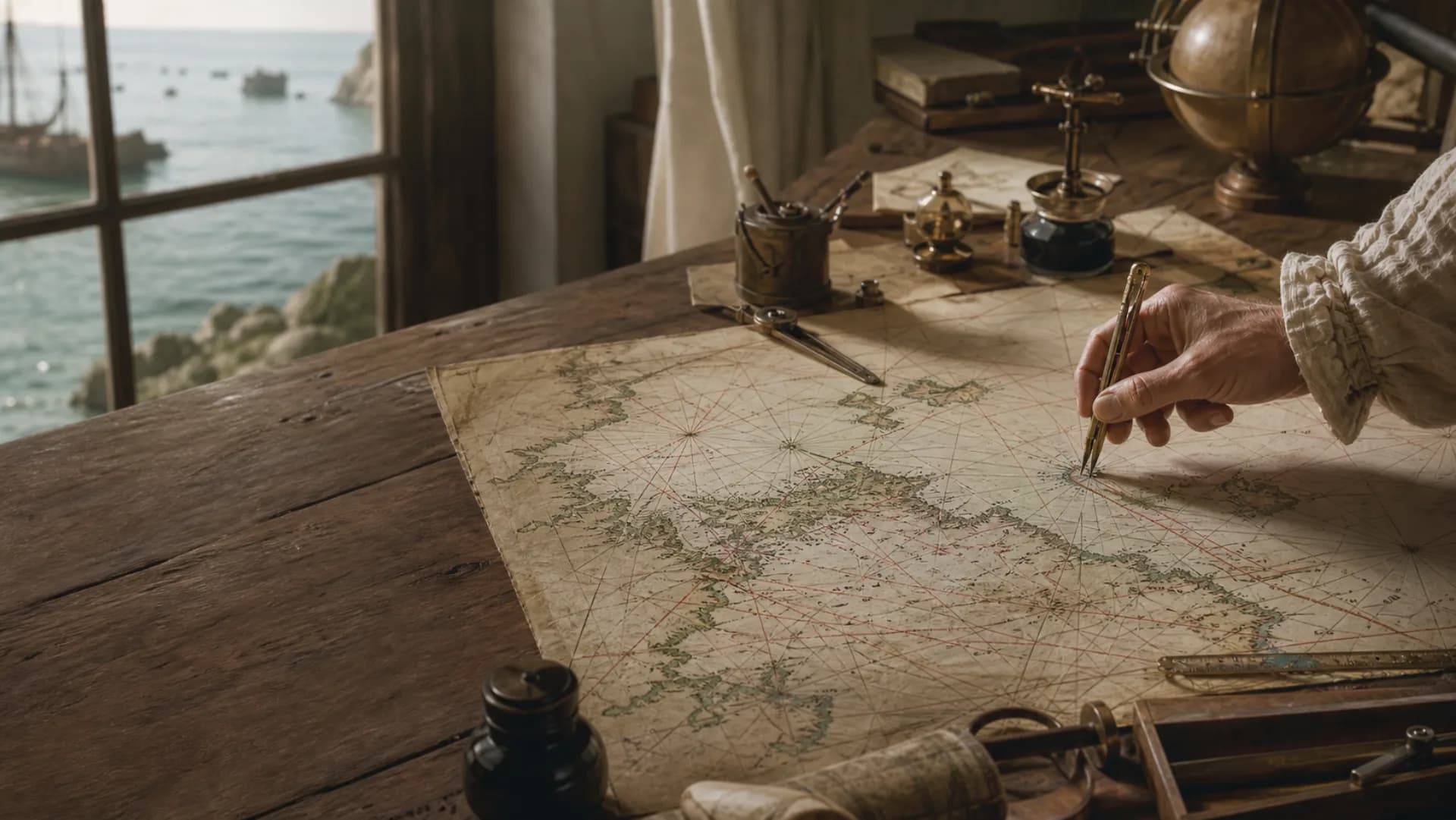 04
04