 ship structure
The wind arrow has shifted forty-five degrees, but the route has not
Mast
Masts and rigging transfer sail loads into the hull.
Deck
Deck beams help the hull resist transverse deformation.
Keel
The main longitudinal member forms the structural baseline of many wooden sailing ships.
Points of sail describe an angle to the wind, not a compass bearing
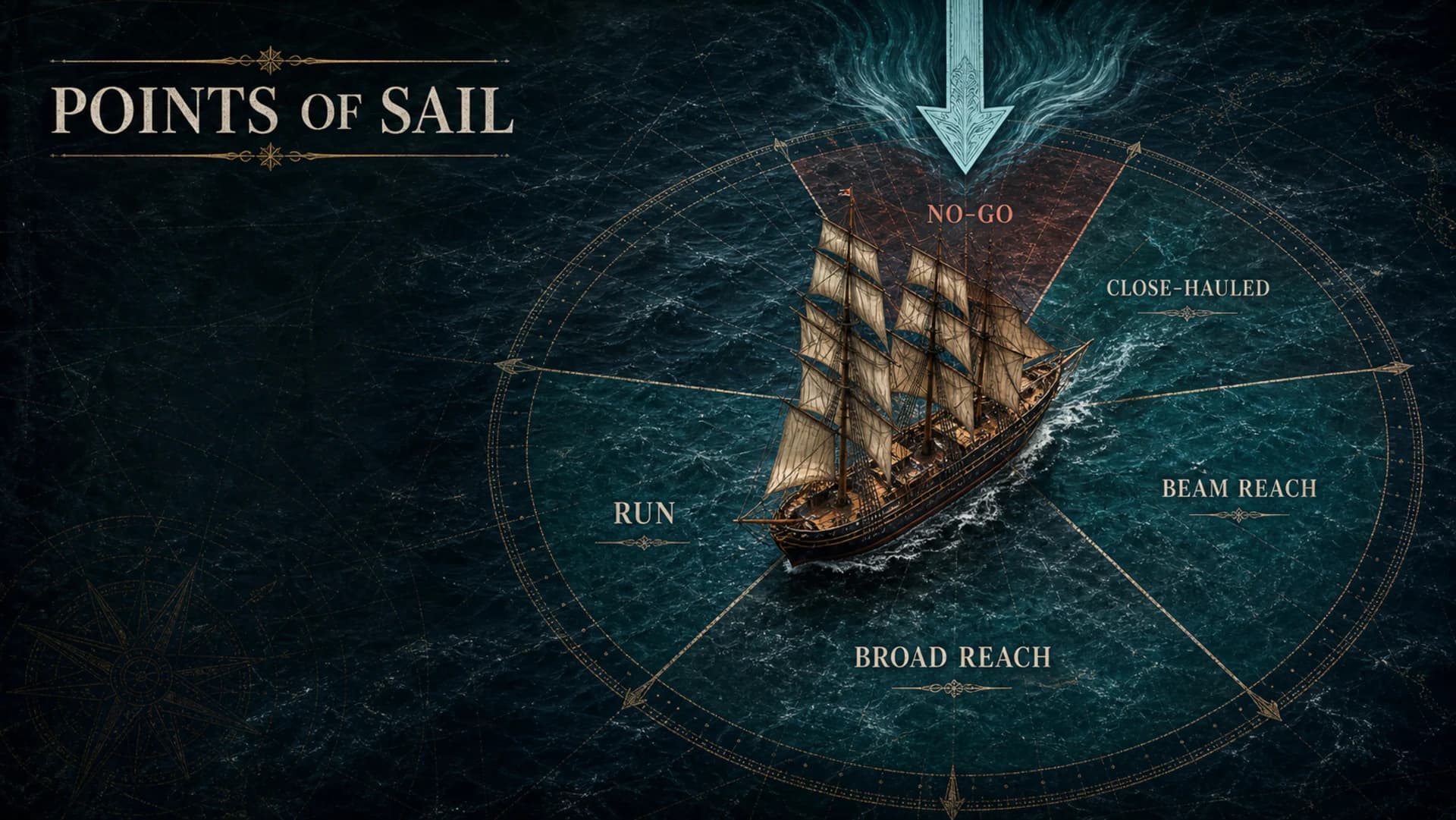
North, south, east and west describe where a vessel is heading over the Earth. Points of sail describe the relationship between the bow and the incoming wind. Wind near the bow produces an upwind point of sail, wind across the side produces a reaching course, and wind from aft produces a downwind course. If the wind shifts while the bow does not, the point of sail changes.
Teaching diagrams usually put the vessel at the center, hold the wind direction fixed and divide the circle into the no-go zone, close-hauled, close reach, beam reach, broad reach and run. Port and starboard sides mirror one another. The names describe a relative angle; they do not require any geographic heading.
The sails actually respond to apparent wind. Once the boat accelerates, airflow created by its own motion combines with true wind and pulls the observed direction forward. The diagram supplies a shared vocabulary, while real trim still depends on telltales, luff behavior, speed and balance rather than one fixed angle printed on a page.
The no-go zone and close-hauled course set the windward limit
When the bow points directly into the incoming wind, a sail cannot maintain useful attached flow and shape. The cloth luffs and drive rapidly falls away. This is the no-go zone. Its width is not identical for every boat: rig, hull, underwater lateral area, sea state and handling all change the practical limit.
Sailing steadily along the edge of that zone is close-hauled. The sails are trimmed near the centerline, while the keel, centerboard or immersed hull resists most of the transverse force. Some leeway remains, so the compass heading and actual track over the bottom do not perfectly coincide.
A destination directly upwind cannot be reached on one straight course. The boat alternates close-hauled legs on either side of the no-go zone. Turning the bow through the wind is a tack; the useful windward component of successive angled legs produces the net progress.
Close reach, beam reach and broad reach move the wind progressively aft
Bear away slightly from close-hauled and the boat enters a close reach. The sails can be eased and the course still contains a clear windward component. Continue until the wind is roughly across the beam and the result is a beam reach. Many training boats feel fast and steady here, making it a useful course for learning how helm, sail trim and heel interact.
Bear away farther and the wind moves onto the after quarter: a broad reach. Main and headsails are normally eased farther out. Side force and heel may decrease, yet gusts, following waves and one sail blanketing another can still change the handling quickly.
These points are sectors rather than razor-thin angle lines. Teaching diagrams differ slightly, and the physics does not switch abruptly at one number. A better working check asks whether the wind is forward of, across or abaft the beam, whether the sails hold an efficient shape, and whether the boat is making the intended track.
A run looks direct but magnifies apparent-wind, blanketing and boom-control problems
With true wind directly astern, the boat is on a run. A modern fore-and-aft rig eases its sails well out and may set main and headsail on opposite sides. A square-rigger can brace tiers of square sail to useful angles and spread large areas of canvas in steady following wind.
Downwind does not automatically mean fastest or easiest. Because boat motion is in the same direction as true wind, apparent wind felt aboard can weaken. The mainsail may blanket the headsail. Following seas can yaw or roll the hull, and a small course change can send a boom or yard across with dangerous speed.
Crews therefore often use a training run, with wind just off the stern, or a deep broad reach that keeps sail pressure and steering more stable. Whether that is faster than a dead run depends on hull, rig, sea state and the extra distance sailed. The name of the point of sail alone cannot settle the comparison.
Every course change calls for sheeting in, easing out or changing tack
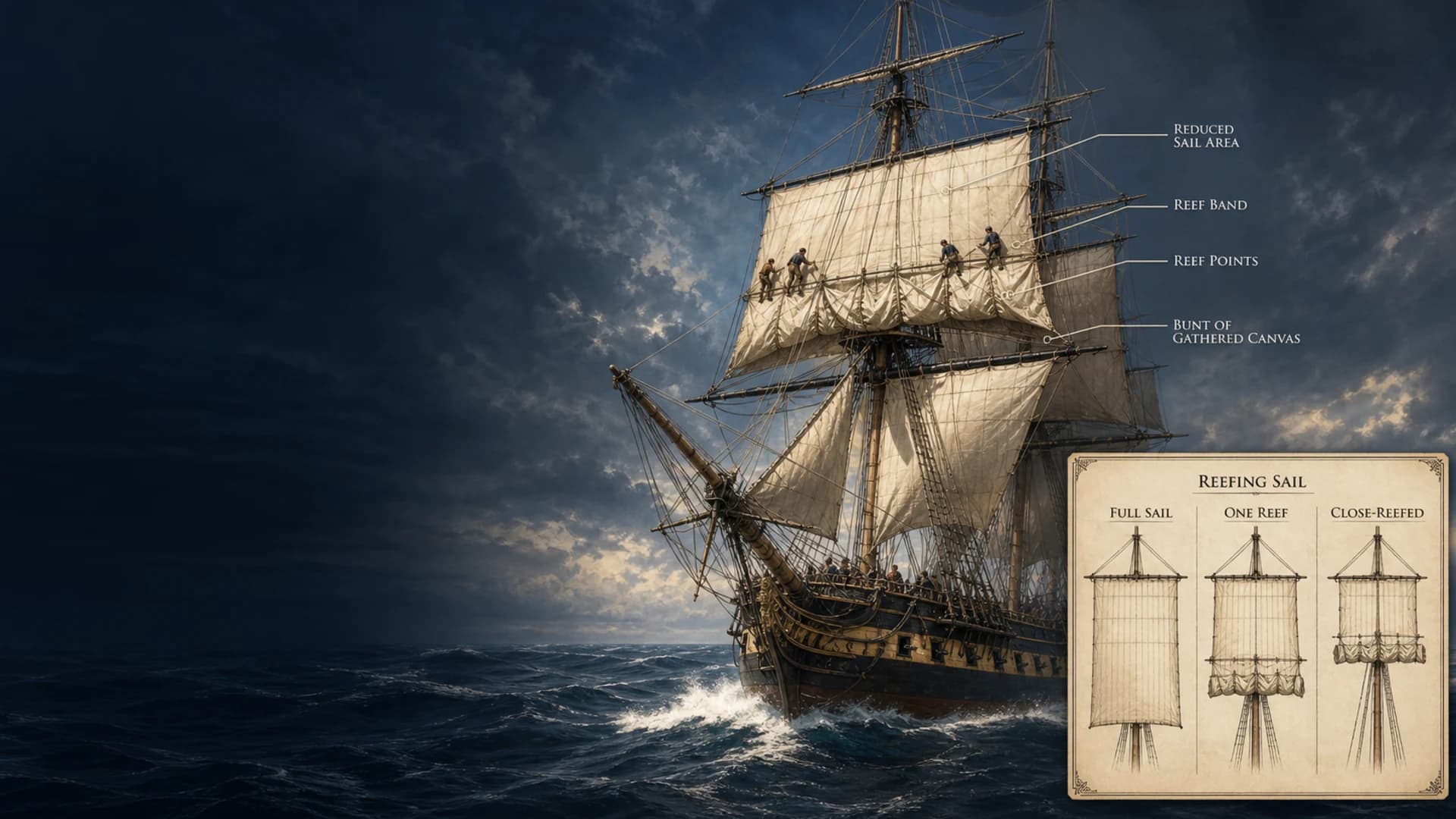
Turning toward the wind is heading up and normally calls for progressively sheeting in. Turning away is bearing away and normally calls for easing the sails. Useful trim is not one memorized boom angle: the crew adjusts during the turn until the luff just stops fluttering and the sail regains an effective shape.
A tack takes the bow through the wind. A gybe takes the stern through the wind. Both place the sails on the other side, but loads develop differently. A tack briefly crosses the no-go zone and relies on momentum. A gybe can drive the mainsail across while it remains powered, so strong-wind handling must control the boom, yards and sheets.
Wind also refuses to remain fixed. Gusts, shore effects and the boat's own acceleration change apparent direction. A dependable cycle is to identify where the wind comes from, name the current sector, observe sail shape and speed, then test the diagnosis with small helm and sheet adjustments.
Questions
Continue exploring this subject
How many points of sail are there?
A common teaching set includes the no-go zone, close-hauled, close reach, beam reach, broad reach and run. Totals differ when port and starboard are counted separately or a training run is added.
Why is a beam reach often called the fastest point of sail?
Many ordinary boats combine an efficient sail shape with strong apparent wind near a beam reach, but the fastest angle depends on hull, rig, sea state and wind strength. It is not a universal rule.
Can a sailboat sail directly into the wind?
Normally no. Drive collapses in the no-go zone, so the vessel must sail close-hauled on alternating sides and tack to make net progress upwind.
What is the difference between close-hauled and close reach?
Close-hauled is the closest sustainable course to the wind. A close reach is slightly farther away, allowing the sails to ease and usually giving more steering margin.
Are tacking and gybing both changes of side?
Yes, but a tack turns the bow through the wind while a gybe turns the stern through it. A gybe can send a powered mainsail and boom rapidly across the boat.
Sources
Continue the research
- Do You Know Your Points Of Sail?Royal Yachting Association
- Sailing and the Tech DinghyMIT Sailing
- How It Works: SailboatsNASA Goddard Space Flight Center
- Friendship's Rigging Fully in Place for the First TimeU.S. National Park Service
- Text-Book of Seamanship: Reefing and handling sailHistoric Naval Ships Association
 01
01 02
02 03
03 06
06