 ship structure
The ship is still sliding downwind; the three forces have not settled
Mast
Masts and rigging transfer sail loads into the hull.
Deck
Deck beams help the hull resist transverse deformation.
Keel
The main longitudinal member forms the structural baseline of many wooden sailing ships.
Heaving to is a dynamic balance with wind pressure, steerage and leeward drift
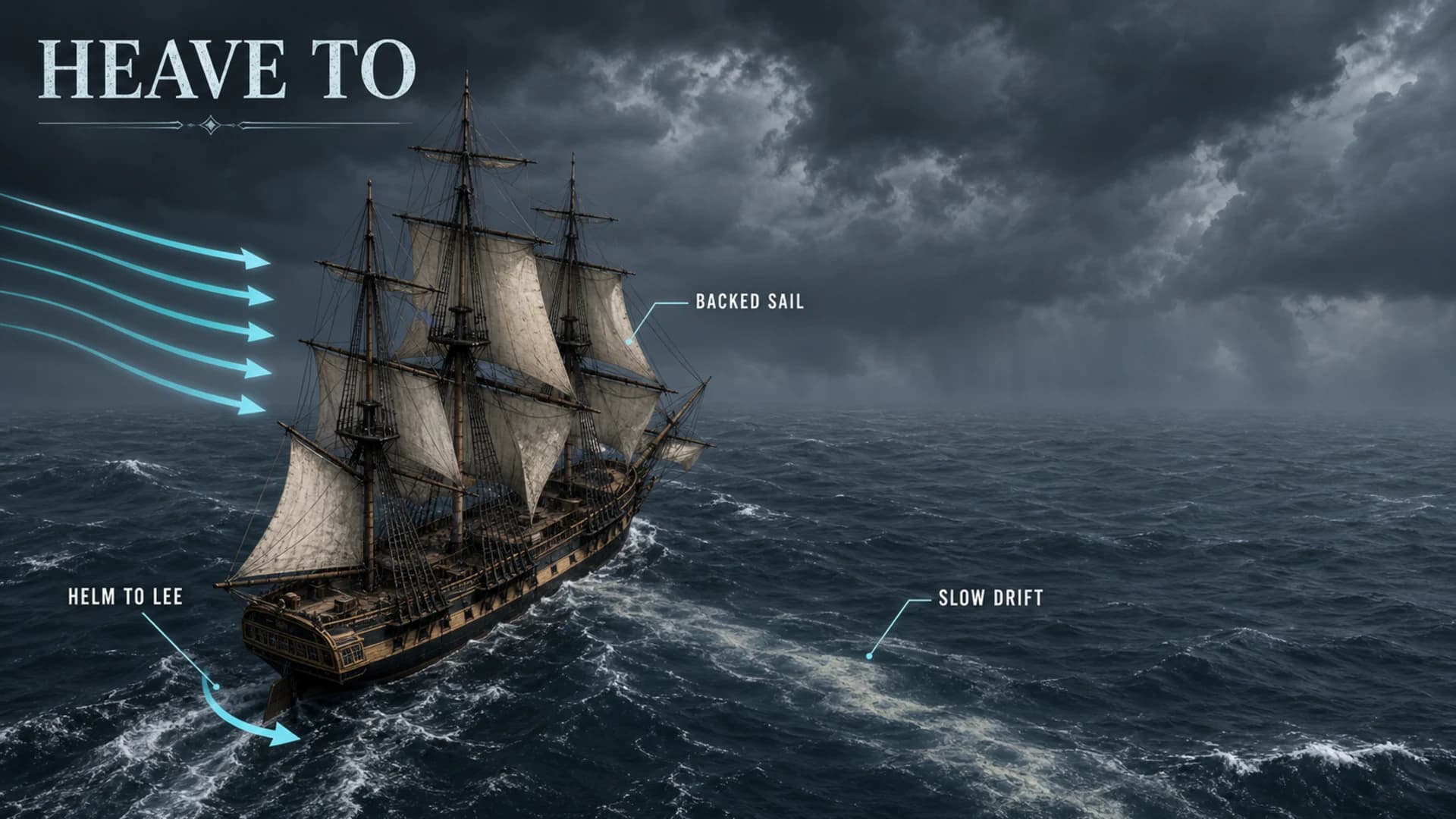
A hove-to vessel is not stationary like one made fast to a pier. Wind still presses on sail and hull, waves continue to move the ship, and water passes its rudder and underwater lateral surfaces. The crew arranges those forces so that forward speed becomes small, heading changes remain limited and the resulting leeward drift is slow enough to manage and predict.
The characteristic attitude puts the bow obliquely toward the wind rather than directly head-to-wind or continuing along the original course. The vessel may hunt through a small arc: one sail tends to push the bow downwind, while the main, an after sail or the helm brings it back up. Neither turning moment wins completely, and their opposition creates the comparatively steady state.
This is distinct from lying ahull, in which a vessel may carry almost no sail and accept the motion imposed by sea and wind. It is also different from anchoring or merely slowing down. The word stop can mislead; the useful observations are heading, roll, residual way and the actual track being made to leeward.
A modern fore-and-aft boat often balances a backed headsail, mainsail and helm
A common modern arrangement leaves the headsail on its original side as the boat changes tack, so that the new wind presses the wrong face of it. This backed headsail tends to force the bow away from the wind. A partly drawing mainsail tends to turn the vessel back toward the wind, and the secured rudder is placed to support that restoring tendency.
If the headsail is too dominant or the main too weak, the boat may continue falling off and gather way. If the main and rudder produce too much weather-turning moment, it may pass through the wind or lose a stable pressure pattern. Sail-area ratios, keel shape, rudder, freeboard and mass differ, so one sheet length and one rudder angle cannot be a universal recipe.
Once balanced, the boat normally leaves a modest track to leeward and can create a patch of disturbed, sometimes flatter water on its weather side. That slick may change how some waves meet the hull, but it is not a protective wall. A compass, chart plot or observed transit should confirm the real drift instead of the crew assuming that the quietened deck means the boat has stopped.
A square-rigger braces groups of yards for opposing pressure rather than copying a dinghy
Square sails cannot simply remain backed on a single forestay like a triangular jib. A square-rigged ship uses braces to change the angles of yards on different masts. Some groups of sail can then press in their normal direction while others press aback. Headsails, after sails and rudder add their own turning moments until forces trying to bring the bow up and bear it away approach a balance.
Which sails remain set depends on vessel and weather. A ship may heave to under more canvas in moderate conditions, but retain only low, strong sails in heavy weather to preserve steerage without raising the center of effort. Historical manuals therefore record several dispositions rather than presenting a single command as the answer for every square-rigged hull.
Entering the state requires both space and coordination. The helmsman controls the rate through the wind while mast crews brace yards, tend sheets and alter fore-and-aft sail in sequence. With one group already aback and another still driving normally, the ship can briefly experience complex yawing and rig loads. This is why period evolutions break the maneuver into commands by mast, sail tier and wind direction.
Heaving to can buy time for reefing, waiting or recovery, but it is not a storm switch
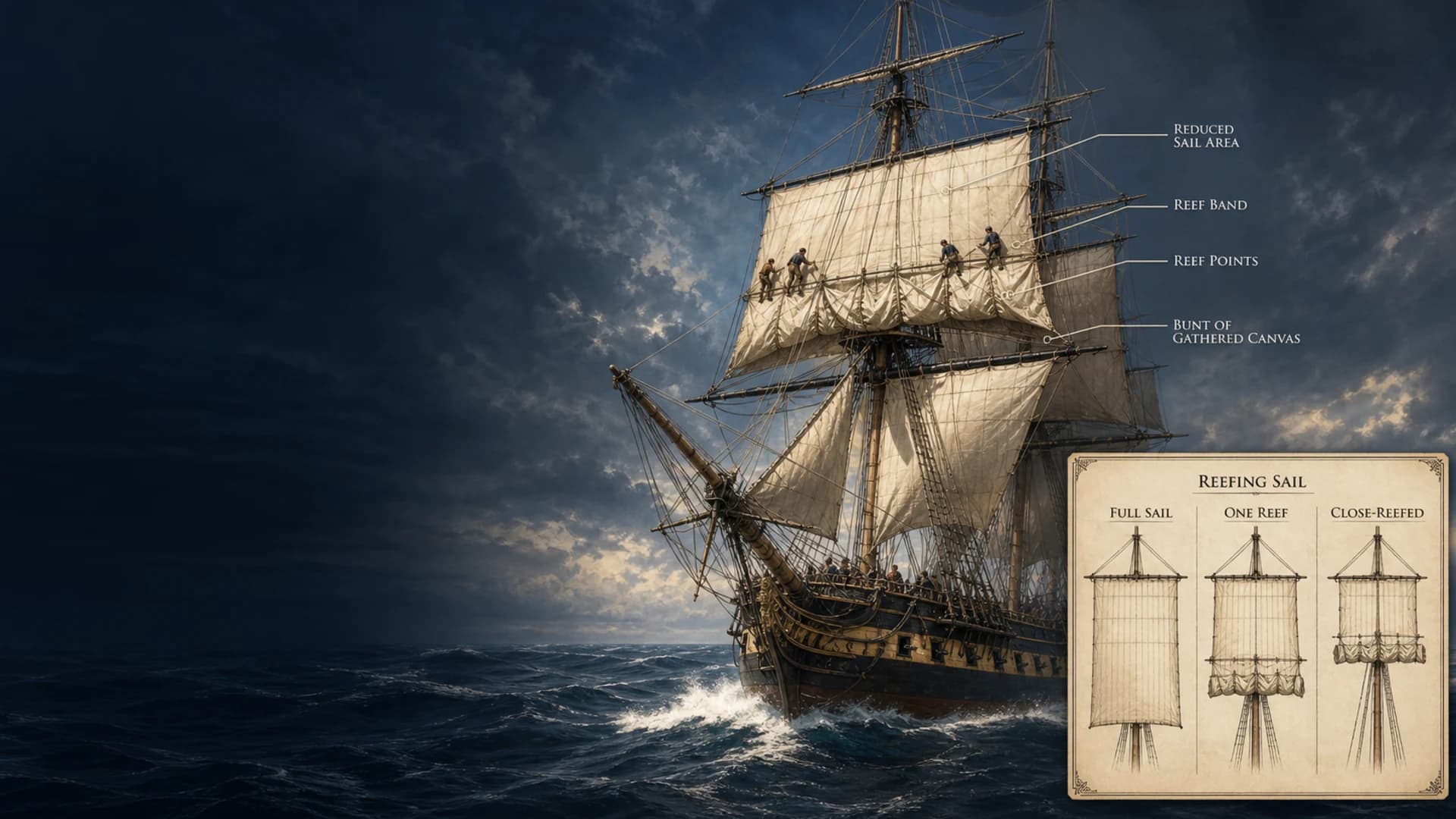
A vessel that settles reliably can exchange rapid progress for a slower drift and give the crew a more stable platform to reef, repair rigging, rest, wait for visibility or organize a person-overboard recovery. Historical seamanship manuals include heaving to in both recovery and heavy-weather evolutions, although the sails carried and the final heading depend on the immediate purpose.
For a modern small craft it is often a way to pause without dropping every sail. For a large square-rigger it could also serve while waiting for company, controlling an approach or preserving maneuverability in severe conditions. The intention may sound similar, yet the rigging actions, manpower and time required differ substantially between those vessels.
Every use assumes that the vessel has actually found a stable balance. If it continues to lie broadside to breaking seas, yaws through a large arc or drifts much faster than expected, calling the condition hove to does not make it successful. Motion, loads and ground track must all be monitored, with another heavy-weather strategy ready if the balance deteriorates.
Sea room, wave direction and vessel design determine when the state cannot continue
The most immediate spatial cost is leeway. Even when forward speed is nearly zero, wind and waves carry the vessel downwind. A lee shore, shoal, traffic lane or nearby ship steadily consumes the available margin. Before heaving to, the crew must estimate both the direction of drift and the sea room; afterward, an observed track replaces the initial estimate.
Wave direction can also differ from wind direction. A bow that sits comfortably oblique to the wind may still be struck broadside by swell. Extreme seas can roll a hove-to ship heavily or force it away from its expected attitude. Accident evidence involving larger vessels makes the same point: heaving to is a change of course and speed, not a guarantee that ship motion or cargo loads will disappear.
Leaving the state normally requires freeing the backed sail, returning the helm to active control and allowing the working sails to fill. Before doing so, the crew checks lee-room, loose running rigging and everyone’s position on deck. Treating heaving to as a state that must be entered, monitored and exited is more reliable than memorizing one nominal rudder angle.
Questions
Continue exploring this subject
Does heaving to stop a sailboat completely?
No. It normally drifts slowly to leeward and may retain slight forward motion and heading oscillation. The actual ground track still needs continuous checking.
What is the difference between heaving to and anchoring?
An anchor and rode connect a vessel to the seabed. Heaving to uses the dynamic balance of sails, helm, hull, wind and water and makes no connection to the bottom.
Do all sailboats heave to in the same way?
No. Headsail size, main, keel, rudder and square-sail arrangement all alter turning moments, so the required sail and helm settings depend on the vessel and conditions.
Can a square-rigged ship heave to?
Yes. Its crew can brace sail groups so some draw normally and others press aback, then use headsails, after sails and rudder to balance the ship.
Is heaving to always safe in a storm?
No. Lee shores, drift rate, crossing seas, vessel behavior and rig limits can make it unsuitable. A deteriorating attitude or motion calls for another heavy-weather strategy.
Sources
Continue the research
- Text-Book of Seamanship, Part 8Historic Naval Ships Association
- Text-Book of Seamanship, Part 10Historic Naval Ships Association
- The Elements and Practice of Rigging and Seamanship, Part 10Historic Naval Ships Association
- Man Overboard StudyUS Sailing
- Safety Digest 1/2012UK Marine Accident Investigation Branch
 01
01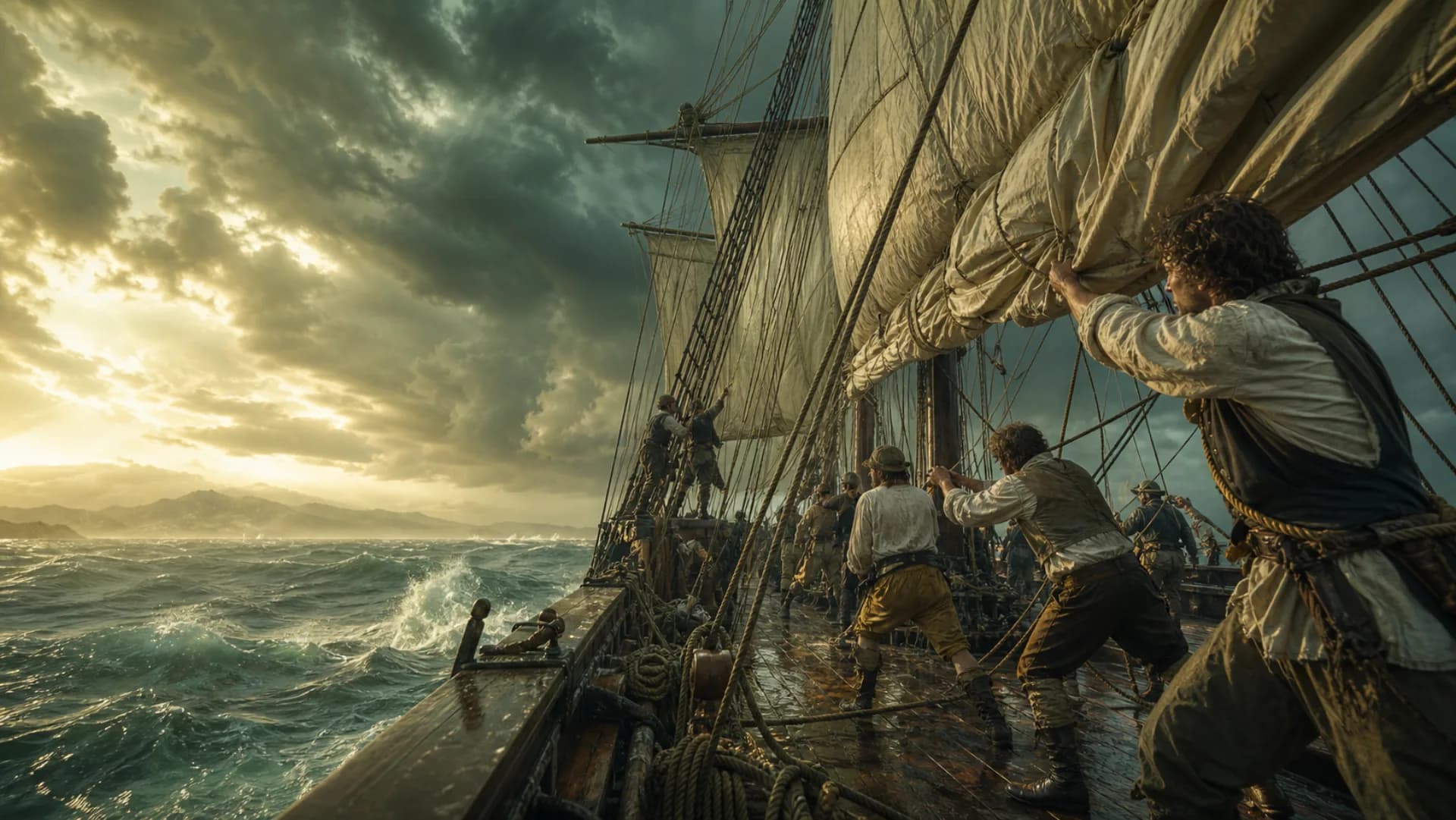 02
02 03
03