 ship structure
A gust has buried the lee rail. Is it time for one reef?
Mast
Masts and rigging transfer sail loads into the hull.
Deck
Deck beams help the hull resist transverse deformation.
Keel
The main longitudinal member forms the structural baseline of many wooden sailing ships.
A reef is a smaller load-bearing sail shape, not merely a fold in the cloth
Aerodynamic force rises sharply as wind speed increases. Carrying full canvas for too long can increase heel, helm load and rigging tension together. The vessel may even lose average speed as excessive heel changes the underwater shape and repeated steering corrections add drag. Reefing is intended to reduce the exposed area and lower the center of effort while retaining enough controlled drive to steer and make the chosen course.
After one reef in a modern fore-and-aft mainsail, the head usually remains attached to the mast but the luff has been lowered. A pair of reinforced cringles becomes a new tack and clew. Halyard tension, the tack attachment, the reefing line at the clew and foot tension then establish the working boundary of the smaller sail. Simply tying up the middle without first creating that load path can put strain into cloth and stitching that were never designed to carry it.
The operation therefore has two distinct jobs: establish a new effective edge for the sail, then control the part of the canvas no longer in use. Reduced area is the most visible result, but shape, tension and the balance of the whole sail plan determine whether the reef actually makes the vessel easier and safer to handle.
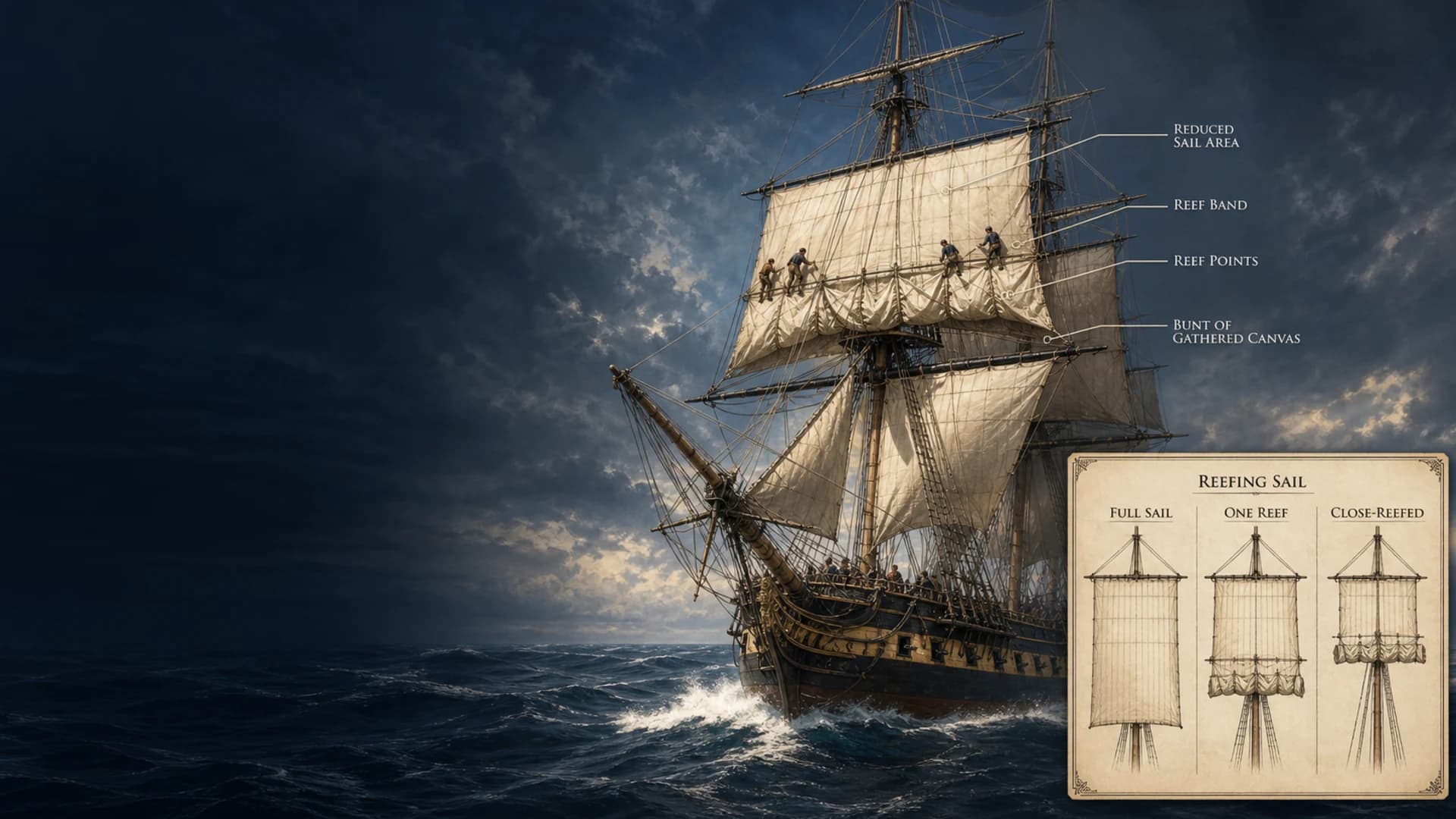
Reef cringles, reef bands and reef points have different structural jobs
A reef row commonly includes a reinforced band across the sail and strongly built cringles near the luff and leech. In a modern slab-reefing system, those two principal cringles form the new tack and clew. Their reinforcement distributes tension into the sail edges, while fittings and lines transfer it to the mast and boom. The cloth between them can then be stretched into a functional airfoil rather than left as a loose bundle.
The several small reef points across the middle look conspicuous, but their usual purpose is to gather slack canvas so that it does not flog, obscure vision or fill with water. They are not substitutes for the reinforced corners. Tying them too tightly, or around a boom where the particular sailmaker did not intend it, can damage the sail. The correct lead, attachment and knot must follow the design of the individual sail and rig.
A useful way to understand any reefing arrangement is to trace its loads. Where does the halyard stop the head? What secures the new tack? How does the new clew receive both aft and downward tension? How is surplus canvas controlled without becoming a primary structural member? This explains why single-line, two-line, hook and ring systems can share one objective while requiring different detailed actions.
A sound sequence unloads the sail before securing the new corners and retensioning it
The most manageable reef is normally taken while the vessel still has course and handling margin. The crew first chooses a heading that reduces mainsail pressure without surrendering control, clears the halyard and reefing lines, secures loose deck gear, and keeps people away from loaded ropes and the sweep of the boom or sail. Reefing early is therefore about working conditions as much as ultimate sail area.
The luff is then eased enough to reach the chosen reef row. The new tack is secured, the reefing line draws the new clew into position, and halyard and foot tensions are restored. Exact order changes among single-line, twin-line, in-mast and in-boom systems. The common logic is to avoid forcing fittings against a fully loaded sail and to seat the major load-bearing points before treating the loose body of the canvas.
Afterward, sail shape, helm pressure, heel and the relationship between main and headsail all need another look. Reefing only the main while leaving an oversized headsail—or reducing the headsail without matching the main—can move the center of effort and alter steering balance. A reef is a new sail-plan setting, not the end of adjustment, and it must be checked again as gusts and sea state change.
Square-rigged ships sent crew onto the yard to gather canvas along the spar
A traditional square sail does not use the same geometry as a triangular modern mainsail. It carried one or more reef bands, reef points and reinforced edge fittings. Deck crews first controlled the corners, altered the height of the yard or otherwise reduced tension in the relevant part of the sail. Sailors then moved out along footropes beneath the yard and leaned over the spar to pull the canvas upward.
People at the yardarms handled the reef earings and reinforced edge attachments while those inboard hauled successive sections of cloth onto the yard and secured the reef points. A stronger wind made the flogging canvas, moving yard and wet footropes increasingly dangerous. Work aloft also depended on coordinated use of halyards, clewlines, sheets and braces below; the familiar image of men on a yard was only one part of a ship-wide evolution.
Nineteenth-century seamanship manuals repeatedly describe reducing the strain before the men reefed and distributing the hands along the yard. An uncontrolled sail could transfer violent loads into both crew and rig. Square-rigged ships required large watch teams because every tier of sail had its own yard, corners and gathering path, and safe timing depended on synchronized human decisions rather than a single roller mechanism.
Reefing, furling, storm sails and flattening solve four different problems
Reefing leaves a portion of a sail set and working. Furling generally stows a sail, although a purpose-designed modern roller can also remain partly rolled to reduce area. Both can make less cloth visible, but their load paths, shape quality and equipment limits are different. A partially rolled sail cannot automatically be treated as equivalent to a well-tensioned slab reef.
A dedicated storm sail replaces everyday canvas with a smaller sail whose cloth and corners are built for severe loads. Flattening a normal sail, tightening controls or changing stay tension can reduce depth and power in moderate wind without removing as much effective area as a formal reef. Shape control has limits and cannot indefinitely substitute for reducing canvas as the wind continues to build.
The appropriate combination depends on vessel, rig, heading, sea state and sea room. The best result is not necessarily the neatest photograph. It is a vessel that can hold the required course with helm in reserve, carry tolerable rig loads and leave its crew able to make the next change safely before conditions overtake them.
Questions
Continue exploring this subject
Are reefing and furling the same thing?
No. Reefing keeps a smaller bounded part of the sail working, while furling normally stows it. Partial roller reefing can reduce area, but its shape and load path depend on a system designed for that use.
Why is it better to reef early?
Before heel and loads become excessive, the crew has more control over heading, lines and attachment points and retains margin for a gust, sea-state change or equipment problem.
Do the small reef points carry the whole sail load?
Normally no. They gather surplus cloth; the reinforced new tack and clew and their rigging carry the principal tension. Follow the instructions for the specific sail and system.
How did a square-rigged ship reef sail?
Deck crews first reduced and controlled sail tension. Sailors then went out on footropes, gathered part of the sail onto its yard and secured reinforced edge fittings and the row of reef points.
Does reefing always make a boat slower?
Not necessarily. Too much canvas can produce heel, helm drag and loss of control. An appropriate reef may improve balance and make average speed steadier in strong wind.
Sources
Continue the research
- RYA Sail Trim HandbookRoyal Yachting Association
- Speed Guide ExplanationUS Sailing
- Text-Book of Seamanship, Part 3Historic Naval Ships Association
- Text-Book of Seamanship, Part 8Historic Naval Ships Association
- Preliminary Training, Part 2Historic Naval Ships Association
 01
01 02
02 03
03 04
04 05
05