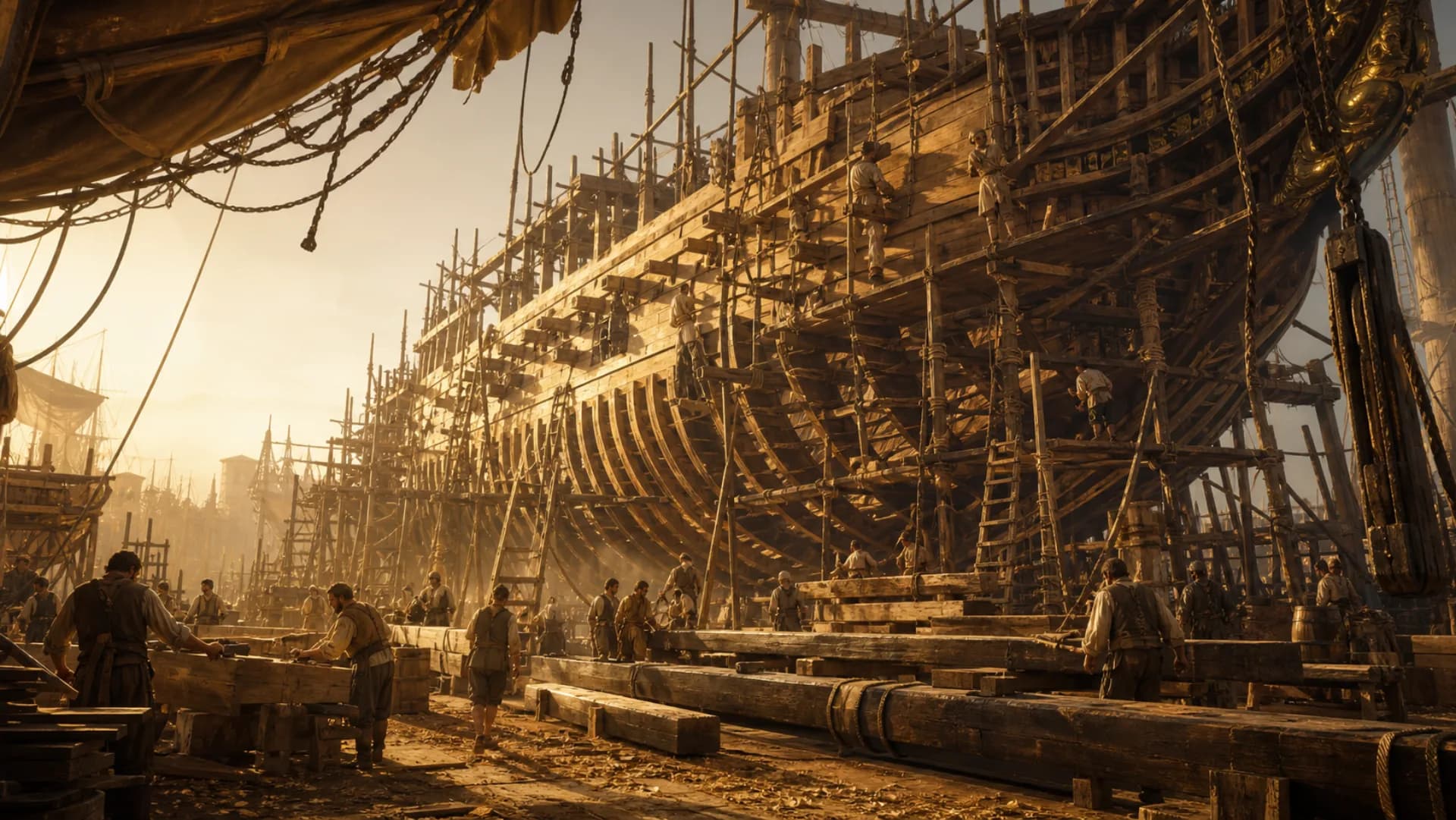
 ship structure
The next passage crosses an upwind strait
Mast
Masts and rigging transfer sail loads into the hull.
Deck
Deck beams help the hull resist transverse deformation.
Keel
The main longitudinal member forms the structural baseline of many wooden sailing ships.
Classification follows how a sail is set, not whether its outline is square
A square sail hangs from a yard lying broadly athwart the vessel's fore-and-aft centerline. The yard can be braced obliquely without turning the sail into a fore-and-aft one. A fore-and-aft sail works chiefly along the vessel's length: it may hang from a gaff and boom behind a mast or form a triangular staysail between masts or ahead of the foremast. A square sail's outline is often trapezoidal.
To identify an old vessel image, find the masts, then transverse yards, gaffs and stays, and finally record the sail on each mast. A triangle is not enough to label the entire vessel, because mixed rigs are common. Rigs also changed during repairs and changes of trade. The name describes the arrangement at a particular date, not an immutable identity of the hull.
The rigs favor different wind directions rather than one being universally faster
A square-rigger can stack courses, topsails, topgallants and royals, creating a large total area for long passages in trade winds or prevailing westerlies. It is not limited to dead downwind sailing: yards can be braced for broad and beam reaches and a degree of windward work. Yard geometry and sail shape, however, usually leave a wider no-go zone.
A fore-and-aft sail aligns more readily with apparent wind and changes side without rotating a whole tier of yards, so it commonly points closer to windward. National Park Service research on Great Lakes vessels links the nineteenth-century schooner's popularity to speed, maneuverability, windward ability and smaller crews. Yet flat-bottomed schooners made considerable leeway until centerboards improved their underwater resistance. The hull still mattered.
Crew demand follows the number, height and machinery of the sails
Dividing square canvas among several tiers lets a crew shorten sail in stages, but requires yards, standing rigging and a dense network of running lines. Sailors brace yards, handle sheets and clewlines, and may climb aloft to loose or furl canvas. Balclutha carried 25 sails, fifteen set square across the masts; Friendship's seventeen sails were controlled through about fifty miles of line. Those details explain the labor cost better than a slogan.
A fore-and-aft rig is not automatically a one-person system. A large gaff sail is heavy, while headsails and topsails retain separate controls; reefing in bad weather remains skilled work. Meaningful comparison must hold vessel size, sail area and mechanization reasonably constant. Coastal owners chose schooners partly because short voyages, frequent harbor work and wages created an economic advantage, not because the rig won every possible speed contest.
Ship, barque, brigantine and schooner specify mast-by-mast arrangements
In strict English rig terminology, a ship-rigged vessel has at least three masts square-rigged on each. A barque has at least three masts, square-rigged except for a fore-and-aft aftermost mast. A brig has two square-rigged masts; a brigantine normally combines a square foremast with a fore-and-aft mainmast. A schooner has at least two masts and is predominantly fore-and-aft, although historical examples may set square topsails.
The 1877 Elissa provides a documented barque. Restoration records describe square sails on fore and main masts, a gaff topsail and spanker aft, plus jibs and staysails: nineteen sails totaling about 12,000 square feet. The same hull was later reduced first to a barkentine and then to a schooner rig. A vessel's rig category can therefore change while its name and much of its structure remain.
A mixed rig assigned different jobs to different sails
Fore-and-aft sails could balance the fore and after ends and assist steering, while square sails supplied broad ocean-going power. Friendship met the formal definition of a ship yet carried six fore-and-aft sails to help it point and turn. A barque's fore-and-aft mizzen similarly reduced after-yard work and improved handling. The real sail plan is more informative than forcing a vessel into an all-square or all-longitudinal binary.
Route requirements decided the tradeoff. A long passage in steady favorable winds, a coastal trade against prevailing wind, and a confined river entrance reward different qualities. Hull resistance, cargo, ballast, canvas condition and crew performance can outweigh the category name on a particular voyage. The most reliable description gives date, mast count, sail type on each mast and intended service.
Questions
Continue exploring this subject
Is a square sail literally square?
Not necessarily. The term refers mainly to setting the sail on an athwartship yard; the sail itself is often rectangular or trapezoidal.
Are fore-and-aft sails always faster?
No. They usually offer better windward ability and handling, while square rigs can spread very large area in favorable ocean winds. Hull, load and conditions decide actual speed.
Why is a barque a mixed rig?
A typical barque has at least three masts, with square sails on the forward masts and a fore-and-aft sail plan on the aftermost mast, balancing ocean power and handling.
Can a vessel's rig name change after a refit?
Yes. Removing square yards and fitting fore-and-aft sails can change the rig classification even when the hull and ship name remain; Elissa underwent several such changes.
Sources
Continue the research
- Friendship's Rigging Fully in Place for the First TimeU.S. National Park Service
- Great Lakes Shipwrecks of WisconsinU.S. National Park Service
- Elissa National Register of Historic Places RegistrationU.S. National Park Service
- BarqueThe Mariners' Museum and Park
- Classification for the topmasts, yards, and sailsRoyal Museums Greenwich
 04
04