 compass
The bow has entered the eye of the wind as a wave strips away speed
TACK LEDGER · HEADING, MOMENTUM AND WINDWARD PROGRESS
A tack is a lossy dynamic manoeuvre, not a sharp corner on a chart
The ledger assumes true wind from 000° and illustrative 45-degree close-hauled courses. Real angles and speed response vary with craft, wind, waves, loading and control.| Phase | Illustrative heading | Speed state | Observable condition |
|---|---|---|---|
| Approach | 315° | 5.0 kn | Close-hauled on starboard; preserve momentum |
| Head up | about 340° | falling | Luffing sails rapidly lose drive |
| Pass head to wind | 000° | minimum zone | Directional boundary of the tack |
| Exit no-go sector | about 030° | recovering | Sails cross and fill on the new side |
| Rebuild speed | 045° | target 5.0 kn | Accelerate before pinching to target angle |
VMG = 5 × cos 45° = 3.54 knThis is the component toward the windward mark, not log speed.
3.54 × 20 / 3600 = 0.0196 NMAbout 36 m of windward progress. This is a route-comparison assumption, not a universal tack penalty.
Tack names both a windward side and a bow-through-wind manoeuvre
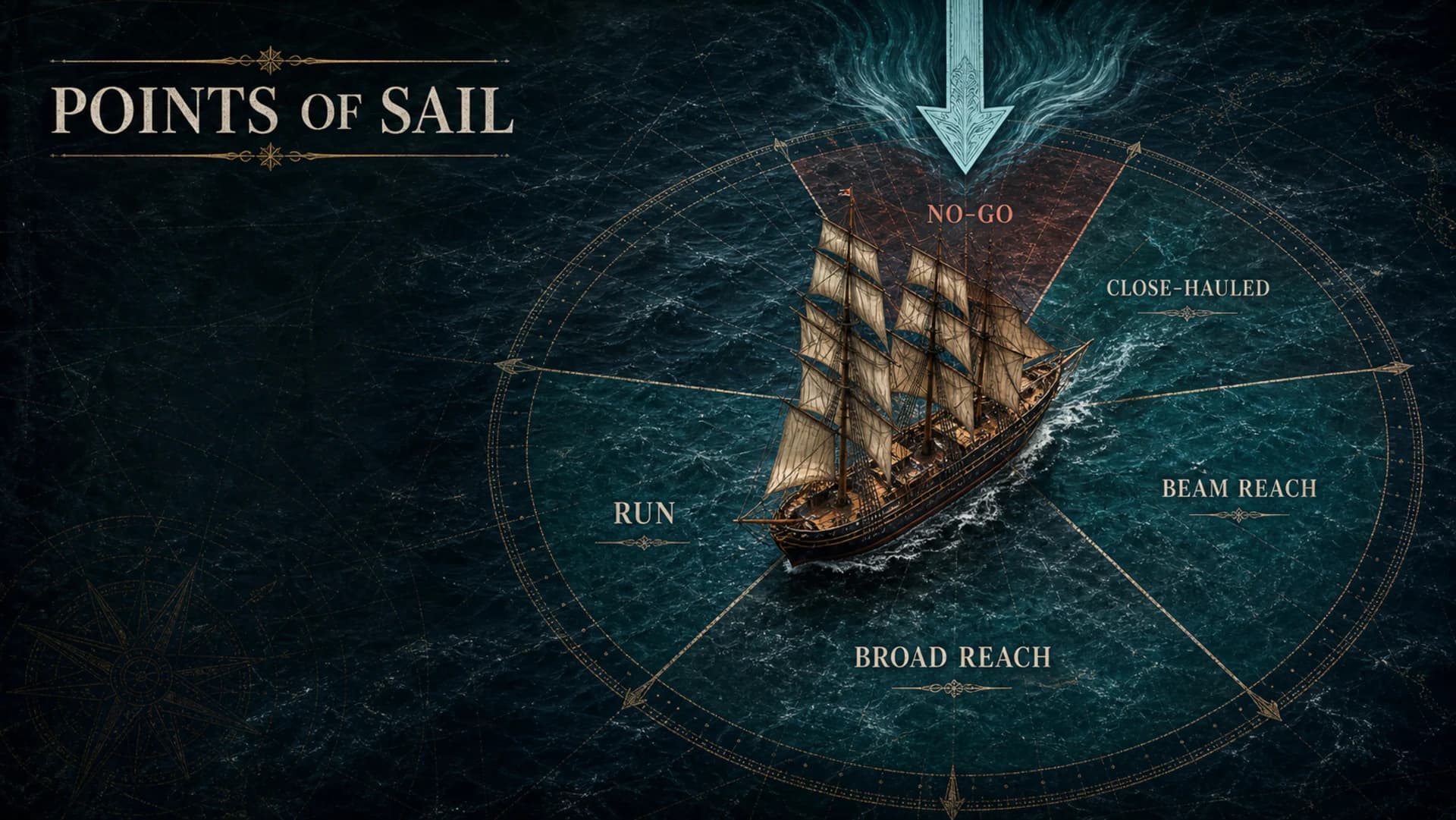
The English word tack carries two connected meanings that should not be collapsed. A boat on starboard or port tack is named for its windward side; this is also the definition used by World Sailing. The mainsail normally lies to leeward, so on starboard tack the wind arrives over the starboard side while the mainsail lies to port. The label does not depend on whether the boat points east or west, and a photograph of the sail alone can mislead unless the wind direction is known.
As a manoeuvre, tacking or coming about means heading toward the wind, taking the bow through head to wind, and establishing a close-hauled course on the other tack. A gybe takes the stern through the wind, normally on a downwind leg. Both move the sail across the boat, but the direction of rotation, boom-sweep hazard and load sequence differ. Beating to windward is the larger route made from multiple close-hauled legs and tacks; it is not another name for one turn.
A tack proceeds through entry, lost drive, wind crossing and acceleration
A modern fore-and-aft-rigged dinghy generally approaches close-hauled with enough speed for steering, then turns progressively toward the wind. As the leading edges of the sails luff, aerodynamic drive falls rapidly. Near head to wind, the sails contribute little forward drive and the craft continues rotating largely on stored momentum. After the bow crosses the eye of the wind, headsail and mainsail move to their new sides, fill as the boat leaves the no-go sector, and rebuild speed. Many craft accelerate slightly below the final close-hauled angle before heading up to their target.
A rudder produces a useful yawing moment only while water flows across it, and it also produces induced and separation drag. A University of Southampton AC45 simulator study framed tack performance around speed loss through head to wind and time to recover a stated fraction of entry speed. In that model, very fast, excessive rudder input increased loss and could stall the rudder, leaving the boat stuck near head to wind. Its exact optimum angle does not transfer to a cruising monohull; the transferable lesson is the balance between reducing sail-less time and avoiding needless steering drag.
Repeated tacks create windward VMG rather than a direct bow-to-mark track
A sailing craft cannot remain steadily head to wind, but it can sail close-hauled along either edge of its no-go sector. If an illustrative craft makes five knots on courses 45 degrees from the true wind, its ideal velocity made good directly to windward is five times the cosine of 45 degrees, or about 3.54 knots. The crosswind component reverses on the other tack. This is a component example, not a universal polar diagram: real close-hauled angle and speed depend on rig, hull, sea state and wind strength.
The decision to tack is consequently part of route planning. Standing on one tack too long can carry the vessel beyond a layline to the destination, while tacking too frequently repeatedly pays the costs of deceleration, sail handling and crew movement. Gusts and directional shifts can favor one tack. Tide and current separate heading from track over ground. COG and SOG support an arrival-oriented VMG over Earth, while heading and speed through water help diagnose the craft's own windward performance. The two reference frames answer different questions.
Head to wind is both a handling state and a racing-rules boundary
World Sailing's 2025–2028 rule 13 draws a precise rules boundary at the moment a boat passes head to wind. From that point until she reaches a close-hauled course on the new tack, she must keep clear of other boats; the ordinary port-starboard, windward-leeward and clear-ahead rules do not apply in their usual combination during that interval. This legal definition supports consistent race decisions. It does not claim that the hydrodynamic manoeuvre begins or ends at exactly the same instants.
Seamanship adds room and communication to the geometry. Before turning, a crew checks the new course and leeward side for vessels, marks, shallow water and waves, gives an understood command, and ensures sheets will run without snagging. A double-handed dinghy coordinates headsail transfer, body movement and the boom. Near a lee shore or inside a narrow channel, one failed attempt can consume critical room. A diagram can identify the directional relationship, but training on the particular craft, safety equipment, weather and local water remains essential.
Tacking a square-rigged ship was a coordinated evolution of the whole rig
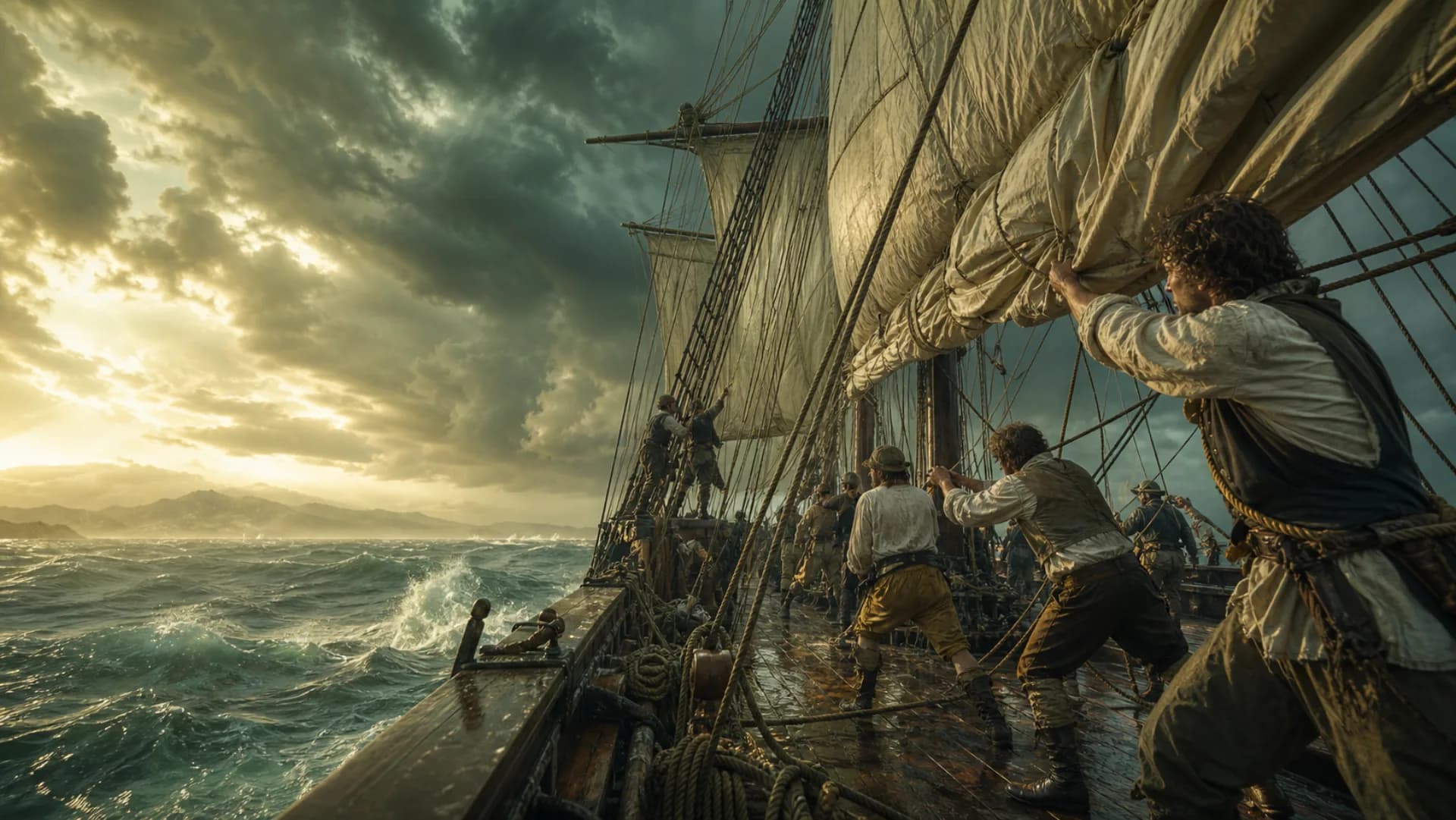
A square-rigged ship can also change tack by putting her bow through the wind, but her yards cannot simply swing across like a dinghy mainsail. USS Independence orders from 1815 list a sequence including Ready, Helm's alee, Mainsail haul, and Let go and haul. Luce's nineteenth-century Text-Book of Seamanship stations crews at sheets, tacks, clew-garnets, braces and fore-and-aft sails, then swings the after and head yards at different stages. Timing changes with wind strength and the individual ship's working qualities.
If a ship in light air, a head sea or low speed lacks momentum to pass the wind, she may miss stays: the bow reaches the eye of the wind but fails to fall onto the new tack. Historical procedures could gather sternway or box the head yards to recover. Another option was wearing ship—bearing away and taking the stern through the wind in a much wider sweep. Luce describes the greater leeward loss of wearing but identifies heavy weather with a sea on the weather bow, or insufficient headway in light air, as conditions in which it could be chosen. This was a complete ship evolution, not merely an enlarged modern dinghy gybe.
A reproducible tack record separates geometry, control and environment
A useful analysis can log pre-entry heading and speed, first rudder movement, the time the bow passes head to wind, maximum rudder angle, arrival on the new close-hauled course, and time to recover 80 or 95 percent of entry speed. Research instrumentation can add mast or sail angle, SOG, effective upwind direction and attitude. A time series distinguishes a weak entry, a stall at head to wind, over-rotation, and premature sheeting after the turn much better than a note saying only that the tack felt slow.
Those measurements also need craft type, loading, wind, waves, current, velocity reference and sample rate. Assuming 20 seconds at zero windward VMG may help compare routes, but it does not make 20 seconds a fixed penalty for every tack. An AC45 rudder result belongs to its model and conditions. The instructional sequence is the defensible common ground: enter with usable speed, carry the bow through the wind, transfer the sails, check rotation and rebuild speed. Craft-specific thresholds should come from its manual and observations rather than being projected across every sailing vessel and historical period.
Questions
Continue exploring this subject
What does tacking a sailboat mean?
It means turning the bow through the direction from which the wind comes so the wind changes sides and the sails fill on the new tack. Repeated tacks create a zigzag route to windward.
Which side does the wind come from on starboard tack?
World Sailing names the tack for the windward side. On starboard tack, wind arrives over the starboard side and the mainsail normally lies to leeward on port.
What is the difference between a tack and a gybe?
A tack takes the bow through the wind and commonly belongs to windward sailing. A gybe takes the stern through the wind on a downwind course, with a different boom movement and load sequence.
Why does a sailboat get stuck head to wind?
Sails provide little forward drive near head to wind. Low entry speed, wave resistance, poor rudder use or mistimed sail handling can consume the momentum needed to complete the turn.
Did square-rigged ships tack like modern dinghies?
The bow still crossed the wind, but the operation required staged handling of yards, braces, tacks, sheets and fore-and-aft sails. If it failed, a ship could recover with special procedures or wear around downwind.
Sources
Continue the research
- Sailing and the Tech DinghyMIT Sailing
- Do You Know Your Points of Sail?Royal Yachting Association
- Racing Rules of Sailing 2025–2028 with Changes and CorrectionsWorld Sailing
- Investigation of Tacking Strategies Using an America's Cup 45 Catamaran SimulatorUniversity of Southampton
- Multi-Sensor System for Analysis of Maneuver Performance in Olympic SailingApplied Sciences
- General Orders, USS Independence, 1815U.S. Naval History and Heritage Command
- Text-Book of Seamanship, Chapter XXIVHistoric Naval Ships Association
- The Elements and Practice of Rigging and Seamanship, Evolution of a ShipHistoric Naval Ships Association
 01
01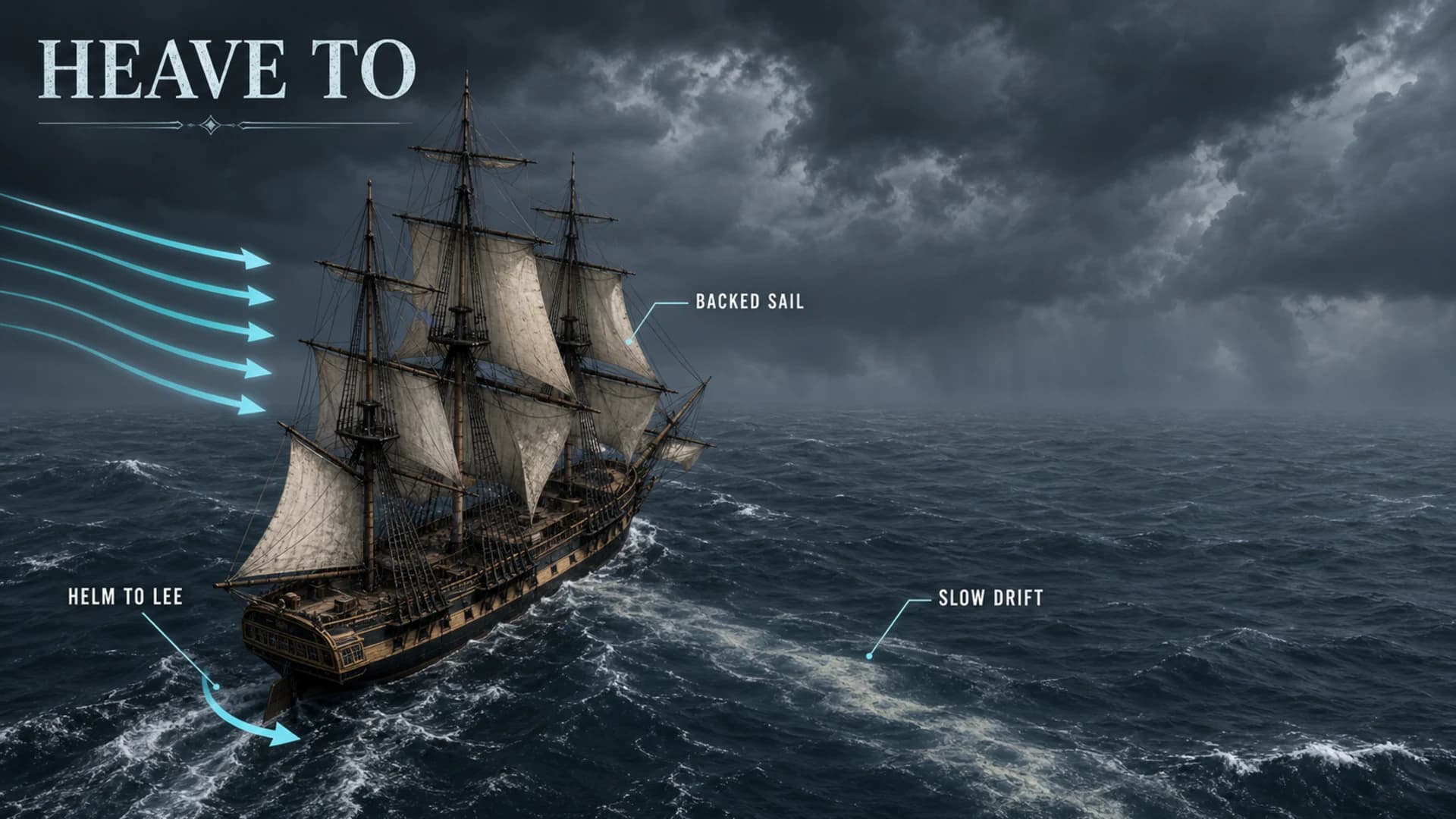 02
02 06
06