 ship structure
The ship has just launched, but three new port seams leak faster than the old planking
Mast
Masts and rigging transfer sail loads into the hull.
Deck
Deck beams help the hull resist transverse deformation.
Keel
The main longitudinal member forms the structural baseline of many wooden sailing ships.
Timber swelling helped, but watertightness still depended on a controlled seam
Carvel hull and deck planks changed dimension with moisture, temperature and hull load. Immersion compressed caulking as timber swelled, but could not correct a bad edge, loose fastening or structural distortion. A long-dry hull might leak heavily when first returned to water.
Caulking created a resilient, repairable fibre barrier and protected its face. It did not glue planks or mend rotten frames. Caulker, shipwright and ship's carpenter therefore occupied related but distinct positions in seam work, structure and voyage maintenance.
Raking and reading the plank condition determined whether new material had sound ground
Old loose compound and decayed fibre had to be removed deeply enough for the replacement without cutting the plank edge. Seam width, depth, softness and fastening condition governed the amount. If structural movement created the opening, hammering in more oakum concealed rather than solved it.
New work also required consistent preparation. A yard gang progressed by section and marked completion across thousands of feet of seam. An omitted length might remain invisible until launch converted it into pump time.
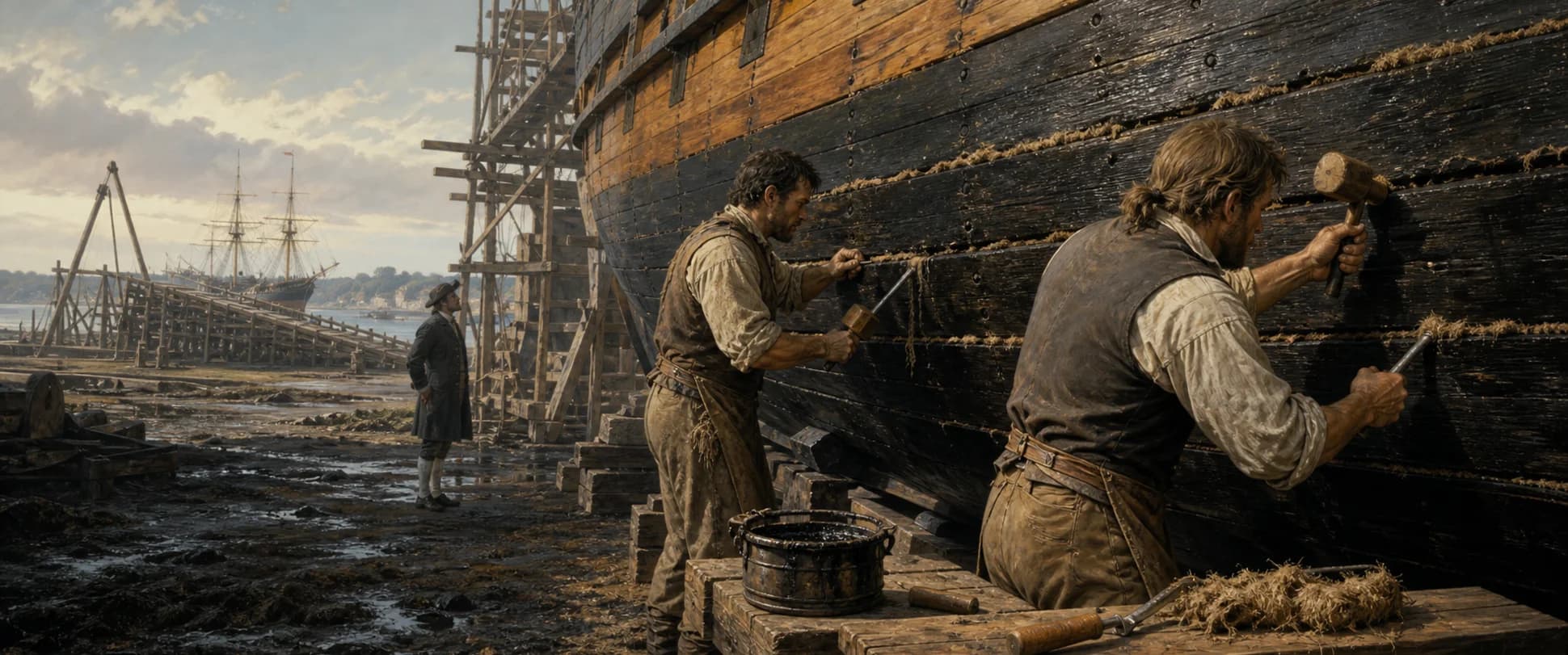
Oakum turned hemp fibre, often recovered from old rope, into continuous seam packing
Workers picked apart cordage or prepared new hemp, removed dirt and rolled the fibre into strands sized to the seam. Light tarring improved resistance to rot. Dust, sticks and hard lumps produced voids or injured the wood under the iron.
Fibre supplied packing and resilience; tar or pitch protected the face. Pouring compound into an empty joint was not equivalent. Separate pitch houses and oakum lofts show a material chain rather than an improvised smear.
Shaped irons drove successive layers; the mallet's resistance and sound helped govern density
A caulker started and set strands with irons suited to the opening, then finished the surface before it was paid. The long-handled cylindrical mallet could be swung for hours against hull, bottom and deck. Return of the fibre, resistance and the plank's note helped an experienced worker maintain an even run.
Too little left a water path; too much turned packing into a wedge that spread the seam or bruised its arris. Neighbouring workers had to join runs smoothly, while plank ends, fastenings, hatches and the waterline demanded adjusted technique. More force was not better workmanship.
Launch, loading and pump-well records provided the final acceptance test
A hull bent differently on blocks, afloat and under stores. Yard staff watched seepage and pumping after launch and marked returns. Deck seams then endured rain, drying and traffic. A dry visual inspection could not reproduce those loads.
At sea, the carpenter and mates inspected seams, bilge and well. A local leak might be checked temporarily; extensive underwater work required dock, slip or careening. Rising water could also indicate collision, failed fastening, decay or distortion, so caulking was one diagnosis rather than every answer.
Questions
Continue exploring this subject
What was oakum?
Picked hemp fibre, often recovered from old rope, cleaned, lightly tarred and rolled into strands for driving between wooden planks.
Did swelling timber seal a wooden ship by itself?
No. Swelling compressed a properly built and caulked seam, but could not compensate for damaged edges, bad fastening, decay or distortion.
Was tighter caulking always better?
No. Loose packing leaked, while excessive driving could wedge planks apart, bruise their edges or distort the shell.
Was a caulker the ship's carpenter?
Usually not. Caulkers specialized in yard seam work; the ship's carpenter inspected and repaired hull, spars and pumps at sea and might perform routine caulking.
Why was pitch applied over the seam?
It protected the fibre and sealed the face, but could not replace correctly driven oakum or repair structural failure.
Sources
Continue the research
- Small Jobs with Big Purpose: CaulkingUSS Constitution Museum
- Building 10 – Pitch House and Oakum LoftUSS Constitution Museum
- Architectural Use of Wood and Coal Tars in EnglandHistoric England
- Taylor's BoatyardHistoric England
- Ranks + RatesUSS Constitution Museum
- The Elements and Practice of Rigging and SeamanshipSmithsonian Libraries and Archives
 01
01 03
03