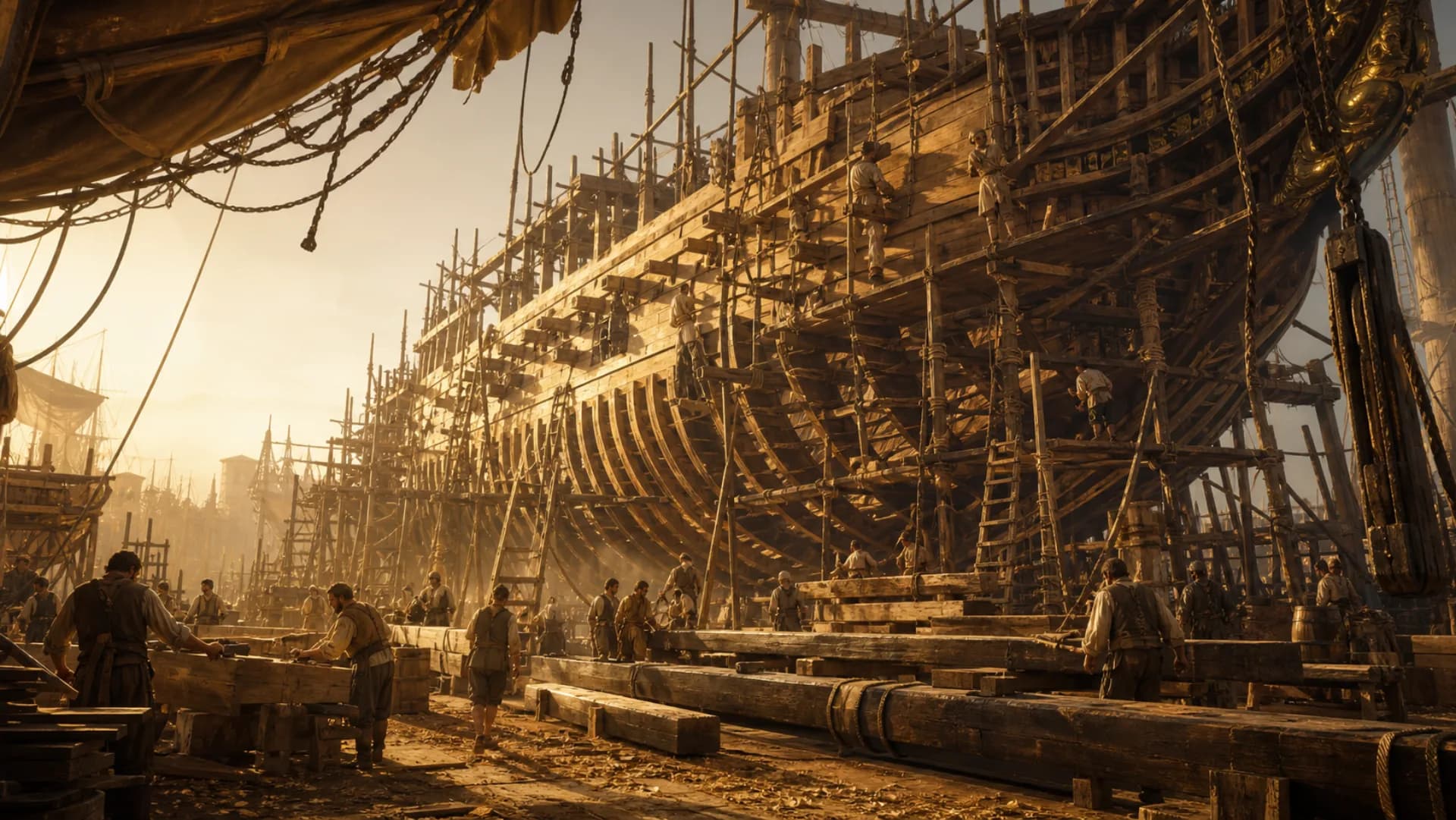
 ship structure
The fin's leading edge struck rock, but the bilge shows no obvious flooding
KEEL AUDIT · STRUCTURE, SIDE FORCE AND WEIGHT MOMENT
One word, keel, crosses three different engineering problems
Keel can mean a hull member, an underwater foil, or ballast weight. Many yachts combine all three in one assembly while their mechanical functions remain distinct.| Function | Possible member | Checkable role |
|---|---|---|
| Structural centreline | Timber keel, hog or moulded reinforcement | Joins end structures and transverse framing; distributes load |
| Hydrodynamic foil | Long keel, fin keel, daggerboard or centreboard | Develops lateral force at a small leeway angle |
| Low weight | Lead, iron or encapsulated fixed ballast | Lowers whole-vessel CG according to weight and vertical position |
| External protection | False keel, worm shoe or keel iron | Protects primary structure from wear or grounding; details vary |
ΔKG = w × Δz / Δ = 1,000 × (−1.50) / 5,000 = −0.30 mWith total mass fixed at 5,000 kg, moving 1,000 kg downward by 1.50 m lowers the whole-craft CG by 0.30 m.
- Record impact speed, direction and subsequent symptoms
- Inspect fin, hull joint, floors and keel-bolt region
- Have qualified personnel determine hidden damage and repair scope
Keel can mean a backbone, an underwater foil or a ballast assembly
Everyday language often merges three engineering objects. The keel timber of a traditionally built wooden hull is a longitudinal centreline member in the structural backbone. A modern glass-reinforced-plastic boat can likewise have extra centreline laminate forming structural reinforcement. The long keel or fin extending below a sailing hull also operates as a hydrodynamic foil. If lead, iron or other fixed weight is enclosed within or attached to it, the assembly additionally becomes a ballast keel. These functions can occupy one assembly, but that does not mean every keel is heavy, deep or structurally equivalent.
Terminology has to follow material and section. The National Park Service recording guide lists timber keel, ballast keel, keelson, false keel and worm shoe as separate survey items. FAO fibreglass construction guidance describes additional centreline laminate as a structural backbone. A flat-bottomed powerboat may have centreline structure without a deep fin or external ballast, while a light dinghy may gain lateral area from a retractable centreboard without a heavy fixed keel.
Timber keel and keelson clamp the transverse structure into a centreline system
A representative traditional wooden section may run upward from a worm shoe or protective strip through false keel, primary keel timber, bottom planking and garboard strakes, transverse floors, and an internal keelson or hog. Frames and floors carry loads between the two sides and the centreline; the keel connects the stem and after structure; the keelson lies inside the hull and distributes load longitudinally across the floors. Exact names, layers and joints vary by region, period and vessel type.
A false keel is commonly fixed outside the primary keel so that grounding and wear first damage a replaceable layer. A worm shoe provides another sacrificial bottom protection. Neither becomes the main backbone simply by being the lowest visible timber. FAO wooden-vessel standards label keel, hog, keel bolt, worm shoe and stopwater separately, with specified scarf and fastening relationships. A photograph of one timber on the bottom is therefore insufficient to identify the member.
An underwater keel trades a little leeway for lateral force
A sail producing forward force normally also applies substantial transverse force. Hull and appendages need an opposing hydrodynamic force or the vessel would simply slip downwind. MIT's model-tank explanation describes keel and centreboard as immersed surfaces resisting sideways motion. Like foils, they develop lift when they meet the water at a small angle of attack—the leeway angle. A keel does not mechanically lock out leeway; it works through a balance of limited side slip, drag and useful lateral force.
Greater depth, area or aspect ratio can improve some lateral-force characteristics, but it also changes wetted area, structural load, draught and grounding exposure. The MIT explanation explicitly frames side force and drag as an engineering compromise. A centreboard can be lowered for windward sailing and partly raised when its area is less useful; a fixed keel avoids that operation and can carry ballast, but constrains shallow-water access, trailering and hauling. Rudder, hull and the balance between sail and underwater force centres remain part of the system.
Low ballast lowers whole-vessel centre of gravity through a weight moment
The stability contribution comes from weight and location, not from the word keel. If a vessel's total mass remains 5,000 kilograms while 1,000 kilograms within that total is relocated 1.50 metres downward, the first-order weight moment lowers the whole-vessel centre of gravity by 1,000 times 1.50 divided by 5,000, or 0.30 metre. An external lead fin, encapsulated metal or other fixed ballast can all enter the centre-of-gravity calculation through their mass and coordinates.
Lowering the centre of gravity generally changes righting capability, but a 0.30-metre KG shift alone does not prove that the vessel is safe. Stability also depends on the immersed hull's changing centre of buoyancy, free surfaces, downflooding openings, loading condition and full GZ curve. FAO stability guidance commonly uses keel as the reference from which KG is measured, while making clear that G belongs to the distribution of every mass aboard. A ballast keel is one input to whole-vessel stability, not a stand-alone anti-capsize certificate.
Long keel, fin keel and centreboard embody different design choices
A long keel spreads lateral area over a substantial length and may blend into the hull and stern structure. A fin keel concentrates area in a shorter, deeper foil and may carry external ballast attached by bolts. A centreboard or daggerboard retracts and primarily supplies lateral area; it may not be heavy enough to serve as the principal ballast. Bilge keels are commonly fitted as a pair around the bilge and may reduce rolling on power vessels, so their name does not make them equivalent to a yacht's central ballast fin.
These labels describe geometry or installation and cannot by themselves prove that one craft is safer, faster or more weatherly. Design still has to reconcile structural load, ballast centre, draught limit, operating area, maintenance, grounding and the hydrodynamic balance among hull, rudder and sail plan. A continuous timber keel on a historic vessel and a bolted metal fin beneath a composite yacht both occupy the centreline, yet their internal load paths, inspection methods and likely failure modes differ.
After a grounding, inspection follows the external fin's load path into the hull
When a fixed fin keel strikes the seabed, the load does not stop at its leading edge. Bending moment travels into keel bolts, the landing surface, bottom laminate, floors or structural grid. A small external scrape can coexist with internal cracking, debonding, fastener deformation or leakage. The UK Maritime and Coastguard Agency issued MGN 613 specifically for grounding of fixed-fin GRP yachts and emphasizes professional assessment and the possibility of hidden structural damage rather than cosmetic surface repair alone.
A reproducible record includes impact speed and direction, draught and bottom type, leakage or unusual sounds afterward, change at the hull-keel joint, bolt and floor condition, and prior repair history. A timber vessel instead directs attention to the primary keel, scarfs, fastenings, floors, keelson and sacrificial layers. The two checklists are not interchangeable. Their common principle is to follow force from the struck region through each connection into the hull rather than treating the keel as an isolated bottom accessory.
Questions
Continue exploring this subject
What does a ship's keel do?
Depending on the vessel, it can provide centreline hull structure, hydrodynamic resistance to side slip, and a low location for fixed ballast. Not every keel performs all three roles.
What is the difference between keel and keelson?
In a traditional wooden hull, the keel runs along the outside centreline and joins the end structure. The keelson lies inside, longitudinally above the floors, strengthening and distributing load.
Is a false keel the main keel?
Usually not. It is an external, often sacrificial member intended to absorb wear or grounding damage before the primary keel. Details vary with construction.
Does a sailboat keel eliminate leeway?
No. A hydrodynamic keel generally needs a small angle to the water flow to develop opposing lateral force, so some leeway remains while the design balances lift and drag.
Does a heavy ballast keel guarantee stability?
No. Its mass and low position influence centre of gravity, but adequate stability also depends on hull buoyancy, loading, free surfaces, downflooding and the complete GZ curve.
Sources
Continue the research
- Guidelines for Recording Historic Ships, Third EditionU.S. National Park Service
- Safety Recommendations: Recommended construction standards for wooden fishing vesselsFAO / ILO / IMO
- Building a fibreglass fishing boat: Keels and areas requiring extra stiffeningFood and Agriculture Organization
- Fishing boat designs: V-bottom boats of planked and plywood constructionFood and Agriculture Organization
- MIT Science Reporter: Sailing by ComputerMassachusetts Institute of Technology
- Sailing and the Tech Dinghy: The CenterboardMIT Sailing
- Safety practices related to small fishing vessel stabilityFood and Agriculture Organization
- MGN 613: Grounding of fixed fin keel GRP yachtsUK Maritime and Coastguard Agency
 03
03