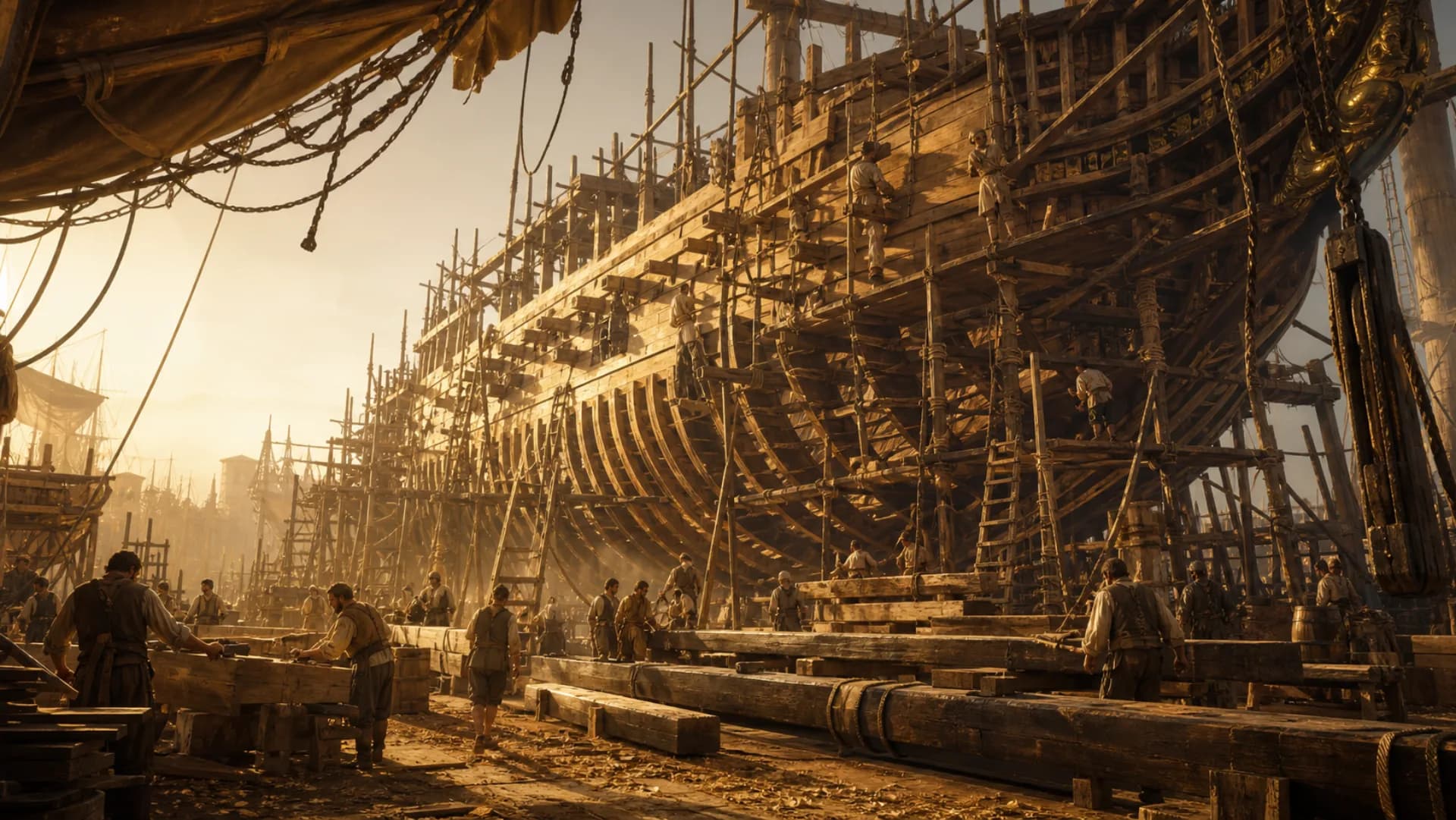
 ship structure
The hold has been emptied
Mast
Masts and rigging transfer sail loads into the hull.
Deck
Deck beams help the hull resist transverse deformation.
Keel
The main longitudinal member forms the structural baseline of many wooden sailing ships.
Ballast changes weight distribution; it does not simply hold a ship down
Wind acting high in sails and masts creates a heeling moment. Ballast secured near the keel lowers the common center of gravity, G, of hull, rig, cargo, people and ballast. In upright calm-water equilibrium, total weight acts downward and equal buoyancy acts upward along the same vertical line, so the forces create no turning moment.
As the vessel heels, the shape of displaced water changes and the center of buoyancy, B, shifts toward the immersed side. Separation of the weight and buoyancy lines creates the righting arm GZ; displacement multiplied by GZ gives righting moment. A low center of gravity usually improves recovery through part of the heel range, but real safety requires the whole GZ curve, hull form and loading condition—not one slogan about G and B.
Ballast also managed draft, trim and steering immersion
An unloaded merchant ship floated higher, presented proportionally more windage, and might leave too little rudder or lateral hull in the water. Ballast restored a workable draft. Moving weight fore or aft adjusted trim so neither end rode excessively high. Unequal port-starboard distribution produced a static list, which is distinct from transient heel caused by wind or waves.
Cargo belonged in the same calculation. Dense goods low in the hold helped lower the common center of gravity; deck cargo raised it. Unloading could therefore turn a satisfactory vessel into one needing ballast. Naval-architecture training treats additions, removals and shifts of weight as related calculations affecting draft, trim, metacentric height and the righting-arm curve. Tonnes alone are insufficient without their locations.
A simple weight-shift relation makes the point: moving one item aft moves the vessel's common center of gravity in proportion to that item's weight times distance, divided by total displacement. Real stowage also checks structural loading, hold geometry and free surfaces. The same ten tonnes beside the keel, on deck, at the bow or off-center therefore produces very different results.
Stone, sand, brick and compact iron involved different costs
Solid ballast included locally available stone, sand, gravel, brick and scrap iron. It had to be laid low, spread and restrained so it did not abrade the hull, block bilge drainage or roll in a seaway. Stone was cheap but voluminous. Denser iron used less hold for the same mass and preserved cargo room, although it had more purchase value.
USS Alligator offers a documented example. NOAA's wreck account says the 1821 warship carried about sixteen tons of heavy iron blocks called kentledge instead of the stone common on many contemporary vessels. That figure belongs to this hull, rig, armament and service. It is not a standard allowance for every ship of similar length; transferring it without a weight and stability calculation could produce the wrong draft or behavior.
Too much, too stiff or shifting ballast could remain dangerous
Excess ballast increased draft and wetted surface, reduced payload and could prevent passage over a shoal. A vessel with very high initial stability, described as stiff, snapped back through a short, violent roll that loaded masts, rigging, cargo and people. A tender vessel with too little initial stability heeled farther and returned slowly. The objective was an acceptable stability range through changing voyage loads, not the greatest possible weight or GM.
Unsecured stones, guns, barrels or cargo sliding toward the low side shifted the common center of gravity and deepened the heel. A partly filled liquid space created a related free-surface effect as fluid ran to the low side, reducing effective initial stability. Reducing sail, securing every heavy item, keeping bilge routes clear and maintaining pumps were therefore inseparable from ballasting. Carrying ballast never guaranteed immunity from capsize.
Ballast stones suggest routes but rarely prove a ship's origin alone
After a wooden hull decays or is salvaged, its ballast mound may dominate the wreck site. A nineteenth-century wreck in Biscayne National Park retains basalt ballast, yet investigators explicitly leave its origin unknown. Ballast was loaded and discharged as cargo conditions changed and transferred among vessels. A foreign rock may record any of several voyage legs.
Petrology and geochemistry can still propose source regions, while mound size helps delimit a site, but the inference needs hull fasteners, timber, cargo, weapons, port accounts and wreck records. Solid ballast also transported soil and organisms; NOAA research identifies it as one pathway for plant introductions from the seventeenth to early twentieth centuries. Built-in water tanks spread from the mid-nineteenth century to save solid-ballast labor, creating the later ecological problem of ballast-water transport.
Questions
Continue exploring this subject
What did sailing ships use as ballast?
Common materials included stone, sand, gravel, brick and iron. Dense cargo stowed low also affected the same weight and stability calculation; choices varied by ship, voyage and port.
Did more ballast always make a ship safer?
No. Excess weight increased draft and could cause violent stiff rolling, while high, off-center or moving ballast could directly reduce safety.
Why was ballast kept low and secured?
Low weight reduced the common center of gravity. Restraint stopped it sliding to the low side in a roll, which would shift that center and worsen heel.
Can ballast stones identify where a wreck came from?
Rarely by themselves. Ballast moved among ports and ships, so geological results must be combined with hull, cargo, artifact and documentary evidence.
Sources
Continue the research
- Ship Hydrostatics and StructuresMIT OpenCourseWare
- EN342: Ship Hydrostatics and StabilityUnited States Naval Academy
- 19th Century Wooden Sailing VesselU.S. National Park Service
- USS AlligatorNOAA Florida Keys National Marine Sanctuary
- Shipping as a Major Pathway of Transmission of Nonindigenous SpeciesNOAA Central Library
- Transportation and Ship DesignUniversity of Hawaiʻi at Mānoa
 03
03