Ledger index ↓
Ledger abstract
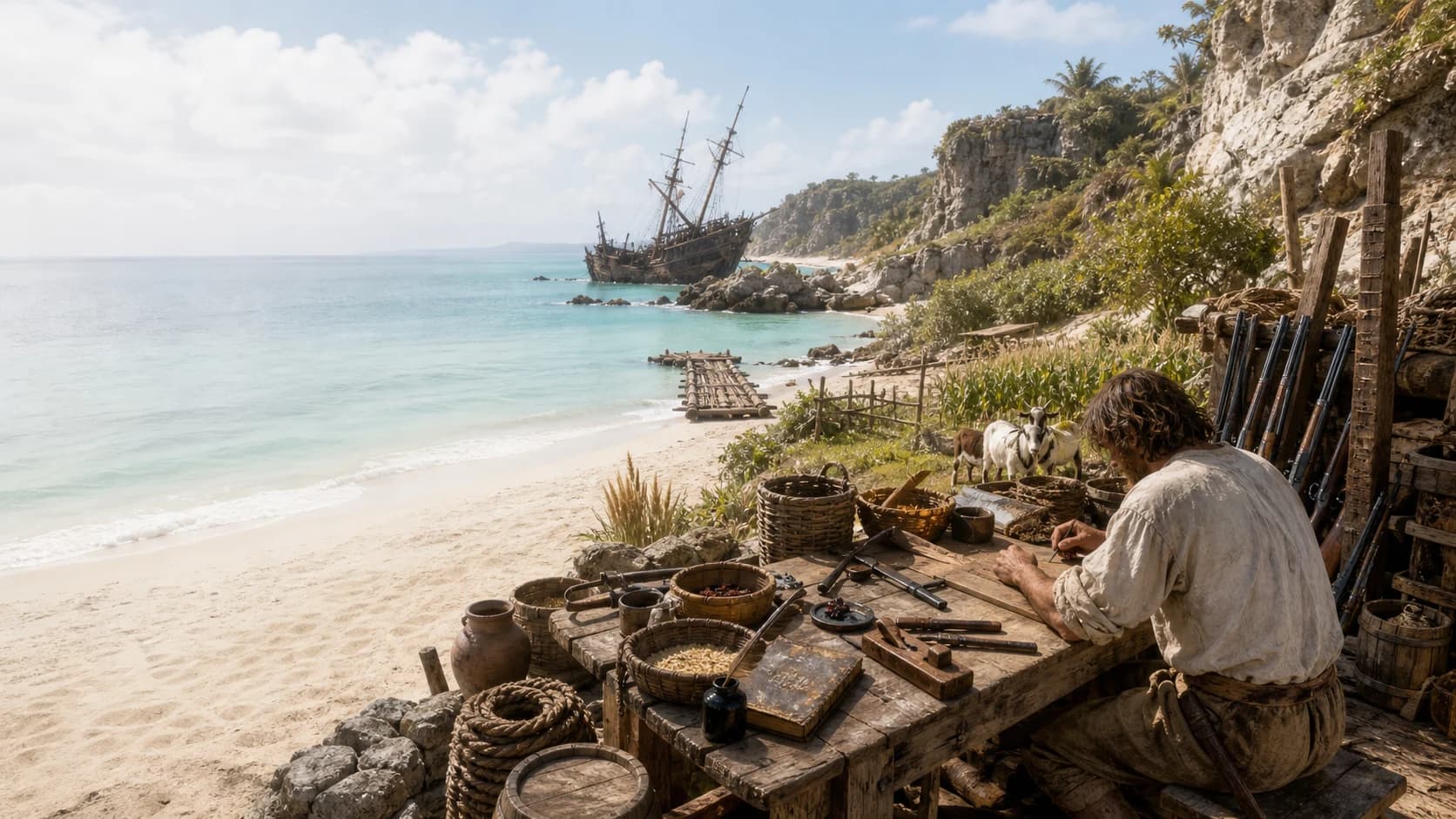
This is no beginning from zero: ship, plantation, accounts, and empire come ashore with him.
Daniel Defoe wrote Robinson Crusoe, and the London bookseller William Taylor published it in April 1719. The first edition named Crusoe rather than Defoe as its author and closed its title with “Written by Himself,” inviting readers to approach a fictional life as authentic travel testimony. The narrative is much larger than island survival. Crusoe leaves York in 1651, survives storms, profits from a Guinea trading voyage, is enslaved at Sallee in Morocco, escapes by boat with a boy called Xury, and is rescued by a Portuguese captain. In Brazil he acquires a tobacco and sugar plantation. In 1659 he agrees to serve as supercargo on a clandestine voyage intended to purchase enslaved Africans for several plantations. The shipwreck near the mouth of the Orinoco occurs inside that venture. Guns, powder, carpenter’s tools, sails, food, paper, ink, and books recovered from the wreck become the island’s initial capital. A notched calendar post, daily journal, repeated inventories, and a debit-and-credit table of evil and good bring time and emotion under management. When a few grains sprout accidentally, Crusoe spends seasons making a wooden spade, baskets, pottery, mortar, sieve, and oven: one loaf reveals how many specialized operations society ordinarily hides. Biblical reading turns his history into a pattern of sin, punishment, repentance, and deliverance, yet inward conversion develops beside possession. Crusoe calls the land his property, imagines himself king, lord, and lawgiver, names a rescued islander Friday, and first teaches him to call Crusoe Master. After leaving in 1686 and reaching England in 1687, the proceeds of the Brazilian plantation make him wealthy. Alexander Selkirk’s well-publicized isolation in the Juan Fernández archipelago from 1704 to 1709 contributed important material, but Defoe placed the fictional island on the Atlantic side of the Americas and drew on shipwreck relations, spiritual autobiography, travel writing, commercial calculation, and colonial projects. The novel’s durable force lies in these systems operating together: tools can preserve life and accounts can steady a mind, while the apparently self-sufficient island remains connected from its first day to ships, plantations, enslavement, property, and print.
Original passages
Six first-edition passages connect slave voyage, time, labour, faith, and mastery.
- ENTRY 01The slave-trading voyageBrazil and the Guinea proposal · 1719 first edition
They had a Mind to fit out a Ship to go to Guinea ... to bring the Negroes on Shoar privately, and divide them among their own Plantations.
Close readingThe planters intend one clandestine voyage to transport enslaved Africans and distribute them among their Brazilian estates.
The shipwreck occurs during this venture. Investors, trade cargo, supercargo, and intended allocation place the island narrative inside plantation expansion. - ENTRY 02Keeping timeThe calendar post · 1719 first edition
I came on Shore here on the 30th of Sept. 1659 ... and thus I kept my Kalander, or weekly, monthly, and yearly reckoning of Time.
Close readingThe inscription fixes his landing, while graduated notches continue the count by week, month, and year.
The post is memorial, calendar, and ordering device. It differentiates island days and keeps Sabbath, labour cycle, and narrative chronology available. - ENTRY 03A moral ledgerTaking stock of his condition · 1719 first edition
I stated it very impartially, like Debtor and Creditor, the Comforts I enjoy'd, against the Miseries I suffer'd.
Close readingHe balances present comforts against afflictions as though entering the two sides of a merchant’s account.
Commercial bookkeeping becomes a practice of mind. Writing stabilizes despair and turns providential interpretation into comparable entries. - ENTRY 04One loaf of breadGrain, tools, and operations · 1719 first edition
The strange Multitude of little Things necessary in the Providing, Producing, Curing, Dressing, Making and Finishing this one Article of Bread.
Close readingA loaf requires a multitude of operations: provision, production, curing, dressing, making, and finishing.
Seed does not become food at discovery. Sowing, delay, harvest, storage, milling, pottery, and an oven compress many social trades into years of solitary experiment. - ENTRY 05Property and ruleAfter the island is peopled · 1719 first edition
The whole Country was my own meer Property ... I was absolute Lord and Law-giver; they all owed their Lives to me.
Close readingCrusoe describes the country as his property and himself as absolute lord and lawgiver over people whose lives he believes he has saved.
The sentence advances improvement into territorial title and rescue into subjection. Property, sovereignty, and toleration meet in one comic royal inventory. - ENTRY 06Friday and MasterThe first language lesson · 1719 first edition
I made him know his Name should be Friday ... I likewise taught him to say Master, and then let him know, that was to be my Name.
Close readingCrusoe assigns Friday a new name and assigns himself the relational name Master in their first English lesson.
Language distributes identity and power at once. Companionship develops through shared work and conversation, but it begins within an explicit hierarchy.
Story time × publication time
A fictional life of thirty-five years meets a three-year explosion in print.
- 01
Crusoe is born at York
This is fictional chronology. His father recommends the stable ‘middle state’; departure and discontent later become Crusoe’s recurring explanations for disaster.
- 02
The first departure
A passage from Hull towards London brings an immediate storm. A vow made under threat vanishes when weather and company improve.
- 03
Guinea trade, Sallee slavery, and escape
After one profitable trading voyage, Crusoe is captured and enslaved at Sallee for about two years, then escapes southward by boat with Xury.
- 04
The Brazilian plantation
A Portuguese captain rescues them and purchases Xury’s term of service. Crusoe acquires land in Brazil and expands tobacco and sugar production.
- 05
A clandestine slave-trading voyage sails
Brazilian planters finance the vessel and appoint Crusoe supercargo to purchase enslaved Africans for private division. A storm carries the ship towards the Orinoco.
- 06
Shipwreck and landing
Crusoe alone survives. The wreck remains accessible long enough for repeated journeys carrying weapons, powder, tools, canvas, food, paper, ink, and books ashore.
- 07
Calendar, enclosure, and journal
Notches preserve dates; cave and palisade order stores; a retrospective journal records work and feeling until its ink supply fails.
- 08
Grain, pottery, and bread
Accidentally sprouted grain passes through seed saving and failed harvests before tools, storage, processing, and an oven form a food system.
- 09
A footprint on the shore
A single trace alters the island’s emotional and defensive landscape. Years of watching and fear follow before direct encounter.
- 10
Friday is rescued and named
The two establish speech, shared labour, and religious dialogue. Naming, the title Master, and firearm superiority structure the relationship.
- 11
Departure and return to England
Crusoe recovers a mutinied English ship, leaves after twenty-eight years, two months, and nineteen days, and reaches England the following June.
- 12
Four editions in four months
William Taylor publishes the first edition in April; second, third, and fourth editions follow in May, June, and August as demand accelerates.
- 13
Sequels, translations, and visual expansion
Farther Adventures appears in 1719 and Serious Reflections in 1720. Dutch, French, and German translations, illustrated editions, and abridgements remake the narrative.
Eighteen reading movements
The first edition has no numbered chapters; this index follows turns in economy, labour, faith, and relation.
LEDGER 01
The Atlantic before the island
The first edition runs continuously; these are editorial reading movements.- 01
York and the middle state
Parental counsel, restless departure, and Crusoe’s ‘original sin’
- 02
Hull towards London
First storm, rescue, and an abandoned vow
- 03
The Guinea trade
Navigation, gold dust, small capital, and merchant identity
- 04
Sallee and Xury
Captivity, slavery, boat escape, and Portuguese rescue
- 05
The Brazilian plantation
Land, tobacco, sugar, and the clandestine Guinea plan
LEDGER 02
A wreck becomes a storehouse
Goods, space, and measured time form the first survival system.- 06
Storm and landing
Shipwreck near the Orinoco and a sole survivor
- 07
Twelve salvage journeys
Rafts, tides, tools, arms, food, and canvas
- 08
Palisade and cave
Camp, magazine, dwelling, and defensive space
- 09
The calendar post
Dates, Sabbath, and labour cycles regain measure
- 10
Two columns of good and evil
A spiritual crisis written as debit and credit
LEDGER 03
Labour, providence, and territory
Years of making and waiting become a story of providence and possession.- 11
Journal and illness
Paper, ink, fever, tobacco, dream, and Bible
- 12
From grain to bread
Sowing, seed saving, harvest, storage, milling, and oven
- 13
Coasting and canoe
Reading currents and the risk of being swept away
- 14
Footprint and defence
Fear reorganizes shelter, sightlines, and violence
LEDGER 04
Friday, rescue, and returns
As population grows, Crusoe writes relationships in the language of rule.- 15
Encounter and naming
Rescue, Friday, Master, and the first language lesson
- 16
Dialogue and shared labour
Theology, firearms, cultivation, and a plan to sail
- 17
Prisoners and mutiny
Friday’s father, a Spaniard, and an English captain
- 18
Departure and plantation proceeds
The recovered ship, Europe, and Brazilian accounts
Atlantic prehistory
Before the wreck, Crusoe has already been merchant, slave, slaveholder, and planter.
The narrative leaves the York household for an interconnected maritime economy. One Guinea voyage teaches Crusoe trade and basic navigation; a second leads to captivity at Sallee. When he escapes with Xury, he is a fugitive from enslavement who also controls the boat, gun, and course. After rescue, he agrees that the Portuguese captain may purchase Xury’s term of service. Position changes rapidly at sea.
Brazil supplies the island’s most important economic prehistory. Crusoe invests money held by the captain, acquires land, and grows tobacco and sugar through neighbours, hired work, and enslaved labour. He accepts the Guinea assignment because planters want to bypass a restricted market and secure labour directly. The wreck occurs within that expansion rather than after a clean break from it.
Every useful object aboard consequently carries a social origin: guns and powder belong to an armed merchant vessel, tools embody shipboard trades, biscuit and dried food come from provisioning, and paper and ink belong to commercial record. The starting scene is not a human creating from nothing but a survivor redeploying the remainder of a ship and colonial world.
Wreck inventory
Twelve passages turn a damaged ship into the island’s starting capital.
Tide, surf, and the wreck’s position establish narrow working windows. Crusoe first lashes spars and timber into rafts, then loads food, drink, clothes, arms, powder, axes, chisels, nails, cordage, canvas, and nautical objects. Weight and freeboard remain hazards; finding the creek and waiting for the tide are as important as possession.
Value changes ashore. Coin temporarily loses exchange power while iron, powder, grindstone, and needles become precious. Shelves, wall pegs, and classified storage turn the cave into a ‘general magazine of all necessary things.’ Inventory means access, dryness, separated powder, and a rate of consumption—not ownership alone.
Firearms supply food and security while making ammunition a countdown. The narrative repeatedly takes stock of powder, lead, grain, and livestock because technical advantage depends on reserve. An object’s route from wreck to store and then into labour or defence makes equipment a changing system.
Labour time
From a few grains to one loaf, the novel makes hidden social division of labour visible.
A few grains of barley and rice sprout from discarded husks, at first appearing miraculous. Crusoe saves the seed, negotiates wet seasons, mistimes planting, and endures insufficient harvests before the stock can support eating. Agriculture is made from season, error, and deferred consumption.
Bread demands another chain: a wooden spade, improvised harvesting tool, baskets, hand threshing, mortar and pestle, sieve, earthenware, and an oven. Each instrument demands material, experience, and repair. A finished loaf condenses work that a settled society normally distributes among many occupations.
Calendar notches, daily tasks, and annual yields measure this work. Modern scholarship has also calculated the narrative’s compressed engineering: the dimensions of timber, available tools, and solitary labour make some rafts, excavations, and palisades implausibly fast. Technical density creates realism even when narrative time serves allegory and plot.
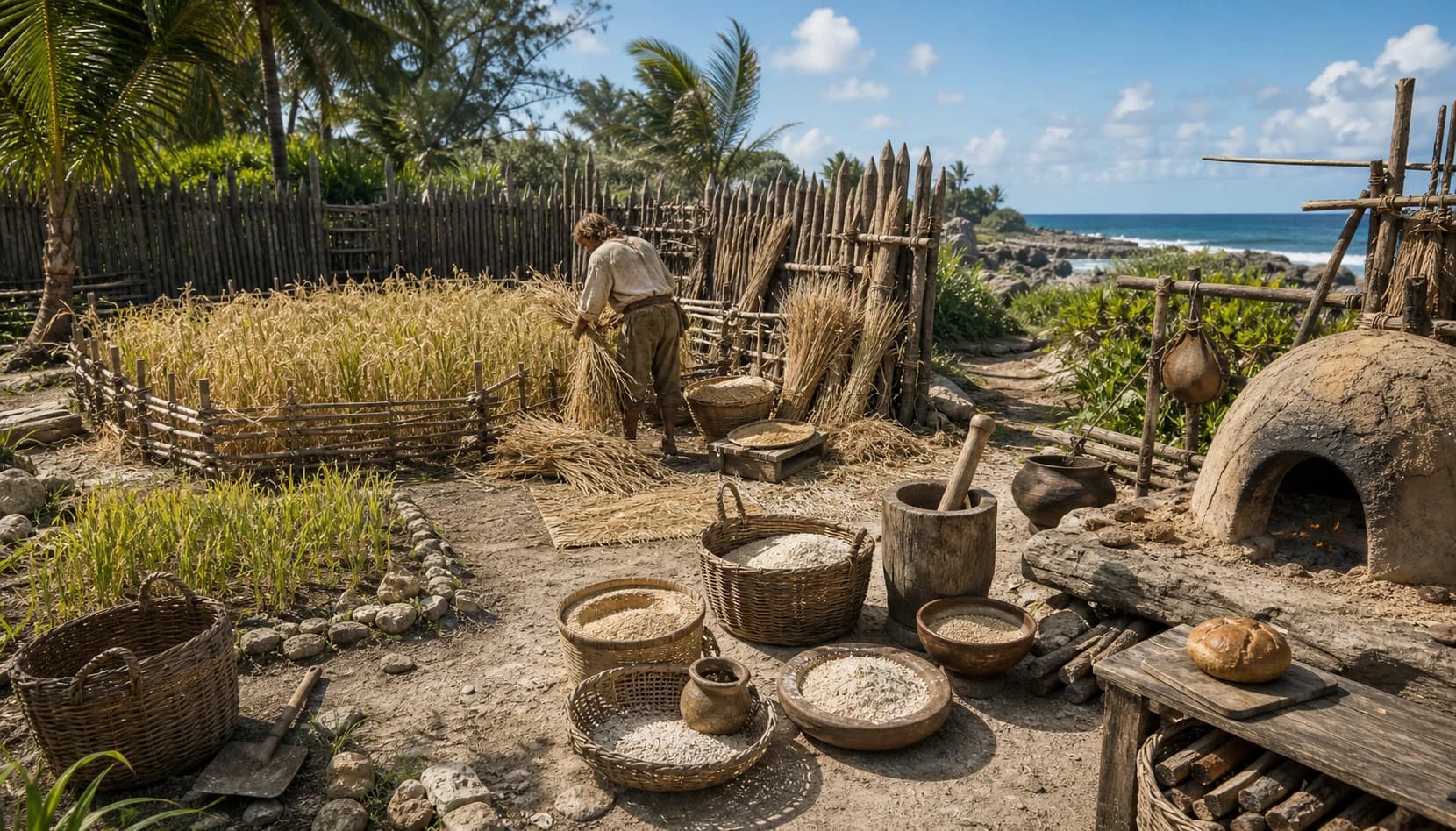
One loaf requires seed, season, tools, storage, fuel, and operations learned through failure; the novel unfolds otherwise invisible labour.
Spiritual accounts
Journal, balance sheet, and Bible turn isolation into a history of repentance.
Crusoe builds a calendar and then begins a journal. They work at different scales: the post maintains week, month, and year, while the journal retells labour, weather, sickness, and emotion. Its opening days are retrospective and repeat earlier narrative; once ink fails, continuous daily entry gives way again to recollection.
The evil-and-good table borrows directly from double-entry language. Solitude, nakedness, and lack of rescue stand opposite survival, climate, and stores. It is not cold arithmetic but a cognitive technology: catastrophe becomes comparable entries, allowing reason to constrain despair.
Fever, dream, and biblical reading transform the explanatory frame. Departure, accumulation, and the Guinea voyage become sin and punishment; survival, grain, and rescue become providence. Conversion changes Crusoe’s inward life without dissolving possession or subjection. Spiritual autobiography and commercial success still coexist at the ending.
A model territory
A protective enclosure becomes a boundary, and improvement becomes a claim to sovereignty.
The dwelling acquires successive names: camp, enclosure, castle, country house, and dominion. Crusoe plants trees to screen the entrance, uses a ladder across the barrier, and establishes further storage and retreat. Labour gives space a private order; narration then enlarges use into ownership of the whole island.
The footprint breaks the fantasy of vacant land. Crusoe immediately imagines visitors, observation points, weapons, and escape, including schemes of pre-emptive violence. When population later grows, he calls himself king and lawgiver. The island becomes territory through fear, force, naming, and improvement rather than through an original political blank.
Nature enters the same account. Goats are enclosed and bred, grapes dried into stores, trees converted into hedges, canoe, and fuel. Ecological history adds that the Juan Fernández archipelago associated with Selkirk had already been altered by introduced goats, timber use, and passing mariners. Real remote islands also carry histories of transoceanic species and occupation.
Relation and transmission
Friday brings dialogue and makes inequalities of naming, language, faith, and firepower visible.
Crusoe saves a man facing death but neither asks nor preserves his existing name. He assigns Friday from the day of encounter and makes Master his own relational name in English. They go on to cultivate, cook, build, plan voyages, discuss God, and rescue others. Cooperative intimacy and hierarchy remain simultaneous.
The novel compresses other islanders into a broad cannibal category, reducing distinct societies to threat and religious difference. Friday’s theological questions nevertheless make Crusoe admit limits to his own explanations, especially about evil, the Devil, and divine power. Conversion dialogue sometimes exposes the teacher’s uncertainty.
After departure, accumulated Brazilian proceeds reconnect Crusoe with Atlantic wealth. Print produces a second expansion: four editions in 1719, a sequel that year, translations in 1720, and continuous abridgement and illustration establish the Robinsonade. Later retellings often preserve the footprint, Friday, and survival kit while cutting Sallee, Xury, plantation, and slave voyage. Unabridged reading reconnects those shortened ends.
Evidence limits
Fictional facts, historical institutions, probable sources, and engineering calculation work at different levels.
Dates and inventory
Landing date, twenty-eight-year duration, salvaged objects, and labour sequence belong to the narrated fiction. They support interpretation but are not the archive of an actual wreck.
Brazilian plantations and Atlantic slavery
The novel uses real commodities, routes, labour regimes, and commercial roles. Portuguese imperial, Brazilian, and slave-trade research must calibrate their specific operation.
Alexander Selkirk
Selkirk lived in the Juan Fernández archipelago from 1704 to 1709 and appeared in Woodes Rogers’s account. Character, geography, dates, and plot remain different.
Raft, cave, and palisade
Technical detail creates powerful verisimilitude, while some solitary construction times have been challenged. Dimensions, tools, labour rate, and narrative omission require separate calculation.
Reading editions
Continuous first print, modern annotation, and free search texts answer different questions.
Oxford World’s Classics · edited by Thomas Keymer
An unabridged reading text with substantial introduction and notes on genre, religion, colonialism, and publication. Its continuous structure is especially useful for a serious first reading.
Penguin Classics · edited by John Richetti
Richetti’s introduction and notes return the novel to Defoe’s career, eighteenth-century economy, and prose form. Check editor and ISBN because Penguin publishes several formats.
University of Virginia Anthology · William Taylor transcription
A corrected transcription based on the 1719 first edition, with editorial markup and page-image access, for historical spelling, continuous structure, and passage checking.
Project Gutenberg #521
Excellent for search and electronic reading, but based on a 1919 illustrated reset that adds twenty chapter titles and normalizes spelling. Return to 1719 for first-edition structure.
Reader questions
Author, wreck, island geography, Selkirk, chapters, and Friday.
Who wrote Robinson Crusoe?+
Daniel Defoe wrote it. The title page of the 1719 first edition did not name him and instead presented the narrative as written by Crusoe himself; modern bibliography securely attributes the work to Defoe.
What is Robinson Crusoe about?+
Crusoe leaves York, passes through trade, captivity, escape, and a Brazilian plantation, and is wrecked during a slave-trading voyage. He spends twenty-eight years creating stores, agriculture, spiritual discipline, and political rule, meets Friday, and returns to the proceeds of his plantation.
Why was Crusoe on the voyage that wrecked?+
Brazilian planters appoint him supercargo for a clandestine voyage to purchase enslaved Africans on the Guinea coast and distribute them among their estates. The September 1659 storm diverts and wrecks the ship near the Orinoco.
How long did Robinson Crusoe live on the island?+
The novel specifies twenty-eight years, two months, and nineteen days: from 30 September 1659 to 19 December 1686. He reaches England on 11 June 1687.
Is the fictional island today’s Robinson Crusoe Island?+
The title places the fictional island near the Orinoco on the Atlantic side of the Americas. Chile’s Robinson Crusoe Island is in the Pacific Juan Fernández archipelago, where Selkirk lived; it received its present name in 1966.
Was Alexander Selkirk the real Robinson Crusoe?+
His 1704–1709 isolation and Woodes Rogers’s printed account are major sources, but Defoe also combined shipwreck, travel, spiritual, and commercial writing. A single-model explanation understates that synthesis.
How many chapters did the 1719 book have?+
The 1719 William Taylor text did not use the numbered chapters familiar from many later editions. Editors divide the continuous narrative differently; this page’s eighteen movements are a reading guide rather than an original contents list.
Why is Friday central to a modern reading?+
Friday turns solitude into relationship. Crusoe renames him and teaches him to say Master while the two share labour, travel, and religious discussion. The combination supports analysis of companionship, language, conversion, and colonial power.
Research sources
First edition, print history, slave trade, colonial scholarship, and archaeology calibrate the novel together.
- 01Robinson Crusoe · 1719 first-edition transcription ↗
University of Virginia Anthology
Corrected transcription and page images based on William Taylor’s first edition; principal passage-checking source - 02The life and strange surprizing adventures of Robinson Crusoe ↗
Oxford Text Archive / Great Writers Inspire
First-edition title, collation, issue points, and British Library reproduction record - 03Transnational Crusoe, Illustration and Reading History, 1719–1722 ↗
Cambridge University Press, 2025
Open-access study of early editions, sequels, translations, copperplates, and illustrated abridgement - 04Robinson Crusoe and Defoe’s Career as a Writer ↗
The Cambridge Companion to Robinson Crusoe
The full narrative route through Sallee, Xury, Brazil, the island, and the European return - 05Mastering the savage: conversion in Robinson Crusoe ↗
Defoe’s America / Cambridge University Press
Conversion, mastery of wilderness, colonial enterprise, and structures of subjection - 06Robinson Crusoe and the Slave Trade: A Treatise Against Adventure ↗
Modern Philology / University of Chicago Press
Recent recontextualization of slave trade, technology, contingency, thrift, and adventure - 07A Cruising Voyage Round the World ↗
Wellcome Collection · Woodes Rogers, 1712
Full text of Rogers’s voyage and an early printed account of Selkirk’s four years and four months alone - 08Excavation at Aguas Buenas, Robinson Crusoe Island ↗
Post-Medieval Archaeology
Archaeological case for an early European campsite and navigational dividers in the Juan Fernández archipelago - 09Robinson Crusoe’s Implausible Palisades ↗
Études anglaises
Labour calculation for raft, excavation, and enclosure in contexts of realism, privateering, colonialism, and finance - 10The Life and Adventures of Robinson Crusoe · eBook #521 ↗
Project Gutenberg
Free searchable reading text whose 1919 base and added chapter headings must be distinguished from 1719 - 11Robinson Crusoe · John Richetti edition ↗
Penguin Random House
Editor, bibliographic details, current Penguin reading edition, and publication overview
Research and image assets updated 2026-08-26. Read our editorial and citation standards