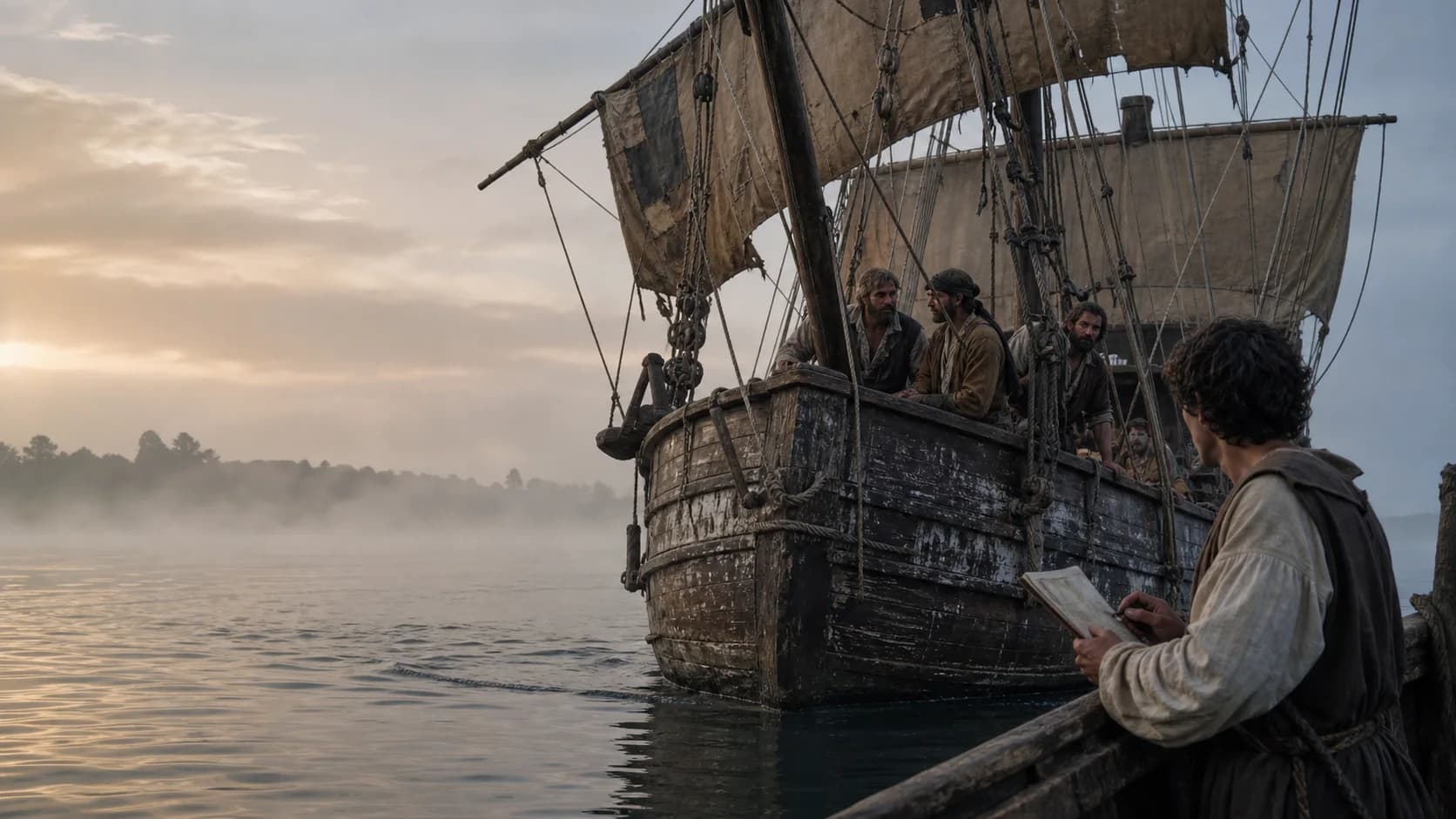
Logbook contents ↓
CAPTAIN'S COPY · DIRECT ANSWER
What is The First Voyage Around the World?
The First Voyage Around the World is the narrative Antonio Pigafetta prepared after returning to Europe from notes kept during the 1519–1522 expedition. It preserves unusually close detail about fleet signals, sailing, food, disease, word lists, ceremonies, plants, animals, the battle of Mactan, the clove trade, and the lost calendar day. Pigafetta’s working journal and presentation copy are lost; the work survives in one Italian and three French manuscripts. His admiration for Magellan and near-silence about Elcano also shape the narrative. Read beside Francisco Albo’s pilot book, crew rolls, accounts, and other testimony, it anchors a fuller reconstruction of the expedition.
“un libro scritto de mia mano de tutte le cose passate de giorno in giorno”Pigafetta at the close of the narrative · his claim to daily recordingFLEET MANIFEST
Five ships. One direct return.
- 01TRINIDAD1522 · seized by Portugal
- 02SAN ANTONIO1520 · returned to Spain
- 03CONCEPCIÓN1521 · burned for lack of crew
- 04VICTORIA1522 · returned directly
- 05SANTIAGO1520 · wrecked scouting
THE DIMINISHING FLEET · 1519–1525
Ships, crews, and commanders diminish along the global wake.
- 01
Five ships leave Seville and Sanlúcar
Trinidad, San Antonio, Concepción, Victoria, and Santiago sail west in search of a route to the Moluccas.
- 02
Winter, mutiny, and a wreck at San Julián
The fleet winters in Patagonia, Magellan suppresses a mutiny, and Santiago is wrecked while scouting.
- 03
The fleet passes the strait
San Antonio turns back during reconnaissance; the remaining three ships enter the Pacific on 28 November.
- 04
The Pacific proves wider than expected
For more than three months there is almost no resupply. Hunger and scurvy kill crewmen, though Pigafetta reports that he remained well.
- 05
Arrival in the Philippine archipelago
After Guam the fleet reaches Homonhon, Mazaua, and Cebu, where trade, alliance, baptism, and demands for authority rapidly intertwine.
- 06
Magellan dies at Mactan
The expedition intervenes in a local conflict involving Cebu and Mactan. Shallows hamper the landing party, and Magellan is killed during its retreat.
- 07
Leadership losses and arrival in the Moluccas
After the Cebu banquet killings, too few hands remain and Concepción is burned. Trinidad and Victoria finally reach Tidore.
- 08
Victoria completes the westward return
Elcano leads Victoria across the Indian Ocean and around the Cape. On 6 September, eighteen direct circumnavigators return to Sanlúcar.
- 09
Daily notes become a presentation narrative
Pigafetta presents Charles V with a handwritten account and dedicates a reworked version to the grand master of the Knights of Rhodes.
- 10
Four manuscripts and layered translations
The autograph and early presentation copy disappear; one Italian and three French manuscripts, later abridgements, and retranslations shape the textual record.
TRANSCRIPT LEAVES · ORIGINAL ITALIAN
Six early Italian passages return the voyage to the scene.
- FOL. 01Reason for sailingDedication and prologue
Andare a vedere quelle cose, che potessero dare alcuna satisfazione a me medesimo e potessero partorirme qualche nome appresso la posterità.
TranslationI wished to go and see those things that might give me some personal satisfaction and might win me a name among posterity.
Pigafetta places curiosity, firsthand experience, and reputation together. From the outset he is also fashioning a place for himself before future readers.
- FOL. 02Night signalsAtlantic passage
Lui de notte sempre voleva andar innanzi de le altre navi ed elle seguitasseno la sua con una facella grande di legno, che la chiamano farol.
TranslationAt night the captain-general always wished to sail ahead of the other ships, which followed his by a large wooden light called a farol.
This is not picturesque atmosphere but the beginning of a communications protocol that held five ships together through darkness and bad weather.
- FOL. 03Pacific hungerNovember 1520–March 1521
Mangiavamo biscotto, non più biscotto, ma polvere de quello con vermi a pugnate.
TranslationWe ate biscuit—no longer biscuit, but its powder, swarming with handfuls of worms.
Pigafetta goes on to record foul water, hardened oxhide, sawdust, and scurvy. The ocean named Pacific is anything but peaceful in his account.
- FOL. 04Retreat at Mactan27 April 1521
Quando lo ferivano, molte volte se voltò indietro per vedere se èramo tutti dentro ne li battelli.
TranslationEven as they wounded him, he turned back many times to see whether we had all reached the boats.
This sentence anchors Pigafetta’s final portrait of Magellan and displays both his loyalty to the commander and his tendency toward heroic framing.
- FOL. 05Cloves at their sourceTidore and the Moluccas
Quando nascono li garofoli sono bianchi, quando sono maturi rossi, e secchi negri.
TranslationWhen cloves first appear they are white; when ripe they are red, and when dried they are black.
The expedition’s commercial objective becomes an observable plant. Pigafetta continues with its season, upland habitat, harvesting, and quantities traded.
- FOL. 06The missing dayCape Verde, July 1522
Non era errore; ma il viaggio fatto sempre per occidente e ritornato a lo stesso luogo, come fa il sole, aveva portato quel vantaggio de ore ventiquattro.
TranslationIt was no error: by travelling continually westward and returning to the same place, as the sun does, the voyage had gained those twenty-four hours.
This was not the discovery that Earth is spherical. It was a concrete calendrical consequence of completing a westward circuit.
ROUTE / KNOWLEDGE INDEX
Fifteen reading coordinates: twelve voyage legs and three bodies of shipboard knowledge.
Atlantic and Patagonia
The objective is still the Moluccas; a completed circuit is not yet the story’s destination.
- 01Seville to SanlúcarFive-ship formation and signals
- 02Brazil and the Río de la PlataSearching for a South American passage
- 03Port San JuliánWinter, mutiny, punishment
- 04The Patagonian straitReconnaissance and San Antonio’s return
Pacific and the Philippines
Ocean scale, supply failure, and local politics successively remake the expedition.
- 05Pacific crossingHunger, scurvy, two uninhabited islands
- 06GuamExchange, violence, and European naming
- 07Homonhon to MazauaResupply, gifts, and interpretation
- 08Cebu to MactanAlliance, baptism, and failed landing
Moluccas and the return
After severe losses, the expedition becomes a series of leadership changes and two homeward routes.
- 09Borneo and MindanaoTrade, feasting, and a revised route
- 10Tidore and the MoluccasCloves, alliance, and loading
- 11Timor to the CapeA long leg avoiding Portuguese ports
- 12Cape Verde to SanlúcarThe date discrepancy and eighteen returners
Knowledge embedded in the voyage
Vocabularies, maps, and a navigation treatise make the work more than an event narrative.
- 13Patagonian vocabularyCollecting words through gesture and writing
- 14Philippine vocabularyAn early European language record
- 15Malay vocabulary and navigationA port lingua franca and technical appendix
FORM OF THE EVIDENCE
Daily notes became a presentation narrative after the voyage.
At the end of the voyage Pigafetta says that he presented Charles V with a book written in his own hand, recording what happened day by day. Continuous note-taking aboard ship is hardly in doubt, but neither that working journal nor the early presentation copy can now be inspected. The surviving work is a post-return narrative shaped for patrons and future readers, complete with dedication, hindsight, characterisation, maps, and vocabularies.
Dates, headings, latitude, food, and sailing detail rest on a log-like practice, while paragraph structure and causal explanations belong to later arrangement. Spanish crown records and pilot Francisco Albo’s more continuous positions provide another time-and-location framework for Pigafetta’s personal narrative.
Four early manuscript witnesses widen the distance between working notes and the modern book. Yale’s Beinecke MS 351 is the fullest and most lavish French witness, with twenty-three painted maps; Milan’s Ambrosiana L 103 Sup. is the sole Italian witness. Neither has been established as Pigafetta’s autograph.
FLEET AS A SYSTEM
Lights, watches, and commands first made five ships behave as one in the dark.
Pigafetta begins not with exotic wonders but with the captain-general’s use of one or more lights, lanterns, and gunfire to order following, turning, reducing sail, striking sail, or warning of land and shoals. Three night watches divided each ship’s labour. Steering, sail handling, and prompt response held the formation together.
The protocol also reveals power. Magellan did not disclose the whole plan, while Castilian captains distrusted a Portuguese commander. Secrecy of route, national tension, and rivalry for authority culminated in mutiny at San Julián. Pigafetta remained loyal to Magellan and narrates executions and marooning from the victors’ side.
The five ships did not complete the route as a stable unit: one wrecked, one returned, one was burned, Trinidad was later seized by the Portuguese, and only Victoria sailed directly home. The circumnavigation was therefore not one smooth, undamaged circle but five diverging ship histories, closed at last by a single vessel.
MEASURING AN OCEAN
The Pacific’s width was measured first in gums, stomachs, and bodies.
After leaving the strait on 28 November 1520, the ships went more than three months without real resupply. Pigafetta’s biscuit became worm-filled powder; the water was yellow and foul; sailors boiled oxhide hardened by sun and rain, and rats commanded extraordinary prices. Swollen gums that prevented eating are a classic symptom of scurvy.
His estimate of roughly four thousand leagues with only two uninhabited islands also matters. Its exact value changes with the league, speed estimation, and manuscript, but it makes the severe European underestimate of the Pacific unmistakable. The voyage was not an experiment designed to prove a spherical Earth. What remained unknown was the water’s scale, the supply points, and a viable route.
Pigafetta says he stayed healthy, allowing him to keep recording. It also means hunger and disease reach us mainly through a survivor’s eyes. Muster rolls, wage accounts, and other testimony restore names, jobs, and different paths home that the formula ‘eighteen returned’ can otherwise flatten.
WITNESS AND POSITION
At Mactan, close-range observation carries the landing party’s viewpoint.
Pigafetta took part in the battle of 27 April 1521 and had already been wounded before its end. He records Magellan refusing a larger allied force, European boats unable to approach across the reef, soldiers wading ashore beyond effective naval gunfire, and Mactan fighters concentrating on unarmoured legs. Terrain and decisions explain the defeat better than a mythic single combat.
His narrative says Lapulapu’s side refused obedience because Pigafetta accepts the political frame built by Magellan and Cebu ruler Humabon. From Mactan, the expedition was demanding submission, tribute, and conversion while entering a local alliance conflict. Pigafetta preserves Lapulapu’s name but not enough evidence for a full biography, appearance, religion, or modern national consciousness.
Pigafetta writes the battle as a widening gap in support: boats remain beyond the reef, naval fire sits at the edge of effectiveness, and men who have waded ashore cannot retreat quickly. The narrative then contracts around Magellan’s wounded body and repeated glances back, turning a collective withdrawal into the commander’s martyrdom. That structure preserves tactical detail while completing Pigafetta’s heroic portrait of Magellan.
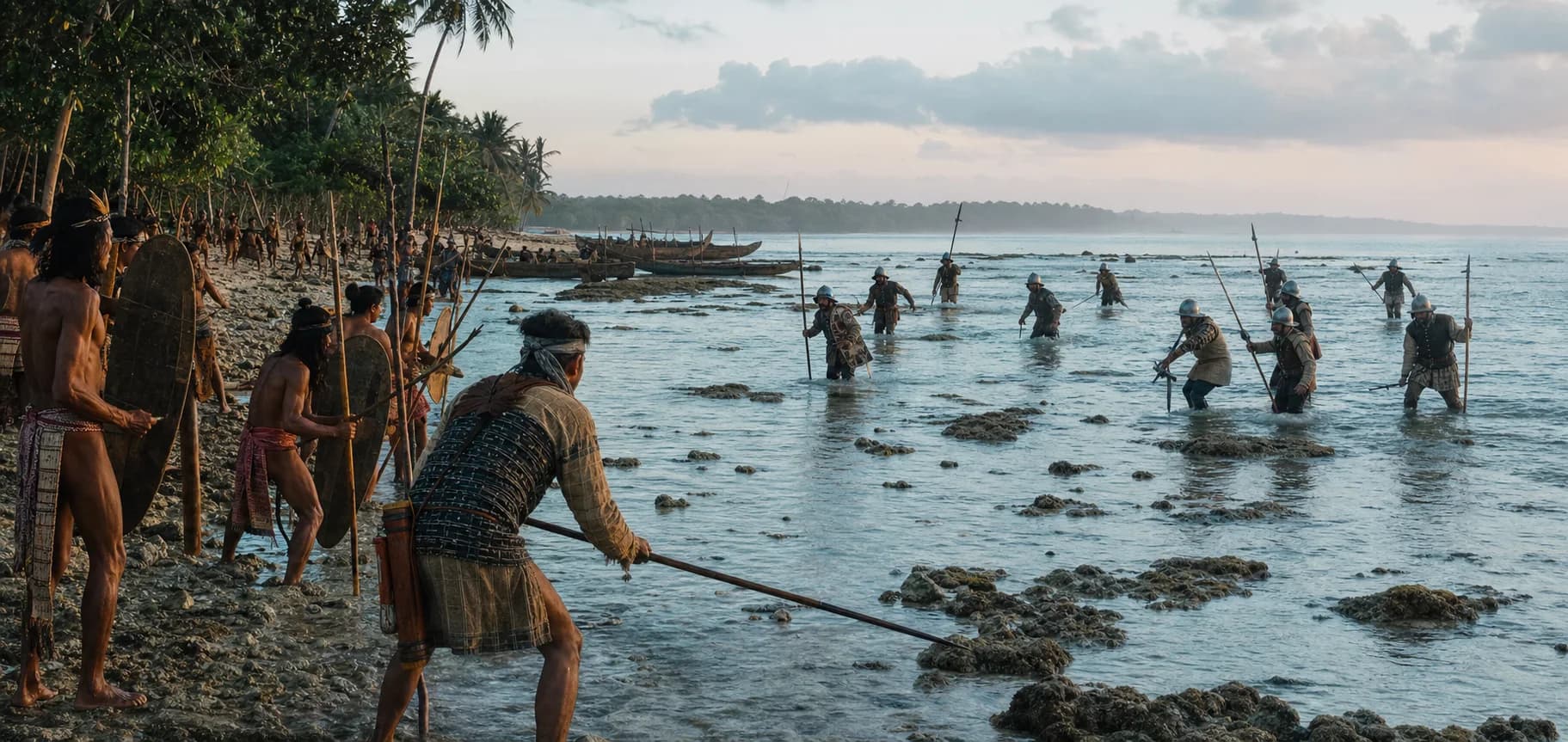
The reef separates the landing party from naval guns; wading distance, range, and retreat routes shape the tactical disadvantage.
LANGUAGE AND GLOBAL EXPERIENCE
Word lists and a missing day make the circuit more than a line on a map.
Pigafetta repeatedly asks for local words and records Patagonian, Philippine, and Malay vocabularies. The Yale manuscript even arranges word lists in two columns. Sounds filtered through Italian or French spelling, while questions often depended on gesture, translation, and unequal encounters. They are not transparent modern dictionaries, but they preserve traces of voices at contact.
The Malay-speaking interpreter Enrique made communication at Cebu possible. He had been carried from Southeast Asia to Europe and then sailed west back into the same language world, leading some to call him the first individual circumnavigator. Yet the text associates him with Sumatra; his birthplace, earlier route, and fate after Mactan remain uncertain. An attractive possibility is not a settled conclusion.
At Cape Verde, the crew learned that the local calendar stood one day ahead of their uninterrupted record. Pigafetta insisted that he had written every day and later understood that continued westward travel accumulated a twenty-four-hour discrepancy. A small calendar mismatch turned ‘circumnavigation’ from a royal geographic claim into something experienced through body, time, and writing.
MANUSCRIPT AFTERLIFE
The title, language, and paragraph you read depend on which witness you open.
Pigafetta probably prepared a dedication text around 1524, but no simple first publication date or language can describe its afterlife. A French abridgement appeared in the sixteenth century, and Ramusio translated French material back into Italian. Abridgement, sanitisation, and retranslation pushed some passages far from the lost original.
Nineteenth-century editions and translations by Amoretti, Andrea da Mosto, and Stanley restored the work to broad circulation but used different witnesses and editorial rules. Robertson’s 1906 edition printed the Ambrosiana Italian with English; Theodore J. Cachey Jr. offered a modern English entry point in 1995; Andrea Canova’s 1999 Italian critical edition is central to current scholarship.
The text has three layers: notes Pigafetta wrote at sea, the work fashioned after return, and versions established by modern editors from different witnesses. Early Italian spelling, French manuscript wording, and later English translations do not always align sentence by sentence; placement, omission, and tone can alter how the same event is understood.
EVIDENCE WATCH
Observation, narrative position, and corroboration
Shipboard procedure and witnessed detail
Signals, watches, food, illness, objects, words, and landings in which Pigafetta participated form the narrative’s most concrete observational layer.
Positions, headcounts, and leadership changes
Albo’s pilot book, rolls, accounts, and legal testimony help test coordinates, dates, numbers, and different definitions of survival.
Lapulapu’s identity and life
Pigafetta preserves a name, resistance, and actions in battle. Philippine traditions, colonial archives, and later memory supply separate layers for a fuller history.
Whether Enrique first completed an individual circuit
His birthplace and movements after Mactan are unknown. The documented route comes close to closure but does not confirm it.
READING WATCH · EDITIONS
Manuscript traditions and modern reading paths
Theodore J. Cachey Jr. · The First Voyage around the World
The preferred modern English entry point, with introduction, notes, and textual history. Read the complete narrative here before tracing individual manuscripts.
Andrea Canova · Relazione del primo viaggio attorno al mondo
A modern critical edition centred on the sole Italian manuscript tradition, useful for checking early Italian, variants, and editorial judgments.
James Alexander Robertson · Magellan’s Voyage Around the World
Ambrosiana text with facing English, notes, bibliography, and index. A public digital scan remains particularly useful for searching.
Lord Stanley · The First Voyage Round the World
A public-domain translation bundled with Albo and other contemporary documents. Its language and textual choices belong to a nineteenth-century context.
WATCH OFFICER'S QUESTIONS
Frequently asked questions about Pigafetta’s record
Who wrote The First Voyage Around the World?+
Antonio Pigafetta of Vicenza wrote it. He sailed first aboard Trinidad, later transferred to Victoria, and was one of the eighteen direct returners who completed the route in 1522.
Is Pigafetta’s work an official logbook?+
No. He kept daily notes aboard ship, but the surviving work is a post-return narrative made for patrons, with maps, vocabularies, and retrospective writing—not the crown’s or a pilot’s official journal.
Does Pigafetta’s original manuscript survive?+
Neither the working journal nor the early presentation copy survives. The main early witnesses are one Italian and three French manuscripts, with differences in wording and content.
Did Magellan complete the circumnavigation?+
No. He died at Mactan in 1521. Elcano commanded Victoria on the Indian Ocean and Cape route back to Spain, with Pigafetta aboard.
How many people completed the first circumnavigation?+
The familiar eighteen are those who returned directly to Sanlúcar aboard Victoria in 1522. Other men from Trinidad and Cape Verde returned by different paths, so any total of survivors needs a stated definition.
Is Pigafetta’s Mactan account reliable?+
He witnessed the battle, making its terrain, weapons, and retreat details crucial. He also revered Magellan and understood events through the expedition’s alliance. Observation and narrative position must be evaluated separately.
Was the voyage meant to prove that Earth is round?+
No. A spherical Earth was already accepted in learned European geography. The objective was a westward route to the spice islands and the trade and geopolitical rights attached to it; the completed circuit emerged from loss and route choices.
Why does Pigafetta barely mention Elcano?+
The reason cannot be proved. His book centres Magellan, to whom he was close. Leadership conflict, post-voyage memory politics, and literary selection may all matter, so Elcano’s letter and administrative records are necessary supplements.
SOURCE MANIFEST
What evidence supports this dossier?
- 01Relazione del primo viaggio intorno al mondo ↗
Italian Wikisource
Searchable early Italian text used to verify the original passages - 02Journal of Magellan’s Voyage · Beinecke MS 351 ↗
Library of Congress / World Digital Library
French illuminated manuscript of about 1525 with twenty-three maps - 03Beinecke MS 351 catalogue record ↗
Yale University Beinecke Library
Witnesses, physical description, maps, and provenance - 04First Voyage of Circumnavigation by Magellan and Elcano ↗
UNESCO Memory of the World
The expedition archive and its Memory of the World registration - 05The First Voyage Round the World, by Magellan ↗
Project Gutenberg / Hakluyt Society 1874
Stanley’s public-domain translation with contemporary documents - 06Magellan’s Voyage Around the World ↗
Biblioteca Nacional de Portugal · Robertson 1906
Ambrosiana Italian text, English translation, notes, and bibliography - 07Relazione del primo viaggio attorno al mondo ↗
Folger Shakespeare Library catalogue
Bibliographic record for Andrea Canova’s 1999 critical edition - 08A dialogue of sources: Francisco Albo vs. Antonio Pigafetta ↗
RiMe · Italian National Research Council
Comparison of the expedition’s two principal eyewitness records - 09Negotiating Empire: From Magellan to the Founding of Manila ↗
Library of Congress
Mactan, imperial demands, and Philippine documentary context
Original text, manuscript records, and modern research are listed separately; disputes over numbers, identity, and sequence identify both the counting rule and strength of evidence. Read our editorial and corrections policy