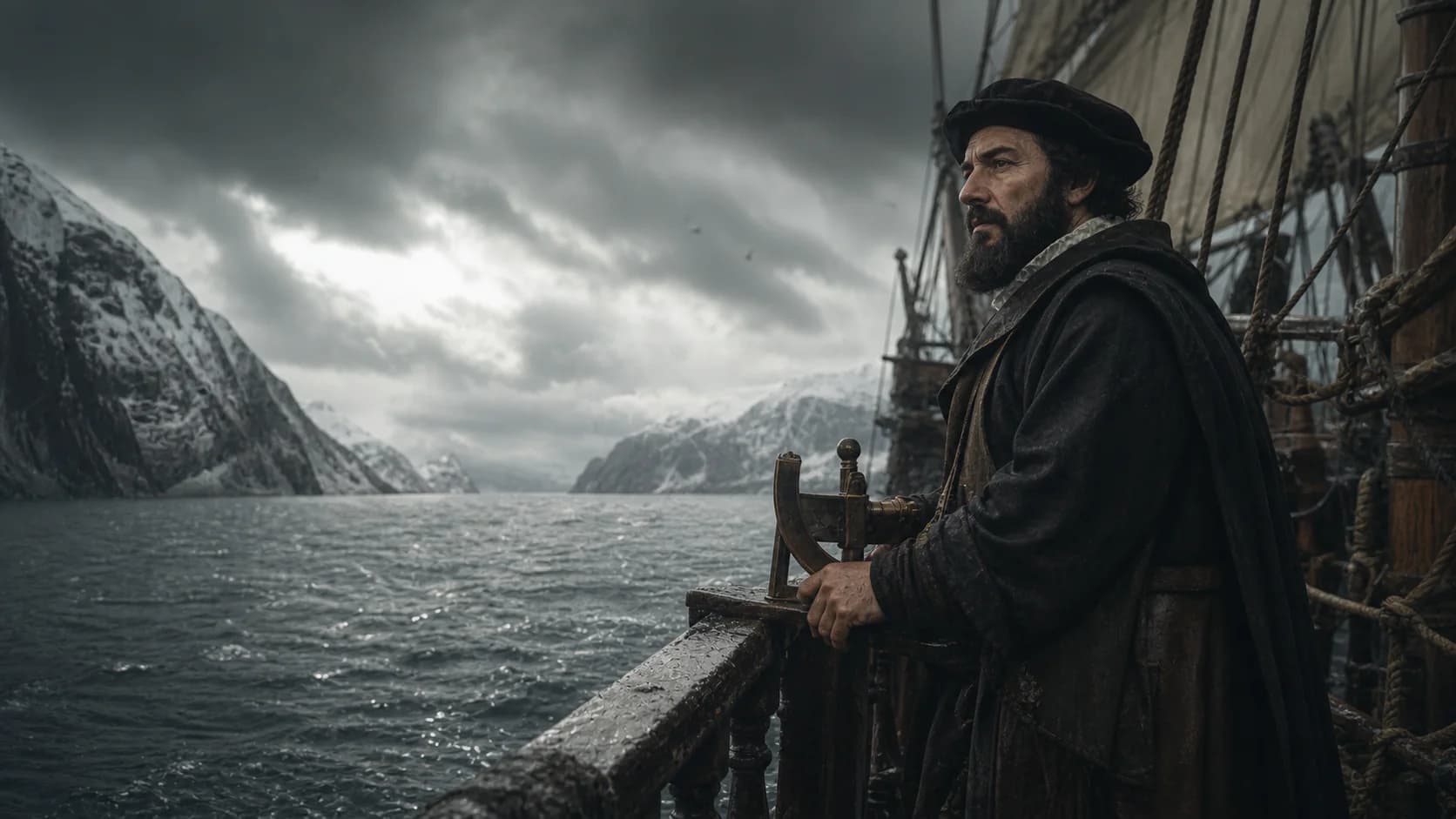
Opening portrait
Who was Ferdinand Magellan?
Ferdinand Magellan organized and commanded the Spanish expedition that sailed west in 1519 toward the Spice Islands. He led it through the South American strait and across the Pacific, but died in a conflict at Mactan in 1521. Magellan did not complete the circumnavigation. Juan Sebastián Elcano later commanded Victoria across the Indian Ocean and back to Spain in 1522.
- Expedition
- 1519—1522
- Ships at departure
- Five
- Strait crossing
- 1520
- Completed return
- Elcano and Victoria
Defining moment
1519–1522 · First circumnavigation
He never returned to the starting point, but the expedition he began closed the globe.
Five ships left Spain, found a narrow passage beyond the end of South America and crossed an ocean vast enough to keep them at sea for nearly four months. Magellan died at Mactan; Elcano brought Victoria home across the Indian Ocean. Three years after departure, east and west had finally joined in a single expedition.
Life at a glance
Ferdinand Magellan · career timeline
Key dates connect biography, expeditions and later consequences across a career longer than any one ‘discovery’.
- 01
Five ships sail west
The expedition leaves Spain seeking a western route to the Spice Islands.
- 02
The fleet passes the strait
After winter, mutiny and losses, three vessels emerge into the Pacific.
- 03
Magellan dies at Mactan
His intervention in Philippine politics ends in a failed attack and his death.
- 04
Elcano returns with Victoria
The surviving ship reaches Spain and closes the first recorded circumnavigation.
The life in sequence
Follow the voyage from its beginnings to its aftermath.
These chapters follow the order of a life and its expeditions, and are designed to be read as one continuous narrative.
The objective was a western route into the spice trade
Magellan proposed avoiding Portugal's eastern route by sailing west to the Moluccas. The fleet searched the South American coast, survived winter, mutiny and ship loss, and finally passed through the strait now bearing his name.
The Pacific beyond it was far wider than European planning allowed. Rotten food, scurvy and the absence of known supply turned the crossing into the expedition's longest trial.
Magellan died halfway around the route
In the Philippines, he entered regional politics on behalf of an ally at Cebu and led an attack at Mactan. Shallow water kept cannon support offshore; Magellan was killed as the landing force retreated.
Survivors continued to the Moluccas under changing leaders. Elcano then took Victoria across the Indian Ocean and around the Cape. The circumnavigation was an expeditionary relay, not Magellan's personal completed circuit.
Victoria returned with cloves—and accounts to settle
The cargo proved that spices could reach Spain by a westward outward route and a westward return. Crown, investors and sailors then argued over cargo value, wages, rewards and the expense of five ships reduced to one.
The cloves could not erase the human and material loss, but the voyage carried enormous strategic meaning. Spain now had evidence for contesting Portugal's claims around the Moluccas.
Beyond the voyage
Some histories come into focus outside the timeline.
Local societies, navigation, surviving records and later consequences each open a separate path into the story.
Records and evidence
How do the sources support these claims?
Confirmed facts, disputed questions and common misconceptions appear as distinct parts of the record.
Different commanders completed different halves
Magellan's party crossed the strait and Pacific; Elcano brought Victoria across the Indian Ocean to Spain after several changes of command.
The survivor total depends on definition
Eighteen completed the full route aboard Victoria; other expedition members survived detention or returned later by different paths.
The expedition did not originate a round Earth
Its distinctive evidence was a navigated global circuit and a drastic correction to European estimates of the Pacific.
Questions to carry forward
Common questions
Who completed the first circumnavigation?
Magellan led the strait and Pacific stages. After his death, Elcano and Victoria's surviving crew completed the return in 1522.
How long did it take?
The fleet left Spain in September 1519 and Victoria returned in September 1522—almost three years.
Did the voyage prove Earth was round?
A spherical Earth was already an established idea. The voyage completed a real global circuit and transformed European estimates of the Pacific's size.
Why did Magellan die at Mactan?
He intervened in a conflict between his Cebu ally and Lapulapu of Mactan. The attack failed, and he was killed during the retreat in April 1521.
Sources
Sources and further verification
The institutions below support the account; disputed numbers, place identifications and claims of ‘first discovery’ retain their uncertainty.
- First Voyage of Circumnavigation by Magellan and Elcano (1519–1522)UNESCO Memory of the World
- Ferdinand Magellan Interactive MapThe Mariners’ Museum and Park
- Today in History — November 28Library of Congress
- Research guide: Exploration and discoveryRoyal Museums Greenwich
Age of Seas editorial research distinguishes documentary facts, scholarly disputes and narrative judgments.Editorial standards and corrections ↗