In one minute
What did this event actually change?
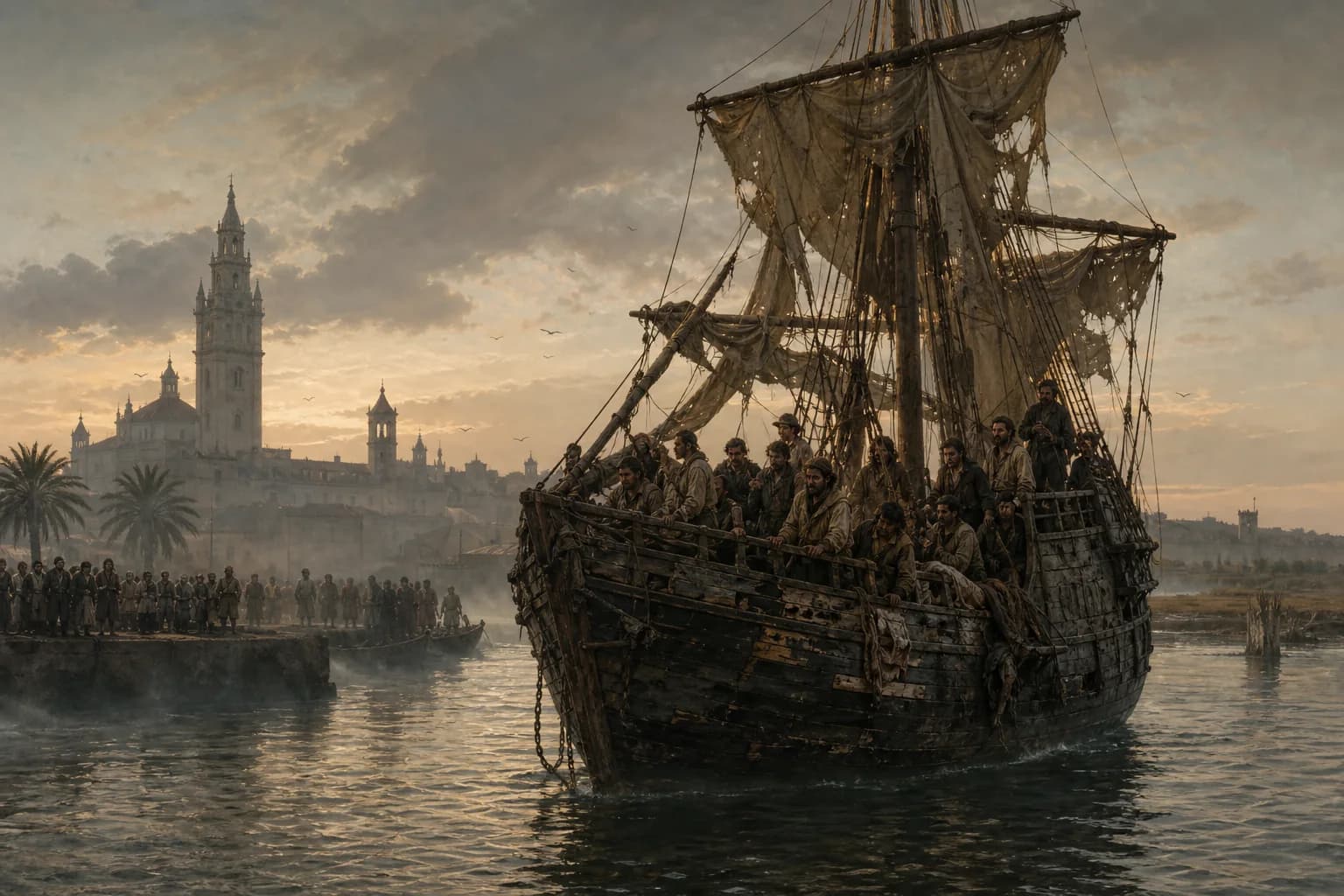
Five ships left Spain in 1519 seeking a westward route to the Spice Islands. They crossed the strait at South America's southern end in 1520 and then the unexpectedly vast Pacific. Ferdinand Magellan was killed after intervening in a war at Mactan in 1521, so he did not complete the circuit. Juan Sebastián Elcano commanded Victoria across the Indian Ocean and around the Cape, returning in 1522 with eighteen men who had sailed the full route aboard that ship.
- Expedition
- 1519—1522
- At departure
- Five ships and about 240 people
- Initial commander
- Ferdinand Magellan
- Returning commander and ship
- Juan Sebastián Elcano aboard Victoria
- Full-route returnees on Victoria
- Eighteen; other expedition members survived by different routes
Chronology
A process, not a single date
Causes, turning points and aftermath form one process, far larger than a capital’s fall, a signed treaty or a company’s founding date.
- 01
Five ships sail from Sanlúcar
They seek a westward path to the Moluccas and a Spanish claim within the unresolved Iberian division of the globe.
- 02
Mutiny breaks out at San Julián
Magellan suppresses resistance among officers during the winter; Santiago is later wrecked on reconnaissance.
- 03
The fleet passes through the strait
San Antonio deserts for Spain, while the remaining three ships emerge into an ocean far wider than expected.
- 04
The Pacific crossing becomes an ordeal
Food rots, scurvy spreads and people die as the fleet searches across the ocean for land and supplies.
- 05
Magellan is killed at Mactan
His attempt to defeat a ruler opposed to his Cebu ally ends in a failed landing and his death.
- 06
Victoria carries cloves westward
Elcano avoids Portuguese positions, rounds the Cape and returns to Spain, completing the circuit.
The expedition was not launched to prove Earth was round
Educated Europeans and mariners already widely accepted a spherical Earth. The commercial and political question was whether a passage through or around South America could reach the Moluccas from the west—and place their spices within Spain's claimed hemisphere.
What no one aboard understood accurately was the Pacific's width, the location of dependable supply or the difficulty of the southern passage. Circumnavigation emerged through survival and changing command, not as a classroom demonstration designed in advance.
Why do Magellan and Elcano share the story?
Magellan commanded the Atlantic voyage, found the strait and led the Pacific crossing. He died at Mactan before reaching the Moluccas and never sailed the homeward half.
Several leaders succeeded him before Elcano took Victoria west across the Indian Ocean. Sailors, pilots, the interpreter Enrique and people who provided information and food across the route all made continuation possible. The first circuit was a relay carried by an expedition, not one man's uninterrupted feat.
Mactan was not a random Indigenous attack
In the Philippines, Magellan allied with the ruler of Cebu, promoted conversion and demanded political submission. He then led a force against Lapulapu at Mactan. Shallow water kept the European ships and cannon too far offshore, and the landing party was overwhelmed.
The battle belonged to local politics into which the expedition deliberately inserted itself. Cebu and Mactan had their own alliances, rivalries and aims; the islands were not a passive stage awaiting European arrival.
What changed when Victoria returned?
The return made the world's connected oceans tangible through one continuous route and exposed the enormous scale of the Pacific. The crew's disagreement with the calendar after travelling west also dramatized a problem later handled by an international date line.
The route was not immediately a practical Spanish trade circuit. The Pacific crossing was punishing and Portugal contested the Cape passage. Its first importance lay in geographical experience and imperial rivalry; regular trans-Pacific commerce took a different route decades later.
Evidence boundary
Fact, interpretation and uncertainty
The evidence reveals where imperial claims diverged from reality and where heroic stories compressed complex wars.
Magellan began the expedition and Elcano completed its circuit
Pigafetta's account, logs and the documentary record establish the command changes and Victoria's return.
The famous eighteen are not all the expedition's survivors
Eighteen men arrived on Victoria in September 1522 after sailing the entire route. Other members, including some from Trinidad, returned later by different paths.
The voyage did not first prove a spherical Earth
That idea was ancient and broadly accepted. The expedition's achievement was physically completing a global circuit and revealing the Pacific's scale.
Questions
Common questions
Did Magellan circumnavigate the world?
Not on this expedition. He died at Mactan in 1521. Elcano and Victoria's surviving crew completed the route to Spain.
Why did only one ship return by the full route?
The others deserted, wrecked, were abandoned or fell into Portuguese hands. Death and the shortage of crew also forced consolidation.
Why did Lapulapu fight Magellan?
Magellan entered a regional alliance and tried to coerce a ruler who rejected the authority of Cebu's leader and Spain. The Europeans initiated the landing attack.
What did the voyage prove?
It completed a continuous ocean journey around the globe and gave direct evidence of the Pacific's vast width. It did not originate the concept of a round Earth.
Sources
Sources and further verification
Archives, museums, international organizations and academic publications support the facts and interpretive limits in this account.
- First Voyage of Circumnavigation by Magellan and ElcanoUNESCO Memory of the World
- Journal of Magellan’s VoyageLibrary of Congress
- Today in History: Crossing the PacificLibrary of Congress
- Ferdinand Magellan Interactive MapThe Mariners’ Museum and Park
Age of Seas editorial research distinguishes verifiable facts, historical interpretation and potentially misleading simplifications.Editorial standards and corrections ↗