Voyage and scale index ↓
Four-part abstract
The book keeps moving the observer until the traveller can no longer see himself.
Gulliver’s Travels appeared anonymously in 1726, presented by its full title as the four-part travel account of Lemuel Gulliver, first a ship’s surgeon and later a captain. Lilliput turns him into a giant resource managed by the state. Brobdingnag reduces European war, politics, and the human body to repellent small things. Laputa and its neighbouring lands test the separation of abstract knowledge, government, and material labour. The country of the Houyhnhnms places rational horses, Yahoos, and Europeans inside an increasingly dangerous act of classification. Dates, latitude, ships, money, measurement, language learning, and return routes sustain a documentary surface while the narrator gradually loses the ability to judge himself. The book is a parody of travel writing and a satire on politics, science, empire, and human self-regard. Adaptations for children often preserve the scale adventures of the first two parts while cutting the sharpest material in Parts III and IV.
Original passages
Six passages show documentary voice producing belief—and belief damaging the narrator.
- 01Documentary shellPart I, chapter 1
My father now and then sending me small sums of money, I laid them out in learning navigation, and other parts of the mathematics, useful to those who intend to travel.
Chart-room readingProfessional training comes before wonder: Gulliver gives readers the practical education expected of a surgeon who means to sail.
Cambridge, apprenticeship, Leiden, wages, marriage, and named ships establish a credible career before an impossible country appears. - 02Scale and rulePart I, chapter 1
I perceived it to be a human creature not six inches high, with a bow and arrow in his hands, and a quiver at his back.
Chart-room readingSix inches converts astonishment into a measurement, after which ropes, provisions, transport, and offices make scale a problem of government.
The first Lilliputian is both tiny person and armed official; bodily difference enters administration immediately. - 03Europe reflectedPart II, chapter 6
I cannot but conclude the bulk of your natives to be the most pernicious race of little odious vermin that nature ever suffered to crawl upon the surface of the earth.
Chart-room readingAfter hearing of gunpowder, war, parties, and institutions, the king returns European self-praise as a verdict upon destructive small creatures.
The judgment belongs to the King of Brobdingnag, while Gulliver’s wounded pride keeps the satirical distance visible. - 04Cartographic authorityPart II, chapter 4
They ought to correct their maps and charts, by joining this vast tract of land to the north-west parts of America, wherein I shall be ready to lend them my assistance.
Chart-room readingAn invented continent is fitted between Japan, California, and Tartary; the confident offer of correction exposes how a traveller manufactures authority.
Real geography and imaginary land share one sentence, just as the engraved maps make fiction look surveyable. - 05Project and experimentPart III, chapter 5
There was a most ingenious architect, who had contrived a new method for building houses, by beginning at the roof, and working downward to the foundation.
Chart-room readingThe Academy of Lagado makes procedural inversion sound like expertise, while unfinished buildings transfer the joke into material cost.
Swift also respects practical knowledge; the target is a project protected from testing and consequence, not every experiment. - 06The traveller’s oathPart IV, chapter 12
A traveller’s chief aim should be to make men wiser and better, and to improve their minds by the bad, as well as good, example of what they deliver concerning foreign places.
Chart-room readingThe principle sounds exemplary, but it is spoken after Gulliver’s severe alienation, keeping truthfulness and failed self-knowledge in the same frame.
The final chapter turns the travel book’s claim to moral usefulness into one last test of its narrator.
Fictional time × publication time
Sixteen years and seven months of invented travel enter three centuries of transmission.
- 01
Voyage I · Lilliput
After the Antelope is wrecked, Gulliver wakes in Lilliput; the giant body becomes provision, weapon, infrastructure, and political liability before he escapes through Blefuscu.
- 02
Voyage II · Brobdingnag
The Adventure carries him to a land of giants; farm exhibition, court dialogue, and a box at sea reduce the European to specimen and subject of judgment.
- 03
Voyage III · Laputa and beyond
After a pirate attack he passes through the flying island, Balnibarbi, Glubbdubdrib, Luggnagg, and Japan; knowledge, history, immortality, and imperial rule come under review.
- 04
Voyage IV · the Houyhnhnms
Mutineers maroon their captain. Gulliver learns the Houyhnhnm language and accepts the Yahoo classification, returning unable to resume ordinary life with his family.
- 05
Swift forms the manuscript
Composition is generally placed across these years, although no surviving manuscript settles a precise opening date or sequence for every part.
- 06
Friends carry the manuscript into print
Publication intermediaries kept Swift at a distance from Benjamin Motte, extending Gulliver’s apparent authorship beyond the narrative.
- 07
The London first edition appears
Two anonymous volumes name Lemuel Gulliver, accompanied by his portrait and four maps. Further impressions followed rapidly within the year.
- 08
A Dublin edition claims corrections
J. Hyde’s title page already makes textual rivalry part of the book’s identity, while published answers show readers decoding its satire at once.
- 09
Gulliver writes to his cousin Sympson
The fictional author complains that the printer corrupted dates, spelling, and meaning. Later editions place this letter before the work and deepen its editorial masquerade.
- 10
Faulkner’s Works of Swift
The Dublin text restores and revises material found differently in 1726; modern editors treat it as a major witness to Swift’s revisions, with qualifications.
- 11
Abridgement and children’s publishing
Scale adventure, illustration, and simplified prose broaden the readership. Political, bodily, and Houyhnhnm material is often cut, creating a second transmission history.
- 12
Bibliography rebuilds the text
Harold Williams, the Teerink–Scouten system, and modern Cambridge and Oxford editions continue to compare Motte impressions, Faulkner, and evidence of authorial correction.
Four parts · thirty-nine chapters
The contents are an instrument: body, knowledge, and species position recalibrate every eight to twelve chapters.
PART 01
Part I · Lilliput
When the body expands, force, provisioning, office, and war become measurable political engineering.- 01
Wreck and six-inch inhabitants
Antelope, latitude, landing, ropes, and first language contact
- 02
Transporting a giant
Machines, food budget, capital, and temporary lodging
- 03
Rope dancing and office
Promotion, high and low heels, and political scale
- 04
Inventory of the capital
Urban measurement, palace access, and imperial conversation
- 05
Taking the enemy fleet
Blefuscu, the channel, and refusal of total conquest
- 06
Institutions explained
Law, education, marriage, and the fiscal cost of Gulliver
- 07
Impeachment and flight
Palace fire, intelligence, blinding sentence, and asylum
- 08
Returning to England
The recovered boat, specimens, and first homecoming
PART 02
Part II · Brobdingnag
When the body contracts, European civilization, heroic narrative, and skin itself enter close inspection.- 09
Giants in the corn
Adventure, landing, reapers, and reversed scale
- 10
A farmer’s exhibit
Glumdalclitch, touring display, and bodily exhaustion
- 11
Entering the palace
The queen’s purchase, learned examination, and a fitted room
- 12
Country and map
Geography, roads, cities, and an erroneous world
- 13
Dangers of the small
Wasps, dwarf, apples, and environmental risk
- 14
Explaining Europe to the king
Parliament, war, gunpowder, and the vermin verdict
- 15
Knowledge and government
Education, law, army, and deliberately simple institutions
- 16
A box at sea
Eagle, floating room, British sailors, and restored scale
PART 03
Part III · Flying island and archive
Abstract knowledge, projects, summoned history, and immortality form a route through failed understanding.- 17
Pirates and the flying island
Hopewell, a castaway boat, and rescue from the air
- 18
The flappers
Mathematics, music, attention, and conversation
- 19
The magnetic state
Flight mechanics, jurisdiction, and aerial coercion
- 20
Down to Balnibarbi
Munosdi, ruined improvement, and the old estate
- 21
Lagado Academy I
Sunbeams, excrement, and roof-first architecture
- 22
Lagado Academy II
The writing engine, object-language, and political schemes
- 23
Glubbdubdrib
Necromancy, ancient figures, and testimony from history
- 24
History backstage
Genealogy, physicians, and a rewritten past
- 25
Luggnagg
Court ritual, reception, and the route to Japan
- 26
The immortals
Struldbrugs and ageing without an end
- 27
Home by way of Japan
Edo, Dutch identity, and the bridge to real geography
PART 04
Part IV · Houyhnhnm and Yahoo
The last part turns the instrument of observation upon species, language, colonialism, and the narrator.- 28
Mutiny and marooning
A captain loses his ship, lands, and meets the Yahoos
- 29
Inside a Houyhnhnm house
Horse order, food, and taxonomic confusion
- 30
Learning the language
Naming, imitation, and Gulliver’s account of himself
- 31
Explaining falsehood
Saying the thing that is not and European habits of knowledge
- 32
An account of war
Dynasty, religion, commerce, and reasons for killing
- 33
Law and money
Lawyers, doctors, wealth, and social appetite
- 34
Observing Yahoos
Body, possession, filth, and projection
- 35
Houyhnhnm institutions
Education, pairing, death, and rational order
- 36
The assembly decides
The Yahoo problem, colonial proposal, and banishment
- 37
Leaving by canoe
Making, farewell, and search for solitude
- 38
Pedro de Mendez
A Portuguese captain’s kindness and Gulliver’s refusal
- 39
Home and the colonial ending
Family, stable, traveller’s oath, and Crown claims
The travel-book machine
Ships, dates, latitude, and a surgical career give fiction the shape of testimony.
The book opens with a career rather than a fairy-tale summons: Cambridge education, a London surgeon’s apprenticeship, medical study at Leiden, Mediterranean and East and West Indies voyages, marriage money, and a failing practice. Navigation, mathematics, and medicine make Gulliver the useful travelling professional recognized by the contemporary book market.
Each part continues with ship and captain names, dates, storms, bearings, latitude, currencies, measurement, and a route home. Invented countries sit near Van Diemen’s Land, Japan, California, and the Cape. Engraved maps make blank ocean look locatable. These details reproduce the methods by which voyage books solicited belief.
The narrator repeatedly promises plain style, accuracy, and eyewitness truth. Numbers make impossibility sound factual: six-inch inhabitants, twelvefold bodies, a magnetic flying island. The book uses travel writing’s language of evidence while testing whether seeing something can ever guarantee understanding it.
Four experiments in scale
Gulliver’s body is repeatedly recalculated, and political judgment moves with the observer.
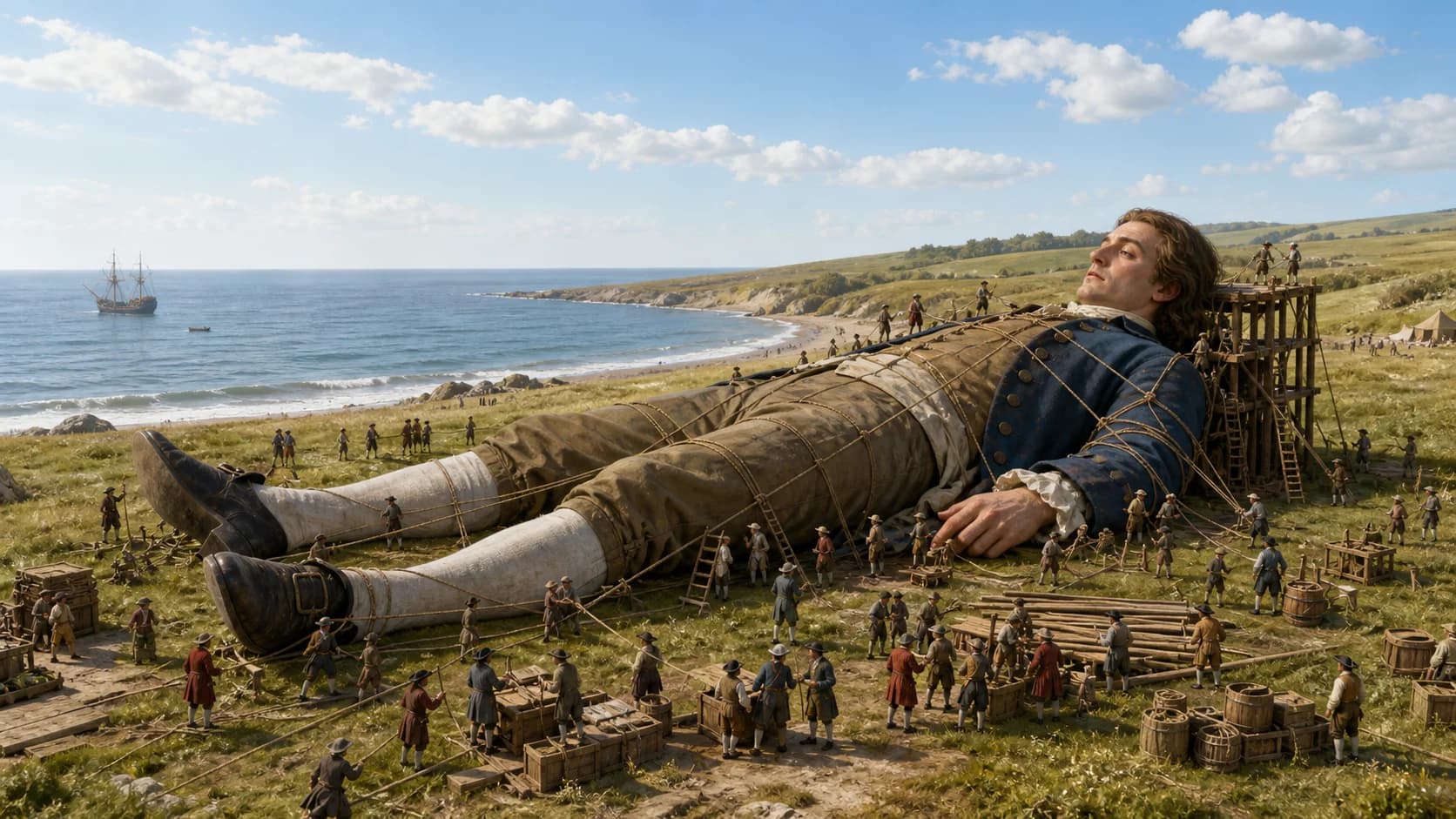
In Lilliput he can tow a fleet and extinguish a palace fire, while an entire state must calculate his food and transport. The huge body is weapon, infrastructure, budget, and diplomatic risk at once. Wonder becomes contract, ration, command, and flight almost immediately.
Brobdingnag reverses the instrument. Gulliver moves through a farmer’s display box and the queen’s fitted chamber; wasp, monkey, rat, and bowl of cream become hazards. His proud account of Britain and gunpowder sounds to the king like a small creature’s history of destruction.
Parts III and IV shift proportion from body to knowledge and species. The flying island controls land from above; projectors lose contact with labour; Houyhnhnms classify humans as Yahoos, and Gulliver absorbs the scheme. Height and distance no longer guarantee judgment.
Knowledge and labour
Laputa hangs over the fields: abstract schemes and material life occupy different heights.
Laputans master mathematics and music but need flappers to call their senses back to conversation and roads. A magnetic mechanism moves the island, which can withhold rain and sunlight or crush resistance. Knowledge appears as cognitive habit, engineering, and state force together.
Balnibarbi supplies the ground-level comparison. Projectors chase sunbeams from cucumbers and houses built downward from roofs while town and field decay; Munodi’s unfashionable estate remains productive. Repeatable result, maintenance, and the labouring consequence take priority over the prestige of a scheme.
The Academy has long been read as an attack on the Royal Society. Recent scholarship sharpens the distinction: the book mocks speculation insulated from testing while using mathematical, medical, and engineering language with control. Its persistent question is how knowledge claims authority and who pays for failure.
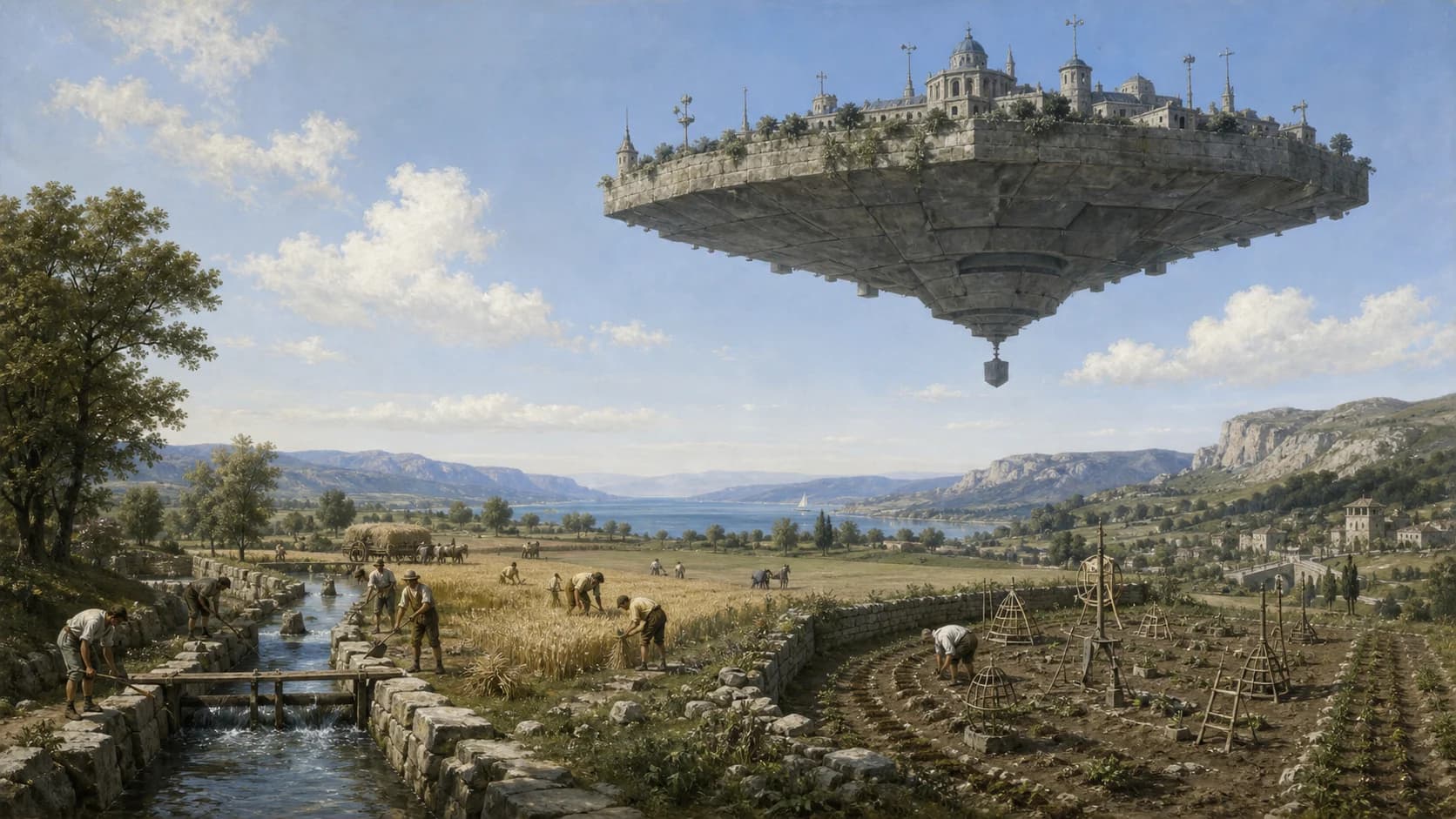
The flying island controls height and magnet; the ground carries irrigation, harvest, and the cost of failed projects. Power and labour occupy different levels.
Empire and colony
The last chapter joins discovery, mapping, possession, and conquest in one maritime procedure.
Every voyage crosses a contact zone. Gulliver offers military service, carries specimens home, explains European trade and war, and tries to place strange lands on British maps. Observation and naming can produce knowledge, but they can also prepare possession.
At the end he is reminded that lands discovered by an English subject belong to the Crown. Gulliver invokes Cortés in the Americas, then estimates the conquest cost of all four countries. A passage shaped like legal and military advice exposes the proprietary logic built into many voyage narratives.
He finally advises against invasion, yet his reasons depend partly on force and resistance rather than a stable principle of equality. The anti-imperial pressure remains productive and incomplete: European superiority collapses, while foreign societies continue to serve as satirical instruments.
The narrator breaks
The fourth homecoming does not restore normal scale; Gulliver brings the satire into his house.
After earlier returns he soon sails again; leaving Brobdingnag, he even mistakes ordinary British sailors for pygmies. The body must recalibrate. The Houyhnhnm country cuts deeper because Gulliver adopts a taxonomy that names himself, his crew, and his family as Yahoos.
Pedro de Mendez counters this total judgment with patience, food, clothing, shelter, and safe passage. Concrete human kindness stands directly before Gulliver, yet he can process it only as the conduct of an animal with a small portion of reason. His system no longer receives evidence that contradicts it.
At home he recoils from his wife and children and spends hours speaking to horses. The final oath of travel truth therefore carries two voices: it defends experience and honesty, and it comes from a man without self-knowledge. No foreign country survives as a simple model ready to copy.
Complete text and children’s versions
Lilliput became the global emblem; the complete four-part book remains far sharper than a scale adventure.
Ropes across a giant body, palm-sized people, and the giants of Brobdingnag readily became illustration, theatre, and children’s adaptation. Publishers simplified language and cut political allusion, bodily detail, and much of the final two parts, producing a powerful second life for the work.
Abridgement changes structure as well as length. Without Laputa, readers lose the relation among knowledge, government, and labour. Without the Houyhnhnms, Gulliver does not break on returning home. The first two parts make a satisfying adventure; all four disclose the narrator’s movement from credible professional to dangerous judge.
When choosing an edition, check for four parts and thirty-nine chapters, then identify whether it follows Motte’s 1726 print, Faulkner’s 1735 text, or a modern composite. Children’s adaptations have their own purposes; textual study needs explicit notice of cuts, modernized spelling, and illustration.
Evidence limits
Routes, editions, political allusion, and narrative voice require different evidence.
The voyages carry continuous dates but no historical expedition
Real seas and ports provide a coordinate frame for invented lands. The route can be reconstructed as fiction, not used as evidence of an unrecorded discovery.
Motte 1726 and Faulkner 1735 both enter modern texts
Bookseller intervention, authorial correction, and later editing remain bibliographical questions. A political quotation should identify its edition.
Characters rarely remain one-to-one political ciphers
Lilliput can recall British party politics, yet a person, ritual, or institution may compress several targets. Mechanical decoding reduces the book’s reach.
Gulliver’s conclusion is not automatically Swift’s judgment
Part IV depends upon this distance. The narrator’s disgust, pride, and failed self-perception are themselves evidence presented by the work.
Reading editions
Complete text, first-edition transcription, and modern critical editions answer different questions.
Oxford World’s Classics · Claude Rawson / Ian Higgins
An unabridged annotated entry with substantial historical framing. Check the imprint and textual note when selecting a particular reissue.
Cambridge Edition · David Womersley
A modern scholarly edition for textual work, extensive annotation, and the place of Gulliver’s Travels within Swift’s writings.
University of Virginia · Motte first edition
Transcription, page images, and an editorial statement make this a useful route into first-publication form and disputed passages.
Project Gutenberg · eBook 829
Convenient for search and continuous reading across all four parts, with the later Gulliver-to-Sympson letter; identify the base text for formal citation.
Reader questions
Author, four countries, Lilliput, Houyhnhnms, children’s versions, and editions.
Who wrote Gulliver’s Travels?+
Jonathan Swift wrote it. The 1726 first edition was anonymous and presented Lemuel Gulliver, first a surgeon and then a captain, as the author. That publishing fiction extends the documentary game outside the narrative.
What is Gulliver’s Travels about?+
Gulliver visits Lilliput, Brobdingnag, Laputa and neighbouring lands, and the country of the Houyhnhnms. Changes of scale, knowledge, and species position satirize politics, war, scientific authority, empire, and human self-understanding.
How many voyages and countries are in Gulliver’s Travels?+
The book has four parts and four voyages. Part III crosses several places—Laputa, Balnibarbi, Glubbdubdrib, Luggnagg, and Japan—so its number of destinations is greater than four.
What are the small and giant countries called?+
They are Lilliput and Brobdingnag. Spelling varies in early textual history—Gulliver’s later letter even complains about Brobdingnag—and transliterations vary across languages.
Is Gulliver’s Travels a children’s book?+
The complete 1726 work belongs to adult satirical culture. Scale adventures soon entered children’s publishing through illustration and abridgement; that branch is historically important but does not replace the four-part text.
What are Houyhnhnms and Yahoos?+
Houyhnhnms are horse-shaped beings who organize life around their account of reason and order. Yahoos are human-shaped creatures associated with appetite and filth. Gulliver’s extreme acceptance of that taxonomy is part of the satire.
Does Laputa only satirize the Royal Society?+
The Academy episodes participate in debate around experimental and project culture and have often been linked to the Royal Society. Their field also includes abstract mathematics, state power, speculative projects, practical test, and labour.
Should I read the 1726 or 1735 text?+
Motte’s 1726 edition preserves first-publication form; Faulkner’s 1735 text carries important revisions. A modern unabridged edition should state how it chooses or collates them. Check both when the exact wording matters.
Research sources
First print, bibliography, travel satire, science, empire, and map scholarship calibrate the work together.
- 01Gulliver’s Travels · eBook 829 ↗
Project Gutenberg
Searchable full text, four-part structure, chapter sequence, and narrative dates - 02Travels into Several Remote Nations of the World · 1726 ↗
University of Virginia Library
Digital transcription, page images, and editorial statement for Benjamin Motte’s first edition - 03Jonathan Swift · Gulliver’s Travels · First Edition ↗
Folger Shakespeare Library
Collection record and overview of the 1726 first edition and its interpretive range - 04Travels into several remote nations of the world · Dublin 1726 ↗
Folger Library Catalogue
Bibliographic record for J. Hyde’s two-volume Dublin edition, portrait, and maps - 05An Introduction to Gulliver’s Travels ↗
Jonathan Swift Archive
Faulkner 1735, the 1727 corrections list, and intervention in the published text - 06The ‘1735’ Faulkner Edition of Swift’s Works ↗
The Library · Oxford Academic
Modern bibliographical assessment of Faulkner’s authority and its limits - 07Swift, Gulliver, and Travel Satire ↗
Oxford Handbook of Eighteenth-Century Satire
The travel-writing tradition, the charge that travellers lie, and generic collapse - 08Science, Empire, and Observation ↗
Cambridge University Press
Observation, scientific authority, contact zones, and imperial superiority - 09The Text of Gulliver’s Travels ↗
Cambridge University Press
Harold Williams on Motte impressions, Faulkner, and the bibliographical problem - 10Who wrote Gulliver’s Travels? ↗
Oxford University Press
Anonymous publication, friendly intermediaries, authorial masquerade, and the date 28 October 1726 - 11How to Do Narratives with Maps? ↗
Old Dominion University
Research on fictional maps, narrative space, and cartography as an act
Research and image assets updated 2026-08-26. Read our editorial and citation standards