INPUT
→Read specification and allocate iron
Confirm type, target weight, pattern, bar quality and stock interface.
A real Age of Sail career dossier · 31
Anchor Smith · Anchorsmith · Master Anchor Smith
The specialist who turned many wrought-iron bars and many people's blows into one trusted anchor.
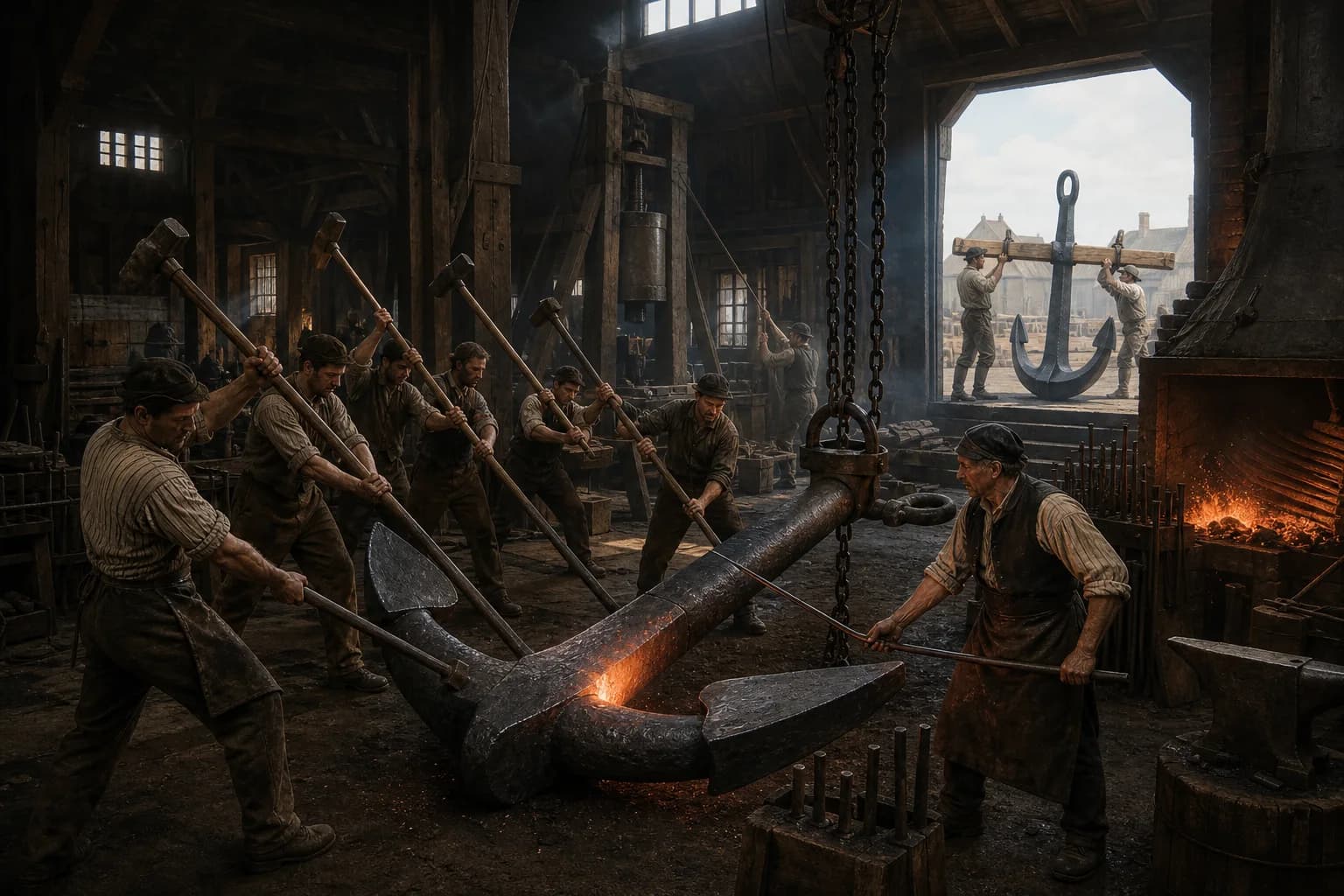
An anchor smith was a heavy-iron specialist who organized the forging gang that made and repaired ships' anchors. A traditional stock anchor was not poured whole into a mould. Its shank was built from many bars of tough wrought iron heated, bundled and forge-welded; arms, palms or flukes and ring were formed separately and joined at scarf welds. A stock of two oak beams was fitted by woodworkers with bolts, treenails and iron hoops transverse to the arms. The Master Anchor Smith translated vessel, anchor type and prescribed weight into the proportions of trend, shank, arms, throat, bills and ring, then controlled heats, turning, lifting, hammer rhythm and inspection. A general ship smith made a much wider range of smaller fittings, a cable smith specialized in the iron chains that expanded during the nineteenth century, and a cannon founder melted and cast ordnance. Organization varied, so this page concentrates on European and North American evidence from the late seventeenth to the first half of the nineteenth century.
Information arrives, judgment forms, and work passes on through a complete watch.
Confirm type, target weight, pattern, bar quality and stock interface.
Make shank pile, arms, palms and ring separately while preserving the correct scarfs.
Synchronize hearth, tackle, turning and blows to join palms, arms, crown and ring.
Remove scale, weigh, verify geometry and welds, and match wooden stock and cable interface.
Relied on sledge rhythm, chains, levers and falling weights such as Hercules and Monkey for great welds.
Used blowing engines, tilt hammers, lifting plant and divided stations for heat, impact and output.
Examined throat, palm, ring and bending, then chose local scarf repair, reforging or condemnation.
Bring the core of a bar pile to welding heat and consolidate it before the useful heat vanished.
Translate weight and pattern into trend, shank, arms, palms, ring and stock interfaces.
Sequence hearth, lifting, turning, strikers and powered hammer with safe positions.
Use surface, note, deformation, cooling cracks and service damage to judge repairable and fatal welds.
Institutions, experience, patronage, and opportunity shaped each person’s route.
Learn position, fuel, handling, hammer rhythm and fire reading.
Complete rings, hoops, small scarfs and kedge components.
Own arm, palm and shank heats and direct a hammer gang.
Control pattern, material contract, gangs, machines, acceptance and casualty liability.
An anchor concentrated a ship's safety into a few massive welds. An 1820 U.S. naval-yard return counted anchor smiths separately from blacksmiths and from cable and caboose smiths. Ship smiths made bolts, nails, straps, hoops, pintles, gudgeons and general fittings; founders poured molten metal; anchor smiths specialized in heating, piling, forge-welding and setting great wrought-iron masses.
A small port master blacksmith might accept anchors and miscellaneous repairs, while one company might own anchor, chain-cable and foundry departments. The meaningful boundary lies in process, plant, gang organization and liability, not an identical job title in every harbour.
Late-eighteenth-century British sources distinguished sheet, best bower and small bower anchors, smaller stream and kedge anchors, and boat grapnels. Names, complements and weights changed with navy, merchant rule, tonnage and date, but the master needed a target weight and pattern before calculating bars, heats, weld stages and gang size.
Steel used the trend as a governing dimension: arm length from throat to bill was transferred to the shank, from which shank and ring positions followed. Shank, square, eye, crown, throat, arm, palm or fluke, bill, ring and stock were not antiquarian vocabulary; they were the interfaces by which the anchor connected to cable, turned and entered the ground.
Steel specified many long bars of the best tough iron, well wrought together. The shop selected material neither too soft nor brittle, cleaned and assembled bars, held the pile, then heated and welded it section by section. Increasing mass restricted how much could be heated evenly and struck before cooling.
Wrought iron already carried slag stringers, and a built-up shank added deliberate weld interfaces. A cold shut or unwelded core followed insufficient heat; overheating burnt the surface; blows that consolidated only the skin could hide a weak centre. The master read colour, sparks, surface flow, hammer note and deformation, supported by continuity between heats rather than colour alone.
No lone smith held a great shank at a cottage anvil. Collar and chain carried work between hearth and anvil; porter, cross-bars and twining irons gave turning leverage; the foreman called position and rhythm while hammermen alternated long-handled sledges. A mistimed stroke endangered tools, chains and neighbours.
Steel called anchor-making a most laborious employment and described Hercules and Monkey machines: an approximately 400-pound falling weight for straightening shanks and welding palms and arms, and a roughly 200-pound horizontal suspended ram for setting arms. Woolwich's 1814–16 anchor forge used three steam engines for blowing and five tilt hammers. Power increased heat and impact without removing the master's decisions about sequence, placement and weld state.
Each arm was built from shorter high-quality bars and tapered from throat toward bill. Thick triangular palms were themselves wrought from several pieces and shut onto seats in the arms. The two arm scarfs then met the shank scarf around the crown. Arm angle, palm area, bill and crown determined how the anchor turned, penetrated ground and returned cable load to the shank.
A circa-1750 Admiralty Pattern anchor at Royal Museums Greenwich has a pointed crown and sharp arm-shank angle associated with the early form; the museum notes that such anchors frequently failed at the throat and returned for repair. Later improvement sought holding power and a less destructive transition as well as nominal weight. Geometry and weld quality therefore matter more than a simple 'heavier anchor' statistic.
The ring was forged separately, passed through a punched eye at the shank head, and welded closed. Rounded eye edges reduced damage as the ring moved. A rope or chain department attached the cable, so section, diameter, weld and freedom all had to satisfy downstream use. Iron chain expanded in the nineteenth century; hemp cable remains the correct default for many earlier settings.
A conventional wooden stock comprised two tapered oak beams around the shank, secured by bolts, treenails and four iron hoops, transverse to the palms. The anchor smith supplied nuts, hoops, bolts and dimensions while shipwrights, carpenters or specialist woodworkers prepared timber. The stock rolled the landed anchor so one fluke could bite; it was not an iron crossbar cast in one pour with the body.
After scale removal, inspectors checked shank straightness, matching arm shape and angle, fair palms, ring eye, stock nuts and prescribed weight, while searching scarfs for openings, hollows, abnormal note and cooling cracks. Steel's demand that work be smooth, fair and even was functional: regular surfaces exposed uneven deformation and ugly weld closure.
The statutory proving regime of the later nineteenth century cannot be projected onto every 1700 workshop. Comparative trials, proof machines, strain tables and certificates grew during the nineteenth century; circa-1830 trade cards in the Science Museum archive advertised anchor and chain weights and even testing machines. Earlier acceptance mixed specification, supervised process, weight, visual or sounding inspection, sampling and service feedback.
Strong blast and fuel drove scale and sparks through the smithery while sledges, lifting chains, drop weights, levers and tons of iron converged on one station. Burns, fumes, hearing damage, detached hammer heads, failed tackle, rolling work, crushing and fatigue-induced mistiming were routine hazards. Large floor-set capstans recorded at Devonport show the fixed mechanical advantage needed to bend and position heavy iron.
Quality risk travelled farther. One omitted heat, a shortened soak before the tide, or doubtful iron added to reach weight could pass out of the gate and break in a gale. A responsible shop tracked iron batch, heat sequence, hammer gang, final weight and rework; the master protected the workforce and resisted schedule pressure from owner, yard or fleet.
Entry might be smith's labourer, bellows hand, striker or blacksmith apprentice. A worker learned rhythm, handling, fire reading and small scarf work before palms, rings, arm sections and small kedges. Planning the bar pile, weld order, hammer positions and lifting scheme, then accepting the result, marked foreman or master responsibility.
Steam blowing, tilt hammers, rolled iron and the chain-cable industry moved the trade toward large factories in the nineteenth century; titles could become foreman forger, anchor manufacturer or heavy smith. The older knowledge persisted: getting the centre of a huge section to proper heat, controlling deformation and judging weld closure remained heavy-forging decisions.
career.anchor-smith
An anchor smith was a heavy wrought-iron specialist who assembled bars, controlled heats and forge welds, directed lifting and hammer crews, shaped the anchor and accepted or repaired critical joints.
A typical eighteenth-century wrought-iron stock anchor was not. Shank, arms, palms and ring were built separately from bars or plates and joined by forge welding.
A ship smith made broad ranges of bolts, straps, hoops and hinges. The anchor smith specialized in anchor proportion, massive handling, gang welding and its safety liability, though small shops could combine work.
Some firms operated both departments, but cable or chain smithing could be a separate trade. Iron cable expanded chiefly in the nineteenth century; earlier anchors commonly used hemp cable.
Mounted transverse to the arms, it rolled an anchor on the bottom so one fluke pointed down and could penetrate. It was commonly two oak beams secured by bolts, treenails and iron hoops.
Risks included incomplete welding within piled iron, the arm-shank throat and crown, palm joints and ring weld, compounded by soft, brittle or overheated iron and asymmetric geometry.