INPUT
→Define form
Reconcile mission, dimensions, draught, rule or model with stability and capacity constraints.
A real Age of Sail career dossier · 26
Shipwright · Master Shipwright · Master Builder
The craftsperson who turns hull curves, natural timber and coordinated gangs into a floating structure.
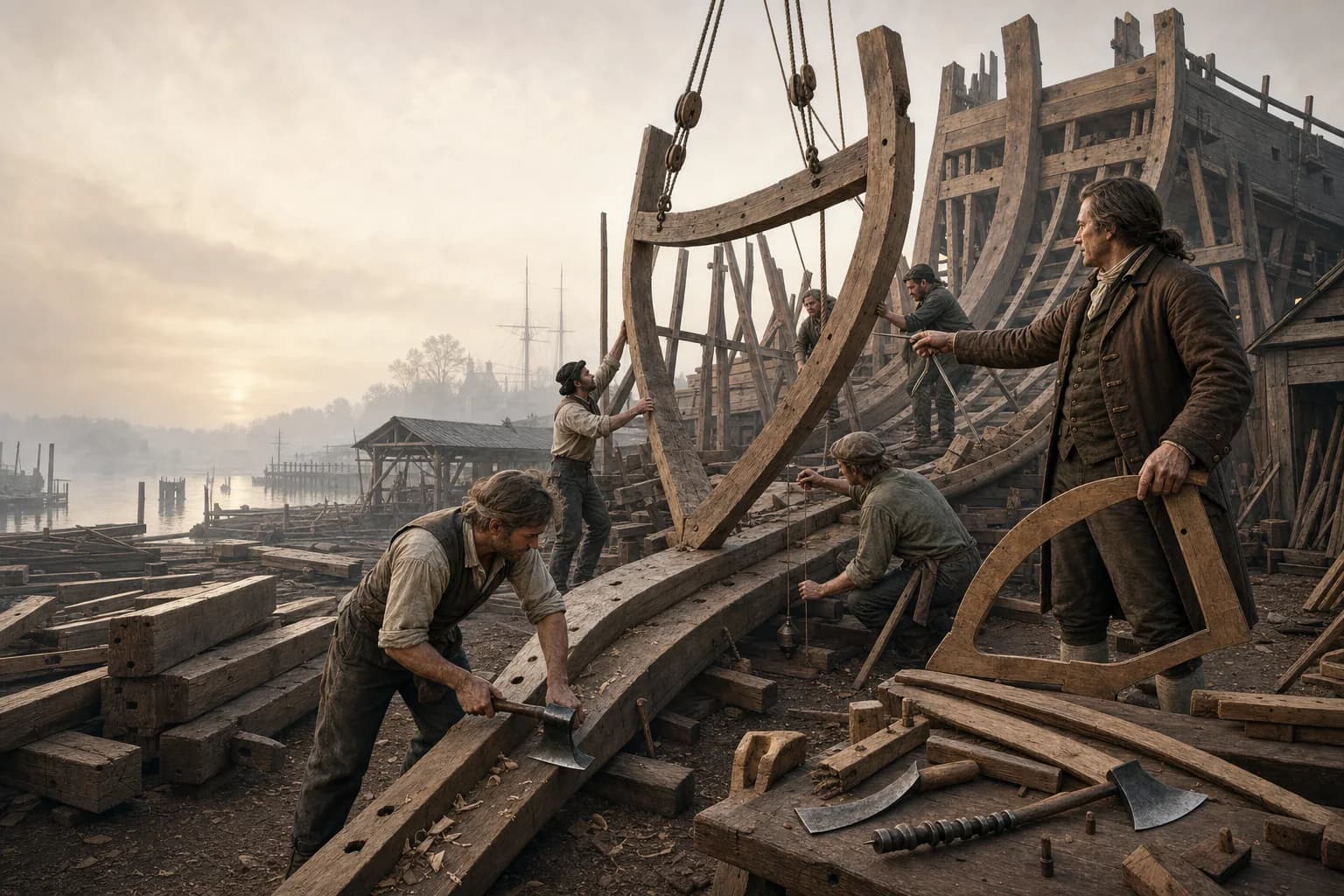
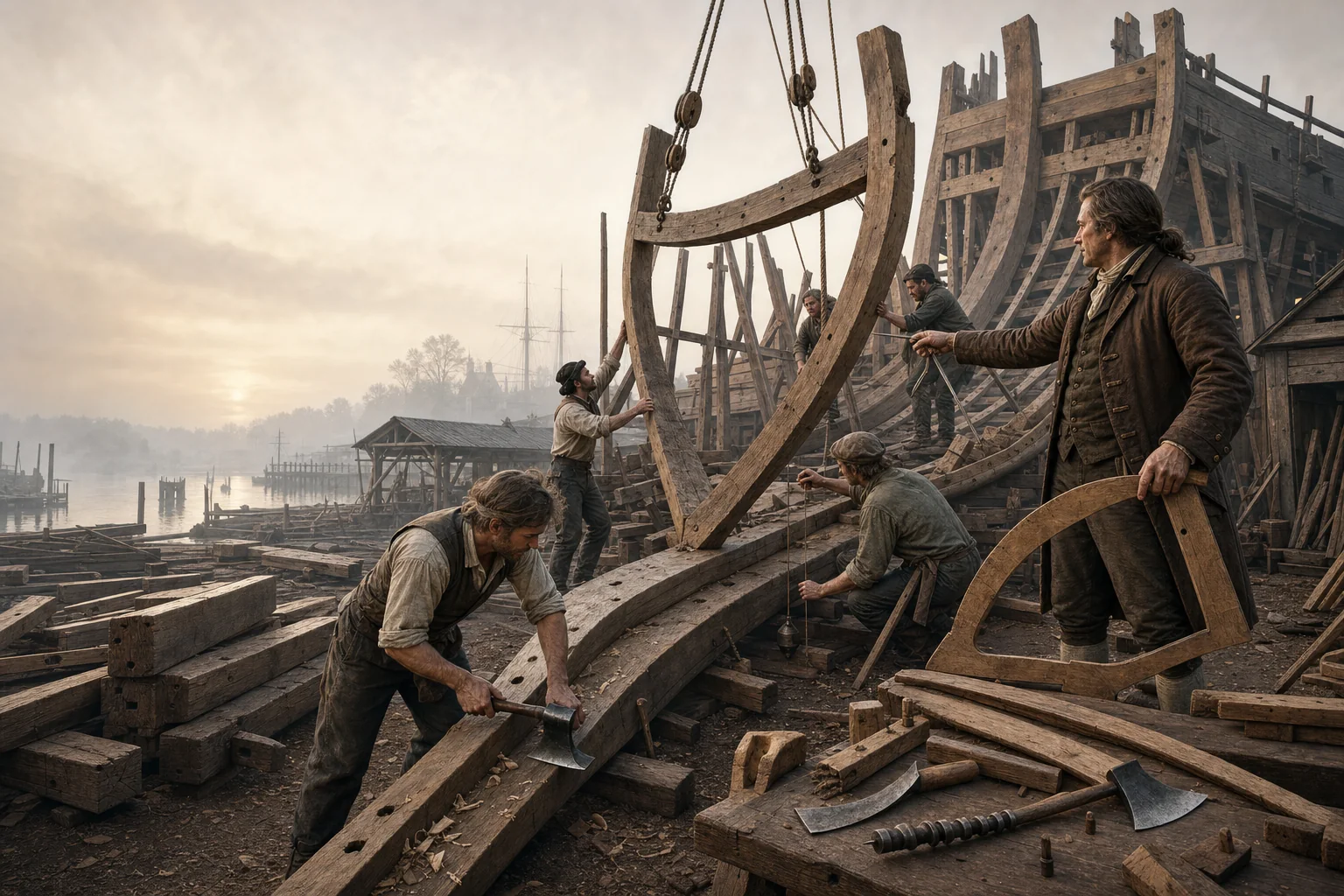
Shipwright could mean a skilled worker shaping and assembling a hull or a master shipwright or naval constructor responsible for dimensions, lofting, engineering judgment and gangs. In the large frame-built wooden vessels common to the European Atlantic, shipwrights derived hull form from principal dimensions, rules, models or lines plans; transferred curves through full-size moulds; selected straight and naturally curved timber; laid keel, stem and sternpost; assembled and raised frames; and coordinated planking, fastening, caulking, deck structure and launch. Not every ship began with a complete drawing. A shipwright was also not identical to the ship's carpenter who sailed with a vessel and maintained it. Design, yard construction and shipboard repair overlapped but occupied different positions.
 Open full image↗
The banner crops and darkens this artwork. This plate preserves the complete composition; click it to view the image on its own.
↗Information arrives, judgment forms, and work passes on through a complete watch.
Reconcile mission, dimensions, draught, rule or model with stability and capacity constraints.
Fair lines, make moulds and mark each timber for function, bevel and station.
Lay keel, raise frames, strengthen, plank and accept every trade interface.
Arrange ways and cradle, choose tide and observe leak, trim and distortion afloat.
A master builder might set dimensions, estimate, buy, direct the slip and guarantee work through reputation.
Build and repair standardized warships inside approved plans, stores accounts and a large hierarchy.
Rely more heavily on mould, rule, model and oral knowledge within a place-specific hull tradition.
Expand and fair dimensions, model or lines plan into reliable full-size moulds.
Select and convert material by grain, natural curve, moisture, defect and structural use.
Control keel, scarph, station, bevel, fastening, planking and internal strength.
Join material, gangs, lifting, weather, contract and launch on one critical path.
Institutions, experience, patronage, and opportunity shaped each person’s route.
Learn tool care, measurement, moulds, timber marks and lifting safety.
Work frames, scarphs, planking and difficult bevels independently.
Control output, quality and handover for one gang or hull region.
Answer for design interpretation, the whole build, resources, contract and launch.
A working shipwright shaped structural timber with axe, adze, saw, chisel, auger, square and mould. A leading hand or quarterman directed a gang, a foreman controlled an area and a Master Shipwright might answer for construction and repair, workforce, material and time across a yard. Before 1832, Britain's Royal Dockyards belonged to the Navy Board's civil establishment, and their Master Shipwright was not the warrant carpenter aboard one warship.
A private master builder might negotiate with an owner, choose dimensions, estimate labour and material, direct the slip and stake his reputation on quality. Large state yards separated Surveyor, draughtsman, mould loft, timber master and trades. This dossier follows the occupational core—turning hull form into a wooden structure—without making one celebrated designer the hands of hundreds.
Early and local yards could use whole-moulding, a master-frame pattern, geometric rules and a master's tacit knowledge. Many eighteenth-century merchant vessels are described as built by rack of eye. Shell-first, clinker, carvel and frame-first traditions also differed, so the sequence of a European ship of the line cannot represent a Mediterranean craft, Nordic boat, Indian Ocean dhow or Chinese junk.
By the eighteenth century, state navies increasingly preserved sheer, half-breadth and body plans, approved dimensions and required contract yards to build from them. A 1795 plan for Merlin and Pheasant preserves all three views. The first game decision is therefore to identify whether the yard holds contract dimensions, proportion rules, model, moulds, offsets or an approved draught.
In a major yard, selected shipwrights expanded a scale lines plan across a fair floor, drawing or scribing frame stations, waterlines, buttocks, stem and stern full size. Flexible battens passed through control points and an unfair curve was corrected. Chatham's 1753–58 Mould Loft was itself one enormous full-size drawing board.
Workers assembled light moulds or templates on those lines and marked sided and moulded dimensions, bevel, scarph, datum and frame number before sending them to the timber yard. Records for USS Constitution show hundreds of timber moulds and gauges shipped to Boston in 1794. One bad template could repeat across frames and surface only when raising or planking became expensive.
Keel, plank, mast and deck beam demanded different length and grain. Floors, futtocks, knees, stem and deadwood favored compass timber whose natural bend let grain follow load. British royal yards created a Timber Master to control receipt, conversion, marking and waste, making material accounting part of construction.
Oak dominates British, French and American frigate accounts but was not the world's only ship timber. Species, transport, seasoning, rot, insects and wartime supply set usable size. Constitution's live-oak procurement sent axemen and ship carpenters south, where sickness, desertion and death followed. A material record needs grain run, natural curve, sapwood, moisture, defect and intended structural use, not a simple rare-wood tier.
The slip was prepared with keel blocks and a gradient toward future launch. Long keels were scarfed, bolted and treenailed from several timbers, followed by stem, sternpost and deadwood. Constitution's keel joined four large lengths of New Jersey white oak. Error in centerline, level or declivity propagated into frame, plank and launching ways.
Frames of floor, futtocks and top timbers were assembled on the ground, raised by tackle and held to station and plumb with ribbands, shores and braces. Shipwrights checked breadth, height, diagonal and bevel so neighboring surfaces ran fair. Strength was not a frame-count statistic: staggered joints, grain, fastenings, gunports and internal structure formed the load path.
Heavy outer planks were sampled at each frame, hewn and planed, softened by fire, hot water or steam when needed, and drawn home with clamp, rope, wedge and tackle. Treenails, spikes or bolts fastened them, butts were shifted and heavier wales reinforced stressed zones. Ceiling, deck clamps, beams and riders strengthened the inside.
Caulkers drove oakum into outer and deck seams and paid the surface with pitch or related material. The French naval museum's construction model likewise distinguishes shipwright planking from caulker watertight work. A master accepted interfaces rather than personally working every seam, while sawyers, piercers, joiners, smiths, blockmakers, ropemakers and sailmakers retained their trades.
Sawpits converted logs to thickstuff and plank; smithies supplied bolts, spikes, straps and fittings; treenail makers produced pins; joiners fitted lighter interior work; mastmakers, ropemakers and sailmakers built the propulsion system. Wet timber, a missing knee, bad ironwork or unavailable lifting tackle could idle the next gang.
Royal dockyards used commissioner, Clerk of Cheque, storekeeper, Master Shipwright, foremen, muster and stores accounts. Private yards answered to contract, credit and owner inspection. French evidence also records women picking oakum and convicts and labourers working in the arsenal. Compression brought overtime, falls, edged-tool injury, failed lifts and green timber enclosed before it could season.
In the sixteenth century, Ribeira das Naus occupied shipbuilding beaches along the Tagus immediately west of Ribeira Palace and became the crown's principal Portuguese yard for many of the naus and galleons serving the India Route. It is securely documented as a dependency of the Armazéns de Guiné e Índia from 1524; only in 1545–46 was the yard more clearly separated from neighboring private works by a wall and beaching ground. It joined royal finance, stores, contracts, technical supervision and slipway labour rather than merely enlarging a carpenter's shop.
The neat image of warehouses, ropewalk and building beach all directly under the palace is misleading. Hulls rose on beaches west of the palace and parts of fleet administration and storage stood beside or within it, but hemp came from Ribatejo and Torre de Moncorvo and Lisbon's ropewalk lay near the Santa Catarina gates. Smithies and other processing units also spread beyond the enclosure. Timber arrived from Ribatejo, the south bank of the Tagus and Leiria; mast timber connected the yard to northern Europe, while sailcloth, nails and pitch joined domestic, French and Biscayan markets. An ocean ship really was a city and interregional supply-chain undertaking, not a crowd around one keel.
Scale was not simply a prosperous spectacle. Crown-appointed masters of carpentry and caulking controlled technical work, while direct day labour, contract building and mixed arrangements coexisted. At peaks, carpenters and caulkers could be summoned from other Portuguese ports. Privileged craftsmen owed priority service to royal orders, sometimes leaving private work and accepting lower wages than private employers paid. The hammers at Ribeira therefore belong to histories of craft, state logistics, commercial risk and coerced labour together.
Portuguese settlers used Madeira's forests for cleared farmland, fuel, buildings, casks, furniture and ships. Research names shipbuilding hardwoods including til, barbusano, teixo and vinhático; not every timber was a laurel tree in the narrow sense, because Laurisilva is a forest community of many evergreen trees and shrubs. Suitable large-ship timber could be exported to Portugal while island sugar competed for fuel, containers and construction wood.
Dense forest did not mean ready-made frames. A shipwright still matched length, natural compass, grain run, defect, moisture and transport to a structural use; hardwood fit for furniture or a cask did not automatically fit a loaded frame. Surviving primary Laurisilva is concentrated in steep northern valleys, and UNESCO considers much of its core never felled. The dossier therefore records exploitation and selection while preserving undeveloped areas and present conservation value rather than turning the whole forest into a new timber ground.
A building slip inclined to the water while blocks, shores and braces held the growing hull. Before launch workers laid sliding ways, built cradle or bilgeways, lubricated contact, transferred weight in stages and selected tide. Early release meant runaway motion; excess friction meant a stuck hull. USS Constitution stopped on her ways during the first 1797 attempt despite expert direction.
Launch only put a hull afloat. Buoyancy now supported it differently and could reveal hog, sag, leak or bad trim. Masts, rigging, armament, boats, stores and interior still required fitting. The Master Shipwright measured draft, leakage and distortion and ordered correction. A ceremony was the start of structural validation, not the end of construction.
A ship's carpenter inspected hull, masts, yards, boats, pumps and stores at sea, caulked routine leaks and prepared plugs, lead and shores for shot holes. A shipwright chiefly built, rebuilt and carried out major yard or dock repairs. Naval rules could pay embarked shipwrights, carpenter's mates and caulkers extra for a major refit, so records still overlap.
Workplace, appointment and object of responsibility are more reliable than a translated title. Skill with an adze did not automatically include fairing lines; a master new-builder did not automatically know the hidden decay of one old ship. In repair they collaborated: the ship's carpenter supplied its service history and the shipwright planned support, removal and structural reinstatement.
career.shipwright
Converted dimensions, experience, models or plans into a hull by making moulds, selecting and shaping timber, laying the keel, raising frames, planking and coordinating fastening, caulking, decks and launch.
Shipwright could mean a skilled yard worker. A Master Shipwright normally carried higher responsibility for design judgment, construction and repair plans, workforce, material and quality, although titles varied.
No. Builders also used principal dimensions, geometric rules, master-frame moulds, models and tacit knowledge. Systematic lines plans, offsets and mould-loft practice expanded unevenly.
A large fair floor where scale hull lines were drawn or scribed full size, corrected and converted into numbered templates for cutting and assembling structural timber.
No. The royal slips adjoined the palace on the west and some administration and storage stood beside or within it, but the ropewalk, smithies and supply chain spread across Lisbon and well beyond the city. It was a production network centered on a yard.
No. Laurisilva contains many species. Research identifies several hardwoods used in shipbuilding, but builders still matched species, natural curve, grain, defect, size and moisture to each member. UNESCO also considers much of the surviving core forest never felled.
Not exactly. Shipwrights mainly built and reconstructed vessels in yards; ship's carpenters maintained hull, pumps, spars and boats at sea. Their skills overlapped and they could cooperate or move between settings.
No. Launch exposed the hull to buoyant support and tests for leak, distortion and trim. Masts, rigging, fittings, armament and stores still had to be installed and accepted.