 ship structure
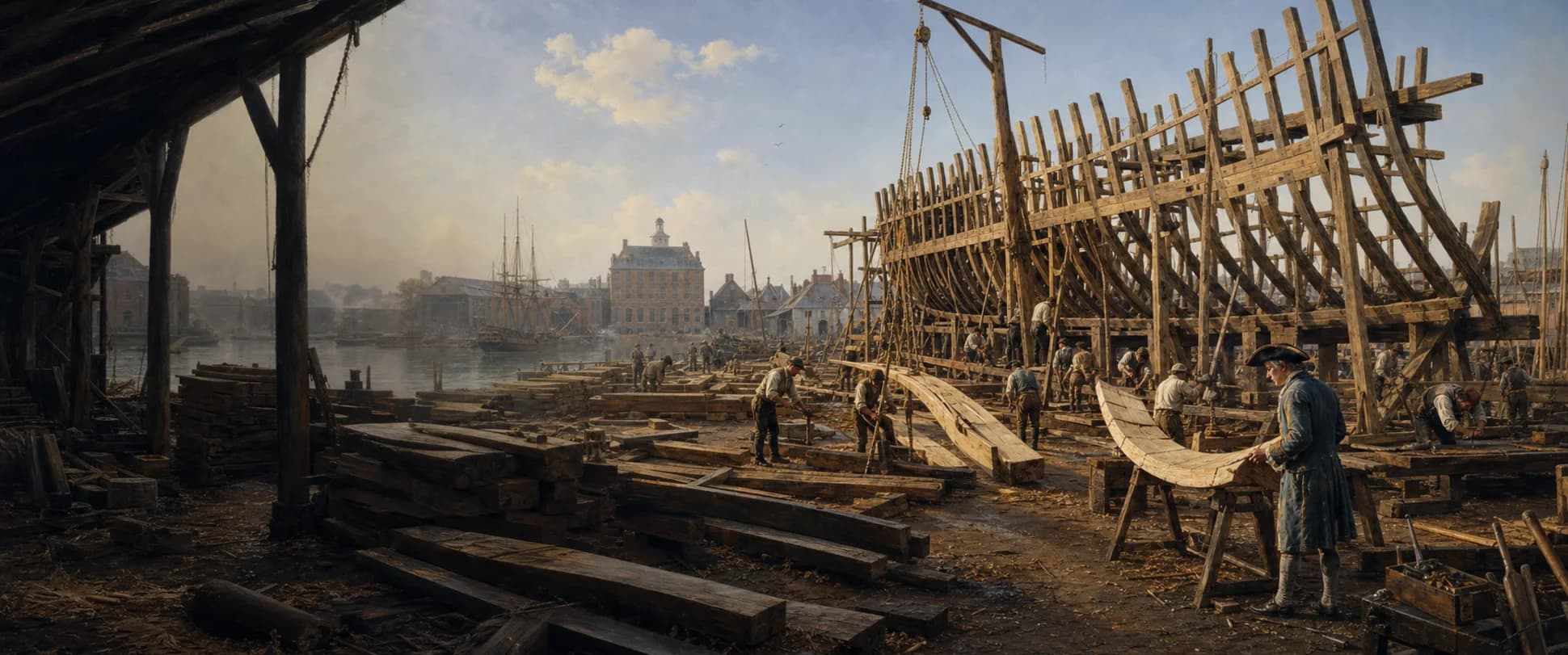
The frames are still open when the last compass timber fails inspection
Mast
Masts and rigging transfer sail loads into the hull.
Deck
Deck beams help the hull resist transverse deformation.
Keel
The main longitudinal member forms the structural baseline of many wooden sailing ships.
Building began with an order, authority and material account—not a lone keel on a beach
A navy, merchant or private owner established service, dimensions, tonnage, armament or cargo aim and arranged funding and delivery with a royal yard or private builder. The British Navy Board's major yards separated resident administration, construction, harbour movement, muster and pay, and store inspection among named officers. A private yard might combine posts, but still needed to know who approved change, accepted work and carried an overrun.
War, timber supply, slip capacity, skilled labour and cash all shaped the schedule. Altering beam changed frames, deck beams, capacity, mast steps, gun positions and draught downstream. A yard was therefore an organisation of dimensions, issues, hours and payments as much as a landscape of hand tools.
The mould loft converted design into curves that could be carried to timber and slip
The master shipwright and assistants laid key hull lines on a broad, clear floor and produced moulds, ribbands or other patterns for frames, posts and planking. Models of eighteenth-century Chatham and Woolwich place mould loft, mast pond, storehouse, slips and dry docks within one connected yard. Design control and heavy material work had to remain physically close.
Methods differed by country, century and scale. A complete later lofting practice should not be projected unchanged onto a small sixteenth-century yard. The continuing logic was to establish repeatable shape control and make natural crooks and local adjustment answer to a coherent hull. A mould was a working pattern that located one piece in the whole geometry, not a display model.
The timber system looked for useful grain and natural shape before deciding how to cut
Straight stock supplied planks and beams; compass timber supplied frames and knees whose grain followed the curve. Merchants, surveyors and shipwrights judged species, grain, rot, shake and size. Waterborne logs were sorted on arrival, with long spars kept in mast ponds and other material seasoned or stored according to local practice. A rare crook sawn into ordinary boards could not be recreated later by extra labour.
Before powered mills, topman and pitman sawed great volumes lengthwise over sawpits. Historic England records one hundred sawyers at Chatham in 1787, a reminder that “carpenters built the ship” hides a large cutting workforce. Smiths, blockmakers, ropemakers, sailmakers, caulkers, tar and pitch suppliers, and labourers supplied fastenings, blocks, cordage, canvas, oakum, waterproofing and movement in parallel.
Work on the slip closed load-bearing frame, shell and watertight boundary in sequence
Workers laid the keel and joined stem and sternpost, raised floor timbers and frames, held their developing shape with ribbands, then added beams, knees, internal work, planking and decks. Human power, capstans, tackles, sheers and cranes shifted massive pieces. An error had to be corrected before more structure locked it in. Shipwrights controlled interfaces; sawyers supplied shape, labourers moved it, and smiths delivered bolts, spikes and straps.
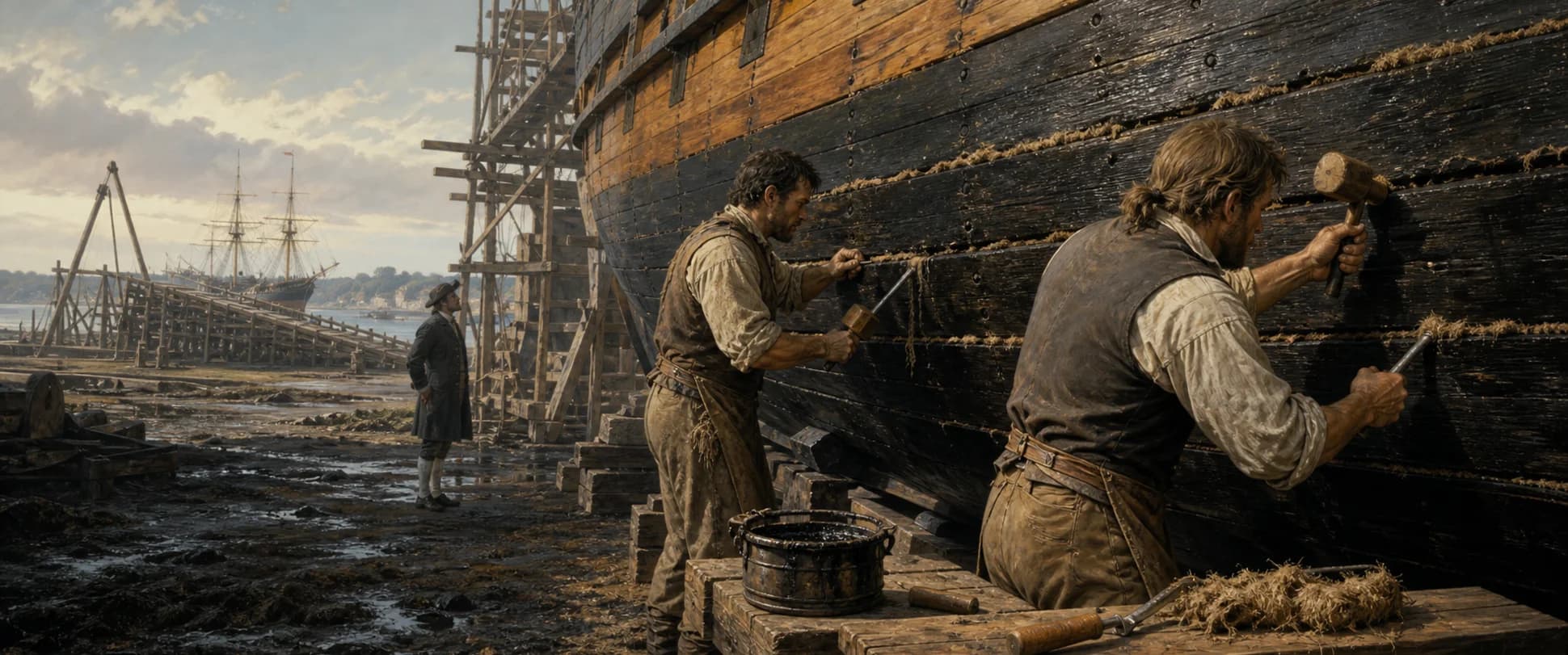
After planking, caulkers cleaned seams, drove oakum and paid the surface with pitch or related compounds. Caulking formed a watertight seam; it could not redeem rotten timber or bad framing. Copper, rudder and pumps might follow, with inspections of dimensions, fastening and leakage. Accelerated work released a slip sooner but could pass green timber, open seams and repair liabilities into service.
Launch transferred work from slip to water; fitting out and trial could continue for months
Once a hull slid down greased ways or floated from a flooded dock, masts, yards, standing and running rigging, sails, anchors, boats, accommodation and mission equipment continued to arrive. A warship took gun carriages, ordnance and magazine stores; a merchant vessel arranged holds, ventilation and handling for its trade. Mastmakers, riggers, sailmakers, armourers, joiners, painters and store departments now met at the same hull.
Acceptance watched draught, trim, bilge water, steering and rig tension before harbour or sea trials exposed defects. Royal dockyards also repaired active ships and distributed fleet stores; private yards moved between new construction and repair. The useful model is not one production line but a loop joining design, material, slip, basin, administration and return work on the same waterfront.
Questions
Continue exploring this subject
Did builders draw a complete modern engineering plan before starting?
Practice varied. Shipwrights used scale design, dimensions, laying down and patterns, but early yards did not share one modern drawing system. Experience and adjustment at full size remained important.
Was a mould loft a room for model ships?
Its central job was to lay down hull geometry and make working patterns. In this context a mould was usually a shape-control template, not a museum model.
Why did a yard preserve naturally curved timber?
Frames and knees needed curved members with grain following the load path. A natural crook usually served that purpose better than the same curve cut across straight grain.
Was a wooden ship finished when launched?
No. Masts, rigging, sails, steering, anchors, boats, interiors, weapons and stores could still require extensive fitting out, inspection and trial afloat.
How did a royal dockyard differ from a private yard?
Royal yards tended to maintain permanent officers, stores, docks, ropeworks and standard supply systems. Private yards relied more heavily on a contract and outside suppliers. Scale and specialisation varied widely in both.
Sources
Continue the research
- Life at a Royal Naval DockyardRoyal Museums Greenwich
- Topographical model of Chatham Dockyard, 1774Royal Museums Greenwich
- Royal Dockyard at Woolwich modelRoyal Museums Greenwich
- Brunel Sawmills, Chatham DockyardHistoric England
- Charlestown Navy Yard Pitch House and Oakum LoftU.S. National Park Service
- A Shipyard in Maine: Percy & SmallMaine Maritime Museum
 01
01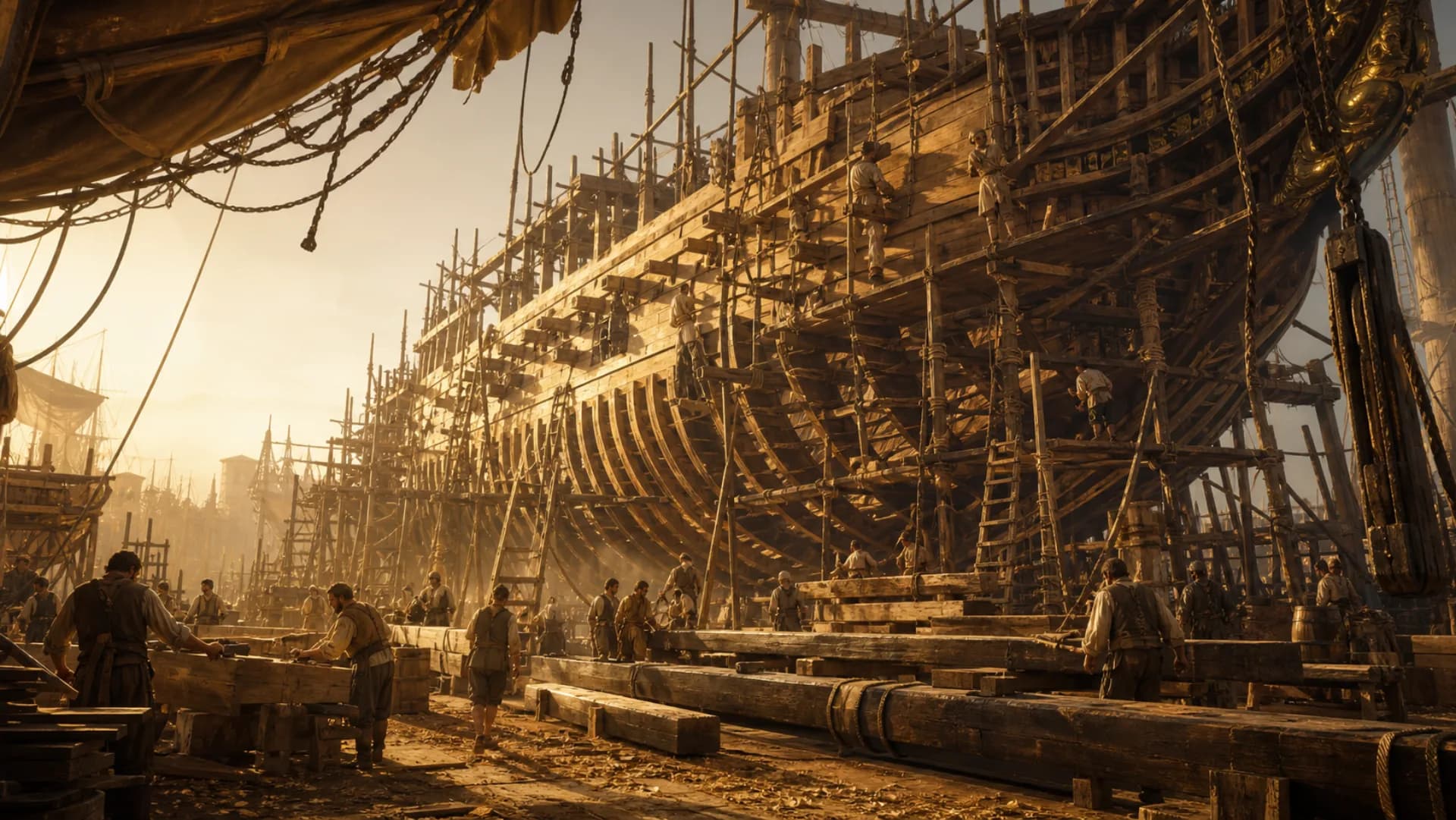 02
02 03
03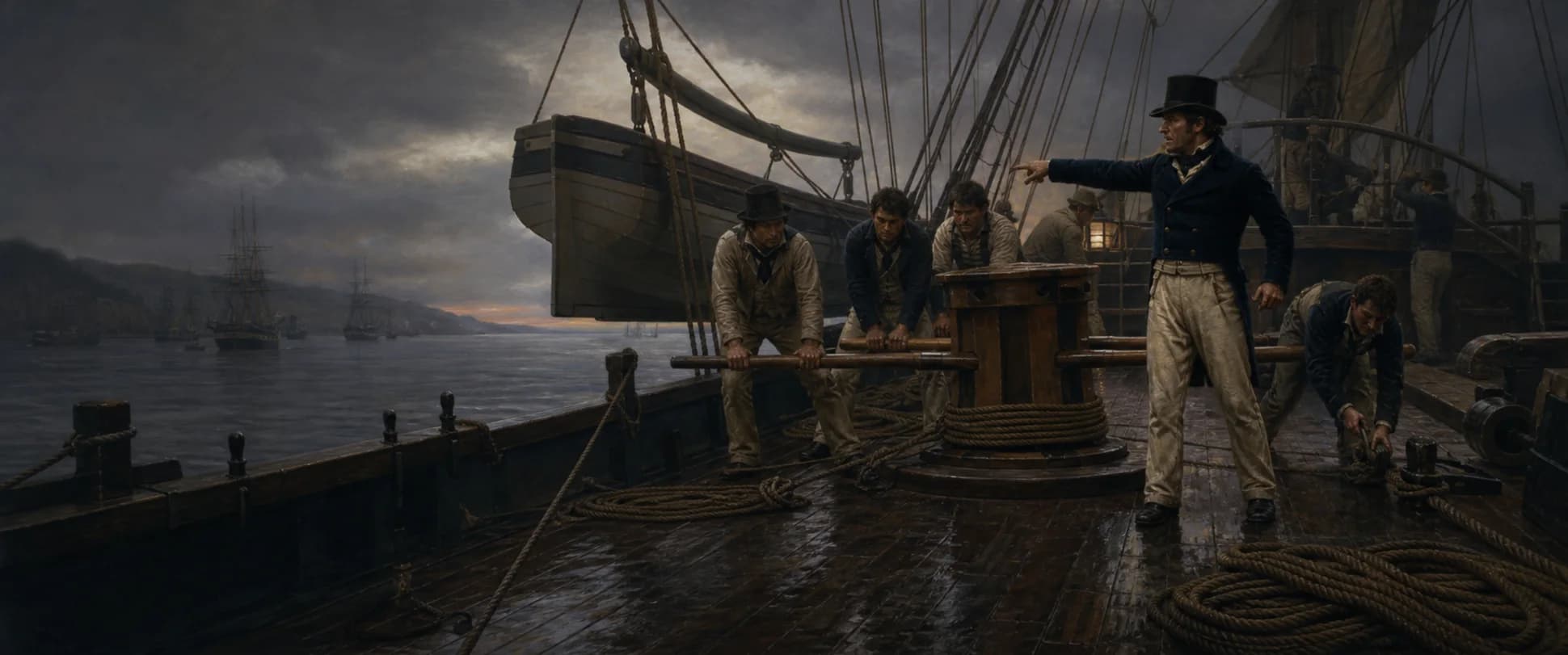 04
04