INPUT
→Dress and weigh
Separate long hemp from shorts and establish batch and process quantity.
A real Age of Sail career dossier · 29
Ropemaker · Rope Maker · Cordwainer (historical contexts)
The worker who locked thousands of fibres into a traceable load-bearing member through opposing turns.
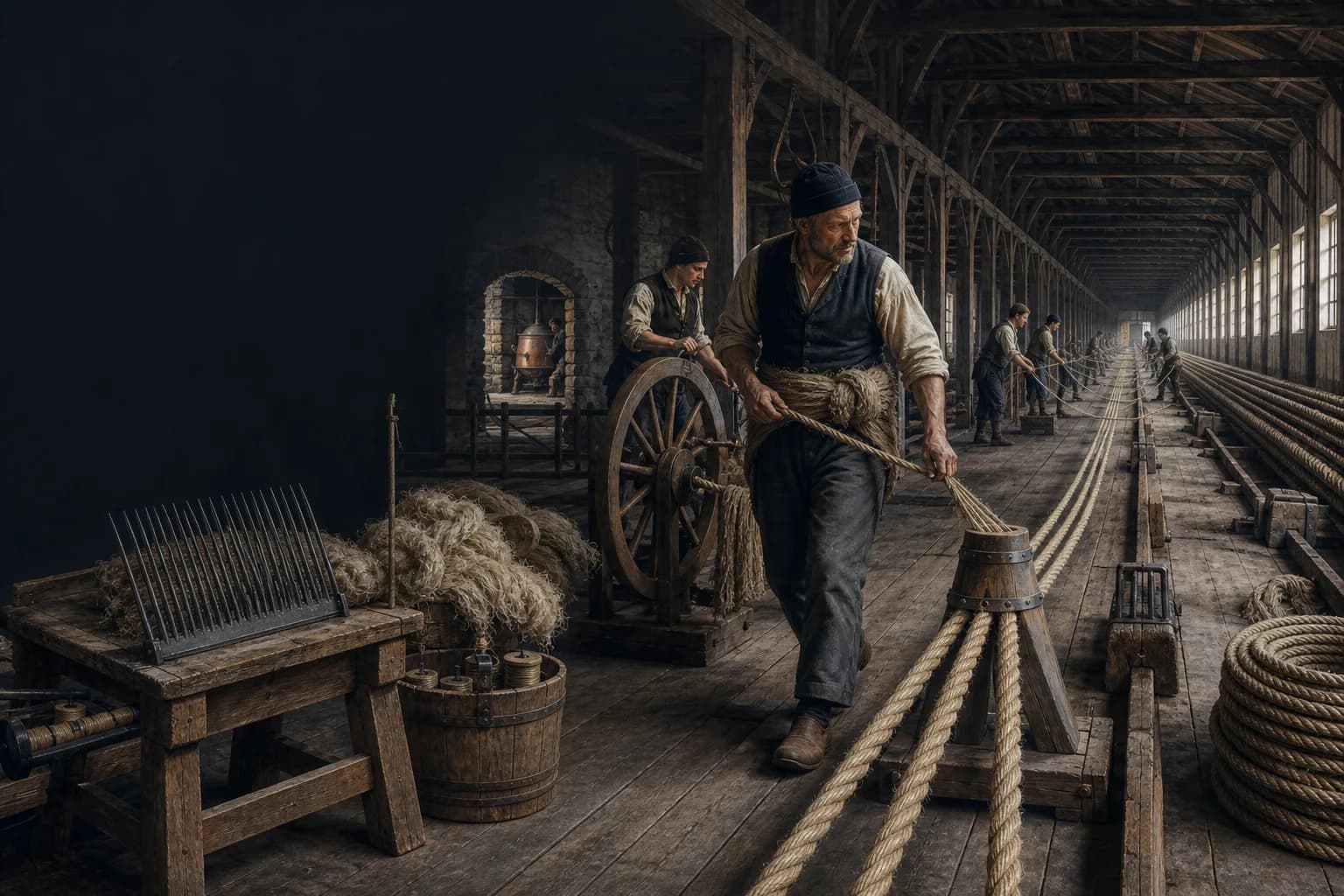
A ropemaker worked in a ropeyard or ropewalk, converting hemp and other long fibre into specified cordage. Hatchellers combed, aligned and cleared the fibre on long iron teeth. Spinners walked backward while feeding hemp into a turning hook, controlling yarn size and twist. Yarns were warped, selected batches passed through a tar kettle and dried, then forming gangs twisted many yarns into strands and closed those strands in the opposite direction into stable rope. Three strands closed directly commonly made hawser-laid rope; three already-laid ropes closed again made cable-laid rope. A Master Ropemaker controlled material, specification, output and quality. Riggers, boatswains and crews cut, spliced, served, installed and maintained the product aboard ship. Fibre and mechanisation varied, so this page uses seventeenth- to early-nineteenth-century British and American naval ropeyards as its principal evidence window.
Information arrives, judgment forms, and work passes on through a complete watch.
Separate long hemp from shorts and establish batch and process quantity.
Feed continuous standard yarn, wind it and assemble hauls.
Assign tarring, form strands, balance tension and close in the opposing turn.
Reconcile length, weight, circumference and lay, sample internally and mark the batch.
Organised mass production through standard tables, batches, maker marks and fleet orders.
Served merchant shipping, fishing, building and local markets, with more combined tasks.
Machines changed consistency, gender, age, pace and accident exposure rather than simply removing skill.
Distinguish length, damp, short fibre, adulteration and grades for different cordage.
Keep feed, diameter and turn even while walking backward.
Match direction, shortening and tension across yarn, strand and final closing.
Build evidence from origin through yarn count, weight, circumference, lay and storage.
Institutions, experience, patronage, and opportunity shaped each person’s route.
Learn production rhythm through hemp, yarn, cleaning and wheel work.
Maintain yarn or control tension and shortening during strand and rope formation.
Schedule specification, gangs, equipment and quality holds.
Control material acceptance, qualification, fleet order, product liability and fire precautions.
A large ropeyard divided work among hatchellers, spinners, warpers, tar-house hands, strand makers, layers, labourers, foremen and a Master Ropemaker. Chatham's Rope Yard operated as a distinct dockyard business unit under its own clerk and workforce accounts.
The yard delivered rope by circumference, length, lay, fibre, tar and use. Riggers measured, cut, spliced, wormed, parcelled, served and installed shrouds, stays and running gear; boatswains managed it in service; sailmakers sewed bolt rope to canvas. Small shops combined tasks, but product handover defines the occupations better than shared knowledge of knots.
European sailing navies depended heavily on hemp. Chatham stored fibre grown in southern Russia and shipped through Baltic ports such as Riga. Historical place names could act as commercial grades; one 1794 preference for Riga or Petersburg hemp is not a universal rule for every nation, century or rope. Coir, flax and other fibres served different needs.
Receipt checked length, cleanliness, moisture, rot, contamination and batch weight before storekeepers issued oldest stock first. Supplier, Ropeyard Clerk and Master Ropemaker held commercial, accounting and technical evidence. Without separation, damp, short or adulterated fibre could disappear inside a visually acceptable rope.
A hatchel was a board of dense long iron pins. Workers repeatedly drew hemp through successively finer teeth to align it and remove woody matter, tangles and short fibre, using a little oil to ease passage. Chatham's 1787 Hatchelling House isolated this heavy semi-skilled operation; nineteen hatchellers worked there in 1803.
Toppings, ground tow and long fibre were not one grade. Critical yarn demanded thorough topping and tailing. Shorts could make lesser small stuff and spunyarn, and further-picked waste became caulking oakum. By-product use did not authorize concealing short hemp in a stay or cable; weights and tickets had to preserve destination.
Dressed hemp sat around the spinner's waist. Its end attached to a hook, and the worker walked backward down the spinning room while feeding a continuous supply; a wheel turned several hooks. Steel required the hand close to the forming point and a regular wheel speed, otherwise yarn became uneven or slack and broke during warping or stretching.
One yarn could extend hundreds of metres, demanding continuous overlap, hand feel and walking pace. Finished yarn went to a winch at specified length and weight. Children and young labourers carried yarn along the walk; later machines employed many women as minders. Their distance, dust and entanglement risk belong in the occupation's record, not under one master's name.
A ropewalk held yarns, strands or rope straight while they twisted under tension. Chatham's surviving ropery exceeds 1,100 feet, while a first-rate ship could require about 31 miles of cordage. Length was production geometry, not architectural spectacle. Open-air walks served private makers but offered less weather control.
Yarn ran from winches along supports to a distant sledge; capstan, crab and tackle stretched it while gangs checked snag, crossover and tension. Forming strand and closing rope consumed length, so a final order could not start with yarn cut to the same measure. Length, twist and diameter were one calculation.
Yarn selected for treatment was warped into hauls, drawn by capstan through a hot copper tar kettle and dried in a black-yarn house. Tar improved weather resistance for standing rigging and some cordage but altered flexibility and mass. Running lines, tiller rope, bolt rope and small stuff might require white yarn, less tar or later treatment.
Dry hemp, timber buildings and hot tar were a dangerous combination. Separation of tar house, hemp house and yarn stores, ventilation, cleanliness and cooling were production controls. Overheated tar damaged fibre; excess squeezed out during later laying and promoted kinks. More black coating did not equal better rope.
Many yarns hardened into equal strands on rotating hooks. A moving sledge, wolders and a grooved laying top guided them together at equal tension. Final closing opposed the strand turn, balancing torque. Unequal length, yarn count or tension produced corkscrew, soft and hard places or an unround rope.
Hawser-laid rope commonly closed three strands directly. Cable-laid rope usually closed three three-strand ropes in the opposite direction, giving nine foundational strands. Four-strand stays might include a heart. Cable, stay, tack, running line, lead line and small stuff demanded different flexibility, wear, stretch and strength; bigger alone was not the specification.
The Master Ropemaker and foremen checked hemp batch, equal yarn division, circumference, standing length, unit weight, lay, surface and joins. Steel advised opening several feet at a rope end, separating strands and yarn to expose inferior short fibre. Appearance was not final inspection; critical cable could also face institutional proof or sampling.
Chatham later carried coloured worsted government marks through strands to identify the yard and deter substitution. Origin did not prove good storage. Coils needed ventilation, dry support and classification by size and use. A later chafe or overload failure at sea did not by itself prove ropeyard fraud.
An apprentice or labourer could progress from cleaning, carrying and wheel work through spinning, warping, strand forming, laying, splicing and inspection to journeyman, foreman or Master Ropemaker. Senior work scheduled daily specifications, issued material, trained gangs, certified hemp and cordage, and coordinated with Master Attendant, stores and rigging demand.
Huddart, Treadwell and powered systems gradually changed consistency and labour after the late eighteenth century without replacing all hand practice at once. Machines regularised some twist and magnified entanglement hazards; women and children changing tasks did not remove skill. The real occupational drama lies in batch quality, length, fleet urgency, fire separation and traceable delivery—not a magical knot-maker.
career.ropemaker
A ropemaker dressed hemp or other fibre, spun yarn, optionally tarred it, formed strands and laid specified cordage in a ropeyard.
Ropemakers manufactured rope in batches. Riggers cut, spliced, served and fitted it as standing and running rigging on a particular vessel.
Yarn and strands had to extend under tension across the intended product length, and forming and closing shortened them. The long walk supplied controlled space.
Hawser-laid rope commonly closes three strands directly. Cable-laid rope commonly closes three three-strand ropes again in the opposite direction.
No. Standing rigging often valued tarred weather resistance; running lines through blocks, tiller rope and some bolt rope required different flexibility or treatment.
They reconciled fibre, yarn count, weight and circumference, then could open rope, strands and yarn at a sample end. Some systems also used proof and maker marks.