INPUT
→Receive and grade
Check timber mark, defect, sweep, moisture and orientation under future load.
A real Age of Sail career dossier · 28
Mastmaker · Mast Maker · Spar Maker
The craftsperson who preserved axis, taper and every loaded interface across a timber tens of metres long.
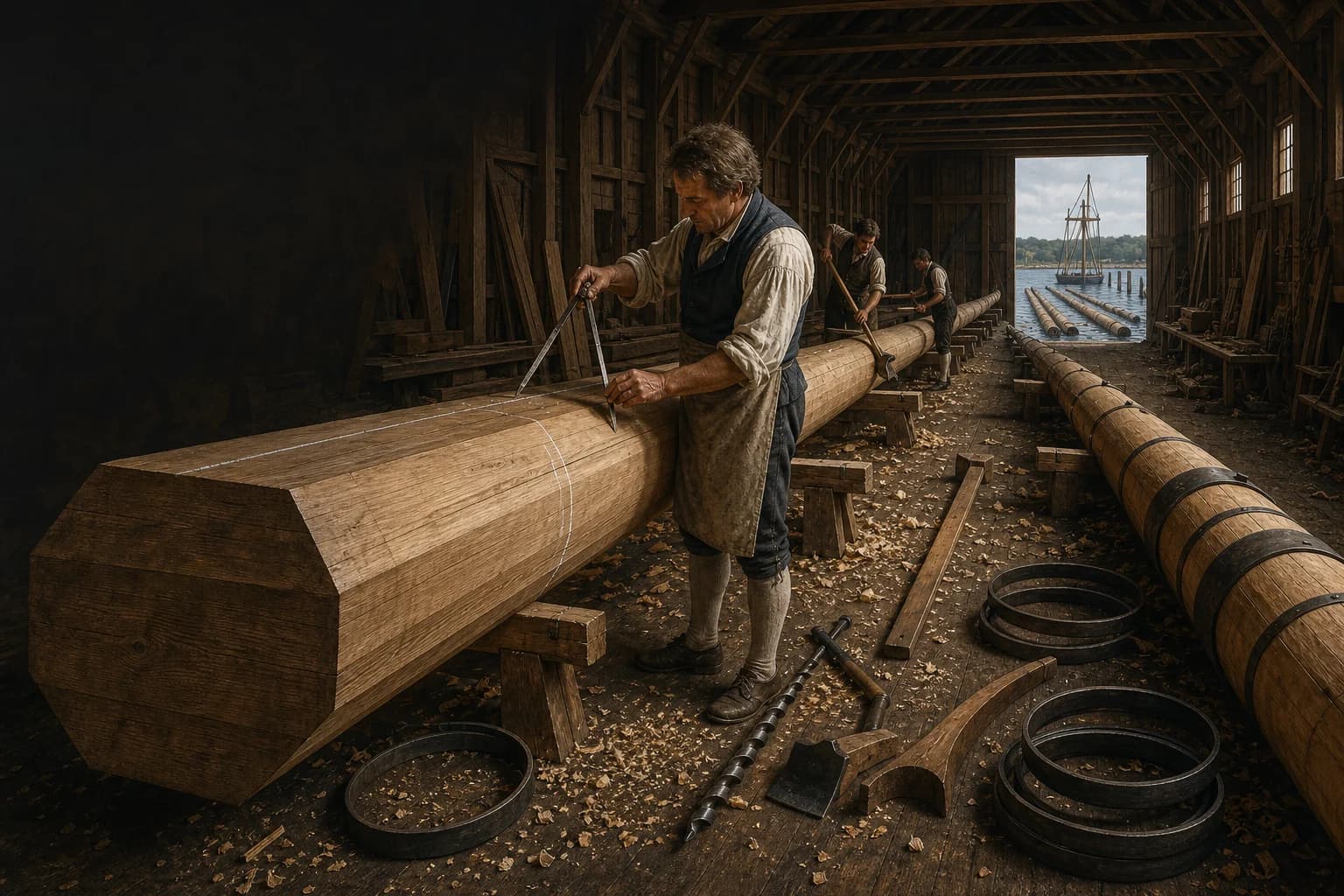
A mastmaker was the dockyard specialist who manufactured masts and spars. He selected suitable fir, pine or spruce for a vessel's dimensions and rig, examined sweep, knots, decay and grain, marked heel, partners, quarters, hounds and head, then converted the long timber from square through eight- and sixteen-sided stages to a fair round taper. Smaller masts, upper masts and yards could be pole masts or single-tree spars. Great lower masts commonly combined a spindle, side trees, fishes, cheeks and fillings with fitted joints, bolts, iron hoops and wooldings to form a made mast. The mastmaker delivered a product fitting the mast step, partners, cap and trestletrees. Riggers set up standing and running rigging; the ship's carpenter inspected and repaired spars at sea. Practice varied by country, period and naval or merchant service, so this page uses the late-eighteenth-century Atlantic yard as its principal evidence window.
Information arrives, judgment forms, and work passes on through a complete watch.
Check timber mark, defect, sweep, moisture and orientation under future load.
Mark stations and reduce the timber progressively to specified taper and section.
Fit component timbers and install bolts, iron hoops, fishes and wooldings.
Audit interfaces, mark balance and direction, and release product and record to lift and rigging gangs.
Independent mast house, master mastmaker, standard dimensions and cross-department acceptance were most explicit.
Orders followed vessel and market; a mastmaker might also buy timber, rig or perform general carpentry.
Reinterpreted metropolitan specifications through local species, imported sticks, scarce iron and available skill.
Read straightness, grain, knot, shake, rot and sweep against the intended spar.
Control a continuous taper from square through eight- and sixteen-sided stations to round.
Execute scarph, coak, faying, fish, bolt, hoop and woolding as one load path.
Verify step, partners, cap, trestletree, yard and rig dimensions and hand over safely.
Institutions, experience, patronage, and opportunity shaped each person’s route.
Learn grain-aware cutting, edge maintenance, long support and safe handling.
Shape by station, fit fishes and cooperate in hooping without constant correction.
Grade sticks, coordinate simultaneous work and certify handover dimensions.
Control orders, allocation, quality and interfaces between departments.
Eighteenth-century mastmaking encompassed lower masts, topmasts, topgallant masts, bowsprits, yards, booms, gaffs, tops and associated timber fittings. A complete mast rose in successive sections. The mastmaker produced this wooden system but did not thereby design the entire rig, sew sails or control all rigging.
Shipwrights concentrated on keel, frames, planking and hull interfaces; mastmakers controlled the axis, taper, section and combined strength of exceptional long timber. Riggers stepped masts and fitted shrouds, stays, yards and running rigging. At sea, the ship's carpenter and boatswain's department inspected, reinforced and maintained woodwork and rigging. Small private yards might combine trades; a major naval yard was more likely to maintain a mast house and master mastmaker.
Fir, pine and spruce offered unusual length, manageable weight and useful resilience. David Steel's 1794 practice treated fir as mastmaking's principal material and ranked supplies from Riga, Gothenburg, Norway, New England and Scotland by experienced estimates of strength. Those rankings belong to one historical system, not a modern universal test table.
A mast selector, timber merchant or contractor sought long straight stems in forest and port, but the yard still inspected shakes, rot, cross grain, great knots, eccentric growth and sweep. Curvature did not always condemn a stick: Steel directed that the rounding side of a curved mast face forward, but every defect had to be read against future load. A surviving 1806 Navy Office Riga mast contract reveals an international chain of selection, grading, freight and acceptance rather than a mastmaker simply felling a tree behind the yard.
Historic England defines a mast pond as a basin where poles were kept under water to reduce drying and splitting, and a mast house as a building for their manufacture and storage. Chatham's 1753–55 mast house used its open ground floor to shape and store masts; its length gave gangs access to timbers many tens of metres long, while the mould loft above served full-size hull drawing.
After lifting, a stick needed identity records, surface cleaning, stable supports and clear movement space. A settling trestle or uneven exposure could distort the reference line. Handling was itself production: capstans, crabs, rollers, tackles, sheers and labour gangs moved heavy spars, while a poor sling point could bend unfinished work, roll it from its supports or crush a worker.
The mastmaker took overall length and the controlling diameter at the partners from a plan or table, then marked heel, partners, quarters, hounds, stop and head along the axis. Straightedge, batten, chalk line, square and compasses joined each station radius into a fair taper. This was not eye-balling a log into roundness but preserving one axis through a very long three-dimensional workpiece.
Axe and adze removed stock, forming square, eight-square and sixteen-square stages before planes faired the remaining arrises into a circle. Every cant required stable support and another check for winding and orientation. Diameter deliberately varied: the partners met deck wedges, the hounds carried cheeks, trestletrees and top, and the mast-head retained square interfaces. Smooth finish could not redeem an error at one of those stations.
A mast section fashioned principally from one tree was a pole mast; upper masts, yards and many merchant masts could use this method. When a great warship's lower mast exceeded reliable single sticks, a made mast combined a central spindle, side trees, side fishes, heel and head pieces, cheeks, front fish and fillings. This was not a bundle of round logs: scarphs, coaks or tables, grain and staggered joints transferred load.
Inner faces were planed, fayed and paid with tar, then locked with bolts, nails and fitted members. After the exterior reached its designed section, iron hoops formed separate drifts driven from head and heel. USS Constitution's great original lower mast sections combined multiple pieces of white pine while higher sections used single sticks, so one ship could embody both systems.
Steel's iron hoops were made from a girth taken at each station and shortened for interference, heated, driven over a tallowed surface and cooled with water to shrink tight. The mastmaker supplied moulds for the non-circular upper stations to the smith. This was a dimensional contract between woodworker and ironworker, not a circumference guessed independently at the forge.
Woolding laid repeated turns of rope between hoops over a fair bearing made by the front fish and fillings, with leather beneath nail heads to reduce cutting. A loose hoop allowed joints to work; excessive interference or later moisture movement could crush wood. Fishing added a long reinforcing timber outside a damaged mast or yard but did not magically restore original strength. Crack position, weather, canvas carried and access to replacement still governed the decision to sail.
Inspection covered overall length, every station diameter, straightness, orientation of head and heel, tenon, hounds, cheeks, bibbs, trestletrees, caps, sheave holes and hoop stations. The mastmaker followed the approved masting plan; the shipwright supplied actual mast step and deck partner interfaces; the smith delivered hoops and bolts; blockmaker, rigger and sailmaker depended upon correct cleats, bees, holes and yard dimensions.
A launched hull was therefore not ready for sea. After USS Constitution launched in 1797, its three massive lower masts were not stepped until late December, dozens of upper masts, yards and other spars remained in work, and miles of rope still had to arrive. A heel that would not enter the step, insufficient partner allowance or a yard sling away from its balance point blocked vessel, lifting plant and several trades at once.
Before portal cranes, shore- or ship-mounted wooden A-frame masting sheers lowered a great lower mast through the partners to its step; upper sections could rise by tackles using the standing lower mast. The lift required marked centre of gravity, sling and orientation, protected hoops and worked faces, and tag lines against swing. A mastmaker could resolve fit without becoming commander of the entire harbour movement and rigging evolution.
Riggers then installed shrouds, stays and backstays and connected caps, tops, crosstrees and yards. Once tension entered the system, a mastmaker or surveyor rechecked joint work, hoops, line and heel seating. A proper record joined timber mark, dimension sheet, defect or repair, hoop station, assigned vessel and installation date. Without it, a later crack could not be separated among material, manufacture, transport, stepping and overload at sea.
Mast timber was valuable, strategically fragile and exposed to war, blockade, duty, shipping and forest policy. A timber merchant financed contracts and carriage, a mast selector made early choices, yard store officers received and accounted, and the mastmaker controlled conversion. One person might combine roles, but commercial interest, technical judgment and final acceptance benefited from an evidence trail and independent checks.
A likely career began as a woodworking or dockyard apprentice, accumulating practice in long-line layout, adze control, faying, hooping and heavy handling before leading hand, mastmaker or master mastmaker. Excellence meant assigning a scarce tree to the right lower mast, yard or smaller spar and rejecting a visually straight stick that could fail at sea, not merely producing chips quickly. Patronage, low pay, accident, coerced labour and imperial supply also shaped the historical yard; the trade should not be reduced to craft romance.
career.mastmaker
A mastmaker manufactured masts, yards, bowsprits and other spars, controlling timber selection, layout, taper, combined construction, hoops and delivery dimensions.
A shipwright concentrated on hull framing, planking and structural interfaces. A mastmaker specialized in the axis, taper, section, combined strength and rig interfaces of long spars. Small yards might combine the work.
Usually not. The mastmaker manufactured wooden masts and spars; riggers stepped them and fitted shrouds, stays, yards and working rigging.
A pole mast was principally fashioned from one tree. A made mast combined several timbers with fitted joints, bolts, iron hoops and wooldings to reach the required size.
Historic yards stored long poles under water to reduce premature drying and splitting while they awaited conversion. They still required correct support, identity and inspection after lifting.
A vessel normally carried no dockyard mastmaker. The ship's carpenter, boatswain and crew fished damage, improvised a replacement spar or reduced sail; major replacement usually waited for a yard.